![]()
|
The stripers arrived at the very end of April on the heels of large menhaden and gorilla bluefish. If you fished at night, you found keepers. Those who fished in the day found big bluefish and small stripers or no stripers at all. My first striper of the year was a 28” and fell to a 4” Ray's Fly. The next fish that night came on an 8” Phantom (an early season menhaden/alewife pattern for dark nights).
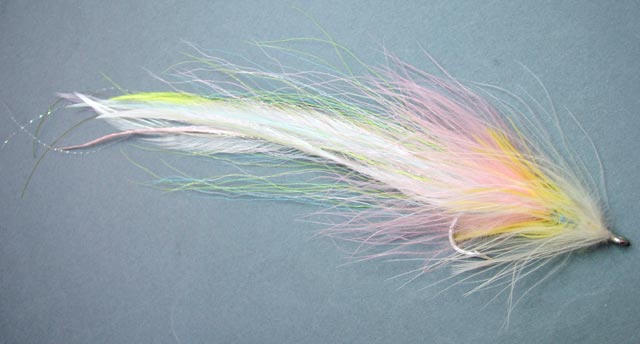
Phantom Flatwing (8 inches)
The next night I went to the same area to christen my newly built fly rod on a discontinued Pacbay Tradition blank and took a 24” striper on a 9-inch Chicken Scratch Squidsicle followed by a 29” striper on the same fly. Though it was designed to suggest a squid it does have menhaden qualties.
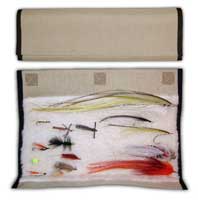
For the record this series of flies have produced throughout the season going on a fourth year now and that makes it a keeper in my fly wallet. Chicken Scratch Squidsicle (9 inches)
This striper premiered my newly built rod and the Chicken Scratch Squidsicle.
On my last outing, late May 8th into the May 9th I found a large variety of bait and sizes. There were shrimp from ¾” to 1½” and silversides from about 2” to large 6” breeders. As May progresses there will be more and more types of bait in a large range of sizes. So it's time to cast multiple flies to quickly find out what the stripers prefer at that moment. They can change their preferences during a tide. I use one or two droppers and make them using a 4-turn Surgeon's knot. The tag shouldn't be longer than 4 inches or it will foul with the leader. I keep a distance of 18” between the droppers and the point fly (furthest away). The rig approach yields results quickly versus changing flies. In most cases the stripers will prefer one over all the others. Then I can either continue to fish all three or remove the flies and just fish the preferred. Many though a team of flies in itself attracts a fish. Tie the largest fly at the point and each fly moving up the leader should become smaller. This helps in casting the rig. Choosing the flies is fun. A good starting point is to pick flies that represent what is in the water. I may use three flies that are the same pattern but different sizes or the same size and different colors or a 4” menhaden, 3” silverside and a 2” bay anchovy or a 7” eel, 4” menhaden and a 2” shrimp. Here is an example that I plan to use at this week of a 7” silverside, 4” silverside and a 1½” shrimp:
With so many flies on the leader the casting cadence needs to be slower to form a more open loop and don't force the cast. With practice good distance can be achieved.
A noreaster blew in early on May 9th and hopefully it will bring another supply of stripers who will be just as aggressive as this last batch.
|
|||||||||||||||||||||||||||
| Copyright
© 2008 by Mark Gustavson webstat |
||||||||||||||||||||||||||||