Volume 38, Number 5
September/October 1998
ODD NUMBERS
by Brian Hayes
There are brilliant and productive mathematicians who go to the office from nine to five, play tennis on the weekend, and worry about fixing the gearbox in the Volvo. Not many of them become the subjects of popular biographies. Instead we read about the great swashbucklers and misfits of mathematics,
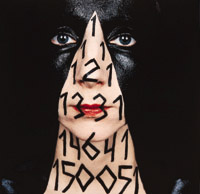
Rimma Gerlovina and Valeriy Gerlovin, Pascal's Triangle, 1990
whose stories combine genius with high romance or eccentricity. The prototype is Évariste Galois, founder of group theory, whose legend is that he wrote his definitive treatise in the predawn hours before the duel of honor that killed him, at age twenty, in 1832. Then there is Srinivasa Ramanujan, the clerk from southern India whose enigmatic formulas astonished the Cambridge dons, but who languished when transplanted to England. Or Alan Turing, code breaker, pioneer of computing, prophet of artificial intelligence, who was persecuted for his homosexuality and wound up a suicide.
The subjects of these new biographies, John Forbes Nash Jr. and Paul Erdös, certainly fit the talent-plus-eccentricity formula, though in very different ways. Their mathematical accomplishments would be enough to merit our attention, but the fact remains, none of these books about them would have been written if there were not also drama and strangeness in their lives. Mere genius is not a story.
If Nash’s name is known to the public, it is because of the Nash equilibrium, a concept that first emerged in the mathematical theory of games and that was soon taken up by economists as a tool for understanding the competitive struggles of the marketplace. Nash
invented his equilibrium in the early 1950s, when he was a young graduate student at Princeton University. In 1994 this youthful work earned him a one-third share of the Central Bank of Sweden Prize in Economic Science in Memory of Alfred Nobel—more familiarly known as the Nobel Prize in economics.
by Sylvia Nasar
Simon & Schuster, 1998
459 pages; $25.00
The Man Who Loved
Only Numbers: The Story
of Paul Erdös and the Search
for Mathematical Truth
by Paul Hoffman
Hyperion, 1998
302 pages; $22.95
My Brain Is Open:
The Mathematical Journeys
of Paul Erdös
by Bruce Schechter
Simon & Schuster, 1998
224 pages; $25.00
Sketched in such minimal outline, Nash’s career looks like a smooth road from early promise to final glory—but, boy, were there some bumps along the way.
In Sylvia Nasar’s account, Nash was a nerdy and unruly kid from West Virginia whose passion for mathematics was ignited when he got to the Carnegie Institute of Technology in Pittsburgh, Pennsylvania. And having discovered he was good at it, he couldn’t stand to be anything but the best. When he fell short of his own expectations, or the world refused to acknowledge his abilities, he became deeply troubled. One crisis arose when he failed to win the William Lowell Putnam Mathematical Competition, a great winnower of undergraduates. Then Harvard offered a graduate fellowship, but the stipend seemed stingy; feeling slighted, he went to Princeton instead, with a sense that he was slumming. The irony here is that Princeton had the much stronger department, yet Nash suffered from Harvard envy for decades.
For the next ten years Nash was on the fast track to academic stardom. After taking his Ph.D. at Princeton, he went on to the Massachusetts Institute of Technology, and spent his summers at the RAND Corporation in Santa Monica, California. Later he was back in Princeton for a year at the Institute for Advanced Study, though during that time he mainly hung out at the Courant Institute of Mathematical Sciences at New York University. Those were all excellent places to have your ticket punched, but it was not enough for Nash. Approaching thirty, he felt he was running out of time. Nasar writes:
What an irony that mathematicians, who live so much more in their minds than most of humanity, should feel so much more trapped by their bodies! An ambitious young mathematician watches the calendar with a sense of trepidation and foreboding equal to or greater than that of any model, actor, or athlete. . . .
Nash’s thirtieth birthday produced a kind of cognitive dissonance. One can almost imagine a sniggering commentator inside Nash’s head: “What, thirty already, and still no prizes, no offer from Harvard, no tenure even? And you thought you were such a great mathematician? A genius? Ha, ha, ha!”
In fact, Nash was an audacious and accomplished mathematician. His early work in game theory solved a subtle problem that the pioneers of the field had neglected. The object in game theory is not necessarily to win a game—some games are unfair and cannot be won—but to find the best rational strategy, the line of play to adopt if your opponents are shrewd players who always seek their own best outcome and never make a mistake. In the 1920s the Hungarian-American mathematician John von Neumann showed that optimal strategies exist for all players in the simplest games: games with just two players and a zero-sum payoff rule (meaning that one player’s gain is the other’s loss). Such games are said to be at equilibrium: no change of strategy by any player can improve that player’s fortune, no matter what the other players do. Many familiar games, from chess to ticktacktoe, are members of that class, but von Neumann’s argument could not be extended to multiplayer games such as poker or to non-zero-sum games such as the puzzle called prisoner’s dilemma. Nash proved that for those games as well, there is always a point of equilibrium, for which the rational strategies of all players are in balance.
The discovery of equilibrium in game theory earned Nash his doctoral degree and eventually his Nobel prize, but in the view of many colleagues it wasn’t even his best work. In topology, Nash made the surprising discovery that every “smooth compact manifold” can be described by a polynomial equation, a fact that was wholly unsuspected. Later, working in a very distant realm of mathematics, he devised solution methods for a class of nonlinear differential equations that have applications in the study of turbulence.
Nash’s style of doing mathematics was brash, cutthroat and mercenary. One of his best results was the product of a dare. A colleague whom Nash had been needling snapped back: “If you’re so good, why don’t you solve the embedding problem for manifolds?” Nash did so. Tellingly, though, before tackling the problem, he checked it out with his colleagues, not to get advice on how to solve it but to make sure they would be sufficiently impressed if he succeeded. Showing off and outdoing rivals were vital sources of energy. Nash and some Princeton friends invented a game that Nash called Fuck Your Buddy. He was good at it.
From those first thirty years of Nash’s life it would be easy to extrapolate another thirty like them. Most people tend to assume that a life will have continuity; there may be ups and downs, but the changes of slope are smooth and gradual. Nash’s life has a sharp kink in the middle. In the early weeks of 1959 he began acting odder than usual, asking incoherent questions of lecturers. He disappeared for two weeks. He reported finding secret personal messages in the headlines of The New York Times, and detected a conspiracy of men in red neckties on the MIT campus. Then he declined a professorship at the University of Chicago, explaining that he was scheduled to become emperor of Antarctica. By April he had been hospitalized against his will, with a diagnosis of paranoid schizophrenia.
Two women in Nash’s life bring his story much of its emotional weight. In 1952 Nash met Eleanor Stier, a “tenderhearted” nurse who had had “a hardscrabble childhood, a harsh mother, and the burden, far too heavy for a young girl, of caring for a younger half-brother.” Nash soaked up all the affection she had to offer, but he concealed her existence from his family and from most of his colleagues at MIT. Nasar suggests that Nash considered himself socially as well as intellectually her superior. When Eleanor became pregnant, he expressed pleasure at the prospect of having a child, but he made no offer of marriage. After his son was born, he continued to see Eleanor but contributed nothing to her support.
Like some hapless heroine of a Victorian melodrama, Eleanor left her baby with a series of families . . . and, finally, at an orphanage whose sentimental name, the New England Home for Little Wanderers, only underscored the Dickensian realities into which she and her son were plunged.
The second woman is Alicia Larde, who was an MIT undergraduate when she fell for her calculus instructor. The fascination continued after the course was over. She arranged to put herself in Nash’s way, and eventually he noticed. They were married in 1957, two years before the first psychotic episode. Their son (both her child and Eleanor’s are named John) was born while Nash was confined at McLean Hospital outside Boston.
Alicia Larde Nash is the pivot of this life story, as Nasar tells it. When Nash’s delusions began, Alicia tried at first to protect him, to conceal his condition, in the natural hope that he would quickly regain his balance and they could go on as before. Later she worked to get him help; it was she who set in motion the involuntary commitment to McLean. One does not have to be paranoid to interpret such an act as a betrayal, and Nash was outraged. When he was released, however, he returned to her, and when he insisted on sailing for Europe—where he would attempt to renounce his citizenship in order to found a world government—Alicia went with him.
Yet this is not a stand-by-your-man story: in 1963 she divorced him. It is a story of forbearance, loyalty, patience and pity. In 1970 Alicia took him in again as a boarder in her small house in Princeton Junction, across from the train station and a few miles from the main university town. No one else would have him. They have not remarried, but they are together still.
In the years before his return to Princeton, Nash had been hospitalized again and had been given psychotherapy, insulin-coma therapy and antipsychotic drugs. In Princeton his main therapy was what he later described as “a quiet life.” For another decade or more he remained delusional. Spending much of his time on campus, he became known as the Phantom of Fine Hall (the building that houses the mathematics department). He sometimes referred to himself as Johann von Nassau, conflating von Neumann, a great Princeton presence, and Nassau Street, the main drag in town. He would leave enigmatic messages on blackboards, signed Ya Ya Fontana. And, as the mythology of madness requires for a mathematician, he became “the greatest numerologist the world has ever seen,” according to William Browder, then the chairman of the department.
Then, ever so slowly—there was no discontinuity this time—Nash began to return to lucidity. The delusions retreated. Or maybe he drove them away; Nash maintains that his recovery was partly an act of will. “Gradually,” as Nasar quotes him, from his autobiographical essay Les Prix Nobel 1994, “I began to intellectually reject some of the delusionally influenced lines of thinking which had been characteristic of my orientation.” Similarly, in a letter to R. Keefe that Nasar also quotes, Nash wrote, “Actually, it can be analogous to the role of willpower in effectively dieting: if one makes an effort to ‘rationalize’ one’s thinking then one can simply recognize and reject the irrational hypotheses of delusional thinking.”
By the time of the Nobel award in 1994, Nash was well enough to participate in a seminar on game theory in Uppsala. Back in Princeton he has resumed research, though with none of the braggadocio of his early years; now he calls it “dabbling.”
Nash makes an eloquent witness to what madness looks like from the inside. In the 1960s, after a relapse, he was asked why he had stopped taking the medication that had given him an interlude of apparent rationality. He answered: “If I take drugs I stop hearing the voices.”
Nasar reports another conversation that took place a few years earlier, between Nash and the mathematician George Mackey:
“How could you,” began Mackey, “how could you, a mathematician, a man devoted to reason and logical proof, . . . how could you believe that extraterrestrials are sending you messages? How could you believe that you are being recruited by aliens from outer space to save the world? How could you . . . ?”
Nash looked up at last and fixed Mackey with an unblinking stare as cool and dispassionate as that of any bird or snake. “Because,” Nash said slowly in his soft, reasonable southern drawl, as if talking to himself, “the ideas I had about supernatural beings came to me the same way that my mathematical ideas did. So I took them seriously.”
To my relief, Nasar makes no attempt to score points off this hint of a connection between mathematics and madness. There are no puns here about irrational numbers and irrational mathematicians, and nothing about losing touch with the real world when you spend too much time among smooth manifolds and algebraic varieties.
Nasar, who is an economics reporter for The New York Times, has been amazingly thorough in documenting Nash’s life. It seems she has interviewed everyone who ever met him. (Unobtrusive notes give details on the sources.) She has checked weather reports for the places Nash visited, and gone off to see them for herself. She could not get enough from Nash’s circle of friends about his stay at McLean Hospital, so she consulted the friends of the poet Robert Lowell, who was confined to the same ward at the same time. It is an impressive body of research, presented with grace and skill.
The one area of weakness is the explanation of Nash’s mathematical work. I spotted no awful blunders, but there were a few passages I could not understand completely, and I had the uneasy feeling that the author didn’t understand them either, that she was repeating material given to her by others. It would have been helpful if Nasar had included an appendix, perhaps written by a mathematician, giving a fuller account. Those with the stamina may want to consult two consecutive special issues of the Duke Mathematical Journal, published in late 1995 and early 1996, which collect seventeen papers on various aspects of Nash’s work.
To speak of Paul Erdös in the same breath with John Nash is to raise uncomfortable questions about the boundaries between madness and oddness. Erdös, who died two years ago, was an eccentric’s eccentric. His mannerisms were strange enough that casual onlookers surely thought there must be something wrong with the man. Always fidgety, he would leap up from time to time and flap his arms, or charge headlong toward a wall and stop with his nose an inch away. He had a hand-washing compulsion. He had a private vocabulary he used in public without explanation, as if everyone should know that a child is an epsilon (the conventional mathematical notation for a small quantity) and that God is the Supreme Fascist. Nevertheless, no one who knew him had any doubt of his sanity. Furthermore, he enjoyed his life immensely; this was no tortured soul.
Erdös (the name is pronounced “air-dish”) grew up between the two world wars in Budapest, and somehow conjured up in that city an entire generation of outstanding mathematicians to serve as his childhood companions. They gathered in a city park, by a statue of the medieval historian Anonymous, where they traded problems and proofs the way other kids might trade baseball cards. Of course this happy gathering was doomed by the onrush of history in Central Europe. The lucky ones wound up in exile. Erdös left in 1934, at age twenty-one already a Ph.D., and began a journey that lasted the rest of his life.
In the Erdös mythology he never again had a home after he left Hungary. That is a slight exaggeration. He spent four years at the University of Manchester in England, and even though he was constantly gadding about to visit friends elsewhere, he at least had a fixed base to come back to. After Manchester he was in Princeton at the Institute for Advanced Study for another year and a half, and he wanted to stay longer. For a while in the 1950s he held a teaching post at the University of Notre Dame in South Bend, Indiana. Apart from those periods, though, he truly was a homeless person for more than fifty years. There was even an interval when he was nearly stateless: after a trip abroad, U.S. officials refused to readmit him—on the grounds that he was a security risk! Israel came to the rescue with a passport.
It was certainly not for lack of job offers that Erdös became a wandering scholar. He was rootless by choice, believing he could be more productive on the road. Here is Paul Hoffman’s sketch of the nomadic way of life:
Erdös . . . structured his life to maximize the amount of time he had for mathematics. He had no wife or children, no job, no hobbies, not even a home, to tie him down. He lived out of a shabby suitcase and a drab orange plastic bag from Centrum Aruhaz (“Central Warehouse”), a large department store in Budapest. In a never-ending search for good mathematical problems and fresh mathematical talent, Erdös crisscrossed four continents at a frenzied pace, moving from one university or research center to the next. His modus operandi was to show up on the doorstep of a fellow mathematician, declare “My brain is open,” work with his host for a day or two, until he was bored or his host was run down, and then move on to another home. Erdös’s motto was not “Other cities, other maidens” but “Another roof, another proof.”
He was the houseguest from hell. The shabby suitcase held enough clothes for only a few days, so his hosts were expected to do his laundry. He didn’t drive, and he wasn’t a very good passenger either. He got up at five in the morning and made sure everybody else got up with him. He couldn’t be trusted in the kitchen. He flooded bathrooms wherever he went. Testimony varies on whether or not he needed help tying his shoes.
In later years Erdös’s primary caregivers were Ronald L. Graham of AT&T Labs in Florham Park, New Jersey, and Fan R.K. Chung of the University of Pennsylvania in Philadelphia, husband-and-wife mathematicians who live in northern New Jersey. They handled his money and travel arrangements, kept his papers and built a small addition to their house for his use. Their affection for Erdös comes through clearly in both of the Erdös biographies under review, and yet even their patience had limits. Hoffman tells a story from 1987: “‘His toenails were bothering him,’ said Graham. ‘They were really grungy. He wanted Fan to cut them, but that’s where she drew the line.’”
It is a testament to Erdös’s charm that mathematicians everywhere continued to welcome him. Or maybe what the stories reveal is why he couldn’t stay in one place for more than a few days at a time.
Erdös was the most prolific mathematician ever, outproducing even the legendary eighteenth-century Swiss mathematician Leonhard Euler. At latest count he had 1,475 publications, and the final total is expected to top 1,500. He was also the most promiscuous of all mathematicians, having written papers in collaboration with at least 485 coauthors. (The coauthors usually did the actual writing, while Erdös moved on to another roof and another proof.) One coauthor compares Erdös to a grand master playing multiple games of simultaneous chess. “Erdös was allowed to think about many problems at once, but he expected his collaborators to focus on the problem at hand,” Hoffman writes. “‘No illegal thinking,’ he’d say when he sensed their minds wandering.”
The vast extended family of Erdös coauthors has inspired a half-facetious application of graph theory, a branch of mathematics that was an Erdös specialty. A mathematical graph is a diagram made up of dots and lines; the dots are usually called vertices, and the connecting lines are called edges. The entire community of mathematicians can be represented by a single gigantic graph in which an edge connecting two vertices signifies that the corresponding mathematicians wrote at least one paper together. In such a “collaboration graph” the dot representing Erdös is a bristling star burst, with 485 edges radiating toward all his coauthors. Each of the coauthors is said to have an Erdös number of 1, since they are one step away from Erdös in the graph. Erdös himself has an Erdös number of 0. Those who have written with an Erdös coauthor but not with Erdös are two steps away and have an Erdös number of 2; as of this writing, 5,337 people are in that category. A folklore conjecture states that every active mathematician has a finite Erdös number. The mathematicians Jerrold W. Grossman of Oakland University in Rochester, Michigan, and Patrick D. F. Ion of Mathematical Reviews in Ann Arbor, Michigan, maintain a database of Erdös numbers on the World-Wide Web.
A slender biography cannot begin to survey all the mathematics in Erdös’s 1,500 publications. Both Hoffman and Bruce Schechter do in fact present a fair amount of mathematics in their books, gently taking the reader by the hand and going step by step through concepts such as Cantor’s diagonal method and Euclid’s proof that there can be no largest prime number. What is frustrating, though, is that the explanations often stop short of where Erdös’s work begins. We get a thorough review of the classical or nineteenth-century foundations, but only a brief glimpse of the structures that Erdös and his colleagues erected on those foundations. Schechter remarks, “Erdös’s new proof of Chebychev’s theorem is simple enough to be understood by an undergraduate.” But if that’s so, then can’t we please see at least a sketch or an outline of the proof? Getting inside Erdös’s mathematics would doubtless demand hard work of both author and reader, but his mathematics is what makes the man worth writing and reading about. A biographer of novelists is expected to discuss novels, and a biographer of generals must talk about battles; the same rule applies here.
For those who want a taste of the undiluted mathematics, a good place to start is a book published this year by Chung and Graham, Erdös on Graphs: His Legacy of Unsolved Problems.
All his life Erdös worked in the areas of mathematics he first explored in his early youth. In addition to graph theory, he was a master of number theory and combinatorics—studies whose subject matter is, roughly speaking, things to count with and things to be counted. The theorem of Chebyshev mentioned above is a statement in number theory, namely that somewhere in the interval between any number and its double there is at least one prime number (a number with no divisors other than itself and 1). Schechter quotes a couplet composed in honor of Erdös by the late mathematician Nathan J. Fine:
Chebychev said it, and I’ll say it again,
The proof of Chebyshev’s theorem was Erdös’s first serious work in mathematics, done when he was nineteen. Two decades later he announced a related but stronger result: an “elementary” proof of the prime number theorem. The theorem lies close to the heart of number theory. It is a statement about the distribution of primes among the integers—how they thin out as numbers get larger. Specifically, it states that the number of primes less than or equal to any number x becomes equal to the ratio of x to the natural logarithm of x, when x gets very large. Erdös’s proof is elementary not because it is easy or simple, but because it relies only on concepts and methods from within the field of the proposition being proved—in this case, number theory. It is a proof built with hand tools, unlike earlier proofs that required heavy-duty machinery such as the theory of the functions of a complex variable.
The proof of the prime number theorem was the only occasion in Erdös’s career marked by an unwilling and unhappy collaboration. The proof was based on prior work by the Norwegian mathematician Atle Selberg, who was at the Institute for Advanced Study during Erdös’s visit there. Erdös assumed they would publish a joint paper; Selberg thought he could complete the proof on his own and that Erdös was poaching on his territory. After a bitter dispute over who did what when, they each published separate proofs, both elementary. In the aftermath, it was Selberg who won the Fields Medal (the most prestigious award in mathematics) and got a permanent appointment at the institute. (On the other hand, Selberg missed his chance to get an Erdös number of 1.)
The Selberg controversy helps illuminate the nature of Erdös’s emotional commitment to mathematics. He was certainly not selfless; getting proper credit for his work mattered deeply. And yet mathematics was not a game to be won by scoring points against rivals. It was a team sport, with all the mathematicians on one side, and on the other side the Supreme Fascist, keeper of The Book, where all the best proofs are written out but concealed from us. The greatest satisfaction comes from reducing the SF’s score.
The question of life’s satisfactions and pleasures hovers over any reading of Erdös’s story. The man seems to have been not only content with his unusual existence but passionately engaged in it. Yet the ordinary reader—or even that ordinary mathematician I mentioned at the outset, with the Volvo and the weekend tennis match—can’t quite suppress the thought that there is something missing here. For starters, there’s the matter of a sex life. Hoffman gives the subject a few pages, concluding there was none. And intimacy without sex is something Erdös knew only with his mother. He had 485 coauthors and not one lover. Schechter repeats a joke that seems right on the mark:
On one of his frequent journeys across the United States, Erdös decided for once to ride the train. As luck would have it he found himself seated next to a stunningly beautiful young woman. The two struck up a conversation, and one thing led to another. By the time the train was pulling into Penn Station, they had written a joint paper.
Along with sex, he gave up power and money. Both Hoffman and Schechter refer to Erdös as a monk, and Schechter uses the word saint as well. “He renounced physical pleasure and material possessions for an ascetic, contemplative life,” Hoffman writes. Neither author means to suggest that the renunciation was a painful sacrifice. Erdös didn’t give up the world altruistically, a martyr to mathematics; all the evidence suggests he strongly preferred mathematics. If anything, he was indulging himself. Even so, the reader with the Volvo cannot quite put down a vague uneasiness about a life so cerebral and singular. Many of us covet the distinction of a low Erdös number, but not 0.
Hoffman’s and Schechter’s books are strikingly similar. It is not really surprising that they would tell the same Erdös stories, but it is a little uncanny that they both pass along the same anecdotes about others who figured in his life. I don’t mean to suggest that there is anything at all improper about those coincidences. It’s just a case of two writers with similar interests and backgrounds (they were both once on the staff of Discover magazine) reading the same sources and talking to many of the same people. But it does make one wish they had gotten together, in the spirit of Erdös, to collaborate on a joint biography. •
THE AUTHOR
Brian Hayes writes the Computing Science column in American Scientist. Next year he will be journalist in residence at the Mathematical Sciences Research Institute in Berkeley, California.
|
Home About The Sciences The Library Art in the Sciences Humor Current Issue Event Horizon Join the Academy Subscribe to The Sciences Write to Us Site Map Published by the New York Academy of Sciences © 2000 by the New York Academy of Sciences. All rights reserved. |