Author: Matthew G. Saroff

A Key Part of the “Grand Bargain” Does not Wporkl

It turns out that upping the medicare eligibility age does not save a meaningful amount of money:

Raising the Medicare eligibility age to 67 saves far less than previously projected, a revelation that makes the policy far less attractive in upcoming deficit reduction negotiations in Congress.

The long-debated policy now cuts the deficit by just $19 billion over a decade, according to a report released Thursday by the nonpartisan Congressional Budget Office. Last year, the same policy — of gradually lifting the eligibility age by two months every year until it reached 67 — was found by the CBO to save $113 billion over the same time period.

The idea has been floated since 2011, when President Barack Obama and Speaker John Boehner nearly agreed to a broad debt deal that adopted it. But while conservatives still support the policy, along with deeper long-term cuts to retirement benefit programs, the White House and top Democrats have since cooled to it.

“This would have been a tough sell when it raised $100 billion. It’s hard to imagine making such a drastic change now that we know it saves far less,” said a senior Senate Democratic aide, in response to the CBO report.

Of course, this is not really about is an attempt to incrementally destroy the program.

As the age goes up, the people get progressively sicker, and the per capita cost goes up, and the population served shrinks, and the program enters a political and fiscal death spiral.

This is the real goal of people who really want this.

Linkage


H/t PP at the Stellar Parthenon BBS for passing along this cartoon.

Economists are Douchebags

A business school professor at Wharton has found that not only are economists more selfish and more likely to cheat, but that even just the study of economics and business has a criminogenic effect.

The quick bullet points are:

  • Less charitable giving
  • More deception for personal gain
  • Greater acceptance of greed
  • Less concern for fairness

He wonders if there is a problem with how we teach economics.

Gee,  you think?

Go read the rest.

H/t Salon.

Religion as an Excuse for Mindless Hate

A South Carolina soup kitchen has refused to allow atheists to volunteer:

A group called the Upstate Atheists in Spartanburg, South Carolina were rebuffed in their efforts to volunteer at the Spartanburg Soup Kitchen.

“I told [the Spartanburg Soup Kitchen] we wouldn’t wear our T-shirts. We wouldn’t tell anyone who we are with. We just want to help out,” Upstate Atheist president Eve Brannon told the Spartanburg Herald-Jounal. “And they told us that we were not allowed.”

Lou Landrum, the Soup Kitchen’s executive director, told the same paper that allowing the atheists to work at the facility would be a “disservice to this community.”

“We stand on the principles of God,” she said. “Do [atheists] think that our guests are so ignorant that they don’t know what an atheist is? Why are they targeting us? They don’t give any money. I wouldn’t want their money.”

I have repeatedly quoted Bishop Shelby Spong saying too many people use religion as a, “Veil under which anger can be legitimatized.”

Ms. Landrum who cannot see beyond religion as a club to justify her hate while maintaining her thoroughly undeserved sense of moral superiority.

The Daily Show Draws Blood

They decided to cover voter suppression efforts in North Carolina, and the find a precinct chairman who is an unrepentant racist who admits that the new laws are purely for partisan political advantage.

Perhaps, we should say former precinct chairman.

He got canned the day after the broadcast.

I guess that saying that some of the people who were complaining about the barriers to voting were, “lazy black people that wants the government to give them everything,” was not good for his future in politics.

It’s arguable that the above quote was not the most offensive thing that he said.

Even better, this happened just before the DoJ suit against the voter suppression laws is to go to trial.

Today’s Must Read

Felix Salmon has a nice survey on how the proposed new process for sovereign debt restructuring that the IMF is considering represents a major shift:

………The paper raised quite a few eyebrows, since it marked the first time in a decade that the IMF has talked in public about changing the international financial architecture around debt restructuring. Its last attempt to tackle the subject, known as the Sovereign Debt Restructuring Mechanism, or SDRM, died ignominiously, bereft of any US support.

………

Lipton, in his speech, said that he was worried that “official resources, including from the Fund, would be used to pay out other creditors”. He also said that “in cases where the need for debt reduction may be unclear at the outset, in our view the key is to keep creditors on board while the debtor’s adjustment program is given a chance to work”.

.
This idea is very close to the “standstill” that was originally proposed as part of the SDRM; another name for it is “default”. And as veteran sovereign debt advisor Rafael Molina patiently explained later on in the panel, sovereign debt managers will, as a rule, do anything to avoid defaulting on their debt. As a result, tensions are naturally very high whenever this idea is brought up, despite the upbeat spin that the IMF puts on it in its paper:

The primary objective of creditor bail-in would be designed to ensure that creditors would not exit during the period while the Fund is providing financial assistance. This would also give more time for the Fund to determine whether the problem is one of liquidity or solvency. Accordingly, the measures would typically involve a rescheduling of debt, rather than the type of debt stock reduction that is normally required in circumstances where the debt is judged to be unsustainable. Providing the member with a more comfortable debt profile would also have the additional benefit of enhancing market confidence in the feasibility of the member’s adjustment efforts, thereby reducing the risk that the debt will, in fact, become unsustainable.

Translating into English, the IMF here is essentially saying this: “Sometimes we don’t know whether a country’s debt is too high. We need time to work that out. But if we’re lending, during that period, then while we’re deciding whether or not the country’s debt is sustainable, we’re going to force it to default on its private debt.”

Read the rest.

Signs of the Apocalypse, Richard Cohen Edition

I’ve been rather hard on him.

I’ve called him a sociopath, a racist, an idiot, and a bad writer.

I stand by these assessments, but in the same way that a stopped clock is right twice a day, he can’t get everything wrong every time.

On the matter of Edward Snowden, he has admitted that he was wrong, and that Snowden is a whistle-blower, not a traitor.

What are we to make of Edward Snowden? I know what I once made of him. He was no real whistleblower, I wrote, but “ridiculously cinematic” and “narcissistic” as well. As time has proved, my judgments were just plain wrong. Whatever Snowden is, he is curiously modest and has bent over backward to ensure that the information he has divulged has done as little damage as possible. As a “traitor,” he lacks the requisite intent and menace.

But traitor is what Snowden has been roundly called. Harry Reid: “I think Snowden is a traitor.” John Boehner: “He’s a traitor.” Rep. Peter King: “This guy is a traitor; he’s a defector.” And Dick Cheney not only denounced Snowden as a “traitor” but also suggested that he might have shared information with the Chinese. This innuendo, as with Saddam Hussein’s weapons of mass destruction, is more proof of Cheney’s unerring determination to be cosmically wrong.

The early denunciations of Snowden now seem both over the top and beside the point. If he is a traitor, then which side did he betray and to whom does he now owe allegiance? Benedict Arnold, America’s most famous traitor, sold out to the British during the Revolutionary War and wound up a general in King George III’s army. Snowden seems to have sold out to no one. In fact, a knowledgeable source says that Snowden has not even sold his life story and has rebuffed offers of cash for interviews. Maybe his most un-American act is passing up a chance at easy money. Someone ought to look into this.

………

Snowden is one of those people for whom the conjunction “and” is apt. Normally, I prefer the more emphatic “but” so I could say “Snowden did some good but he did a greater amount of damage.” Trouble is, I’m not sure of that. I am sure, though, that he has instigated a worthwhile debate. I am sure that police powers granted the government will be abused over time and that Snowden is an authentic whistleblower, appalled at what he saw on his computer screen and wishing, like Longfellow’s Paul Revere, to tell “every Middlesex village and farm” what our intelligence agencies were doing. Who do they think they are, Google?

But (and?) I am at a loss to say what should be done with Snowden. He broke the law, this is true. He has been chary with his information, but he cannot know all its ramifications and, anyway, the government can’t allow anyone to decide for himself what should be revealed. That, too, is true. So Snowden is, to my mind, a bit like John Brown, the zealot who intensely felt the inhumanity of slavery and broke the law in an attempt to end the practice. My analogy is not neat — Brown killed some people — but you get the point. I suppose Snowden needs to be punished but not as a traitor. He may have been technically disloyal to America but not, after some reflection, to American values.

Stopped clock, I guess.

I’ll need to wait for a 2nd non wanktastic article before I claim that we are seeing an actual learning curve here.

OK, I’m Really Beginning to Like Pope Francis a Lot

He is now talking about how excessive focus on doctrine is a “serious illness in the Churgh”:

Speaking at daily Mass last Thursday, Pope Francis warned Christians against turning their faith into a rigid ideology.

“The faith passes, so to speak, through a distiller and becomes ideology,” he said, according to Radio Vatican. “And ideology does not beckon [people]. In ideologies there is not Jesus: in his tenderness, his love, his meekness. And ideologies are rigid, always. Of every sign: rigid.

“And when a Christian becomes a disciple of the ideology, he has lost the faith: he is no longer a disciple of Jesus, he is a disciple of this attitude of thought… For this reason Jesus said to them: ‘You have taken away the key of knowledge.’ The knowledge of Jesus is transformed into an ideological and also moralistic knowledge, because these close the door with many requirements.”

I’m wondering where this is all going to lead.

Notwithstanding the cries of outrage sure to arise from conservatives, I see this as an unalloyed good.

Still at the Wedding

And seeing a how, based on two decades of observations about how Sharon* is affected by weddings, my guess its that I will more make our to my trusty laptop tonight.

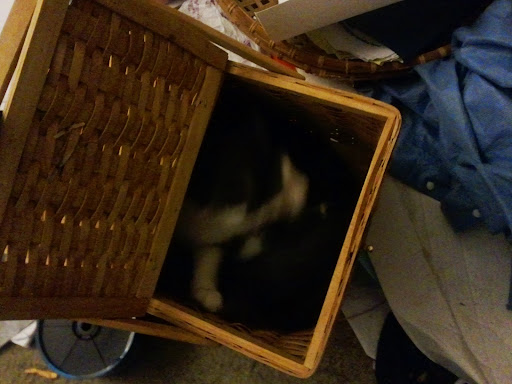
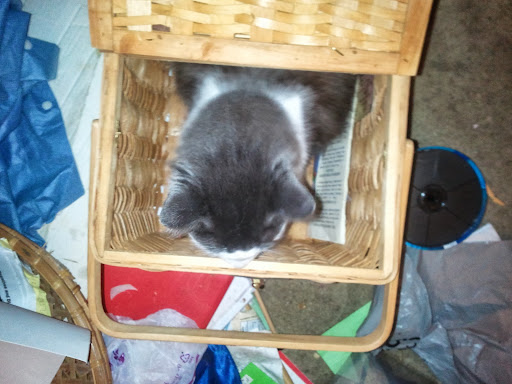
So have some pictures of our kitten, Destructo, age 8 months, I a picnic basket.

Why he went in, I have no idea, but he did NOT want to leave.

* Love of my life, light of the  cosmos, SHE WHO MUST BE 
OBEYED, my wife.

Posted via mobile.

I Hope that He Has Some ITEOD Arrangements

Edward Snowden has told the The New York Times that he no longer has copies of any of his files:

Edward J. Snowden, the former National Security Agency contractor, said in an extensive interview this month that he did not take any secret N.S.A. documents with him to Russia when he fled there in June, assuring that Russian intelligence officials could not get access to them.

Mr. Snowden said he gave all of the classified documents he had obtained to journalists he met in Hong Kong, before flying to Moscow, and did not keep any copies for himself. He did not take the files to Russia “because it wouldn’t serve the public interest,” he said.

“What would be the unique value of personally carrying another copy of the materials onward?” he added.

He also asserted that he was able to protect the documents from China’s spies because he was familiar with that nation’s intelligence abilities, saying that as an N.S.A. contractor he had targeted Chinese operations and had taught a course on Chinese cybercounterintelligence.

“There’s a zero percent chance the Russians or Chinese have received any documents,” he said.

American intelligence officials have expressed grave concern that the files might have fallen into the hands of foreign intelligence services, but Mr. Snowden said he believed that the N.S.A. knew he had not cooperated with the Russians or the Chinese. He said he was publicly revealing that he no longer had any agency documents to explain why he was confident that Russia had not gained access to them. He had been reluctant to disclose that information previously, he said, for fear of exposing the journalists to greater scrutiny.

I hope that he has made some sort of In The Event of Death (ITEOD) arrangements, because, this otherwise means that if the US and UK state security apparatus can get to Glenn Greenwald and documentarian Laura Poitras, particularly with him leaving the Guardian to move to a new journalistic endeavor funded by eBay founder Pierre Omidyar.

There are a lot of people in our government who are determined to destroy all of them, and to the degree that they are in a fledgling organization, this makes the task easier, because potential blow-back is less.

Hey, I Used to Work There!

BAE’s vehicle manufacturing plant in Sealy, Texas is sbeing closed next year:

The U.S. subsidiary of BAE Systems Plc plans to close a military vehicle plant in Texas next year and lay off about 325 employees, the company announced.

The facility, located about 50 miles outside Houston in Sealy, since 1990 has produced tactical wheeled vehicles for the U.S. military, including blast-resistant trucks known as Mine Resistant Ambush Protected vehicles, or MRAPs, for the wars in Iraq and Afghanistan, and the Humvee replacement Joint Light Tactical Vehicle, or JLTV.

The London-based company said industry contraction drove the decision to shutter the site by June 2014.

When I worked there in the early 1900s, it was owned by Stewart & Stevenson, and was the center of the $1.4 billion contract for the 2½ and 5 ton military trucks.

The writing for this plant was on the wall when Oshkosh Corp. managed to decode a Sealy’s sub-par drawing package and win the latest FMTV Contract.

Petition to Arrest Teabagger Reps is Both Stupid and Unconstitutional………

It’s been floating around the internet for a few days, and it is wrong on every level.

First, criminal charging your opponents for being your opponents is wrong.

We have hundreds of years of history to document that.

And then there is Congressional immunity, which guaranteed freedom from criminal or civil liability for official actions of Congress critters, no matter how mind boggling stupid those actions are.

Done with rant.

Missing the Point

Julia Ryan at The Atlantic observes that when correcting for demographics, public schools outperform private schools:

Sarah Theule Lubienski didn’t set out to compare public schools and private schools. A professor at the University of Illinois at Urbana-Champaign, she was studying math instructional techniques when she discovered something surprising: Private schools—long assumed to be educationally superior—were underperforming public schools.

She called her husband, Christopher A. Lubienski, also a professor at the university. “I said, ‘This is a really weird thing,’ and I checked it and double checked it,” she remembers. The couple decided to take on a project that would ultimately disprove decades of assumptions about private and public education.

Studying the National Assessment of Educational Progress and the Early Childhood Longitudinal Study, they have found that, when controlling for demographic factors, public schools are doing a better job academically than private schools. It seems that private school students have higher scores because they come from more affluent backgrounds, not because the schools they attend are better educational institutions. They write about these conclusions—and explain how they came to them—in their book, The Public School Advantage: Why Public Schools Outperform Private Schools. Here’s an interview with the Lubienskis about their work, edited and condensed for clarity and length.

This is not a surprise, but it does not matter for two reasons:

  • The quality of an educational experience is largely determined by the abilities of the students.
  • It creates social connections which serve to preserve a de facto aristocracy.

The biggest determinant of school quality has always been the “quality”, for lack of a better term, of the students.

To the degree that you put good students together in a self contained environment, their educational experience will likely improve, though this will be at the expense of those students, frequently poorer and more heavily pigmented, on the outside.

As to social connections, just look at Harvard, whose undergraduate program is widely considered to be one of the most overrated in academe,* they remain very exclusive.
The reason for this is the quality of the student body, and the social connections that are created by going there. 

It seems like half of the Wall Street banksters went to Harvard, for example.

Nothing binds like those old school ties.

*So says my Radcliffe (Harvard) graduate, former college president, step-mom.