Author: Matthew G. Saroff

Pentagon’s raygun-packing 747 to visit DC

I’m dubious of the technology.

Pentagon’s raygun-packing 747 to visit DC
By Lewis Page
Published Wednesday 20th June 2007 13:14 GMT

The Airborne Laser, the US Missile Defence programme’s raygun-equipped jumbo jet, is to visit Washington tonight in an attempt to drum up support on Capitol Hill.

Airborne Laser aircraft

The Airborne Laser aircraft, intended to explode ICBMs shortly after liftoff.

The Missile Defence Agency says (pdf) the flying energy-weapon platform will fly into Andrews airforce base outside DC from its normal home at Edwards AFB in California. The 747 is expected to make a night landing, before being shown off to politicos, officials, and the media. It will return to the west coast on 21 June.

The Airborne Laser is a modified Boeing 747-400 freighter aircraft intended to use a Chemical Oxygen Iodine Laser (COIL) to destroy a hostile ballistic missile during the highly-vulnerable “boost phase” of its trajectory — the first few minutes after it is launched.

Missiles in boost are full of pressurized explosive fuel, so even a relatively feeble zapping could cause them to explode. Also, attacking a multiple-warhead ICBM at this point will take out all its re-entry vehicles in one shot.

Actually, the missiles are not full of “pressurized explosive fuel”. The last US missile to do this was the Atlas, retired in the 1960s, which used LOX.

Modern missiles use storable liquid propellants, and the most modern, solid fuel, which do not present the same structural vulnerablitiex.

Texas cops taser diabetic seizure man

What the hell is wrong with these cops?

Texas cops taser diabetic seizure man

By Lester Haines
Published Wednesday 20th June 2007 12:25 GMT

A Texas man who called 911 to request medical assistance for a diabetic seizure earned a tasering from local cops for his trouble, the Waxahachie Daily Light reports.

Allen Nelms, 52, was suffering said seizure “during the early morning hours of April 28 when his girlfriend, Josie Edwards, called 911 to request paramedics”.

A police officer duly turned up at the house on Waxahachie’s east side, “inquired as to what was going on”, then called for back-up. Shortly after, and as Nelms was “in his bed in the couple’s bedroom”, cops “burst in with their guns drawn and yelling at him to get on the floor”.

Edwards recalled “about six or seven police officers kicked the front door in and stormed the back bedroom where she said she could hear one telling Nelms to get on the floor”. Her statement, which forms part of an written complaint made by Nelms to the Waxahachie police department, says: “Allen was shouting, ‘Please don’t do me like this. I just need help.’ Next thing I heard some ‘zing’ noise and Allen was shouting. I asked what were they doing to him. One policeman replied, ‘We just took care of him.’ … After they did their shooting and laughing, they came out [of] the rooms. The paramedics had to pull out the Tasers.”

Nelms claims he was “struck by Taser barbs on his left side, his back and his shoulder” as he went to roll over, and subsequently handcuffed, with “paramedics intervening when the officers began trying to yank the Taser barbs from his skin”. The paramedics removed the barbs, checked Nelms’ blood sugar level, and the cuffs came off. He was neither arrested nor charged.

In an interview with the Daily Light, Nelms added: “One of the officers said I ‘lunged’ at him. I asked him, ‘How can I lunge at you from my back and on my bed?'” He said he had “never had a problem in calling for paramedics before, and there is no history of his becoming violent when he is having a diabetic seizure”.

Edwards’ statement says: “Of the 16 years that we [have] lived here and called for paramedics, police decide to come and take over and try to almost kill the man. They never asked any questions [like] did he have a heart pacer, they just wanted to have fun by shooting Tasers and handcuffing the man after he was shot.”

School Administrators are Morons.

13 Year olds are not adults, but this is infantilizing them, and possibly creating sociopaths out of them.

People need physical human contact, perhaps even more so children.

Va. School’s No-Contact Rule Is a Touchy Subject

By Maria Glod
Washington Post Staff Writer
Monday, June 18, 2007; Page B01

Fairfax County middle school student Hal Beaulieu hopped up from his lunch table one day a few months ago, sat next to his girlfriend and slipped his arm around her shoulder. That landed him a trip to the school office.

Among his crimes: hugging.

All touching — not only fighting or inappropriate touching — is against the rules at Kilmer Middle School in Vienna. Hand-holding, handshakes and high-fives? Banned. The rule has been conveyed to students this way: “NO PHYSICAL CONTACT!!!!!”

School officials say the rule helps keep crowded hallways and lunchrooms safe and orderly, and ensures that all students are comfortable. But Hal, 13, and his parents think the school’s hands-off approach goes too far, and they are lobbying for a change.

….

Deborah Hernandez, Kilmer’s principal, said the rule makes sense in a school that was built for 850 students but houses 1,100. She said that students should have their personal space protected and that many lack the maturity to understand what is acceptable or welcome.

No, you are just an uptight bitch.

Hal’s troubles began one day in March when he got up from his assigned cafeteria table and went to a nearby table where his then-girlfriend was sitting. He admits he broke one rule — getting up from his assigned table without permission — and he accepts a reprimand for that. “The table thing, I’m guilty,” he said.

Assigned tables? Jesus H. Christ on a f%$#ing cracker!!!!! What the hell is wrong with these people.

These people won’t be satisfied until they have extracted every gram of humanity from their students.

Hollywood and Net Neutrality

The content providers are so worried about “piracy” that they will impale themselves on the stakes of AT&T and Comcast, who will extract usurious fees.

Make no doubt. These folks will lose far more than someone download a star wars movie if the telcos and cable companies are allowed to go through with this.

Will H’wood take a stand on Net neutrality?

Congloms may be forced to choose as telcos fish for fees
By WILLIAM TRIPLETT

“Net neutrality” may sound like something only a Web geek could love, but at some point showbiz, largely indifferent to it so far, will have to start declaring an interest — perhaps passionately.

Why? Because Net neutrality — or, as some call it, Net regulation — has the potential to affect content protection, otherwise known as Priority No. 1 of the entertainment industry.

Access to online content, itself no small concern, could also be at stake.

Even the term “Net neutrality” is the source of some controversy. Is the issue “neutrality” or “regulation”? It depends on who’s talking.

From its inception, the Internet has always delivered information on a first-come, first-served basis, whether it’s your music download, your neighbor’s porn or your office’s email.

Thus the Net has always been “neutral.”

But there’s no rule that says it has to be that way. If you get your Internet from Time Warner Cable, for example, there’s nothing to stop it from sending you content from Time Warner sites first and doling out content from the competition with whatever bandwidth happens to be left over.

Nor is there anything to keep an Internet service provider like Earthlink from taking fees from Disney or NBC Universal to give some sites priority — and to block other sites altogether.

That would give Web sites with deep pockets behind them a new advantage in getting their content in front of Web users, while sites that can’t afford those fees could be kicked to the virtual curb.

Those who value the current “neutral” state of the Internet are seeking legislation to protect “Net neutrality.” Many of the companies involved, though, see an opportunity to make money. They, along with those who generally favor free markets, condemn such legislation as “Net regulation.”

Fears that the current Net neutrality could be lost erupted at last year’s Telecom Next show after AT&T topper Ed Whitacre (who retired June 4) was quoted as saying that Google and other content providers were getting a free ride.

He told Business Week, “The Internet can’t be free in that sense, because we and the cable companies have made an investment, and for a Google or Yahoo or Vonage or anybody to expect to use these pipes free is nuts!”

Whitacre later backtracked, noting that customers would desert any provider who blocked some sites, but it was too late. The push to protect Net neutrality is on.

Given the potential for chaos if some content gets priority to some customers but not to others, as the pro-NN faction calls it, you’d think the entertainment industry would be all for passing laws that enforce Net neutrality.

You’d be wrong. Very few industry companies have publicly taken a position on NN to date, preferring a wait-and-see approach to the volatile issue.

How volatile? Only one industry exec agreed to be quoted by name on the subject.

“Intellectual property protection is our litmus test,” says Rick Cotton of NBC U, who could easily be speaking for the entire content industry.

As one industry lobbyist notes, showbiz tends to favor the side of the broadband providers, who oppose any mandated Net neutrality, because the providers can help identify and pursue online bootleggers and pirates.

These Morons Won’t Be Satisfied Until they Restart the Arms Race.

Impeach them all now.

Dispute delays arms-control talks with Moscow

By Jonathan S. Landay | McClatchy Newspapers

WASHINGTON — Wrangling between Bush administration aides and U.S. intelligence agencies is holding up talks with Moscow on future monitoring of the thousands of nuclear weapons that the United States and Russia still aim at one another.

The 1991 Strategic Arms Reduction Treaty (START) established the elaborate scheme of inspections, data sharing, advance missile test notifications and satellite surveillance. But the accord will expire in December 2009, and the U.S. spy satellites that locate and count Russian missile sites are stretched thin by the Iraq and Afghanistan wars, concerns about North Korea’s and Iran’s nuclear programs and other threats, current and former U.S. officials and experts said.

Administration policymakers argue that the monitoring system is an outdated vestige of the Cold War that restricts the Pentagon’s ability to respond to new threats. They want to replace it with an informal system of looser inspections that would allow the United States to do things such as replacing nuclear warheads with conventional warheads on intercontinental ballistic missiles.

The end of the U.S.-Soviet rivalry makes strict verification unnecessary, and the START monitoring methods aren’t foolproof, anyway, said senior administration official, who requested anonymity because of the sensitivity of the subject.

Could members of the press Please stop using anonymous sources anonymity when they are spouting the admin line???

Really.

The end of the U.S.-Soviet rivalry makes strict verification unnecessary, and the START monitoring methods aren’t foolproof, anyway, said senior administration official, who requested anonymity because of the sensitivity of the subject.

“We both (Moscow and Washington) want to understand the general trends and directions of each other’s forces. But we don’t need to know everything all the time,” the official said.

Alarmed by the stress on the limited fleet of U.S. spy satellites, however, U.S. intelligence agencies oppose weakening the on-site inspections and other means that give U.S. officials a window into the only nuclear arsenal capable of destroying the United States.

What they are saying here is that between, Iraq, Afghanistan, Iran, and the DPRK (North Korea), their resources are stretched thin.

If it’s not replaced, Moscow and Washington will lose the most reliable means of monitoring each others’ compliance with the 2002 Strategic Offensive Reductions Treaty (SORT), which calls for both sides to reduce the number of warheads on their bombers, long-range missiles and submarines to 2,200 by Dec. 31, 2012. After that, neither side will be bound by limits on its arsenal.

Moreover, because the SORT treaty doesn’t require the destruction of warheads, those removed from service and stored in reserve stockpiles could be redeployed rapidly.

So this is even More destabilizing than it appears at first glance.

Russia wants a legally binding treaty mandating deeper weapons reductions. The United States favors an informal deal, opposes new weapons cuts and wants to eliminate strict verification measures.

So now we’re acting like the old Soviets.

John Bolton, who served as the administration’s top arms control official until August 2005, said it would be better to increase spending on U.S. intelligence than to rely on START-type verification to monitor Russia’s nuclear forces.

If John Bolton is for something, you won’t ever lose money going the other way. The man is a moron.

What She Daid, Deborah Leavy Edition

I guess that the Beltway pundits think that punishment only applies to black and Hispanic folks.

Thank you Ms. Leavy, for a breath of honesty from Philadelphia.

DO THE CRIME, DO THE TIME
Deborah Leavy

PROMINENT conservatives, pundits and websites are rallying around I. Lewis “Scooter” Libby, ex-chief of staff to Vice President Cheney, who has been sentenced to 30 months and fined $250,000 after being convicted of obstruction of justice, perjury and lying to a grand jury and federal investigators.

In sentencing Libby, federal Judge Reggie Walton cited “overwhelming” evidence of Libby’s guilt. “People who occupy these types of positions, where they have the welfare and security of the nation in their hands, have a special obligation,” declared the judge, who was appointed by President George W. Bush.

But conservative Republicans argue that Libby is a dedicated public servant, and that he is merely the victim of a faulty memory. They are pressuring President Bush to pardon Libby.

But many Democrats are gleeful. They haven’t forgotten that when Bill Clinton lied about his relationship with Monica Lewinsky, Republicans called him unfit for office, and Clinton was impeached. Now the shoe is one the other foot, Democrats crow.

Revenge should have no role in the criminal-justice system, nor should it be a reason to exult in Libby’s case. If revenge were the reason for Libby’s sentence, I would join those calling for his pardon.

But I don’t think the judge is sending Libby to prison for payback. Judge Walton is known as a tough sentencer, and since Libby did the crime he should do the time.

Renters Paying Almost Nothing in Rent.

Seriously. This guy is paying just the condo fees and taxes, which means that the landlord is eating about $3000/month on this.

He’s doing it because the complex is empty, so he can’t sell what he has.

Renters hold cards in today’s market

By Dick Hogan
Originally posted on June 18, 2007

Lee County’s burgeoning skyscraper condominium market is a renter’s paradise — but a landlord’s hell.

Experts say as increasing numbers of condo units pour into an already overflowing supply of residential real estate, renters can almost name their price for even the costliest luxury units.

Jim Simon, for example, recently moved into a condo in the 32-story High Point Place in downtown Fort Myers, where the owners of its 105 units typically paid as much as $600,000 for the convenient riverfront location.

But Simon, a commercial real-estate broker, is paying only $1,350 a month — barely enough to cover the taxes and condo association fees.

“It’s like living in the Ritz-Carlton,” Simon said. “It’s got great amenities, it’s clean, it’s safe, it’s got a beautiful view.”

With only about 20 people living there, he practically has the place to himself, and with a number of similar projects under construction around downtown, he expects the good times for renters to last for awhile.

“It wouldn’t surprise me to see people get in for a little less than I’m paying,” Simon said.

The median condo resale price maxed out in February 2006 at $353,900, and by April 2007 the price had fallen to $244,100, down 31 percent, according to Florida Association of Realtors statistics.

As prices have fallen, so have rents. In late 2006 the average rent for a two-bedroom house was $940, down from an all-time high of $1,041 a year earlier, according to rental information service RealFacts.

Rents have continued to fall in recent months, as well, while the inventory of dwellings for sale stays at an all-time high of about 15,000, experts say.

Non-beachfront condos have been coming on line at an accelerating rate as well, in a trend fueled by speculators who bought pre-construction hoping to sell them quickly for a profit.

As a result, 829 new condo units in that category have been completed in the past 2€ years with another 1,769 under construction.

Owners are feeling the pinch on prices as renters have more to choose from.
A lot of people who bought condos as investments want to rent them out now because the market’s slow, said Joe Crimaldi of Rent SWFL in Fort Myers, who handles RENTALS leasing for condo owners throughout the area.

Not all equal

But not all skyscrapers are created equal, Crimaldi said.

For example, he handles leases in Riva Del Lago next to Lakes Park and Mastique on Bunche Beach Road, both in south Fort Myers, which he said are relatively easy to rent out. Riva Del Lago, which had three-bedroom units selling for more than $650,000, now has rentals around $1,500 a month. A three-bedroom condo in Mastique that sold for about $750,000 can be had for $1,750 a month.

Nope…No Coverup Here.

NPR : Abu Ghraib Investigator Says He Was Forced to Retire

Audio link.

Ret. Army Maj. Gen. Antonio Taguba, who was the lead investigator of military personnel working at Iraq’s Abu Ghraib prison, tells New Yorker magazine that he was forced into retirement because of his findings. Seymour Hersh, investigative reporter for the magazine, talks with Michele Norris about his interview with Taguba, who gave some details that were not made public before his comments were published this week in the magazine.

Hats Off To Karen Tumulty On Anonymous Sources

If someone gives a reporter something without prior mutual agreement as to it being off the record.

Reporters who allow a source to unilaterally declare anonymity are not doing their job.

Part of their job is to get attribution where possible. It makes the story more credible, and adds context.

Obama: Stay Tuned

The answer to this is, campaigns should not be allowed to distribute things on a NOT FOR ATTRIBUTION basis. Both NOT FOR ATTRIBUTION and OFF THE RECORD (and their cousins, BACKGROUND and DEEP BACKGROUND) are understandings that are agreed to mutually by a source and a reporter. What I’ve noticed about this cycle is that campaigns (and not just Obama’s) are falling into a bad and sloppy habit of sending out mass hit pieces by e-mail and demanding anonymity. As far as I am concerned, unless I have agreed in advance to accept a specific piece of material from a source on a limited or not for attribution basis, these unilateral declarations of anonymity mean nothing.

Europe Looking for Operational Independence of the US

This is a part of a continuing trend of our NATO allies looking for the ability to conduct operations independently of the US.

Not surprising, when one considers just how badly people have gotten burnt by the Bush admin.

The US is no longer viewed as a dependable ally. We are viewed as a mad dog.

Italy Starts Work on Second-Generation CosmoSkyMed (Subscription Required)

Italy Starts Work on Second-Generation CosmoSkyMed
Aviation Week & Space Technology
06/18/2007, page 72

Andy Nativi
Vandenberg AFB, Calif.
Michael A. Taverna
Paris

With X-band radar satellite safely in orbit, Italy starts work on second-generation design

Printed headline: Cosmo Calling

The first of four CosmoSkyMed radar observation satellites will became operational in December, following a successful launch last week.

Together with Germany’s SARLupe imaging system, the first of which was orbited in December, the Italian X-band satellite will add an all-weather adjunct to Europe’s day/night optical intelligence satellite capacity, based on France’s Helios 2. The combined systems will provide a full space-based intelligence, surveillance and reconnaissance (ISR) capability to support troops deployed in overseas theaters and reinforce immigration control, drug interdiction and other security activities.

The radar network was due to be expanded late last week by a German metric commercial radar spacecraft, TerreSAR-X, and next month by a second SARLupe.

Under a series of agreements dating back to 2001, Italy and France will share access to CosmoSkyMed, Helios 2 and France’s twin-satellite, dual-use Pleiades submetric optical-imaging system, which is to be deployed in 2009-10. An Italian hyperspectral optical instrument may be added to the mix.

Israeli Large Drone Made Public

I showed some blurry pix of this a few weeks back.

I’m a bit dubious of it being used for aerial refuelling. I think that pilots will want a man in the loop.

After months of being coy(Subscription Requited)

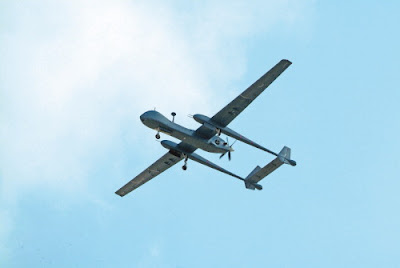
After months of being coy, Israeli defense and aerospace officials have admitted their huge new unmanned aircraft–the Eitan or Heron TP–does exist and will be on public display this week at the Paris air show.

A few poor-quality bootleg pictures of the unmanned, missile-carrying aircraft leaked out last month (AW&ST May 21, p. 32). Now the Defense Ministry has given Israel Aerospace Industries permission to release pictures. The UAV has been test flown sufficiently since its first flight last July that IAI says it is ready for serial production.

TP stands for the Eitan’s 1,200-hp. turboprop engine, which will give the UAV an operational altitude above the 45,000-ft. limit for commercial aircraft. The 10,230-lb. aircraft has a wingspan of 85.28 ft. and loiter time of 36 hr. Descriptions of its capabilities and missions are vaguely worded. The “multi-payload, multi-mission” aircraft carries “front end technologies to meet . . . a large variety of operational missions,” IAI and Israeli Defense Forces officials say.

But there are hints about the capabilities. The high-altitude capability, emphasis on reliability and long loiter time, as well as large internal payload volume and weight, indicate the UAV could serve at least three key missions: defense against ballistic missile launchers and, later, ballistic missiles in boost phase; long-term surveillance and intelligence collection; and as a refueling tanker to operate in areas where large manned aircraft would be vulnerable.


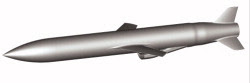
Raytheon Studies Supersonic Tomahawk

Given its relatively low speed, less than Mach 2.5, this is much easier than some of the high supersonic (Mach 3+) and hypersonic vehicles (Mach 5+).

The lower speed eliminates a whole bunch of leading/bleeding edge technologies which are EXPENSIVE and time consuming.

Raytheon Studies Supersonic Tomahawk

Raytheon Studies Supersonic Tomahawk
Aviation Week & Space Technology
06/18/2007, page 56

Douglas Barrie
London

Raytheon studies supersonic cruise missile within Tomahawk infrastructure constraints

Printed headline: High-Speed Shortcut

Raytheon is studying a “Supersonic Tomahawk” concept it believes could offer the U.S. Navy a quick path to fielding a comparatively high-speed conventional strike weapon.

After 18 months of company-funded concept development, Raytheon has submitted preliminary study work to the U.S. Office of Naval Research (ONR).

“We decided to look at what we could do from a Raytheon viewpoint. . . .Could you design a supersonic Tomahawk to fit . . . in the current tube,” says Harry Schulte, vice president of strike weapons at Raytheon Missile Systems.

One aim was to examine whether the constraints of fitting within the existing Tomahawk launch-tube would place unacceptable limitations on a supersonic weapon’s performance in terms of range. “Could we live with the constraints?” says Schulte.

The 1,000-mi.-range subsonic Tomahawk has a cruise speed of about 0.8 Mach. While a supersonic weapon based on the “same” airframe size would not give a similar range, Schulte says the figures came back suggesting 600-650-mi. ranges were achievable.


The Supersonic Tomahawk concept indicates a clear lineage to its subsonic origins. Credit: RAYTHEON

The company discussed with engine manufacturer Williams propulsion options for the design concept. The design studies suggested that a cruise speed of Mach 2 to Mach 2.2 was viable.

Alenia Aeronautic Unveils New Unmanned Aircraft

I just think that this drone is wicked cool looking.

It’s a Predator-B class drone.

Alenia Aeronautic Unveils New Unmanned Aircraft

Aviation Week & Space Technology
06/18/2007, page 112

Andy Nativi
Rome

Sky-Y prototype could clear the way for pan-European unmanned aircraft project

Printed headline: Unmanned and Unveiled

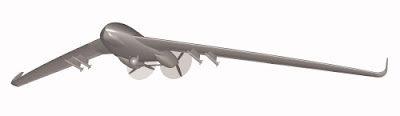
Alenia Aeronautica hopes its work on a medium-altitude long-endurance (MALE) unmanned aircraft demonstrator will spur interest in a future European collaborative program.

The so-called Sky-Y has been underway in secret for several months, but this week the company is expected to lift the veil on the project. A Sky-Y model will be shown at the Paris air show, while the real version is undergoing trials at the Vidsel test range in Sweden.


Finmeccanica is trying to break into the medium-altitude unmanned aircraft market, building on work done with earlier UAV demonstrators. Credit: ALENIA AERONAUTICA

Radar Threatens Stealth

I would note that the basic science of stealth originates same Russian mathematics paper of the mid-1960s as it always had, so my money is on anti-Stealth in the medium term.

Radar Threatens Stealth (Subscription Required)

Aviation Week & Space Technology
06/18/2007, page 132

David A. Fulghum
Washington

The debate continues over whose black projects are most effective

Printed headline: Stealth Rules

The stealth versus radar contest is making another of its periodic swings–this time in favor of new, advanced radars. But stealth specialists say it won’t be enough because stealth is improving even faster than the radars.

There’s a new generation of stealth on the way that will be seen in the F-35 Joint Strike Fighter and the Navy’s new Unmanned Combat Air System. It will provide protection against high-frequency radars traditionally associated with advanced air defenses. But stealth designs will also be tuned to evade low-frequency radars that can detect older stealth designs like the F-117.

Meanwhile, advanced radars are being developed by the U.S., France, Britain and Russia, with Moscow expected to share the technology with the Chinese military. The active electronically scanned array (AESA) radars are made up of thousands of efficient transmitter/receiver modules that produce a versatile, long-range radar. The F-22’s radar, which measures about 2 X 3 ft., has an estimated range of about 125-150 mi. The MP-RTIP radar–designed for the E-10 with a 4 X 20-ft. antenna to counter stealth–would have had an estimated range of perhaps 300 mi. or more. U.S. officials hint at ground-based radars with even greater ranges. It’s known that Israel’s Green Pine AESA radar is big and powerful enough to watch missile tests in Syria and Iran.

Even more intriguingly, if all the beams can be focused on a single spot–perhaps an enemy cruise missile, radar or a headquarters packed with computers–an electronic spike of electricity can be produced large enough to blind sensors, fill them with false targets and scramble computer memories. Raytheon has already tested an air defense system that uses radar transmitters to shoot down shoulder-fired air defense missiles.

Perhaps best of all for the U.S., researchers discovered how to take the products of electronic warfare effects generators and pump them through AESA radars on fighter aircraft–in particular, the latest F/A-18E/F and EA-18G models. That means electronic effects, such as false targets and other misleading data, can be fired as a data stream into the radars and other sensors of other aircraft, missiles and air defense arrays at ranges of a 100 mi. or more, farther than air-to-air weapons.

Air Force officials hint that the capability also exists in the F-22.

“We’re rapidly finding out the things the F-22 brings and how to use them,” says Lt. Gen. Chip Utterback, commander of 13th Air Force. “We are soon to integrate the F-22 and the [Marine Corps AV-8] in ways I would never have imagined. I’m talking about a joint team for a Harrier and an F-22 using the low observability of the F-22 and the ability of the AV-8 to identify and work targets while close to the ground–and while under a high-threat surface-to-air environment. We can put an F-22 in that environment and work some magic . . . in the electronic attack arena where we couldn’t before. With F-22, we can work our conventional forces much more aggressively in a high-threat area.”

Another clue comes from a longtime Pentagon stealth and radar specialist.

“The combination of the F-22’s stealth and electronic attack capabilities allows it to play both sides of the equation by being hard to detect and carrying the capability to generate false targets and jam enemy radars.”


This X-45C tailless flying wing represents the fourth generation of stealth that protects against detection by low-frequency radars as well as it does against traditional high-frequency air defense sensors.Credit: BOEING

….

Phoenix Mars Lander Readied for Launch

This is a highly ambitious project with a real possibility of finding signs of extra-terrestrial life.

Let’s hope that NASA does not screw this up.

Phoenix Mars Lander Readied for Launch(Subscription Required)

Aviation Week & Space Technology
06/11/2007, page 56

Craig Covault
Denver, Colo. & Tuscon, Ariz.

The Phoenix lander—with U.S., Canadian and European technology—will broaden the search for life’s clues beyond Earth

Printed headline: Back to Mars

The NASA Phoenix Mars lander, carrying the most ambitious laboratory hardware ever sent to another planet, is ready for launch on a mission to taste Martian water and search for the organic carbon building-blocks of life near the planet’s north pole.

The spacecraft’s nearly 8-ft.-long robotic arm will dig trenches up to 3 ft. deep for imagery of subsurface layers and the retrieval of soil and ice samples for its complex mini-laboratories. This should enable Phoenix to determine what’s happening now, relative to the suitability for life, at a specific landing site where scientists know there’s water in the form of permafrost or ice. This is in contrast to the Mars rovers Spirit and Opportunity, which are equipped with geology sensors to determine what happened in the past, back to billions of years ago at their respective landing sites.

And Phoenix, with advanced technology from the U.S., Canada and Europe, will conduct much more complex sample processing and climate studies than was possible on the 1976 twin Viking landers that had a less capable arm and different analysis labs.


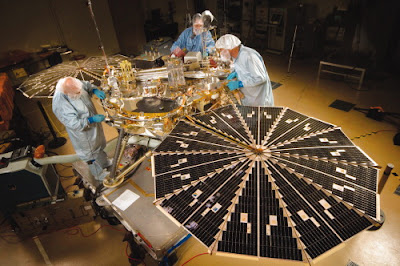
The Phoenix lander will lift off in August on a Delta II headed for touchdown in the north polar region of Mars. It will sample Martian water, ice and soil, searching for organic compounds critical to life. The circular Phoenix solar arrays, spanning 18 ft., were designed by ATK and adopted by Lockheed Martin for its winning Crew Exploration Vehicle design.Credit: PAT CORKERY/LOCKHEED MARTIN


Phoenix will land on 12 Aerojet hydrazine-powered rocket engines. They will be fired after separation from the spacecraft’s parachute at 1,870-ft. altitude 26 sec. before touchdown—171 million mi. from Earth. Phoenix is too large to use airbags, as did the Mars rovers and earlier Pathfinder lander. The 1976 Vikings also used powered descents.Credit: NASA JPL/UNIVERSITY OF ARIZONA


Water blasts through 12 descent engines on nonflight engineering model of spacecraft in critical test of propellant-line stresses as engines cycle on and off on split-second basis.Credit: PAT CORKERY/LOCKHEED MARTIN


Robotic arm (A) equipped with lights and scoop (B) will deposit water, ice and soil samples in eight TEGA ovens (C) that will bake out organic signatures at up to 1,800F. The arm will also deposit soil in MECA wet chemistry lab (D) that will add water to four cells. MECA also has 10 atomic force microscope slides. Canadian weather station (E) includes laser ranging beam and silver temperature/wind mast (center). Stereo imager (F) will take detailed images of trench layers. Lander must relay all data by UHF antenna (G) to Mars orbiters.


Phoenix in launch configuration is encased in aeroshell with heat shield at blunt end for a Mars atmospheric entry. It will employ Mars hypersonic guidance using a segment of the Apollo Earth-reentry algorithm.Credit: PAT CORKERY/LOCKHEED MARTIN

America’s Mayor Skipped 911 Panel for Lucrative Speaking Gigs

Damn, this guy is such a disaster.

He will make Goldwater’s run look like a walk in the park for the Republicans.

Rudy missing in action for Iraq panel

Giuliani’s campaign fundraising kept him from commitment to panel studying Iraq.

BY CRAIG GORDON
craig.gordon@newsday.com

June 18, 2007, 11:41 PM EDT

WASHINGTON — Rudolph Giuliani’s membership on an elite Iraq study panel came to an abrupt end last spring after he failed to show up for a single official meeting of the group, causing the panel’s top Republican to give him a stark choice: either attend the meetings or quit, several sources said.

Giuliani left the Iraq Study Group last May after just two months, walking away from a chance to make up for his lack of foreign policy credentials on the top issue in the 2008 race, the Iraq war.

He cited “previous time commitments” in a letter explaining his decision to quit, and a look at his schedule suggests why — the sessions at times conflicted with Giuliani’s lucrative speaking tour that garnered him $11.4 million in 14 months.

Giuliani failed to show up for a pair of two-day sessions that occurred during his tenure, the sources said — and both times, they conflicted with paid public appearances shown on his recent financial disclosure. Giuliani quit the group during his busiest stretch in 2006, when he gave 20 speeches in a single month that brought in $1.7 million.

On one day the panel gathered in Washington — May 18, 2006 — Giuliani delivered a $100,000 speech on leadership at an Atlanta business awards breakfast. Later that day, he attended a $100-a-ticket Atlanta political fundraiser for conservative ally Ralph Reed, whom Giuliani hoped would provide a major boost to his presidential campaign.

Someone In NASA or the ESA Loves the Teenage Mutant Ninja Turtles

Maybe, it’s happenstance, but I think that it’s the turtles.

Think about it, Leonardo, Donatello, and Raphaelo. Some Italian turtles fan?

NASA Nears Decision on Permanently Attached MPLM

Aviation Week & Space Technology
06/11/2007, page 33

Michael A. Taverna
Turin, Italy

NASA nears decision on MPLM; European inflatable and robot concepts advance

Printed headline: Housecleaning

Thales Alenia Space says it’s close to clinching a deal with the European Space Agency and NASA to modify a Multi-Purpose Logistics Module so it can be permanently moored to the International Space Station once the shuttle is retired.

Such a plan–intended to add pressurized storage space needed to reduce clutter in living and working areas of the ISS–has been “kicking around for a while,” says Dino Brondolo, the company’s director of infrastucture programs, but has grown in priority as NASA confirmed its decision to phase out the shuttle by 2010. A green light would have to be given by the fall in order to complete modifications in time for the final MPLM mission, he says.


This X-45C tailless flying wing represents the fourth generation of stealth that protects against detection by low-frequency radars as well as it does against traditional high-frequency air defense sensors.Credit: BOEING

NASA is working out final specifications and discussing a barter acquisition arrangement with ESA and Italian space agency (ASI) for the plan, along the lines of previous agreements involving two new interconnecting modules, Node 2 and 3, and the Cupola astronaut viewing station, all of which, like MPLM, were built by Thales Alenia. Brondolo rates the chances for a go-ahead as “good.”

Carried in the shuttle cargo bay, the 21-ft.-dia., 15-ft.-long MPLM can supply up to 10 metric tons of pressurized cargo to and from the station, arranged on 16 standard racks. Attached to the ISS, it would provide an additional 70 cu. meters of volume–comparable to the Columbus or U.S. habitation modules–freeing up storage space for other functions.

Three vessels were initially procured from Thales Alenia, for a design life of 25 missions each. However, because of the drastic reduction in shuttle missions, only two–Rafaelo and Leonardo–have flown since their inaugural flight in March 2001, and they have totaled only seven missions between them. The third ship, Donatello, is set for a sole mission in January 2009. Only two other flights are currently planned–Leonardo in October 2008 and Rafaelo in July 2009.

If there had been 4, it would have been named Michaelangelo.

AMD To Challenge Intel on Ultra Mobile PC Chips

I’m rooting for AMD on pretty every thing that they challenge Intel on.

AMD ‘Bobcat’ to challenge Intel next-gen UMPC platform

By Tony Smith
11 Jun 2007 09:43
Rival for ‘Silverthorne’

AMD will next year launch a processor specifically designed for ultra-mobile PCs (UMPCs), the chip maker revealed last week at the Computex show in Taipei.

Details remain scarce, but the chip is currently codenamed ‘Bobcat’, a feline moniker that perhaps aligns it with ‘Puma’, AMD’s upcoming notebook platform. Puma comprises new mobile chipsets and AMD’s ‘Griffin’ processor, the first CPU it has designed specifically for mobile applications rather than a tweaked version of its desktop processors.

It’s not hard to envisage Bobcat as a combination of processor and GPU with both of these components bonded together in a single package. But that’s just conjecture at this point.

France Pushes Operational Space Surveillance, Elint Capabilities

Another case of a headline abuse. The “Accent Graves” thing in the printed version is a bad French pun.

FWIW, Sarkosy will be big on the ability to do this independently, the Gaullists, and his party is one of their descendants have always been bigger on this than the socialists.

France Pushes Operational Space Surveillance, Elint Capabilities

Aviation Week & Space Technology
06/18/2007, page 70

Michael A. Taverna
Broye-les-Pesmes and Rennes, France

France pushes Europe to develop operational space surveillance, elint capabilities

Printed headline: Accent Graves

France is inviting its European neighbors to collaborate on a ground-based space surveillance system as part of a proposed military space buildup that could include operational signals intelligence and data relay networks.

Since December 2005, the French air force’s air defense/air operations command has been operating a space surveillance facility that was initially intended as a technology demonstrator. Unlike existing systems in the U.S. and Russia, which rely on an array of sensors, the French installation, called Graves, uses a single bistatic radar and a powerful 60-Gflop/sec. processing system to detect the angular and radial velocity measurements of orbiting spacecraft and–using patented algorithms–determine their orbital parameters. A four-transmitter array is located at Broye-les-Pesmes, east of Dijon; receivers are on the Plateau d’Albion, 400 km. (250 mi.) south.

Non-NATO Tactical Data Link Developed

Thales can’t be the only people offering this sort of capability.

I imagine that the British or Germans have something similar, and that there was a similar system that dates back to the USSR.

Thales Develops LX16 Tactical Data Link for Non-NATO Countries

Aviation Week & Space Technology
06/18/2007, page 114

Joris Janssen Lok
Paris

Link 16-equivalent data link gives nations option for tactical network

Printed headline: Non-NATO Network

Thales is proposing a tactical data link that gives nations not currently allowed to use the NATO-standard Link 16 the option to acquire a similar capability, which Thales calls LX16.

At least one Asian country is in negotiations to equip all of its armed forces (air, land and maritime) with LX16, say company sources, while declining to identify the customer.

Thales is also receiving “strong interest” in LX16 from several other nations as well as from “aircraft manufacturers who are not in NATO countries and who sell outside NATO.”

“Non-NATO air customers often love to get a Link 16 capability, but they can’t–so we developed an equivalent tactical data link that uses the same message set, grammar and vocabulary,” says Patrice Caine, vice president for communications, navigation and identification activities in Thales Land & Joint Systems.

Once installed, the equipment behind LX16 can be modified “virtually overnight” to support Link 16 proper, Caine suggests. Such an upgrade could be considered if an LX16 user becomes eligible to join the Link 16 user community–for example, when there’s a need to participate in Link 16 networks during coalition operations.

The change from an LX16 to a Link 16 configuration can be achieved by adding a MIDS-LVT (Multifunctional Information Distribution System-Low Volume Terminal) to each aircraft, ship or land asset that needs to participate in the Link 16 network.

Thales is also working to make LX16 interoperable with Link 16 without having to add MIDS-LVT terminals to all platforms. That would be a gateway system that allows the LX16 network to interface with Link 16.

While Link 16 operates in the 960-1215-MHz. frequency range (L-band), Thales’s LX16 operates at 300-600 MHz.

The lower frequency implies that there would be lower throughput, but I’m not up on radio Frequency stuff, so I’m not sure how much.