Category: Business

If You Want to Understand the Face of Modern Capitalism

Just read Aviation Week‘s savaging of Angela Merkel. (Paid Subscription Required)

Seriously, this article makes me feel a modicum of respect for Angela F%$#ing Merkel.

It centers on the role of Merkel of killing the BAE/EADS merger, and Aviation Week, which is at its core a defense industry newsletter, and as suchit does not approve of government “meddling.”

The basic premise behind this is that after sucking up billions of government subsidies and contracts, they want to “unleash the free market” (Translation: move factories to China, overpay senior executives, and continue to get government money).

Nixing the terms demanded by BAE may have been the best thing that Merkel has ever done.

If there is any industry that rivals the banksters for socializing risk and privatizing profits, it is the defense industry, and to treat it as anything but a ward of the state is a profound mistake.

Maybe Not Unto the 3rd Generation, but More than a Decade

John Aravosis wondered how long the boycott of Domino’s Pizza should last beyond Tom Monaghan’s sale of the pizza delivery firm:

The thing is, a lot of people are still ticked at Domino’s for the Monaghan years. I know I am. I still avoid Domino’s when possible, even though I “know” Monaghan is gone. (And most of us didn’t even know about the Romney/Bain connection – they owned the company after Monaghan, though they’re now gone too.)

Like Coors, years after it faced a gay backlash, Domino’s was run by a lot of right-wing jerks during much of its existence, and the company is now trying to figure out how to get rid of some serious baggage. And like Coors, Dominos, Cracker Barrel, Chick-fil-A all give me a bad taste in my mouth, even though the first two have gotten rid of their far-right heritage.

Are liberals being unfair to Domino’s, or Coors or Cracker Barrel? Once bad people sell a company, is it time for us to let bygones be bygones? If Monaghan continues being a jerk, is it time to stop holding Domino’s response for his ongoing actions?

It’s a legitimate question.

I’m not sure how long a boycott for this sort of sh%$ should last, but it should be at least a decade, and probably at least 2.

This is not about being unwilling to let go, it’s about economics:  If a boycott goes away as soon as the right wing ratf%$# sells out, then he can sell out for more money.

Any protest must continue for a long enough time to ensure there is no easy/lucrative escape hatch.

Yes, I know that this is in response from a post made over 2 weeks ago, I came across this when I was doing some house cleaning.

This is What Happens When You F%$# With User Interfaces, Just Because

That is what the much loathed ribbon is all about, and now Windows 8, which has managed to underperform Vista’s market acceptance:

Final online usage numbers for 2012 released Tuesday confirmed that Windows 8 failed to match Windows Vista’s uptake pace during its first two months.

Preliminary numbers from Net Applications last week indicated that Windows 8 would end the month behind Vista’s uptake at the same point in its release cycle. Yesterday’s data confirmed the earlier projections by Computerworld.

………

Apple gets that while a smart phone and a tablet are similar things, that neither of them are a PC, so for tablets and iPhones, you have IOS, and for the MacIntosh, they still run OSX, which is a conventional keyboard and mouse Operating system.

Windows may be a good tablet/phone OS, but for a conventional PC, it sucks wet farts from dead pigeons.

Seriously, it’s worse than Google’s light gray on white color scheme that has become their standard.

I am Going to Miss Spitzer’s Show

They just got sold to Al Jazeera, and they will be replacing the lineup with one of their own:

It looks as if Current TV will soon be a thing of the past. Al Jazeera, the Doha, Qatar-based news broadcaster, has agreed to acquire the seven-year-old cable channel from its co-founders, Al Gore and Joel Hyatt.

Hyatt announced the sale in a memo to employees Wednesday evening, confirming reports in The New York Times and the Hollywood Reporter that a deal was in the works.

“When considering the several suitors who were interested in acquiring Current, it became clear to us that Al Jazeera was founded with the same goals we had for Current,” Hyatt wrote. “Al Jazeera, like Current, believes that facts and truth lead to a better understanding of the world around us.”

Al Jazeera plans to scrap Current’s programming lineup and brand, which never caught on with a critical mass of viewers, and use the channel’s subscriber base of 60 million households as the basis for a new network. A Current spokeswoman had no immediate comment on the reports.

I understand why the deal was made: Current has access to over 100 million eyes, Al Jazeera just a fraction of that, because of our culture of bigotry and xenophobia adopted following 911.

Time Warner has already canceled their contract on the change of ownership clause, but they already carry Al Jazzera, so it might just be that they don’t want to give them two channels.

Best Reason for Britain to Leave the EU

The Banksters are terrified of the idea:

Senior banking and business figures spoken to by The Sunday Telegraph have revealed growing disquiet at Government plans for a referendum where one option could be an exit from the EU.

One senior banking executive said: “The whole issue has the potential to be very destabilising for the City.

“It risks playing with the future of the British economy for the next 30 years.”

We need to understand that big finance is not about what should be its primary function, getting capital to from those who want to invest it to those who need it, but it is about sitting athwart the economy and extracting rents.

Any economy that prioritizes shrinking and stigmatizing the big bankers will do better than one (like ours, see Obama/Geithner) that prioritizes the the “health of the existing financial system.”

The banksters are a cancer than need to be excised from our economy.

Why We Need to Kill Big Pharma, Part LVXXI

So, a company buys the rights to a drug for 100 Grand, and takes the price of a vial from $50 to $28,000:

THE doctor was dumbfounded: a drug that used to cost $50 was now selling for $28,000 for a 5-milliliter vial.

The physician, Dr. Ladislas Lazaro IV, remembered occasionally prescribing this anti-inflammatory, named H.P. Acthar Gel, for gout back in the early 1990s. Then the drug seemed to fade from view. Dr. Lazaro had all but forgotten about it, until a sales representative from a company called Questcor Pharmaceuticals appeared at his office and suggested that he try it for various rheumatologic conditions.

“I’ve never seen anything like this,” Dr. Lazaro, a rheumatologist in Lafayette, La., says of the price increase.

How the price of this drug rose so far, so fast is a story for these troubled times in American health care — a tale of aggressive marketing, questionable medicine and, not least, out-of-control costs. At the center of it is Questcor, which turned the once-obscure Acthar into a hugely profitable wonder drug and itself into one of Wall Street’s highest fliers.

At least until recently, that is. Now some doctors, insurance companies and investors are beginning to have doubts about whether the drug is really any better than much cheaper alternatives. Short-sellers have written scathing criticisms of the company, questioning its marketing tactics and predicting that its shareholders are highly vulnerable.

………

But Questcor did almost no research or development to bring Acthar to market, merely buying the rights to the drug from its previous owner for $100,000 in 2001. And while the manufacturing of Acthar is complex, it accounts for only about 1 cent of every dollar that Questcor charges for the drug.

Moreover, the tiny “orphan” market soon became much bigger. Before long, Questcor began marketing the drug for multiple sclerosis, nephrotic syndrome and rheumatologic conditions, even though there is little evidence that Acthar is more effective for those other conditions than alternatives that are far cheaper. And the company did so without being required to prove that the drug actually works. That is because Acthar was approved for use in 1952, before the Food and Drug Administration required clinical trials to show a drug is effective for a particular disease. Acthar is essentially grandfathered in.

How the F%$# does a drug that was approved for use in 1952 remain under IP protection?

I’m increasingly convinced that our current IP regime is an iron triangle between rent-seekers who produce nothing of value, politicians who take their campaign donations, and the the rest of us, who provide the ill-gotten gains that the rent-seekers use to protect their business models.

More Equal than Others

The latest investment dodge, leveraging green cards for investment capital:

At this remote outpost by the Canadian border, Bill Stenger is overseeing what he says is the biggest economic development project that Vermont has ever seen.

He is expanding the Jay Peak ski resort, which he co-owns, but he is also building a biomedical research firm and a window manufacturing plant, extending the runway at the local airport and rehabilitating much of the nearby town of Newport, where he lives. There, he is developing the waterfront, adding the town’s first hotel and a conference center and rebuilding an entire downtown block. He is also creating what he says is the largest indoor mountain bike park in the world and a state-of-the art tennis center.

The price tag for the entire project, which Mr. Stenger says will create 10,000 direct and indirect jobs over several years, is $865 million.

But even more unusual than the size of the undertaking is the method by which Mr. Stenger and his business partner, Ariel Quiros, are financing it. They have tapped into a federal program that gives green cards, or permanent residency, to foreigners who invest at least $500,000 in an American business — the reward for the investment is a chance at United States citizenship.

(emphasis mine)

It inevitable that any government program that “incentivises” the wealthy is an invitation to corruption and abuse.

Let’s be clear here:  People who are investing are not interested in the return that they can get, they are buying a green card.

The whole Calvinist dichotomy that wealth is synonymous with virtue that the Pilgrims brought over is really completely unbounded in reality.

Why We Need to Destroy Big Pharma

Well, the first answer is a utilitarian answer, we do not need them.

If the government spends 5 out of every 6 dollars spent on medical research, then there is no reason to pay the excessive monopoly rents that they extract from out economy.

But there is also a moral argument, and it is that the large pharmaceutical firms are ineluctably evil.

We have yet another example of this when we discover that they colluded with the government of East Germany to turn their citizenry into unwilling Guinea Pigs:

Major Western pharmaceutical companies carried out tests of medications in the 1980s on patients in communist East Germany, in some cases without the subjects’ knowledge, a media report said Friday.

“We have documents showing there were contracts between Western drug companies and East German institutions for medical tests,” a staff member at the German national archive told AFP, partially confirming a report in the daily Der Tagesspiegel.

The newspaper, which examined the documents, reported that more than 50 Western firms had contracts with East Germany’s Health Ministry to carry out a total of 165 medical tests between 1983 and 1989.

In exchange, the communist authorities were paid up to 860,000 deutschmarks (around 430,000 euros today or $567,000), according to the report, at a time when East Germany was desperate for hard currency.

Der Tagesspiegel said the companies involved included Bayer, Schering, Hoechst (now Sanofi), Boehringer Ingelheim and Goedecke (today owned by Pfizer).

It said the test subjects often were not informed, citing seven specific cases in which patients said later they had been unaware they were involved in testing. The national archive said it could not confirm this.

The taxpayers front ⅚ of the money to do the research, but out of some sort of need to “set the free market loose, we give away the property rights so that they can extract monopoly rents.

Enough.

This is an industry that exists only through the grant of exclusive rights by the government.  This is not free enterprise.

We need to make sure that if the taxpayers pay for the research, then the taxpayers own the research.

As If Facebook Did Not Suck Enough

I’m sure you have heard of the Instagram thing, where they came out with new terms of service which said that they could sell your photographs, and you did not get anything.

It’s a classic Facebook move, but it really does not bother me, because I don’t “get” instagram.

If I want to funky things to photos I snap with my camera phone, I’ll do it on my PC on an old copy of Paint Shop Pro.*

That being said, I really don’t get Facebook either.  I appreciate its huge user base, and I signed up so that I could mirror my blog there, boosting eyeballs.

In the process I did reconnect with a bunch of old friends, but again, that’s largely a function of the user base, not the site.

One of the problems is that it appears that every upgrade makes the totality of the experience worse.

The latest innovation is that Facebook will be adding auto start videos to its video feed:

Get ready for video ads in your news feed.

Facebook is set to unveil a new video-ad product in the first half of next year in its largest attempt to date to attract big swaths of ad dollars from TV advertisers, according to several industry executives who have been briefed on the company’s plans over the past few weeks.

………

In what’s sure to be a controversial move, the visual component of the Facebook video ads will start playing automatically — a dynamic known as “autoplay” — according to two of the executives. Facebook is still debating whether to have the audio component of the ads activated automatically as well, one of these people said.

On the desktop version of Facebook, the video ads are expected to grab a user’s attention by expanding out of the news feed into webpage real estate in both the left and right columns — or rails — of the screen. Facebook is also working on a way to ensure that the video ads stand out on the mobile apps as well, though it is unclear how exactly the company will accomplish this.

I guess that they decided that the whole anal probe ad server thing just wasn’t evil enough.

I do not get it. Are already running their server farms on power generated by incinerating harp seal pups, and claiming that it was “green” energy.

Isn’t that evil enough for them?

Damn, he needs to buy a white Persian cat and a bond villain lair, and be done with it.

*BTW, a big f%$# you to the folks Adobe® who bought the makers of the program, JASC, and shut them down a couple of years later, because they did not want the product, a fairly capable and easy to use image editor, they just wanted to shut down a competitor.

Big Brother is Arlington Hewes*

Verizon has just patented a set top box with cameras that spy on you so that they can serve up targeted ads:

Verizon has filed a patent for a DVR that can watch and listen to the goings-on in your living room. In the application, the company proposes to use the technology to serve targeted ads appropriate to whatever you’re doing in the, uh, privacy of your own home—fighting, cuddling, or hanging out with your cats.

Verizon is far from the first company to think of this unassailably creepy use for a set-top box. Comcast patented similar monitoring technology in 2008 for recommending content based on people it recognizes in the room; Google proposed yet another patent for Google TV that would use audio and video recorders to figure out how many people in a room are watching the current broad

I am appalled by the very concept, and I am also appalled by the fact that the USPTO granted a patent for a television that spies on you, when George Orwell published this idea in his novel Nineteen Eighty-Four published in 1949.

The estate of Eric Arthur Blair should sue.

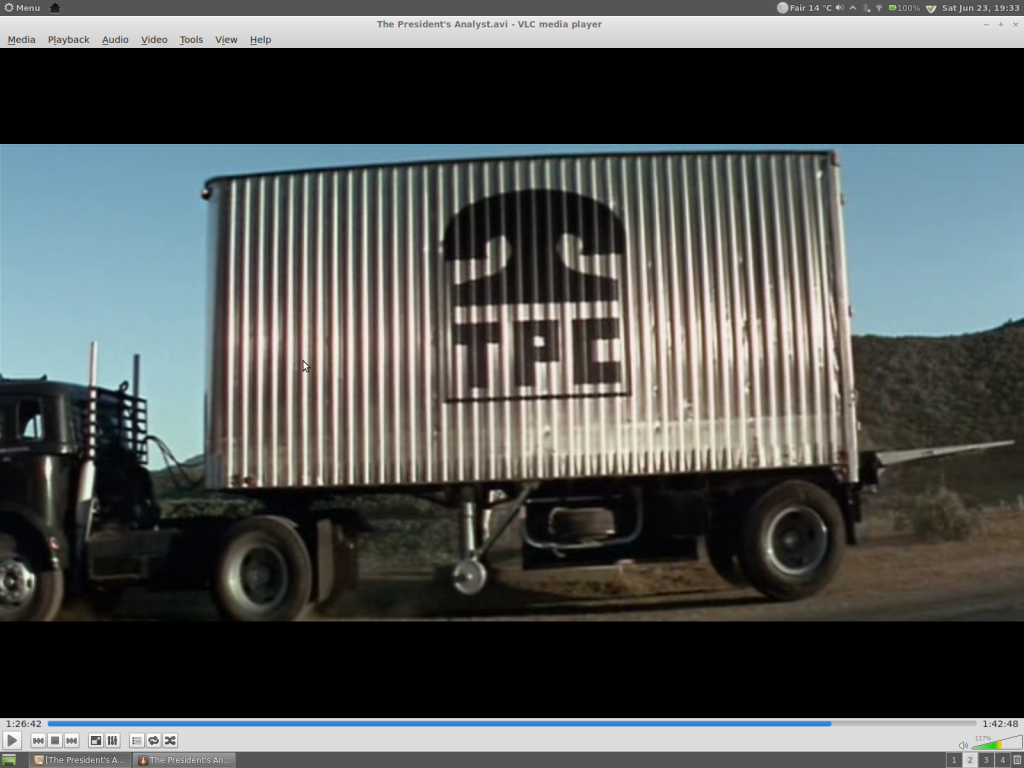
*The President’s Analyst, James Coburn, Godfrey Cambridge, 1967. Arlington Hewes is the president of The Phone Company, which is involved in an evil conspiracy.

Gee, What a Surprise, Regulation Encouraged Cell Phone Companies’ Investments

Last year, the government blocked the merger of AT&T and T-Mobile, and the free-market mousketeers said that it was going to kill private sector investment.

Well, not so much:

Last year, the regulatory agencies charged with overseeing the wireless communications market did something unusual: they actually regulated. After spending the Bush years eagerly facilitating the consolidation of the wireless market, in 2011 the FCC and the Justice Department blocked AT&T from merging with T-Mobile over fears that the deal would be anti-competitive and result in job losses. At the time, conservatives in the media decried this move as gross overregulation of a burgeoning market that would dampen investment and stifle technological development. But here we are almost one year out, and those dire prognostications haven’t played out. In fact, quite the opposite has happened.

………

So what’s happened since then? Well, when the AT&T/T-Mobile merger was first announced, T-Mobile’s parent company, Deutsche Telekom, was looking to wash its hands of the U.S. market. But after the merger fell through and AT&T was obligated to fork over $3 billion to T-Mobile along with a sizeable chunk of wireless spectrum, T-Mobile took the money and invested it almost immediately in network modernization. Now Deutsche Telekom — once eager to be done with the U.S. — is moving to acquire low-cost carrier Metro PCS to build out T-Mobile’s high-speed 4G LTE network.

Meanwhile, the Japanese telecommunications firm Softbank is snapping up Sprint Nextel and infusing $8 billion into the wireless carrier, which will be used to build out its own network. Back when people still thought the AT&T/T-Mobile merger was a sure thing, it was assumed that Sprint would have had to merge with Verizon and we’d be left with a wireless duopoly. Now both Sprint and T-Mobile are investing in their own networks and working to emerge as serious competitors.

And what of AT&T? When the company first announced the proposed merger with T-Mobile in March 2011, it made much of the fact that it would “increase AT&T’s infrastructure investment in the U.S. by more than $8 billion over seven years.” Three weeks ago, AT&T bumped up that number significantly, announcing that “it would invest an extra $14 billion to expand its wireless and broadband services over the next three years.” The New York Times reported on November 9 that the decision to boost infrastructure investment “was motivated by AT&T’s failed $39 billion takeover of T-Mobile USA.”

As a rule of thumb, if a free market absolutist says that something is white, bet on black.

Holy Sh%$, We Are Running out of Gullible Idiots

I understand that all resources are finite, but I never thought that it would apply to human gullibility and stupidity, indicating a continuing fall in trading volume.

His explanation is that we are finally running out of rubes willing to trust Wall Street:

The uptrend bit is easy: volumes, at least until 2009, always went up over time, especially when they were helped along by things like decimalization and high-frequency trading. But what explains the downtrend? It’s not the decreasing number of stocks: that might explain a bit of what’s going on in the US, but it wouldn’t explain the rest of the world.

Instead, I think that what we’re seeing is the slow death of the stock-market investor — the kind of person who subscribes to Barron’s, idolizes Warren Buffett, and thinks of stock-market investing as a do-it-yourself enterprise. During the dot-com bubble, lots of people thought they were really smart when it came to stock-market investing, and then after the dot-com bubble burst, the rise of discount brokerages helped encourage new people to step in to the market and try their luck.

Nowadays, however, the message is sinking in: it’s a rigged game, you can’t win, and you’re better off with a passive strategy.

It is very hard for me to believe, but the idea that Wall Street is finally running out of hard-working, regular folks who are willing to be cheated is not an unreasonable thesis given this data.

Telco Breakup Has Hit the Mainstream

Because it’s hit the New York Times:

Since 1974, when the Justice Department sued to break up the Ma Bell phone monopoly, Americans have been told that competition in telecommunications would produce innovation, better service and lower prices.

What we’ve witnessed instead is low-quality service and prices that are higher than a truly competitive market would bring.

After a brief fling with competition, ownership has reconcentrated into a stodgy duopoly of Bell Twins — AT&T and Verizon. Now, thanks to new government rules, each in effect has become the leader of its own cartel.

The AT&T-DirectTV and Verizon-Bright House-Cox-Comcast-TimeWarner behemoths market what are known as “quad plays”: the phone companies sell mobile services jointly with the “triple play” of Internet, telephone and television connections, which are often provided by supposedly competing cable and satellite companies. And because AT&T’s and Verizon’s own land-based services operate mostly in discrete geographic markets, each cartel rules its domain as a near monopoly.

The result of having such sweeping control of the communications terrain, naturally, is that there is little incentive for either player to lower prices, make improvements to service or significantly invest in new technologies and infrastructure. And that, in turn, leaves American consumers with a major disadvantage compared with their counterparts in the rest of the world.

On average, for instance, a triple-play package that bundles Internet, telephone and television sells for $160 a month with taxes. In France the equivalent costs just $38. For that low price the French also get long distance to 70 foreign countries, not merely one; worldwide television, not just domestic; and an Internet that’s 20 times faster uploading data and 10 times faster downloading it.

It’s not from their editorial board, it’s from former Times correspondent David Cay Johnston, whose beat is consumer protection and tax loopholes, but the fact that anyone gets space in the “Gray Lady” to suggest that deregulation will not create a telecommunications utopia is worth noting.

My God, Actual Regulation!

The Commodity Futures Trading Commission has effectively shut down Intrade, the online gambling house futures trading exchange, for US investors:

Facing accusations that it allowed American investors to bet on the outcome of wars and other world events without the blessing of regulators, Intrade announced on Monday that it was closing its Web site to United States residents.

The disclosure, which referred to “legal and regulatory pressures,” was released hours after American authorities sued the company, which is based in Dublin, over its popular trading network. Investors log on to Intrade by the thousands to bet on the outcomes of elections, the weather and even whether the United States will bomb Iran.

But in a civil complaint filed in federal court in Washington, the Commodity Futures Trading Commission took aim at the company and an affiliate for offering the contracts outside traditional exchanges and without regulatory approval. The agency also accused the companies of “making false statements” to regulators and violating a past order barring it from offering so-called prediction contracts outside traditional exchanges.

“Unfortunately this means that all U.S. residents must begin the process of closing down their Intrade accounts,” the company said on its Web site. “We understand this announcement may come as a surprise and a disappointment, and we apologize for the short notice and haste required to deal with this.”

I’m stunned.

I’m pleased, but I am stunned.

It’s a refutation of the philosophy of the “free-market mousketeers” who are inclined to allow all kinds of crazy sh%$ to pretend to be high finance, as opposed to a particularly abusive casino, in which the house takes even more than Vegas.

BTW, Intrade’s record sucked too, witness the gyrations in the 2008 Democratic and 2012 Republican primary markets.

Someone Here Should Be Going to Jail, and It Ain’t Kim Dotcom

It turns out that most of the evidence in the case against Kim Dotcom and Megaupload was kept on their servers at the request of the US government:

A fresh legal bid to throw out the case against Kim Dotcom in the United States is being made after claims of an FBI double-cross.

Evidence has emerged showing the Department of Homeland Security served a search warrant on Mr Dotcom’s file-sharing company Megaupload in 2010 which he claims forced it to preserve pirated movies found in an unrelated piracy investigation.

The 39 files were identified during an investigation into the NinjaVideo website, which had used Megaupload’s cloud storage to store pirated movies.

………

Mr Dotcom said Megaupload co-operated with the US Government investigation into copyright pirates NinjaVideo and was legally unable to delete the 39 movies identified in the search warrant.

Mr Dotcom said: “We were informed by (the US Government) we were not to interfere with the investigation. We completely co-operated.

………

The FBI application to seize the sites said the “Mega Conspiracy” members were told by “criminal search warrant” in June 2010 “that 39 infringing copies of copyrighted motion pictures were present on their leased servers”. The application was approved to allow the seizure of the domain names.

Someone was outright lying to judges in both the United States and New Zealand in order to do a favor for the pukes at the MPAA.

This is what happens when you make the conscious decision to use the powers of government as the enforcement arm of private interests.

It is inherently corrupt, and inherently corrupting.

(on edit)

If you want to make the argument that the MPAA is just being a zealous protector of its client studios, it’s not.  It’s about power.

If the movie studios were to look at the effect of low levels of file sharing, like that which was done by some Megaupload customers, they would know that shutting down the file storage site cost them money:

A new paper suggests that box office revenues were negatively impacted after the shutdown of Megaupload. The dip in revenues was most visible for average size and smaller films. According to the researchers this may have been caused by the loss of word-of-mouth promotion by people who used the popular file-hosting site to share movies. For blockbuster movies the Megaupload shutdown had the opposite effect.

In common with every file-sharing service, Megaupload was used by some of its members to host copyright-infringing movies.

For this reason the MPAA was one of the main facilitators of the Megaupload investigation, which ultimately led to the shutdown of the company in January.

The movie industry was quick to praise the government’s actions, but a new report suggests that Megaupload’s demise actually resulted in lower box office revenues.

Researchers from Munich School of Management and Copenhagen Business School published a short paper titled “Piracy and Movie Revenues: Evidence from Megaupload.” The study analyzes weekly data from 1344 movies in 49 countries over a five-year period, to asses the impact of the Megaupload shutdown on movie theater visits.

The researchers theorize that some films may actually benefit from piracy due to word of mouth promotion, and their findings partly support this idea.

So some level of file sharing can help, particularly with smaller films, like indie films.

There appears to be less/no benefit to larger films, probably because most of the studio blockbusters are crap, and so word of mouth is a bad thing.

This is not about protecting the artist. This is about protecting the do-nothing job of the studio chief’s brother in law.

Or, to be a little bit less flip, it’s about shutting down potential distribution and publicity channels that threaten the movie and record distributors’ ability act as an intermediary and charge a toll.

Oh to Be a Fly on the Wall

I would love to dial into this conference call:

Karl Rove’s Crossroads outfit is holding a phone call for its big donors Thursday to sum up the race, said Stan Hubbard, a Minnesota media mogul and mega-donor. “Obviously, somebody made a mistake and didn’t do things right. There’s no question about that,” he said.

One would assume that at least a couple of these billionaires are not complete drooling morons, and they might be aware that any number of people have started to notice that Karl Rove, and the rest of the Republican “consultants” have more in common with bunko artists than they do with actual political operators.  (see here, here, and here)

I have the feeling that they will not be pleased with their return on investment.

Just in Time Inventory Gives Unions a Tool

It appears that someone in the labor union movement has realized that with modern lean inventories, labor unions have another lever to use against recalcitrant management:

The recent Walmart strikes — beginning first among warehouse workers in California, then spreading to others in Elwood, Illinois, and finally to Walmart retail stores across the United States — raise the possibility that workers may be able to crack the anti-union wall at the country’s largest employer. The new momentum seems likely to spread among many more workplaces to come. But these wildcat strikes are a reminder that, if American workers are to have a better-organized future, they will have to better understand where their corporate opponents are vulnerable.

The Walmart strikes are part of a significant reevaluation of organizing strategy by labor unions and activists in the context of the continuing decline of unionism in the United States — where fewer than 7 percent of workers in the private sector belong to a union. As Nadine Bloch pointed out two weeks ago, such wildcat strikes on multiple levels of the supply chain at Walmart are unprecedented, and groups like OUR Walmart and Warehouse Workers for Justice are planning to escalate the campaign in the coming weeks.

………

Workers at key points in the supply chain can create massive disruptions in the process. A report conducted in 2002 found that a West Coast longshoremen lockout cost the U.S. economy $2 billion daily. And, in the recent strike of just two dozen subcontracted Walmart warehouse workers in Elwood, Illinois, the strikers heard reports from allies at Walmart retail stores in the region that there were already shortages of goods. This occurred less than 10 days into the strike, Elwood warehouse worker Mike Compton told me.

By focusing on key links in the supply chain, and by using a strike at the beginning of an organizing campaign instead of at the end, Walmart workers are not only taking advantage of the company’s 21st-century weaknesses. They’re also harkening back to an earlier form of union organization, which was far more common prior to the passage of the Wagner Act of 1935.

I’m not sure if I’m heartened, or alarmed that the union movement has to go back to the tactics of the early 1930s.

Now I Know How HP Employees Felt When Fiorina was Fired

Because George Lucas has sold LucasFilm and the Star Wars Franchise, meaning that he will no longer be able f%$# it up. (Ewoks, and the Star Wars Holiday Special, Jar Jar Binks, and midi-chlorians, anyone?)

Unfortunately, I also feel how HP employees felt when Meg F%$#ing Whitman was hired as CEO:

In the rare bit of news that could blow Hurricane Sandy off the map, Disney announced today that it had purchased Lucasfilm for $4.05 billion—and announced that the company will debut Star War Episode VII in 2015. “It’s now time for me to pass Star Wars on to a new generation of filmmakers,” George Lucas said in the official announcement of the transaction, in what is a substantial understatement, given the creative quality of the prequels. “I’ve always believed that Star Wars could live beyond me, and I thought it was important to set up the transition during my lifetime.”

Disney?  The f%$#ing mouse?

He f%$#ing sold f%$#ing Star Wars to the f%$#ing mouse?

Grrr………

Gold Egg Laying Goose, Meet Axe

All Microflaccid has left is its office suite, and it appears that they are determined to drive a steak through its heart:

Office 2013 is going to be, for most users, a fairly minor evolution of Microsoft’s flagship productivity suite, except for one little thing: with Office 2013, Microsoft is pitching Office subscriptions to consumers.

The company has already been courting enterprise users with its Office 365 platform for a little over a year now. There are multiple price tiers, with enterprise users getting some combination of Exchange, SharePoint, Office Web Apps, and the desktop Office suite.

In addition to these enterprise-oriented offerings, the company today unveiled two non-enterprise plans. For $99.99/year, there’s Office 365 Home Premium, giving Word, Excel, PowerPoint, OneNote, Outlook, Publisher, and Access, plus an extra 20 GB of SkyDrive storage (in addition to the 7 GB that you get for free), plus 60 minutes of Skype calls per month. This is licensed on a per-household basis, and one account can be shared by up to 5 users across any mixture of five PCs and Macs.

The other new subscription is the $149.99/year Office 365 Small Business Premium. This adds Lync and InfoPath into the software mix, but changes the cloud services. Instead of SkyDrive and Skype, Small Business Premium users will get a 25 GB mailbox, shared calendaring, 10 GB of shared (company-wide) storage, and another 500 MB of storage per user. This is licensed per user, but that user can install on any combination of PCs and Macs, again up to a total of five systems.

Seriously, they lost me with Office 2007.  I use 2003 at home (unfortunately, I use 2010 at work which I really don’t like

I understand that the “cloud” is in right now, but I like the fact that I don’t have to upgrade to whatever clusterf%$# Microsoft feels fit to call an upgrade (see anything with the f%$#ing ribbon).

I’ve been through this sh%$ with Blogger, where they are determined to f%$# with sh%$ that already f%$3ing works.

Seriously, short these morons.