Category: Business

Things I Really Hate

Number 773 on the list:

The fact that Coca Cola® has come out with a number of new flavors, New Coke, Cherry Coke, Lime Coke, Chocolate Coke, Beer Coke, etc. that have packaging almost identical to Coke Classic®.

I think that part of their marketing scheme is to get people to try the new varieties by mistake.

The special today came with a 20 oz bottle of Coke, and I just got a mouthful of something like Anchovie Coke®.

Blech.

Signs of the Coming Crash: Exotic Liquidity Instruments

I came across a term that I had never heard before, Dark liquidity pools.

These pools are basically a private and unregulated system of equity and bond trading.

It allows people to execute large purchases and sales without any public knowledge.

An activist hedge fund, for instance, may not want to reveal that it is buying up large blocks of stock in a company it is about to attack, or a mutual fund might want to sell a large amount of stock without causing a downdraft that would hurt any shares it still holds.

In a less enlightened era, this might be called fraud or insider trading, but those quaint notions originating from the FDR era reforms have been set by the wayside as a result of “reforms” beginning in the late 1970s (Thanks Jimmy Carter), accelerating in the 1990s (thanks Bill Clinton), and regulations have been largely ignored in the 2009s.

What’s more, the uses of these instruments are exploding.

The hunger for anonymous block trading has caused the field to explode. There are about 40 active pools, double the number just last year. New pools and services to aggregate them are announced almost every month.

We should be concerned because it is yet another way for the insiders to make money off the information asymmetries in the market, and to further leverage their investments.

Much Like in 1929, theese will come back to haunt us. Without transparency, when reverses will set off a cascade of collapse, much in the way that they did on Black Tuesday, because the public prices will no longer accurately reflect asset values, and people will be trading blind.

Schedule Slips on B-787

It looks like Boeing will be slipping the first flight of the 787 until September.

Boeing management is saying that, “But delivery of the first 787 to All Nippon Airways in May 2008 remains possible, (Boeing CEO Jim) McNerney says, even if the already compressed flight test schedule shortens to seven months.”

I discussed this possibility earlier (also here), and said that it was likely that there would be delays in deliveries.

It’s coming to light now because Boeing has a different culture from Aribus, which had similar problems with its A340, and as a result tends to be more upfront about such things.

News Flash, Stealth Ain’t Rocket Science

There are reports that Japan is considering development of a stealth fighter of their own.

Truth be told, the information necessary for reduced radar signatures has been available to the general public, at least those who can speak Russian, for about 40 years now.

The “secrets” of stealth derived from a Russian physics paper that allowed one to analytically determine the radar cross section of surfaces.

That being said, this is not really about Japan developing a stealth fighter. It’s about Japan getting the F-22.

Export of the F-22 is forbidden by law, but Japan wants to buy some so they are starting this research, “in the hope it will spur the United States to review a ban on selling F-22 fighters”.

Internet Radio Reprieve a Trojan Horse

It appears that the olive branch that was offered by SoundExchange contained a hornet’s nest.It comes with a requirement that they use DRM (digital rights management)

Along with the myriad of software issues, particularly across operating systems, that come a DRM scheme, it also reflects a fundamental misunderstanding of the nature of Internet radio.

If people want to store songs on disk, the go with P2P solutions. They tune into Internet radio because they want to listen, not rip.

Does Privacy Sell?

I just read this story aboutAsk.com devising an aggressive privacy policy. It was couched as a way to compete with Google.

I’ve also heard about Microsoft doing the same (in the case of the Borg, however, I won’t trust them to follow through).

This is not an outbreak of corporate ethics, but rather an attempt to capitalize on a perceived weakness of Google, the Elephant in the room, regarding privacy.

My guess is that this will not make a big difference, and we’ll see relaxation of the new policies over the next 18-24 months.

A new Twist on Peer-to-Peer: Telephone Service

A company called Ooma has a new setup to make VOIP work. It will the phone lines of its subscribers to actually complete phone calls

While this is presented as reducing completion charges, the real reason for this is that it is a way of avoiding the frequently infernal machinations of the incumbent local service providers.

The baby Bells are absolutely bone headed about this, because they do not want to see real competition in their markets.

Newspapers and the Chop Shop Mentality of Private Equity

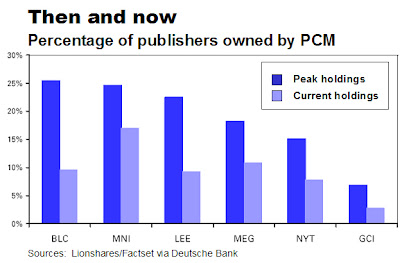
Alan D. Mutter gives us the lowdown on the damage done to newspaper as an insitution by Private Capital Management (PCM).

These folks are best known for forcing the liquidation of Knight-Ridder, and have been dumping their media holdings for quite some time (see pic).

That being said, Mr. Mutter missed the big picture, which is that most private equity functions as the equivalent of a chop shop. They part out businesses, or destroy the aspects of those businesses that made them valuable in the first place, in order to make their profit.

The current “crisis” in newspapers is less a function of declining ad revenues and readership than it is is the increasingly low quality product that is being produced to satisfy Wall St. investors.

More Extortion by the Record Distributors

The Register has some insights into the conflict between Universal’s decision to go with an “At Will” arrangement with Apple’s iTunes.

Basically, it comes down to the record distributors wanting to demand royalties on the music Players.

Microsoft already does so with it’s abysmally received Zune player.

The article is right in some areas, and wrong in others though.

On why Apple is in the Driver’s seat:

Another underlying tension is that Apple has made a huge amount of money from sales of iPods – far more than the labels have made from iTunes. As of April 2007, the iPod had sold over 100 million units worldwide. This makes iPod the best-selling digital audio player series in history.

Analyst estimates for iPhone sales in its first weekend ran as high as 700,000 units, beating many investors’ expectations, and some expect the momentum to continue. The iTunes Store has sold over 2.5 billion songs since its inception four years ago, as well as 50 million TV shows and over 1.3 million movies, making it the world’s most popular online music, TV, and movie store. But the labels only make 70c off each track. This revenue pales in comparison to the amount of money Apple generates from sales of such devices whose purpose, in full (the iPod) or in part (the iPhone) is to store and play these tracks. The money is in the hardware.

No. That $0.70 is pretty significant, particularly since Apple, and the end user are paying ALL costs of distribution. $1.75 billion is not chump change.

It is very possible that Universal intends to use the new “at will” deal to exert pressure on Apple to either replace the 99c fixed price with variable pricing or to agree to pay Universal a royalty on iPods, or both. Or as just discussed, Universal may wish to extend the royalty to any new products that play music, such as the iPhone.

True. They want to get all the golden eggs from the goose.

iPod’s success does not depend on iTunes, but rather the elegance of iPod’s design and ease of use. For these reasons, if Universal retreated from iTunes, no one can reasonably anticipate that it would seriously hurt sales of iPods or iPhones.

Generally agree, but I would also note that there is a chic factor driving iPod sales too.

The Audio Home Recording Act already imposes a royalty on digital tape recorders, but not MP3 Players or computers. But when the AHRA was passed in 1992, the personal computer was only just making its debut in the US, and the MP3 player had yet to be imagined. So while the Act compensates copyright owners and artists for lost sales because of copying, the income generated by the levy has been negligible because AHRA does not apply to the new generations of technology, including personal computers and MP3 players.

This is where the author jumps the shark. Digital tape is a failure because of the AHRA. Between the excessive fees on tapes, and the anti-copying technology that reduced playback quality on home units (notching), the AHRA destroyed the digital tape player.

So why hasn’t the Act been extended to include this new generation of technology? The principal reason is that the major labels have not pushed for it. But wouldn’t the record labels want to collect royalties from the manufacturers who are raking in money from sales of electronic equipment which is being used to acquire and listen to music without compensation to the labels?

Perhaps the main reason is the way royalties are distributed under the AHRA. The first third of royalties go to music publishers and writers. Then four per cent goes to side artists. The balance is paid 60 per cent to the labels and 40 per cent to the artists.

Maybe the record companies are afraid to push the extension of this Act to MP3 players and computers because they don’t want to set another precedent of splitting proceeds on a 60:40 basis with the artists they represent. The standard artist royalty is only 10 to 15 per cent.

Moreover, under the AHRA the artists are paid directly. By targeting a successful individual manufacturer like Apple, Universal is aiming to recoup red balances (the amount it spends on production and marketing) on each artist’s account. Most artists never recoup production and marketing costs so when the record labels collect money from their music, they “allocate” royalties to the artists’ accounts but actually keep the money.

While cheating artists is a major profit stream for the studios, the blithe assertion that the act has not been extended to MP3 players and computers is, “major labels have not pushed for it” is again, wrong.

During the debate over the AHRA, it was clear, and it is more clear now, that Congress was unwilling to to apply it to computer makers, and the basis of the law in the first place, copying, does not apply to MP3 players, which play music, but do not copy music.

As much power as the labels have, the fact that they could not get computers covered in 1992 means that they cannot get this now.

The labels do not go for this because they know that they will lose.
Kudos to IBM

Words I never thought I’d say.

IBM has relinquished a significant portion of its patent portfolio to open source projects.

Not only that, they were smart about it:

There is an exception to the grant of access to the technology: it is closed to anyone taking legal action to block further interoperability. IBM will not extend the access to anyone who is suing someone else over patents necessary for interoperability in the standards to which this technology relates.

This is one serious $%#@ you to Microsoft.

Looks Like Murdoch Gets Dow Jones

Straignt from the horse’s mouth, the Wall Street Journal is reporting that the deal is done, complete with their “engraved style” picture of Rupert.

As I’ve said before, I have mixed emotions. The WSJ has VERY good news coverage, but that gives credibility to the worst editorial page this side of the New York Sun.

Murdoch will destroy it, and in so doing, he’ll make the Editorial page as irrelevant as that of the Moonie Washington Times.

Net Radio Receives a Reprieve

This is about congress taking a good look at the US IP regime, and folks like the RIAA and Sounc Exchange not wanting that. This is whySound Exchange has compromised, and won’t collect the new rates for now.

Intellectual product (IP) is not property. It a temporary exclusive license for the public good.

There are more and more people, including the US Supreme Court, who are finding the US IP regime a hinderance, rather than a help to innovation and art in the US.

Please, Someone Lock These People Up With Leona Helmsley

It appears that Blackstone partners may avoid taxes on their IPO profits completely.

Here is the short form:

...
The paper says that of the $4.75 billion raised by the Blackstone IPO, the firm attributed $3.7 billion to good will, an accounting term that estimates the value of the intangible assets rather than tangible assets such as buildings and equipment owned by the firm.

That $3.7 billion is taxed at a 15 percent tax rate used for capital gains, meaning that the firms’ partners had to pay taxes of $553 million on their gain.

But by transferring that good will to a new corporate structure, the firm is able to deduct that $3.7 billion as a business expense at a 35 percent tax rate, reducing taxes by $1.3 billion over a 15-year period, according to the report.

The Times reports that under terms of the IPO, the Blackstone partners are entitled to 85 percent of those tax savings, or $1.1 billion. They are also able to account for those savings as a lump sum, when adjusting for the current value of those savings over the next 15 years. That brings current tax savings to $751 million, or $198 more than they had been required to pay in taxes on the $3.7 billion gain seen from the IPO.

Damn!!! It’s enough to make one a Marxist.

Truth is, I am, but Groucho, Chico, Harpo, Zeppo, and Gummo, not Karl.

Private Equity is Not Trying Blackmail Over Tax Code

It appears that the managers of private firms are threatening to stop doing deals if they don’t get to keep their tax loophole.

This is bulls%$#. A private equity firm that does not do deals is shut down. Furthermore, they make a lot of money now.

While I do not support the capital gains tax break, I don’t see why we should favor unearned income over that created by honest work, the theory is that you reward people for risking their own money. Here, their fees are for managing someone else’s money. It’s normal income period.

America Will Be the Death of the English Language

I was listening to a sales pitch for a robot.

The salesman was pitching the ease of programming the device, and the ease of porting programs between different models.

He then said that if needed, a “webinar” could be arranged to train our people for training.

Webinar???? What the hell is a Webinar????

He clear meant a teleconference with a shared desktop (Webex®), but why do people have to do this to the English language

Dell Computer is Going Down. Sooner Rather than Later

Dell is done. It is on its way down, and will never be a top tier computer manufacturer again. It will end up where Gateway is today.

First, it started selling its computers through WalMart (Google walmart vlasic), and now it has repeatedly delayed its filings.

The death spiral started when they decided to go cheap with their tech support, and people jumped to HP.

Dell delays filing fiscal reports…again
By Kelly Fiveash
Published Friday 6th July 2007 10:36 GMT

Dell will once again hold back filing its 2007 financial statements to the US Securities and Exchange Commission (SEC) because it is yet to complete an internal investigation into its accounting practices.

The direct computer giant, which earlier this week confirmed that the SEC had set a mid-July deadline for it to file its fiscal reports, has been looking into accounting errors as well as evidence of misconduct at the firm.

The SEC warned Dell that failure to file reports by 16 July could lead to a delisting on the Nasdaq exchange.

I think that a delisting is unlikely, for now, but things are going to get very bad, very fast.

Note: I do not own Dell stock directly, though they may be a tiny part of my index funds (Vanguard’s S&P 500 fund, etc.)