Category: Computer

I am Seriously Considering Changing My Name

A man has changed his last name to “Null” and as a result, has scored lots of free stuff:

A man who changed his surname to ‘Null’ claims he’s bagged numerous freebies because the word isn’t compatible with computer databases.

Raven Felix Null, 24, says he changed his name when he became an adult and claims it’s resulted in seven free nights at seven different hotels and free-of-charge car rental.

It’s all because the word ‘Null’ doesn’t register with the computer’s programming, so computer systems assume he’s not a person.

The glitch means that when receptionists enter “Null” in the surname box the system automatically recognises the word as “an absence of data”.

Which then results in the computer refusing to validate the request and Raven isn’t billed for any of the items he’s purchased.

The IT manager shared his knowledge on Reddit, where he goes by the username koalahumper, saying: “I have gotten a lot of free stuff because [a] code gives an error to the effect of “last name can’t be left blank” and the person helping me will “just put my info in later” but they never do (or can’t).”

If someone decides to challenge him about the issue, Raven threatens to sue the company for discrimination and the problem is often left until later in the day.

………

And Raven insists he didn’t change his surname to “Null” to try and gain freebies, instead he chose it so he could disassociate himself from everything.

He explained: “it means nothing, meaning I am not connected to my “family” in any way any”.

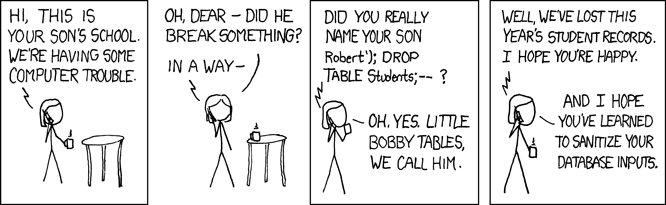
Me, I would change my name to, “Matthew’); DROP TABLE NSA;”.

Welcome to the Internet

Microsoft released an AI chatbot to Twitter. Hilarity ensues:

Microsoft has apologised for creating an artificially intelligent chatbot that quickly turned into a holocaust-denying racist.

But in doing so made it clear Tay’s views were a result of nurture, not nature. Tay confirmed what we already knew: people on the internet can be cruel.

Tay, aimed at 18-24-year-olds on social media, was targeted by a “coordinated attack by a subset of people” after being launched earlier this week.

Within 24 hours Tay had been deactivated so the team could make “adjustments”.

But on Friday, Microsoft’s head of research said the company was “deeply sorry for the unintended offensive and hurtful tweets” and has taken Tay off Twitter for the foreseeable future.

What the hell were they thinking?

What part of 4Chan don’t you get?

Another Strike Against the F-35

Rather unsurprisingly, it is the logistics and prognostics software, ALIS.

It has not been working right in tests, and even when it does, it means that there is effectively an off switch for any foreign buyer’s aircraft located in the United States.

Now we learn that they are intending to go live with the system before testing its vulnerability to hackers: (Paid subscription required)

The F-35’s Autonomic Logistics Information System (ALIS) will deploy its next major software release—2.0.2—in July, but concerns remain about performance and security. A report by the Director of Operational Test and Evaluation (DOT&E) released in January suggests delayed ALIS software may push back U.S. Air Force initial operational capability (IOC) and that the network’s cybersecurity has become a key concern.

Lockheed Martin’s ALIS program manager, Jeff Streznetcky, says a U.S. Marine Corps exercise at Twentynine Palms, California, in December and an ongoing Air Force test program at Mountain Home, Idaho, offer more representative indications of ALIS’s readiness than the report.

“By all accounts, ALIS performed exceptionally well” at Twentynine Palms, he says, “and the reports I’m getting out of Mountain Home are similar. ALIS is doing its job supporting the warfighter and ultimately turning jets.”

………

Leaked National Security Agency briefing documents confirm China obtained F-35 engine schematics and radar designs after compromising program systems in the mid-2000s. Less attention has been focused on the kind of information routinely moving through ALIS, which may represent the program’s biggest threat surface.

“The Chinese see ALIS as a fantastic opportunity to enhance and improve their own fighter-aircraft capabilities,” says Bill Hagestad, a retired Marine Corps colonel and expert on Chinese cyber competencies. “But ALIS data would also be of considerable operational and strategic value to the Chinese if they were able to take a look at the disposition and laydown of deployed combat aircraft.”

According to a 2015 report by cybersecurity vendor FireEye, it takes 205 days on average for network breaches to be detected. Even if all data are encrypted, content could be inferred through analysis of network traffic patterns. Attackers can remain undetected longer if they are leveraging previously unknown vulnerabilities.

ALIS’s security is not just dependent on Lockheed’s own software and network defenses deployed on the different national and corporate systems ALIS data transits. The system incorporates a number of off-the-shelf component programs to handle logistics management and other functions: This has cut development timescales and lowered costs, but any vulnerabilities in those products become ALIS vulnerabilities.

………

A comprehensive, ongoing cybersecurity testing regime would appear to be a necessity. Yet the DOT&E report states: “The program currently does not plan to conduct cybersecurity penetration testing during the development of this ALIS release [2.0.2], or any future developmental releases, but will instead rely on previous, albeit limited, cybersecurity test results.”

This has not gone over well with cybersecurity experts. “Suggesting that this should be deployed before it’s properly tested and then tested after it’s deployed is backward security,” says Adriel Desautels, founder of penetration-testing specialist Netragard. “I don’t have a word strong enough to describe the level of absurdity involved with that. You can’t possibly deploy something that’s this sensitive and just have blind faith that you won’t get hacked.

Of course, Lockheed-Martin and the Pentagon maintain that they will deal with any potential vulnerabilities as soon as they get a round to it.

They want to get the aircraft into the field and have a large captive market before people realize that the aircraft is an unaffordable dog.

Ship, then fix.

As any computer gamer knows, there is a a whole world of grief that comes from this arrangement.

Sick of Those Windows 10 Update Messages?

JR at the Stellarparthenon BBS came up with the following to turn it off:
Windows Registry Editor Version 5.00
[HKEY_LOCAL_MACHINESOFTWAREPoliciesMicrosoftWindowsWindowsUpdate]
"DisableOSUpgrade"=dword:00000001
[HKEY_LOCAL_MACHINESOFTWAREPoliciesMicrosoftWindowsGWX]
"DisableGWX"=dword:00000001

I haven’t tried it myself, but feel free to try this out.

You past this into a text document, and give it the .reg extension, and it will run when you double click on it.

Whip Me, Beat Me, Make Me Buy Apple Products

Seriously. If you feel a burning need to be dominated and degraded by a pro, then you clearly need to own the newest iPhone:

Thousands of iPhone 6 users claim they have been left holding almost worthless phones because Apple’s latest operating system permanently disables the handset if it detects that a repair has been carried out by a non-Apple technician.

Relatively few people outside the tech world are aware of the so-called “error 53” problem, but if it happens to you you’ll know about it. And according to one specialist journalist, it “will kill your iPhone”.

The issue appears to affect handsets where the home button, which has touch ID fingerprint recognition built-in, has been repaired by a “non-official” company or individual. It has also reportedly affected customers whose phone has been damaged but who have been able to carry on using it without the need for a repair.

But the problem only comes to light when the latest version of Apple’s iPhone software, iOS 9, is installed. Indeed, the phone may have been working perfectly for weeks or months since a repair or being damaged.

After installation a growing number of people have watched in horror as their phone, which may well have cost them £500-plus, is rendered useless. Any photos or other data held on the handset is lost – and irretrievable.

Tech experts claim Apple knows all about the problem but has done nothing to warn users that their phone will be “bricked” (ie, rendered as technologically useful as a brick) if they install the iOS upgrade.

Freelance photographer and self-confessed Apple addict Antonio Olmos says this happened to his phone a few weeks ago after he upgraded his software. Olmos had previously had his handset repaired while on an assignment for the Guardian in Macedonia. “I was in the Balkans covering the refugee crisis in September when I dropped my phone. Because I desperately needed it for work I got it fixed at a local shop, as there are no Apple stores in Macedonia. They repaired the screen and home button, and it worked perfectly.”

He says he thought no more about it, until he was sent the standard notification by Apple inviting him to install the latest software. He accepted the upgrade, but within seconds the phone was displaying “error 53” and was, in effect, dead.

When Olmos, who says he has spent thousands of pounds on Apple products over the years, took it to an Apple store in London, staff told him there was nothing they could do, and that his phone was now junk. He had to pay £270 for a replacement and is furious.

“The whole thing is extraordinary. How can a company deliberately make their own products useless with an upgrade and not warn their own customers about it? Outside of the big industrialised nations, Apple stores are few and far between, and damaged phones can only be brought back to life by small third-party repairers.

It appears that Apple’s new motto is, “There is a sucker born every minute.”

We’re Apple, We Don’t Care. We Don’t Have To.


We don’t care, we don’t have to … we’re Apple.

Apple is being sued by Apple 4S users because the pushed an upgrade that rendered their phones about as useful as a third tit:

Lawyers in New York have filed a class action lawsuit against Apple, saying that the iOS 9 operating system upgrade slowed their older iPhone 4S handsets into uselessness.

“Plaintiff and other class members were faced with a difficult decision: use a buggy, slow device that disrupts everyday life or spend hundreds of dollars to buy another smartphone,” reads the lawsuit spotted by Apple Insider.

When iOS 9 was released in September, the operating system was supposed to fix many of the faults of its predecessors. But the owners of more than 100 iPhone 4S handsets claim Apple knew the new OS would be virtually unusable on the older hardware but released it anyway to force people to upgrade.

To add insult to injury, Apple won’t allow the aggrieved users to uninstall iOS 9 and go back to simpler times. So 4S owners are left stuck with sluggish screens, hanging apps, and lousy touch use, the lawsuit claims.

Apple’s internal testing must have shown these effects while the operating system was being developed, but Cook & Co nevertheless advertised the new operating system’s benefits without warning of obsolescent hardware, the plaintiff’s lawyers argue.

………

One suspects Apple’s response will be “well what did you expect?” The iPhone 4S runs a 32-bit A5 processor and packs 512MB of DDR2 RAM, compared to the iPhone 6S’s A9 64-bit core with the M9 coprocessor and 2GB of DDR4 memory. Expecting similar performance ignores certain technical realities.

Actually, the scenario here is pretty straightforward.

Apple pushed an upgrade to inadequate hardware that could not handle it.

Either they did not do appropriate testing, or they did the testing, but decided that they could force users of old phones to upgrade.

In either case, Apple could have provided a downgrade option, or warned of the issues before the release, but they don’t give a sh%$.

Class action lawsuits are the corporate ecosystem’s way of making you give a sh%$.

Sanders Campaign Gets Data Access Back

It sounds like the DNC blinked, notwithstanding their protestations to the contrary:

The Democratic National Committee (DNC) and Sen. Bernie Sanders’ presidential campaign overnight Friday night reached an agreement on voter data access, after a day of acrimony between the sides.

Even in the wake of a deal, the DNC and Sanders’ team have differing stories on how it was settled.

In a statement shortly after midnight, the Sanders campaign said the DNC “capitulated and agreed to reinstate Sen. Bernie Sanders’ campaign’s access to a critically-important voter database.”

The statement said that the campaign’s filing of a lawsuit in the U.S. District Court in Washington brought about the change.

“We are extremely pleased that the DNC has reversed its outrageous decision to take Sen. Sanders’ data. The information we provided tonight is essentially the same information we already sent them by email on Thursday,” said Sanders’ campaign manager Jeff Weaver.

In a statement released at about the same time, DNC Chair Rep. Debbie Wasserman Schultz explained the resolution differently, saying it came after the Sanders camp “complied with the DNC’s request to provide the information that we have requested of them.”

“The Sanders campaign has agreed to fully cooperate with the continuing DNC investigation of this breach,” she added.

“The fact that data was accessed inappropriately is completely unacceptable, and the DNC expects each campaign to operate with integrity going forward with respect to the voter file.”

I don’t think that anyone with a Glasgow Coma Scale score above 3 believes DWS on this one.

Once the lawsuit was filed, and it was clear that the DNC was violating the terms of the contract, there was a 10 day waiting period required before taking action, and that the optics were rebounding to Sanders’ benefit, they had no choice.

Could someone please fire the frowzy headed albatross around the Democratic Party’s neck that is Debbie Wasserman Schultz?

The Bernie Sanders Campaign Just Sued the DNC

After repeated failures by the DNC’s politically connected vendor to properly secure candidate databases, a techie at the Sanders campaign did something wicked stupid, and the DNC cut off the campaign form their own data:

A fight between the campaign of Senator Bernie Sanders and the Democratic leadership went public on Friday as the party punished the campaign over a data breach and the Sanders camp sued the party and accused it of actively trying to help Hillary Clinton.

The dispute came after members of Mr. Sanders’ data team were found to have gotten access to, searched and stored proprietary information from Hillary Clinton’s team during a software glitch with an important voter database. The Democratic National Committee acted swiftly to deny the Sanders campaign future access to the party’s 50-state voter file, which contains information about millions of Democrats and is invaluable to campaigns on a daily basis.

Mr. Sanders’s campaign manager, Jeff Weaver, accused the party committee of stacking the scales to help Mrs. Clinton, claiming that it was being unfairly penalized for the data breach. At a news conference, Mr. Weaver insisted that the campaign had dealt with the situation by firing its national data director. Later Friday, the campaign filed a federal lawsuit seeking to have its access to the file restored.

The Democratic committee is “actively” working to “undermine” the Sanders campaign, Mr. Weaver said, reflecting its longstanding frustration that the party apparatus, which is supposed to be neutral, is lining up behind Mrs. Clinton.

………

At issue is a database of voter information, with millions of records, that the party makes available to campaigns for a fee, and is “heart and soul” of modern presidential campaigns, as the Sanders campaign put it. State parties feed the list with information including names, addresses, ethnicity if available, and voting history. Usually, public election records show which elections a person has voted in, though who they voted for is secret.

The Democratic Party then adds data from commercially available lists that track such information as television habits and magazine subscriptions. They match voter names to donor lists created by both political and nonpolitical organizations.

Each campaign then inputs data gathered by its own staff, gleaned from door knocks, phone calls, emails and other sources. With the data, they can assign each voter their own “score” signifying how likely they are to vote for a candidate. The scores advise everything from decisions about whose doors to knock on to which voters might donate.

It is this use of the massive combination of data that drives modern campaigns, mastered by the Obama operations in 2008 and 2012, which had a team of more than 50 people poring over the information to best target their fund-raising, persuasion and voter turnout efforts.

The breach occurred Wednesday when the firm that handles the list, NGP VAN, was making a tweak to its system and inadvertently dropped the firewall between the campaigns for approximately four hours, according to the court filing by the Sanders campaign. That meant that the campaigns could see each other’s information. But only the Sanders campaign gained access to data that was proprietary.

………

In its lawsuit, filed in Federal District Court in Washington, the Sanders campaign argued that the party had no right to terminate the licensing agreement that allowed the campaign access to the voter file. The campaign estimated that the loss of access would cost it $600,000 in contributions, a serious blow because it has “been financed primarily with contributions from individual donors rather than Political Action Committees.”

“However, the damage to the campaign’s political viability, as a result of being unable to communicate with constituents and voters, is far more severe, and incapable of measurement,” the suit said. Party representatives said they had not seen the suit and thus could not comment.

One show of support for Mr. Sanders’s case came from David Axelrod, a senior adviser for President Obama’s campaigns. He called the penalty “harsh,” saying on Twitter that, without evidence that the campaign hierarchy knew about data poaching, it appear that the “DNC is putting finger on scale.”

Josh Uretsky, the fired national data director from the Sanders campaign, also called the punishment “an overreaction” and insisted that he had merely been trying to verify the data breach, adding: “We did so in a way that we know would create a record that the D.N.C. and NGP VAN would have access to. We deliberately did not download or take custodianship of the records.” Mr. Utresky and Mr. Sanders’ aides did not address why multiple users from the campaign searched the Clinton data.

Mr. Uretsky acknowledged that Clinton data was being looked at, but said his intent was to see whether the Sanders campaign’s data might also be vulnerable.

Utretsky did something classically stupid, and he deserved to be fired.

This is kind of the problematic “IT Bro” bullsh%$ that plagues the computer professions.

The fact that this is all over the news, when repeated failures by this vendor, NGP VAN, over the past few months got buried and ignored does seem to indicate that the always thuggish and incompetent Debbie Wasserman-Schultz is seizing on this incident to once again to put her thumb on the scales in favor of Hillary Clinton.

After all, the stupid sh%$ that the Sanders hapless IT dweeb pulled over a short time, “Over a period of more than 40 minutes,” so the action taken appears to be excessive.

The fact the DNC aggressively leaked of the whole affair to the press, further reinforces the perception that DWS is deliberately f%$#ing the Sanders campaign.

So we have a lawsuit against the DNC to the tune of $600,000.00 a day.

Can we please fire Debbie Wasserman-Schultz now?  She is hopeless and hapless.

The official statement by the Sanders campaign comes after the break:

Statement by Jeff Weaver, Bernie Sanders 2016 Campaign Manager
December 18, 2015

Two months ago, shortly after our digital vendor who conducts modeling for our campaign told us that there was failure in the firewall that prevents campaigns from seeing one another’s data, we contacted the DNC and told them about the failure. We were concerned that our data could be compromised and we were assured at the time the firewall would be restored.

Instead, we found out two days ago that once again, this sensitive and important data was compromised because the DNC and its vendor failed to protect it.

We have invested enormous campaign resources in acquiring the rights to use this proprietary information. But the DNC, in an inappropriate overreaction, has denied us access to our own data.

Let me briefly discuss the three issues involved here.

First, this is not the first time that the vendor hired by the DNC to run the voter file program, NGP VAN, has allowed serious failures to occur. On more than one occasion, they have dropped the firewall between the data of competing Democratic campaigns. That is dangerous incompetence. It was our campaign months ago that alerted the DNC to the fact that campaign data was being made available to other campaigns. At that time our campaign did not run to the media, relying instead on assurances from the vendor that the problem would be resolved. Unfortunately, the other day, the vendor once again dropped the firewall between the campaigns for some data.

Secondly, after discussion with the DNC it became clear that some of our staffers irresponsibly accessed some of the data from another campaign. That behavior is unacceptable to the Sanders campaign and we fired the staffer immediately and made certain that any information obtained was not utilized. We are now speaking to other staffers who might have been involved and further disciplinary action may be taken. Clearly, while that information was made available to our campaign because of the incompetence of the vendor, it should not have been looked at. Period.

Thirdly, rather incredibly, the leadership of the DNC has used this incident to shut down our ability to access our own information, information which is the lifeblood of any campaign. This is the information about our supporters, our volunteers, the lists of people we intend to contact in Iowa, New Hampshire and elsewhere. This is information that we have worked hard to obtain. It is our information, not the DNCs.

In other words, by their action, the leadership of the Democratic National Committee is now actively attempting to undermine our campaign. This is unacceptable. Individual leaders of the DNC can support Hillary Clinton in any way they want, but they are not going to sabotage our campaign – one of the strongest grassroots campaigns in modern history.

We are announcing today that if the DNC continues to hold our data hostage, and continues to try to attack the heart and soul of our campaign, we will be in federal court this afternoon seeking an immediate injunction.

What is required here is a full and independent audit of the DNC’s handling of this data and its security from the beginning of this campaign to the present, including the incident in October that we alerted them to.

Shades of Razorfish

In the late 1990s, one of the darlings of the Dotcom boom was a company called Razorfish.

It all came crashing down in 2000, when its hipster founders appeared on CBS, and they were incapable of describing what their company actually did, despite thousands of employees worldwide and a market valuation in the billions.

In a very real way, it was a seminal moment in the dotcom boom became the dotcom bust, because suddenly it became clear to those ordinary people for who the whole “Internet thing” went from a dazzling mystery to a bunch of hipster snake oil.

The Dotcom bubble, like bubbles, had run out of stupider people who would buy their crap,

Well, I just came across this profile of Famo.us, and I think that it is a clear indicator that it is time to head for the exits, because if this nothing burger can get this sort of funding, the inmates are running the asylum once again:

Famo.us’ 15 minutes of open source fame have come to an end. JavaScript rendering engine Famo.us has pivoted away from its hardcore open sourced engineering platform which had raised over $31 million. It’s now refocused on commercializing the idea of powerful mobile web apps with a content management system for branded marketing apps.

The startup changed its website to famous.co, stuffed its old open source information on famous.org, and laid off a big chunk of the team, including its VP of Engineering, Head of Open Source, and a dozen engineers. But at least now Famo.us has the runway to take another shot at the spotlight.

 ………

Famo.us’ 15 minutes of open source fame have come to an end. JavaScript rendering engine Famo.us has pivoted away from its hardcore open sourced engineering platform which had raised over $31 million. It’s now refocused on commercializing the idea of powerful mobile web apps with a content management system for branded marketing apps.

The startup changed its website to famous.co, stuffed its old open source information on famous.org, and laid off a big chunk of the team, including its VP of Engineering, Head of Open Source, and a dozen engineers. But at least now Famo.us has the runway to take another shot at the spotlight.
 ………(emphasis mine)

Though it was tough to tell if Famo.us would work, investors gave it the benefit of the doubt. That was in large part thanks to Newcomb, who had sold his last startup, natural language search engine Powerset, to Microsoft for $100 million. In early 2013, Famo.us added a $4 million Series A from Javelin Venture Partners and Samsung to its $1.1 million in seed funding from Greylock, Naval Ravikant, Roger Dickey, [and, disclosure, TechCrunch founder Michael Arrington’s CrunchFund].

But Newcomb’s quest to redefine mobile with open source threatened to make Famo.us unsustainable. He told TechCrunch when announcing the funding, “That lean startup style — I don’t believe that” and that he was purposefully trying to be a perfectionist.

Newcomb knocked down the wall between his San Francisco penthouse apartment and the one next to it to create a lavish office for Famo.us. When TechCrunch reporter Anthony Ha visited, Newcomb pointed to some desks that seemed adequate, but insisted they would be replaced soon because they weren’t the right kind of wood.

He told Ha that since Famo.us was a platform for building beautiful apps “everything we do has to represent perfection and elegance.” You can take a tour of the office in TechCrunch’s Cribs video above.

 ………

By August 2014, Famo.us had grown to 25 employees and had 90,000 sign-ups for the platform, still awaiting the finished platform’s public open source release. It managed to raise another $20 million plus $5 million of debt from New York’s Insight Venture Partners. Newcomb told VentureBeat it planned to hire up to 40 more staffers with that cash, though Fetterman departed.

Finally, in June Famo.us “launched.” From a different site Famous.org, it fully open sourced its Engine that improves performance for hardware, and its Framework for integrating Famo.us into apps with blog posts by Myles Borin and Zack Brown.
 ………

I spoke to Newcomb, who confesses that for six months the company struggled to come up with a way to actually earn money. A source close to the company tells me Newcomb pushed the engineer-heavy company into “ideation mode” that made some employees feel like the startup lacked direction. They described engineers as being “fed up.”

………

There the company laid out an entirely new business: “Our mission at Famous is to empower digital marketing professionals to build beautiful branded apps that amplify every aspect of their digital marketing campaigns.” The product is a content management system for digital marketers. It allows them to create “micro-apps” that are basically mobile-optimized websites that can be easily shared and opened without being installed like a native app.

(emphasis mine)

Look at the highlighted portions.

Venture capitalists are throwing money at this, because they believe that there are bigger suckers willing to take a piece of this.

At some point, you always run out of pigeons, and Famo.us is an indicator that the supply is getting thin.

I’m not saying that it’s time to put your money in a mattress, I’m just saying that keeping it in San Jose might be ill advised.
Scott Adams Called This Confusopolies

In response to improvements in information and comparison shopping made available to the consumer through the Internet, the airlines have conspired to make their fare systems Byzantinely complex.

This may be why airlines are waging a war on travel websites. The tools available on these sites make it too difficult to f%$# the customers like a drunk sorority girl:

Once upon a time, there were reasonably well-known ways to pay less for your airfare. Airlines had rules governing ticket prices, those rules were consistent across airlines, and almost everybody knew what the rules were. (If you booked further in advance, the tickets were cheaper. If you stayed a Saturday night, the ticket would be cheaper. That kind of thing.)

Those days, however, are long gone. Airline tickets are no longer priced according to simple rules: they’re dynamically priced according to insanely complex algorithms which, to the naked eye, make no sense at all. Cheap tickets still exist, of course—the problem is that there’s no reliable way of finding them. If you managed to luck into such a ticket a few weeks or months ago, good for you—but don’t for a minute expect that if you behaved exactly the same way today, then you would get a similar result.

A recent paper by Symeon Meichanetzoglou, Sotiris Ioannidis, and Nikolaos Laoutaris sums up the current status quo: “complexity asymmetry,” they conclude, “defeated the web.” The paper is based on a massive database of 1,449,349 flight tickets involving 63 destinations and 125 different airlines—and finds that even the most common-sense rules of airline ticket pricing are regularly violated.

For instance, let’s say you want to book a round-trip flight from Brussels to Stuttgart. The researchers studied six different airlines flying that route, with 619 different fares, and found that 24.5% of the time, it was cheaper to buy two one-way tickets (one from Brussels to Stuttgart, and one from Stuttgart to Brussels) than it was to buy a round-trip. And when they looked at airlines rather than routes, they found similar outliers: one Dutch airline was cheaper more than half the time when buying singles rather than round-trip tickets. (Especially, it seems, on the Frankfurt-Zurich route.)

………

A few years ago, Delta got in trouble for showing higher prices to its frequent fliers than to everybody else; it blamed a “computer glitch.” Ever since then, conspiracy theories have abounded, especially among people who search for flights, find relatively cheap ones, and then find that the fares have suddenly increased when they decide to buy. Is it a good idea to use some kind of private browsing mode when shopping for tickets, so that the airlines can’t identify you and jack their prices accordingly?

The answer, frankly, is that although it won’t hurt if you do that, you’re going to end up outsmarted whatever you do. The airlines and flight search engines have infinitely more information than you do, and that information asymmetry is always going to work to their advantage. If you find a cheap fare, good for you; if you don’t, it’s not your fault. The system is rigged against you. The battle of consumers against the airlines is over. And the airlines have won.

There are industries that hate their customers more than the airlines ***cough*** cable companies ***cough***, but this is a veritable rogues gallery of evil that they have joined.

iPhone Users Just Love Their Walled Garden

Even if it means that Apple is censoring what news they can read:

Metadata+, a free app that catalogues fatal drone strikes by the United States, was pulled from the App Store this morning. Users were alerted via a notification that said the app was removed because of “exceptionally crude or objectionable content.”

Metadata+ was developed by The Intercept’s research editor Josh Begley. The app listed the date and location of drone strikes, as well as the victims, and sent notifications to users when a new strike occurred.

Begley struggled to get the App Store to accept his work—Mashable reports that Metadata+ was approved this February after five rejections. The sensitive topic of U.S. drone strikes seems to have been a problem for Apple: Begley was rejected last August because his app might be “objectionable” for many audiences.

………

Begley told Mashable that an Apple Review Team employee contacted him after several rejections and told him that if the app focused specifically on U.S. drone strikes, “it’s not going to be approved.”

So, it appears that not cheerleading for US drone strikes is unacceptable content for Apple, Inc.

What happens when the FBI comes and asks for a backdoor into your private communications?

At least Android is open source, so if there is a backdoor, someone can compile a version without some back door that has elements of the US state security apparatus leering looking at your private communications.

No wonder Apple is lobbying so hard for a bill in congress that grants them immunity for sharing data.

F#$@ Autocorrect

I am sending a text to She Who Must be Obeyed about getting a dorm fridge to our daughter, and future Tony Award winning actress, Natalie.

She wanted to get it here, and then schlep it up.

I thought that we could find something cheaper in the greater New York City area, so while commuting, I did a web search, and found something quite competitive less than a mile from her school.

What’s more, the have free delivery.

It seemed like a winner to me, but when I attempted to text her that there was a better alternative in Manhattan, what I actually sent said, “Found cheaper fridges in lesbianism.”

Lesbianism?!?  Seriously?!?

I am SO ready for Babel Fish enabled cell phones.

Posted via mobile.

Ashley Madison Hack Data Goes Live………

I think that a fair amount of thought went into the how it was released, which is why is why they released the data on BitTorrent:

Gigabytes worth of data taken during last month’s hack of the Ashley Madison dating website for cheaters has been published online—an act that could be highly embarrassing for the men and women who have used the service over the years.

A 10-gigabyte file containing e-mails, member profiles, credit-card transactions and other sensitive Ashley Madison information became available as a BitTorrent download in the past few hours. Ars downloaded the massive file and it appeared to contain a trove of details taken from a clandestine dating site, but so far there is nothing definitively linking it to Ashley Madison. User data included e-mail addresses, profile descriptions, addresses provided by users, weight, and height. A separate file containing credit card transaction data didn’t include full payment card numbers or billing addresses.

The way that BitTorrent works is that someone puts a file up, and as people download it, they each get a little bit of the file, and then share it amongst themselves, which means two things:

  • There is not a central server to get hammered.
  • Once the whole file is loaded into this distributed network, it takes a long time for it becomes unavailable, because multiple copies of the various bits float around the impromptu network.

In fact, the protocol was developed to help with software firms that saw their servers hammered when they made popular new releases.

After the release, of course, it was applied to songs, movies, bootleg software, etc.

See the picture below for a graphic of how this all works.

It has already outed one prominent Christofascist asshole, who I will not name, because he is on my list of They Who Must Not be Named, so I will experience my Schadenfreude privately.

Belay that Upgrade to Windows 10

No verification yet, but there has been a semi credible report that Microsoft’s new operating system is literally sending everything you do to the Redmond Borg:

Note: Some readers have commented that the original source for the article is of questionably validity. If anyone can confirm or refute the original author’s finding with actual data, please let me know in the comments, and I’ll update this post accordingly.

Some Czech guy did a traffic analysis of data produced by Windows 10, and released his findings the other day. His primary thesis was that Windows 10 acts more like a terminal than an operating system — because of the extent of the “cloud” integration, a large portion of the OS functions are almost dependent on remote (Microsoft’s) servers. The amount of collected information, even with strict privacy settings, is quite alarming.

Information transmitted

All text typed on the keyboard is stored in temporary files, and sent (once per 30 mins) to:

oca.telemetry.microsoft.com.nsatc.net
pre.footprintpredict.com
reports.wes.df.telemetry.microsoft.com

There isn’t a clear purpose for this, considering there there’s no autocorrect/prediction anywhere in the OS (There is autocorrect in certain text fields, but the supposed purpose for transmitting these keystrokes is to improve autocorrect across devices. Whether a full keylog is necessary for this (as opposed to just corrections) is questionable. Furthermore, this appears to still occur even if the user is not signed in to a Microsoft account, eliminating the “across devices” benefit. Perhaps there is a global autocorrect dictionary that benefits all users, but the privacy implications of an un-disableable always-on keylogger outweigh these potential benefits.). The implications of this are significant: because this is an OS-level keylogger, all the data you’re trying to transmit securely is now sitting on some MS server. This includes passwords and encrypted chats. This also includes the on-screen keyboard, so there is no way to authenticate to a website without MS also getting your password.

………

………In another example, typing the name of any popular movie into your local file search starts a telemetry process that indexes all media files on your computer and transmits them to:  ………

………

It’s hard to imagine any purpose for this other than the obvious piracy crackdown possibilities.

When a webcam is first enabled, ~35mb of data gets immediately transmitted to: 

………

Everything that is said into an enabled microphone is immediately transmitted to: 

………

If this weren’t bad enough, this behaviour still occurs after Cortana is fully disabled/uninstalled. It’s speculated that the purpose of this function to build up a massive voice database, then tie those voices to identities, and eventually be able to identify anyone simply by picking up their voice, whether it be a microphone in a public place or a wiretap on a payphone. 

……… 

While the inital reflex may be to block all of the above servers via HOSTS, it turns out this won’t work: Microsoft has taken the care to hardcode certain IPs, meaning that there is no DNS lookup and no HOSTS consultation. However, if the above servers are blocked via HOSTS, Windows will pretend to be crippled by continuously throwing errors, while still maintaining data collection in the background. Other than an increase in errors, HOSTS blocking did not affect the volume, frequency, or rate of data being transmitted. 

So it appears that Microsoft does key-logging under Win 10, which means that they have your password, they phone home with your media files, meaning that the RIAA and MPAA can go after you for your bootlegs, and they have created a voice profile, so that the NSA can listen to you when they recognize your voice..

Again, this is preliminary, but if half of this is true, my next computer will be a Linux box.

Way Too Much Free Time………


On Google using the Lynx text mode browser

Some guy took his early 1980s vintage TRS-80 Model 100 and set it up to surf the net:

The true test of a man’s patience is crimping pins onto the end of a cable that leads to building a custom serial cable—especially if it’s the first time you’ve even handled a serial cable in a decade. So as I searched under my desk, using my phone for a flashlight, I wondered whether I had finally found the IT project that would send me over the edge. On a recent day, I set out to turn my recently acquired vintage Radio Shack TRS-80 Model 100 computer into a working Internet terminal. And at this moment, I crawled on the floor looking for a DB-25 connector’s little gold pin that I had dropped for the sixth—or maybe sixteenth—time.

Thankfully, I underestimated my patience/techno-masochism/insanity. Only a week later, I successfully logged in to Ars’ editorial IRC channel from the Model 100. And seeing as this machine first saw the market in 1983, it took a substantial amount of help: a Raspberry Pi, a little bit of BASIC code, and a hidden file from the website of a certain Eric S. Raymond.

I respect how the author has gotten his geek on.

It means that he is doing his bit to prevent overpopulation, because with that under his arm, he is so never going to get his porcupine whacked.

This Is a New Social Networking Service That I Approve Wholeheartedly

It requires no computer, though it does require a functioning elbow. It is called pub:

A middle-aged visionary has launched an offline service called ‘pub’, which allows friends to interact in a building.

Overweight, balding 46-year-old Martin Bishop sees ‘pub’, known locally as The Woodcutter’s Arms, as a place where people can verbally communicate while drinking beer.

He said: “There’s Steak Night on Tuesdays and a ska band every third Friday. Hopefully we’re getting the toilets done next month because they’re a bit grim at the moment.”

24-year old blogger Nikki Hollis commented: “I love going to the pub because it’s so interactive and exciting. For example, my friend will say something about her life, and then I comment, and then she comments back, and then I comment, and so on.

………

However police have warned about the potential dangers of ‘pub’: “People in the pub aren’t always who they seem to be. A middle-aged man could claim to be a small girl. Stay alert, use your eyes.”

I’m wondering if they could come up with a sports themed version of this.

I think that “Sports Pub” could be a real winner.

Internet Firm Going Public, but Not in a Good Way

It appears that, Ashley Madison the dating site for people who want to cheat on their spouses, has gone public ……… prematurely, and much like their clients, prematurely is not a word that you want to hear:

Large caches of data stolen from online cheating site AshleyMadison.com have been posted online by an individual or group that claims to have completely compromised the company’s user databases, financial records and other proprietary information. The still-unfolding leak could be quite damaging to some 37 million users of the hookup service, whose slogan is “Life is short. Have an affair.”

The data released by the hacker or hackers — which self-identify as The Impact Team — includes sensitive internal data stolen from Avid Life Media (ALM), the Toronto-based firm that owns AshleyMadison as well as related hookup sites Cougar Life and Established Men.

Reached by KrebsOnSecurity late Sunday evening, ALM Chief Executive Noel Biderman confirmed the hack, and said the company was “working diligently and feverishly” to take down ALM’s intellectual property. Indeed, in the short span of 30 minutes between that brief interview and the publication of this story, several of the Impact Team’s Web links were no longer responding.

………

In a long manifesto posted alongside the stolen ALM data, The Impact Team said it decided to publish the information in response to alleged lies ALM told its customers about a service that allows members to completely erase their profile information for a $19 fee.

According to the hackers, although the “full delete” feature that Ashley Madison advertises promises “removal of site usage history and personally identifiable information from the site,” users’ purchase details — including real name and address — aren’t actually scrubbed.

“Full Delete netted ALM $1.7mm in revenue in 2014. It’s also a complete lie,” the hacking group wrote. “Users almost always pay with credit card; their purchase details are not removed as promised, and include real name and address, which is of course the most important information the users want removed.”

On NPR, a representative of ALM said that they were using DMCA take-down notices to keep the information off the web, but that makes no sense at all, because a data is not copyrightable, though there may be some trade secret protections that apply.

In either case, there was a bit of schadenfreude for me when I heard about this.

I can understand how some people might look for someone to cheat with, you see this in the personal ads of the alternative press regularly, but making a whole site for this is just really creepy.

H/T Yves Smith.

After 6 Years of Prosecutorial Excess on Behalf of the Vampire Squid, We Finally See Aleynikov’s Total Exoneration

After multiple prosecutions, by multiple prosecutors, at the behest of Goldman Sachs, Sergey Aleynikov is a free man, for a while, at least:

Kevin H. Marino pumped his fist in the air in celebration. Then Mr. Marino, a New Jersey lawyer with a linebacker’s build, turned to his longtime client, Sergey Aleynikov, and gave Mr. Aleynikov, a former Goldman Sachs programmer, a bear hug and a hearty pat on the back.

Just moments earlier, a clerk in State Supreme Court in Manhattan had given Mr. Marino a copy of the judicial ruling that overturned Mr. Aleynikov’s conviction on a charge that he stole confidential computer code for Goldman Sachs’s high-speed trading business.

The clerk, saving Mr. Marino from having to thumb through the 72 pages to learn what Justice Daniel P. Conviser had ruled, simply whispered congratulations to the lawyer. For Mr. Aleynikov, 45, and Mr. Marino, it appeared to be the end of a six-year legal odyssey through the federal and state court systems in New York.

But the celebration may not last long. State prosecutors in Manhattan have already indicated they may appeal the decision issued Monday, which threw out a jury’s verdict.

Once before, Mr. Aleynikov had believed he was in the clear, when a federal appeals court overturned his conviction under a federal corporate espionage law in 2012. The appellate court ruled that federal prosecutors in Manhattan had misapplied the law, and it ordered Mr. Aleynikov to be immediately released from a federal prison.

Less than a year later, however, Mr. Aleynikov was back in court defending himself, after state prosecutors in Manhattan charged him with violating state computer-theft-related laws.

Now Justice Conviser — much like the federal appellate court before him — ruled that the decades-old state law that Mr. Aleynikov was convicted of violating did not apply to the accusations against him.

………

But Mr. Marino was at no loss for words in criticizing Goldman.

“Goldman Sachs is powerful enough to provoke two failed criminal prosecutions to settle a private score,” Mr. Marino said. “Goldman Sachs has also spent millions in shareholder dollars to evade their obligation to pay Mr. Aleynikov’s legal fees for winning two criminal cases.”

I rather expect Vance to appeal, since the Manhattan district attorney is clearly bought and paid for by Wall Street.

At the time, I was hoping that this would turn over the rock that is the illegal front running high frequency trading conducting by the biggest brokerage firms, but the prosecutors were determined to keep that covered up, and to continue to avoid prosecutions that might bot reveal Goldman’s skullduggery, and follow up with prosecutions grounded in bizarre legal theories.

Background here.