Category: Copyright

F$#@ Kindle, This is Something that Will Revolutionize Publishing

It’s called the Espresso Book Machine, and it prints books on demand.

It literally prints the book and binds it in about 5 minutes from an order.

If you were to integrate a scanner/shredder to do book “returns”, you could eventually run a bookstore without any physical delivery, and only stock those books you sell, plus preprinting stock to put out on your shelves for the things that move faster.

Right now, it’s primarily handling out of copyright works, but the manufacturer is looking to add in copyright works.

List for the machine is about $175,000.00, but that should pay for itself fairly quickly, if just by generating sales that take 5 minutes to deliver, as opposed to 2 weeks, so the customer goes elsewhere.

The big problem, of course, is that book publishers will insist that this new technology will require an even higher profit margin on their part, just like record distributors did with CDs when they came out, even though they were cheaper than vinyl.

Unlike Amazon’s® Kindle®, they can’t turn a book into a $359.00 doorstop because you have a billing or return dispute.

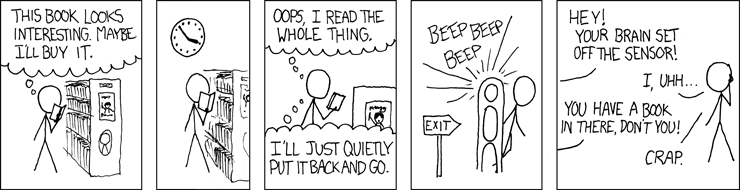
Of course, XKCD was all over this:

Or not, but it’s funny.

Pirate Bay Trial Judge Had Conflict of Interest

He belonged to 2 copyright advocacy organizations that one of the witness headed:

Norstrom is a member of The Swedish Association for Copyright, an organisation whose board includes Peter Danowsky, who represented the music and film industry in the trial, the group said on its website.

Norstrom said he did not believe his memberships had made him ineligible to preside over the trial.

Yeah, sure…..The head of the organization to which you belong is the lawyer litigating in front of you….

In any case, the defense is now asking for a new trial, and they are likely to get it.

Uruguay Round Agreements Act Held Unconstitutional

The case is Golan v. Holder (originally filed when Gonzalez was Attorney General), and challenged the provision of the URAA that restored copyright to out of copyright works, and rendered derivative works that had been made when there was no copyright illegal, and now a Federal District Court has ruled it an unconstitutional violation of the first amendment, after a remand from the appeals court (PDF of opinion at link).

This is the first time ever that, “a court has held any part of the Copyright Act violates the First Amendment and the first time any court has placed specific constitutional limits on the government’s ability to erode the public domain,” so it is very significant.

This differs from Eldred, in which the Supreme Court allowed copyright extension, in that the speech of the plaintiffs was already legally created, and so the change was an infringement on their legally created speech (derivative works of then public domain items).

It is my understanding, that this applies only to legally created derivative works, and one would assume, newly created derivatives of those derivatives, but not new derivatives of these works, but I’m an engineer, not a lawyer, dammit!*

In either case, this is a recognition that IP law is a restriction of the rights of the rest of society, and as such there needs to be a showing a serious state interest in order to override that, and this is IMHO, a major step forward.

*I LOVE IT when I get to go all Doctor McCoy!!!

Wanker of the Day: Henry Porter

Mr. Porter is complaining about Google and Youtube, because in negotiating with Performing Rights Society, the UK music licensing organization, Google, “took down the videos of the artists concerned,” when the PRS demanded £0.22, about $0.40, for each video watched.

I would be surprised if Google grosses $0.04 per video watched on Youtube, and they are demanding nearly half a dollar, so Google tells you to pound sand, and it appears that he’s also angry because Google “only” takes down infringing material promptly when notified, when required by law, as opposed to…well, it’s not clear, but he thinks it’s bad.

Tough.

This is where the idea of IP as “property” as opposed to “temporary exclusive license” gets us, and it does not encourage the useful sciences and arts, which is what it’s there for, at least in the USA.

I Guess that the AP Boycott by Blogs is Back On Again

Truth be told, I never ended mine, and have used alternate sources for stories where ever possible.

In any case, I try to post a link and a summary, and perhaps a sentence or two, which should fall under fair use.

The article, though is rather odd, as it keeps mentioning Google News and Yahoo, which runs no ads, and is a search service, which would generally be construed as fair use, and Huffington post, which licenses what it publishes from the AP.

The EU Gets a Major Case of the Stupids

The European parliament’s legal affairs committee just voted to extend copyright on music performances to 95 years. It was 50 years.

It has to go to the full parliament, but it’s likely to pass next month.

Stupid.

This won’t create any more performances, people don’t perform in the expectation of revenues on year 51, so it won’t create any more music, but what it will do is ensure that obscure works will be lost over time, because the difficulties of preserving and reproducing them will be too great.

Under the rules that they are proposing….Hell under the rules that they have now, Shakespeare’s works would have been forever lost to decay.

They would be gone, but we have to protect the f^%$ing mouse for another 45 f^%$ing years.

Friends Don’t Let Friends Link to the AP

__AP Photo__________“Hope” Poster

For a while now, I have been boycotting the Associated Press, because they established a policy to threaten legal action over copyright for people who link to them and quote a sentence or two.

With one notable exception,* I have avoided their stories, and used Google News to find an alternate when I found a story of theirs.

Well, the Associated Press moron brigade is at it again, with their suing Shepard Fairey, the artist who created the Obama “Hope” poster, because he based the poster on an AP Photo.

As you can see, it’s not a tracing, it’s based on a photo, and clearly fair use. The author took the expression, and you can find dozens of pictures with a similar expression, and little else from the photograph, and what’s more, it appears that the AP may not even have right to the photograph, as the photographer, a stringer named Mannie Garcia, never signed a contract with the AP:

2) Where you either an employee, or a freelance photographer, as defined by their contract, for the AP when you took this image?

I was a temporary hire, filling in for a staffer at the AP. It is my understanding that I was neither a freelancer nor a staffer, but rather a temporary hire. I have never been an AP staff employee, and no, I have never signed an AP contract.

3) So, you own the copyright to the image?

The ownership of the copyright is in dispute, as per the AP. It is my understanding that since I was not a staffer, and was not a freelancer, and did not sign any contract, that I am the owner of the copyright, but I am in discussions with the AP over this issue.

Needless to say, I will continue not linking to Associated Press stories, and using a Google® News search to find alternates.

*When via typo, they referred to Joe Lieberman as the 2000 Vice Presidential pRick.

More on the Latest Diabolical Plan From the RIAA

It appears that there has now been some response from the lower tier ISPs about the RIAA’s proposal attempting to dragoon them into doing their copyright enforcement work for them.

At least one relatively small ISP is saying pay to play:

Jerry Scroggin, owner-operator of Bayou Internet and Communications, wants the music and film industries to know that he’s not a cop and he doesn’t work for free.

Scroggin, who sells Internet access to between 10,000 and 12,000 customers in Louisiana, heard the news on Friday that the Recording Industry Association of America (RIAA) has opted out of suing individuals for pirating music. Instead, the group representing the four largest music labels is forging partnerships with Internet service providers and asking them to crack down on suspected file sharers.

According to Scroggin, if RIAA representatives ask the help of his ISP, they had better bring their checkbook–and leave the legal threats at home. (CNET News obtained a copy of the RIAA’s new notice to ISPs here). Scroggin said that he receives several notices each month with requests that he remove suspected file sharers from his network. Each time, he gets such a notice from an entertainment company, he sends the same reply.

“I ask for their billing address,” Scroggin said. “Usually, I never hear back.”

This makes sense.

Not only is it an expensive process, it is one that is fraught with liability issues from disgruntled customers.

If I were operating an ISP, I’d tell them to pound sand, but I’m not a businessman who has to deal with these compromises. For me, it’s a moral decision: Without a court order, I do not spy on customers.

Were I willing to make a compromise, at a minimum, my price for cooperation would be as follows:

  • The orginization would have to pay the techs at the retail billing rate.
  • The organization would agree to cover any and all legal fees incurred as a result of cooperation.
  • The organization would agree to totally indemnify my company against all claims as a result of this.

The last two are the most important, because when the RIAA goes after a grandmother for downloading the rap song I Want to F*^% You In the A@#, and they already have done so, I would not want to be left holding the bag.

Music Industry to Challenge ISP Common Carrier Status

One of the basics of law, in the US at least, is that ISPs are viewed as common carriers, which means that, much like phone companies, they are not responsible for activity that takes place on their networks.

Much like the phone company is not responsible for people who, for example, plan a bank robbery over their network, so the ISPs are not responsible if these same people were to do so using email or VOIP.

Well, the good folks at the RIAA* have come up with a way to put an end to this legal arrangement, which has served telecommunications for over 100 years now.

Basically, they have decided to abandon their strategy of suing grandmothers for multimillion dollar lawsuits based on dubious data, and instead, they are asking ISPs to take responsibility for the actions that people take through their networks, and threaten them and disconnect them, based on the same bogus data.:

Instead, the Recording Industry Association of America said it plans to try an approach that relies on the cooperation of Internet-service providers. The trade group said it has hashed out preliminary agreements with major ISPs under which it will send an email to the provider when it finds a provider’s customers making music available online for others to take.

Depending on the agreement, the ISP will either forward the note to customers, or alert customers that they appear to be uploading music illegally, and ask them to stop. If the customers continue the file-sharing, they will get one or two more emails, perhaps accompanied by slower service from the provider. Finally, the ISP may cut off their access altogether.

So, they are getting ISPs to agree to take legal responsibility for this, and exposing these same ISPs to legal jeopardy from their customers when they get this wrong.

This is, as Matthew Yglesias frequently notes, a consequence of a lack of understanding of what IP in general, and copyright in particular are actually about.

The purpose of IP is not about the creation of property, nor the guarantee of profits, its purpose is one of public interest. To quote the pertinent section of the US Constitution:

To promote the Progress of Science and useful Arts, by securing for limited Times to Authors and Inventors the exclusive Right to their respective Writings and Discoveries.

(emphasis mine)

Or, as Yglesias puts it:

But boosting album sales is not a legitimate public policy objective. Nor is boosting record company profits. Nor, even tough musicians themselves are a much more sympathetic claimant than record company shareholders, is boosting musician incomes. The purpose of intellectual property law is to protect the interests of consumers. I’ve never seen anybody attempt to argue that people aren’t forming new bands or recording new songs anymore. Nor have I seen anybody attempt to argue that it’s more difficult today to find new music to listen to than it was ten or twenty years ago. In fact, the reverse is the case. The very trends toward digitization and file-copying have made music much more widely available than it was in the past.

Of course, the folks always trot out this graph showing declining album sales, but, as the other Matthew notes, selling albums is not the business of the US government.

Additionally, this is not a graph of album sales, but a graph of album shipments, and the record companies have improved inventory system over the past decade, using software to predict sales, so they ship fewer albums to stores, and get fewer returns.

As if we did not already know that they were lying sacks of sh%$, they are attempting to use new efficiencies in distribution to create the illusion that “pirates” are “destroying their industry”.

*And by, “good folks at the RIAA,” I mean, “bunch of mindless jerks who’ll be the first against the wall when the revolution comes.”

More IP Insanity

Berlin public transportation company BVG and Netherlands Dutch Rail have banned iPhone applications that give users schedule data (see also here).

By “banned” we mean pulled off of iTunes, because they claim that the programs violate their copyright on their transit schedules:

The application – which locates users via their mobile telephone network, tells them which BVG metro stops they can find nearby and helps plan timely routes – is popular with users, but not BVG. The company contacted Witt three weeks ago, telling him the program violated their copyright and demanding he remove it from iTunes. The decision has raised user hackles on internet forums, the paper reported.

I can think of no better example of how IP laws have become insane.

The idea that transit companies would assert property rights over their schedules is completely delusional.

Sarkozy Opposes Rule of Law With Regard to IP

Apparently, it appears that Mr. Congeniality has sent a letter to the European Commission demanding that authorities be able to cut off people accused of violations of IP laws without judicial review.

It seems that a bill going through the European parliment has the following language:

No restriction may be imposed on the fundamental rights and freedoms of end-users without a prior ruling by the judicial authorities.

It also appears that Sarkozy thinks that this is too much of an imposition on the IP dependent industry.

The European commission told him to go pound sand.

Big Surprise, IP Monopolists Pull Numbers out of their Tuchus

One of the frequent refrains about the “costs” of “piracy” is, “750,000 and $200 to $250 billion”.

Well Aris Technica took a look at this number to figure out where it came from, and the answer is: Nowhere.

The Commerce department did a study recently, and said, “$60 billion,” but the authors admit that this is a guess, based from data collected from self selected respondents who are overhwelmingly tied into IP intensive business models.

All they could show on their own was $23 billion.

Of course, $23 billion ain’t chicken feed….That’s what 50 days in Iraq?

Judge Rules that Companies Must Consider Fair Use Before Issuing DMCA Takedown Notice

This is a very good thing.

In the case in question, a parent uploaded a video of their kid dancing to a song by Prince, and because there was 30 seconds of the song in the background, Universal Music issued a DMCA take down notice.

The Judge said that they can’t simply determine that it is their material, but whether it is legal or not:

“Fair use is a lawful use of a copyright,” the judge wrote. “Accordingly, in order for a copyright owner to proceed under the DMCA with ‘a good-faith belief that use of the material in the manner complained of is not authorized by the copyright owner, its agent, or the law,’ the owner must evaluate whether the material makes fair use of the copyright.”

The video of the kid is below…It’s 30 seconds long, and I can’t even recognize the song.

The judge says that, “The Court has considerable doubt that Lenz will be able to prove that Universal acted with the subjective bad faith,” but if I were on the jury I’d vote for the muthas to fry.

More Bad IP Legislation

Well, it appears that Senator Patrick Leahy has merged two draconian IP bills to create a bill that combines the worst of both.

I think that the problem is two fold:

  • The large IP driven businesses know that their business model exists only because of government support, so they spend lavishly.
  • That IP enforcement has been defined as ownership, when it is merely an exclusive license granted for the benefit of society.

So, we now have

  • Doubling of penalties
  • The authorization of federal prosecutors to use civil suits, where the burden of evidence is 50%+1
  • Confiscation of any property tangentially involved, like computers and houses.
  • The creation of an IP “Czar”, which would necessarily lead to an expansive and aggressive policy towards pursuing the law, as it is how the “Czar’s” office would justify its existence.

Bad law, bad policy, and a fundamental misunderstanding of the reasons behind copyright and patent protections.

AP Goes RIAA Route

Well, it looks like the Associated press has decided to try and go the route of the RIAA and MPAA, and create a new “property” right on their material which completely eschews the idea of fair use.

Specifically, they have gone after the Drudge Retort, asking them to take down 7 links, “ranging from 39 to 79 words”.

This places me in the unpleasant position of agreeing with Jeff Jarvis, Liebercrat extrordinaire, that they are stupid, or insane, or both.

According to Whiskey Fire, the AP now has a schedule of licensing fees which start at $12.50 for 5 words…I’m not joking here….Also, it appears to apply to blog comments too.

Interestingly enough, the terms of service are even more restrictive than that. According to Patrick Nielsen Hayden, they also want to prohibit you from criticizing the Associated Press, which means that all those folks following the hacktacular exploits of Nedra Pickler are simply out of luck, I guess.

As a result, TechCrunch, and some other bloggers, including me, will boycott AP stories for the foreseeable future.

Boycott link here.

House Passes Draconian IP Legislation

HR 4279 is a very bad piece of legislation. Among other things, it:

  • Creates an IP “Czar” in the Department of Justice, who would be institutionally driven to make criminal matters out of what is has been a civil offense.
  • Apply civil asset forfeiture, so you could lose your house if law enforcement agencies convince a judge that you might be infringing.
  • Expanded criminal penalties.

Luckily, it’s unlikely to make it through the Senate in an election year, but this legislation is evil.

What too many people do not understand, including over 400 members of Congress, it passed 410 to 10, is that Patent and Copyright Law is at its Core Public Interest Law. It is not a property right, but rather a societal contract in which we all give up our rights in order to encourage artistic and scientific development through the granting of a temporary exclusive license.

Really, Really, Really, Really Bad Ideas, The Juxtaposition of Border Security and Copyright Edition

The newest leaked draft of the Anti-Counterfeiting Trade Agreement (ACTA) is proposing that border security will have the ability to inspect digital devices, determine whether they contain “infringing material”, and then confiscate them.

So if you have MP3’s on your iPod leally ripped from you CD, they get to confiscate it without any due processas, “The draft allows for the confiscation or destruction of any device the agents deem suspect.”

The draft is available at WikiLeaks.