Category: Corruption

It’s On Girl!

So, now both the ACLU and the Department of Justice are suing Florida over Governor Rick Scott’s voter purge, and Florida is suing DHS for access to their immigration database:

The American Civil Liberties Union sued Florida on Friday to stop its controversial program designed to purge noncitizen voters from the rolls.

The ACLU says the program, which overwhelmingly targets minorities, needs approval from the federal government under the 1965 Voting Rights Act — a claim already made last week by the U.S. Department of Justice when it ordered Florida to cease the purge.

Florida Secretary of State Ken Detzner, who is named as a defendant, has said Florida already received permission years ago to clean the voter rolls of noncitizens.

But the ACLU argues that the specific processes for the noncitizen-voter program — a new effort by the state — never received federal approval.

What’s more, the program is too much of a burden on, and too much of a threat to, lawful voters, who could risk being removed from the rolls due to government error, the ACLU says.

“The state of Florida is violating federal law by subjecting citizens to this new and unnecessary requirement in order to exercise their right to vote,” Julie Ebenstein, an ACLU Florida staff attorney, said in a written statement. “We are asking the court to protect the right to vote and stop this unlawful, targeted voting purge.”

Detzner’s office couldn’t immediately respond to all aspects of the suit, which was filed late Friday afternoon. But it insisted the program is fair and needed.

The program is needed of course, because, after all, it would chaos if they let sp**s and n*****s vote.

Here’s a paraphrase of Jeff Foxworthy, “If you think that people who will likely vote against you should be prevent from voting, you might not be a real American.”

It would be nice if someone went to jail over this crap.
Troof

Writer Jamie Malanowski gets to the heart of the matter when he says that if Obama loses, his refusal to prosecute the criminals at the big banks will be a major cause of this:

This much is clear: if President Obama loses this election, the failure to hold financial titans legally, financially and morally responsible for this financial meltdown will be the factor that will have cost him re-election.

I would argue that this was is also much of the reason for the 2010 debacle.

Malanowski talks about bravery, and how Obama has the courage to take down bin Laden, but not the courage to face the banksters.

I don’t think that this is a a matter of courage, but a matter of tribalism.

I am not making a Kenyan Muslim reference here, but rather an Ivy League reference.

I think that Barack Obama (Columbia and then Harvard Law) is simply unwilling to confront the old boy network which he joined when he went to college.

Saroff’s Rule Again

Click for full size


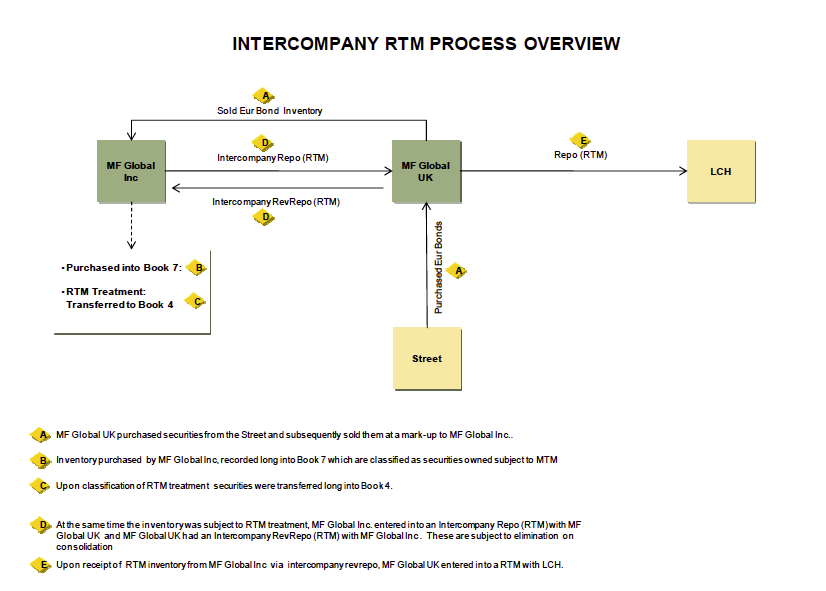
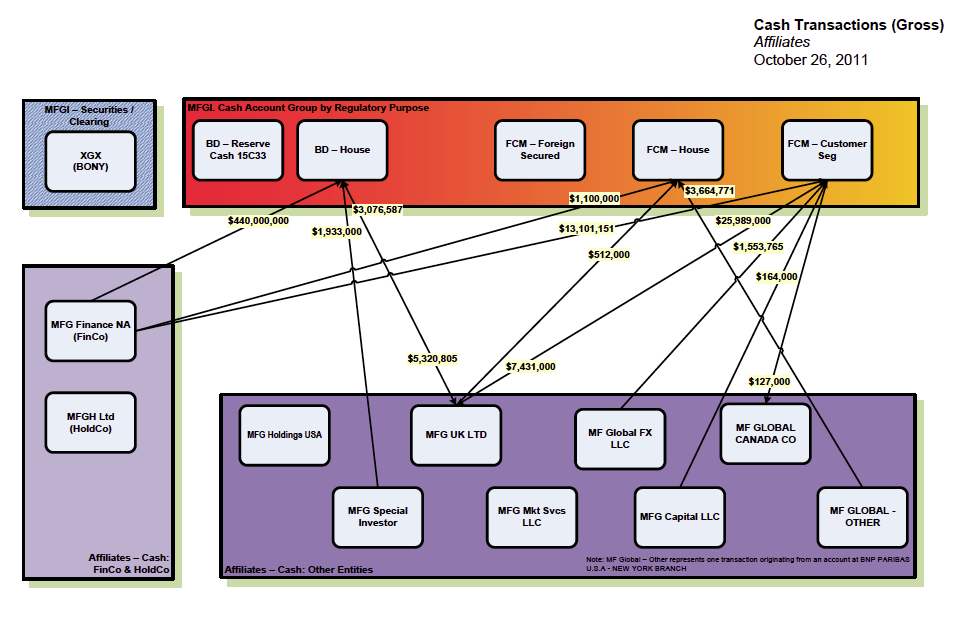
How they shuffled around funds to create the appearance of liquidity


And this is how they covered up their exposure

Yves Smith is all over the report by the bankruptcy trustee for MF Global.

I suggest that you read it, so I will show you to two graphics from the report, and remind you of “Saroff’s Rule”, “If a financial transaction is complex enough to require that a news organization use a cartoon to explain it, its purpose is to deceive.”

It appears that this applies to bankruptcy trustees as well as news orgs.

Go read, and wonder why John Corzine isn’t being frog marched out of his mansion in hand cuffs.

This Smells Like Karl Rove Punking Dan Rather

We have a story that Wisconsin Governor Scott Walker fathered a child out of wedlock, and was rather a cad about it, by noted brain injury specialist Dr. Bernadette Gillick, who said that it was her roommate.

There has since been a denial from the woman in question. (Actually, within hours of the publication of the story)

It smells to me a lot like the punking that Rove gave Dan Rather over George W. Bush’s Texas National Guard service (or lack thereof).

In the case of W, the stories were probably true, and the false story was likely floated in order to defuse the issue.

In the case of Scott Walker, I’m not sure if there is an actually baby that he abandoned, or this is an attempt to distract attention from the John Doe investigation which has already snared his closest political advisers, but it smells like a ‘Phant false flag operation.

In related news, the DoJ will be sending observers to monitor the elections.

I hope they bring cuffs to Waukesha county, because with county clerk Kathy Nickolaus running elections there, despite having been forced to delegate her duties to her deputy, I expect it to be an orgy of irregularities there.

In Other News, the Sky is Blue

Gee, after a long history of blatantly political censorship in its reviews, the CIA is finally investigating its publications review board:

The CIA has begun an internal investigation into whether a process designed to screen books by former employees and protect national security secrets is being used in part to censor agency critics, U.S. officials said.

The investigation coincides with the publication of a flurry of books from CIA veterans, and it is largely aimed at determining whether some redactions have been politically motivated.

Among the publications expected to get particular scrutiny is a memoir by the former head of the CIA’s clandestine service, Jose A. Rodriguez Jr., who used his book, “Hard Measures: How Aggressive CIA Actions After 9/11 Saved American Lives,” to mount a vigorous defense of interrogation methods that were widely condemned but that he asserts provided critical intelligence about al-Qaeda.

The target of the probe is the agency’s Publications Review Board. The PRB evaluates hundreds of submissions each year and is supposed to focus exclusively on whether publication of material would threaten national security interests.

The CIA declined to comment on the internal investigation or to answer questions about the composition and practices of the PRB.

U.S. officials familiar with the inquiry, who spoke on condition of anonymity, said that it reflects growing concern in the intelligence community that the review process is biased toward agency loyalists, particularly those from the executive ranks.

Gee, you think?

This process has been corrupt and self serving for at least a decade.

Why Newspapers are Dying

Because their owners are draining them dry. First, it was the Bancroft family and the Wall Street Journal, and now it’s the Ochs-Sulzberger family the management and the New York Times:

About $11 million of [former NY Times CEO] Robinson’s exit package was from her pension and retirement plan. Another roughly $7 million consisted of her yearly compensation and awards, and stock options she was entitled to after her years at the Times. But she also received a $4.5 million consulting contract, a kind of gratuitous bonus that didn’t look or smell right to anyone who was toiling on Eighth Avenue and worrying over pensions in danger of being frozen in ongoing labor negotiations. That payout has since become the centerpiece of rancorous disputes between the Newspaper Guild of New York, the newsroom’s union, and management. The intense discussions are still in progress as of this writing, hung up on a suggestion made by the Guild to redesign the Times’ pension system.

In the era of Arthur Sulzberger Jr., when newspapers have flailed under new digital realities, the New York Times Company has shrunk dramatically. Once it was a wide-ranging media empire of newspapers and TV stations and websites, and even a baseball team, that was worth almost $7 billion; today it’s essentially two struggling newspapers and a much-­reduced web company, all worth less than $1 billion (for comparison, consider that the Internet music company Pandora is valued at almost $2 billion). Despite the shrinkage, the company has retained essentially the same top-heavy management, which it has kept well compensated. Even though the paper froze executives’ pensions in 2009, as it is threatening to do with union employees, the company created two loopholes, called the Restoration Plan and the Supplemental Executive Savings Plan, which allowed certain high-earning executives to take money out anyway. As a result, Janet Robinson received an additional lump-sum payment of over half a million dollars upon exiting the Times.

And the family wants to re-institute their $20+ million dividends.

Newspapers have a problem, and it’s largely Craigslist eating their lunch on classified ads.

Cutting reporting staff to make a crappier product won’t fix this in the long term, though it might get those damn dividends flowing for the nest few years.

Spain weighs Bankia debt issue – FT.com

Spain has nationalized the failing bank Bankia and it proposed recapitalizing it with Spanish government debt:

Spain is considering directly injecting its own government debt into BFA-Bankia to help fund the stricken lender’s €19bn nationalisation, in an attempt to sidestep borrowing money directly from the bond markets.

The plan, viewed as highly unorthodox by analysts, involves Madrid issuing Spanish government guaranteed debt to Bankia in return for equity, with the bank then able to deposit the bonds with European Central Bank as collateral for cash.

On Friday Bankia, Spain’s third-biggest lender by assets, announced that the state would invest €19bn in what will be the country’s largest ever bailout, with the government expected to control about 90 per cent of its shares.

This would have the effect of the ECB purchasing Spanish debt, which the ECB (the German Bundesbank) is opposed to.

It would be a win win for everyone, but since there is no pain for the ordinary Spaniard involved, the European Central Bank has rejected the deal:

A Spanish plan to recapitalise Bankia, the troubled lender, by indirectly tapping the European Central Bank for cash, was bluntly rejected as unacceptable by the ECB, European officials said.

News of the rejection came as Spain faces elevated borrowing costs in the bond markets, tries to persuade investors it can contain problems in a banking sector weighed down by €180bn of bad property loans and, on Tuesday, saw its central bank governor stand down early.

Madrid had floated the unorthodox idea over the weekend of recapitalising Bankia by injecting €19bn of sovereign bonds into its parent company, which could then be swapped for cash at the ECB’s three-month refinancing window, avoiding the need to raise the money on bond markets.

The ECB told Madrid that a proper capital injection was needed for Bankia and its plans were in danger of breaching an EU ban on “monetary financing,” or central bank funding of governments, according to two European officials.

At this point, the best action for the Spanish government is to allow the bank to default on its bonds (not its deposits), where I am certain that German bank exposure is high.

The Spanish should not make the same mistake as the Irish.  Do not make the bondholders whole.

If you do, you are simply taxing your citizens to fund foreign investors bets.

There is no obligation, either legally or morally, to do so.

H/t Eschaton

You Have It Backwards

Howie Klein wonders, “Do ALL The Members Of The House Financial Services Committee Take Bribes From The Banksters?

He has it backwards. The HFCS is a bloated and overstaffed committee, with two or three times the members that it actually needs, and it does this, because it’s known as a “money” committee.

Basically, people are put on it so that they can fund raise from the banksters.

It’s less of a bribe than it is a shakedown.

The purpose of the committee at its current size is to facilitate taking legalized bribes from the financial services industry.

Pass the Popcorn…


Pass the Popcorn

It looks like former TARP Inspector General Neil Barofsky is writing a tell-all memoir about his experiences with the Bush and Obama administration:

From December 2008 until March 2011, Barofsky was the Special Inspector General charged with oversight of TARP, working to ensure against fraud and abuse in the spending of the $700 billion allocated for the bailouts. From the start he was in constant conflict with the officials at the Treasury Department in charge of the bailouts who were in thrall to the interests of the big banks and steadfastly failed to hold them accountable, even as they disregarded major job losses caused by the auto bailouts and failed to help struggling homeowners. Barofsky recounts how his reports of a wave of criminal mortgage fraud and other abuses being perpetrated against homeowners in connection with programs that the Treasury itself set up were ignored time and again.

Barofsky offers detailed accounts of the behind-the-scenes conflicts and his struggles with Treasury Secretary Timothy Geithner, the Bush appointed “TARP Czar” Neel Kashkari and his successor, the Obama appointed Herb Allison, and others. His revelations show in stark detail just how captured by Wall Street our political system is; why the banks have not been held accountable; and how the failure to enact effective regulation has put the country in danger of an even bigger crisis in the future.

I can’t imagine that either Obama or Geithner are happy about this.

Your Moment of Schadenfreude

The Heartland Institute, the phony “think tank” bought and paid for by the fossil fuel industry, is imploding as a result of revelations proving this:

The first Heartland Institute conference on climate change in 2008 had all the trappings of a major scientific conclave – minus large numbers of real scientists. Hundreds of climate change contrarians, with a few academics among them, descended into the banquet rooms of a lavish Times Square hotel for what was purported to be a reasoned debate about climate change.

But as the latest Heartland climate conference opens in a Chicago hotel on Monday, the thinktank’s claims to reasoned debate lie in shreds and its financial future remains uncertain.

Heartland’s claims to “stay above the fray” of the climate wars was exploded by a billboard campaign earlier this month comparing climate change believers to the Unabomer Ted Kaczynski, and a document sting last February that revealed a plan to spread doubt among kindergarteners on the existence of climate change.

Along with the damage to its reputation, Heartland’s financial future is also threatened by an exodus of corporate donors as well as key members of staff.

In a fiery blogpost on the Heartland website, the organisation’s president Joseph Bast admitted Heartland’s defectors were “abandoning us in this moment of need”.

They flipped out, and this was inevitable once they were outed as bought and paid for:

The pressure point occurred last February when the scientist on the conference mugs, Peter Gleick, used deception to obtain confidential documents from Heartland, including a donors list and plans to indoctrinate school children against belief in climate change.

Once the Charade was outed, they had no choice but to go full wingnut.

Two …… Three … Seven Billion

It looks like their losses for JP Morgan’s bad day at the casino might increasing.

In any case, it’s bad enough that they are dropping a stock buyback,:

The crisis at JP Morgan escalated yesterday as it emerged its trading losses in London could rise to as much as $7bn (£4.5bn) and the US bank cancelled a share buyback. Fears were growing that the losses could spiral from an initial $2bn, which was declared on 10 May, as JP Morgan struggles to unwind the massive bets made by the so-called “London Whale” trader Bruno Iksil.

In a further blow, chairman and chief executive Jamie Dimon has suspended plans to use the US bank’s own funds to buy back $15bn worth of shares. Buybacks are a popular way for firms to use up cash sitting on the balance sheet and prop up the share price.

I’m inclined to believe that the losses are going to get a lot worse.

Stock buybacks are all about management making sure that shareholders won’t feel inclined to try to fire them.

They are bailing out the boat, and they decided that they needed to toss out the life-jackets to lighten the load.

Not good.

Good.

About a week and a half ago, I blogged about how the black hat orthodox community in Brooklyn has been engaging in a systematic program of intimidation and harassment against people who report allegations of the child abuse to the police.

I called them despicable and evil, and I said that I hoped that the Brooklyn DA would go after these instances of intimidation.

Well, my wish has been granted, Brooklyn DA Charles Hynes is opening up a criminal investigation into these allegations:

The Brooklyn district attorney, Charles J. Hynes, is setting up a panel of prosecutors and investigators to crack down on witness intimidation in child sexual abuse cases in the borough’s ultra-Orthodox Jewish community.

Speaking on NY1 on Thursday night, Mr. Hynes said he was asking the panel to “come up with some alternatives to break down this wall of intimidation.”

He criticized elements in the ultra-Orthodox Jewish community over their treatment of sexual abuse victims.

“The level of intimidation is not found nearly as much in organized crime,” he said. “It’s extraordinary just how relentless these people can be.”

“There is no concern for the victim in parts of these communities,” he added. “Everything is for the abuser, and that’s the horrible thing that we have to deal with.”

It was a shift in tone for Mr. Hynes, who in the past has praised ultra-Orthodox Jewish leaders for helping to fight crime in their neighborhoods.

Hopefully, this is real, and not a task force for appearances sake only.

Nothing will change though, until we start seeing the senior rabbis behind this behavior, those with big names and many disciples, are brought up on formal charges.

Trust Timothy “Eddie Haskell” Geithner to Do the Right Think…

When there is absolutely no alternative to doing the right thing.

It looks like little Timmy is Treasury Secretary speak to tell Jamie Dimon to get the f%$# off the board of the New York Bank of the Federal Reserve following his little $2 billion (actually $3 billion) screw-up at JP Morgan Chase:

In an interview Thursday on PBS NewsHour, Jeffrey Brown and Treasury Secretary Tim Geithner had the following exchange:

“JEFFREY BROWN: Do you think Jamie Dimon should be off the board [of the New York Federal Reserve Board]?

TIMOTHY GEITHNER: Well, that’s a question he’ll have to make and the Fed will have to make. But again, on the basic point, which is it is very important, particularly given the damage caused by the crisis, that our system of oversight and safeguards and the enforcement authorities have not just the resources they need, but they are perceived to be above any political influence and have the independence and the ability to make sure these reforms are tough and effective so we protect the American people, again, from a crisis like this. And we’re going to, we’re going to do that.”

In the diplomatic language of Treasury communications, Mr. Geithner just told Jamie Dimon to resign from the New York Fed board (here is the current board composition).  It looks bad – and it is bad – to have him on the board of this key part of the Federal Reserve System at a time when his bank is under investigation with regard to its large trading losses and the apparent failure of its risk management system.  (Update: Mr. Dimon is on the Management and Budget Committee of the NY Fed board; here is the committee’s charter, which includes reviewing and endorsing “the framework for compensation of the Bank’s senior executives (Senior Vice President and above)”.)

Simon Johnson thinks that Dimon will ignore him, and I agree.

Geithner is the banksters bitch, and is not sincere in his request.  He just wants the appearance of getting tough on malfeasance in the financial sector, not the reality.

Another Shoe Drops for JP Morgan

That $2 billion that they lost in obscure casino games? Well now it’s at least 3 billion:

The trading losses suffered by JPMorgan Chase have surged in recent days, surpassing the bank’s initial $2 billion estimate by at least $1 billion, according to people with knowledge of the losses.

When Jamie Dimon, JPMorgan’s chief executive, announced the losses last Thursday, he indicated they could double within the next few quarters. But that process has been compressed into four trading days as hedge funds and other investors take advantage of JPMorgan’s distress, fueling faster deterioration in the underlying credit market positions held by the bank.

A spokeswoman for the bank declined to comment, although Mr. Dimon has said the total paper trading losses will be volatile depending on day-to-day market fluctuations.

We’re going to end up bailing out these ratf%$#s in the next few years, mark my words.

It will either be directly, or indirectly through their counter-parties.

So Not Shocking

Matt Taibbi is looking at documents from the Overstock.com case against the banksters, and discovers some remarkably informative unintentional release of information:

The lawyers for Goldman and Bank of America/Merrill Lynch have been involved in a legal battle for some time – primarily with the retail giant Overstock.com, but also with Rolling Stone, the Economist, Bloomberg, and the New York Times. The banks have been fighting us to keep sealed certain documents that surfaced in the discovery process of an ultimately unsuccessful lawsuit filed by Overstock against the banks.

Last week, in response to an Overstock.com motion to unseal certain documents, the banks’ lawyers, apparently accidentally, filed an unredacted version of Overstock’s motion as an exhibit in their declaration of opposition to that motion. In doing so, they inadvertently entered into the public record a sort of greatest-hits selection of the very material they’ve been fighting for years to keep sealed.+

………

The lawsuit between Overstock and the banks concerned a phenomenon called naked short-selling, a kind of high-finance counterfeiting that, especially prior to the introduction of new regulations in 2008, short-sellers could use to artificially depress the value of the stocks they’ve bet against. The subject of naked short-selling is a) highly technical, and b) very controversial on Wall Street, with many pundits in the financial press for years treating the phenomenon as the stuff of myths and conspiracy theories.

Now, however, through the magic of this unredacted document, the public will be able to see for itself what the banks’ attitudes are not just toward the “mythical” practice of naked short selling (hint: they volubly confess to the activity, in writing), but toward regulations and laws in general.

“F%$# the compliance area – procedures, schmecedures,” chirps Peter Melz, former president of Merrill Lynch Professional Clearing Corp. (a.k.a. Merrill Pro), when a subordinate worries about the company failing to comply with the rules governing short sales.

We also find out here how Wall Street professionals manipulated public opinion by buying off and/or intimidating experts in their respective fields. In one email made public in this document, a lobbyist for SIFMA, the Securities Industry and Financial Markets Association, tells a Goldman executive how to engage an expert who otherwise would go work for “our more powerful enemies,” i.e. would work with Overstock on the company’s lawsuit.

(%$# mine)

Here’s the nickel version.

Short selling works as follows:

  • Locate the requisite shares of stocks.
  • Borrow them (and pay a fee).
  • Sell the borrowed shares.
  • Wait.
  • Buy shares, and return to borrower.

If the share price falls in the interim, you make money.

If it rises, you lose money.

Fairly simple and straightforward, and legal.

What isn’t legal is naked shorting, where you sell the shares, but have never borrowed them.

At one point, because of naked shorts, 107% of all outstanding shares were for sale, with the obvious effect of depressing the stock price (supply and demand), which pretty much guarantees a profit by short sellers, and you do not have to pay fees to borrow the stock.

It’s a win-win for everyone, except of course, the poor dupes who think that they won’t get ripped off by the banksters when they try to invest.

Why Yes, Antonin Scalia has Gone Nuts

It appears that there is a growing consensus on this matter:

In January, Supreme Court Justice Antonin Scalia accused the U.S. Environmental Protection Agency of “high-handedness.” He was just getting warmed up.

Over the next 3 1/2 months, Scalia asked whether federal immigration policy was designed to “please Mexico,” fired off 12 questions and comments in 15 minutes at a government lawyer in a case involving overtime pay, and dismissed part of Solicitor General Donald Verrilli’s defense of President Barack Obama’s health-care law as “extraordinary.”

Scalia’s tone this year, particularly in cases involving the Obama administration, is raising new criticism over the temperament of a justice who has always relished the give-and- take of the Supreme Court’s public sessions. Some lawyers say Scalia, a 1986 appointee of Republican President Ronald Reagan, is crossing the line that separates tough scrutiny from advocacy.

“His questions have been increasingly confrontational,” said Charles Fried, a Harvard Law School professor who served as Reagan’s top Supreme Court advocate. While the justice has always asked “pointed” questions, in the health-care case “he came across much more like an advocate.”

Scalia’s approach is fueling the perception that the biggest cases this term, including health care, may be influenced by politics, rather than the legal principles that he and other justices say should be their guide. A Bloomberg News poll in March showed that 75 percent of Americans think the court’s decision on the 2010 law will be based more on politics than on constitutional merit.

Scalia has always been a partisan political hack, but lately, he’s not even trying to pretend that he has an open mind.

JP Morgan Chase Goes Wile E. Coyote

So, JP Morgan Chase just lost at least $2 billion in ill conceived derivatives trades:

JPMorgan Chase & Co. (JPM) Chief Executive Officer Jamie Dimon said the firm suffered a $2 billion trading loss after an “egregious” failure in a unit managing risks, jeopardizing Wall Street banks’ efforts to loosen a federal ban on bets with their own money.

The firm’s chief investment office, run by Ina Drew, 55, took flawed positions on synthetic credit securities that remain volatile and may cost an additional $1 billion this quarter or next, Dimon told analysts yesterday. Losses mounted as JPMorgan tried to mitigate transactions designed to hedge credit exposure.

“There were many errors, sloppiness and bad judgment,” Dimon said as the company’s stock fell in extended trading. “These were egregious mistakes, they were self-inflicted.”

The chief investment office was thrust into the debate over U.S. efforts to ban proprietary trading when Bloomberg News reported last month that the unit had taken bets so big that JPMorgan, the largest and most profitable U.S. bank, probably couldn’t unwind them without losing money or roiling financial markets. Dimon, 56, had transformed the unit in recent years to make bigger and riskier speculative trades with the bank’s money, five former employees said.

Just so you know, the “Synthetic credit securities” mentioned means that this is basically pure gambling.  There is no ownership or insurance interest in the underlying investment.

It’s not surprising that the SEC has decided to look at this.

As a result of this blowup, Fitch’s and S&P have downgraded the bank.

Henry Blodgett accurately obaserves that, “It’s Just Kids Playing With Dynamite“.

Rather unsurprisingly, advocates of more regulation of the financial industry, are calling for an aggressive implimentation of the Volker rule.

Of course, Jamie Dimon does not think that this shows a need for more regulations, because, “Just because we’re stupid doesn’t mean everybody else was.”

No, actually,  you’re all stupid f%$3s, and you blew up our economy 4 years ago, and the taxpayer dumped more money into you keeping you afloat than we spent on the WW II.

Why no senior banksters have been indicted is beyond me.

A Good Essay on Putin

Stephen Cohen makes some very good points, like the fact that Russia has become less corrupt, journalists and dissidents are less likely to be murdered, his elections are fairer, etc.

Of course, better and more democratic than Yeltsin is not a tough act to follow.

Yeltsin and his cronies looted the country, splitting the proceeds with western banksters, murdered journalists as a fairly brisk clip, impoverished the nation, literally prostituting many of its citizens, and shelled the parliament when they did not do his bidding.

What he misses though is why the west hates Putin so much. It all comes down to the, “Splitting the proceeds with the western banksters,” bit.

One of the rules of the modern neocolonial finance regime is that finance’s masters of the world get to steal other people’s stuff, and those people never get it back.