A 2% annual rate in the 3rd quarter.
Better than a kick in the teeth, but not reat.
A 2% annual rate in the 3rd quarter.
Better than a kick in the teeth, but not reat.
Initial claims down to 369,000, a slight blip up in the 4 week moving average, and continuing claims fell.
I rate it between “meh” and marginally positive.
<object width=”500″ height=”281″><param name=”movie” value=”http://www.youtube.com/v/I5QwKEwo4Bc?version=3&hl=en_US”></param><param name=”allowFullScreen” value=”true”></param><param name=”allowscriptaccess” value=”always”></param><embed src=”http://www.youtube.com/v/I5QwKEwo4Bc?version=3&hl=en_US” type=”application/x-shockwave-flash” width=”500″ height=”281″ allowscriptaccess=”always” allowfullscreen=”true”></embed></object>
Clarke and Dawe, like Stewart and Colbert, show that the only truth tellers out there are the comedians.
 Much like the USSR life expectancies are falling at the end of empire:
For generations of Americans, it was a given that children would live longer than their parents. But there is now mounting evidence that this enduring trend has reversed itself for the country’s least-educated whites, an increasingly troubled group whose life expectancy has fallen by four years since 1990.
Researchers have long documented that the most educated Americans were making the biggest gains in life expectancy, but now they say mortality data show that life spans for some of the least educated Americans are actually contracting. Four studies in recent years identified modest declines, but a new one that looks separately at Americans lacking a high school diploma found disturbingly sharp drops in life expectancy for whites in this group. Experts not involved in the new research said its findings were persuasive.
The reasons for the decline remain unclear, but researchers offered possible explanations, including a spike in prescription drug overdoses among young whites, higher rates of smoking among less educated white women, rising obesity, and a steady increase in the number of the least educated Americans who lack health insurance.
The steepest declines were for white women without a high school diploma, who lost five years of life between 1990 and 2008, said S. Jay Olshansky, a public health professor at the University of Illinois at Chicago and the lead investigator on the study, published last month in Health Affairs. By 2008, life expectancy for black women without a high school diploma had surpassed that of white women of the same education level, the study found.
White men lacking a high school diploma lost three years of life. Life expectancy for both blacks and Hispanics of the same education level rose, the data showed. But blacks over all do not live as long as whites, while Hispanics live longer than both whites and blacks.
“We’re used to looking at groups and complaining that their mortality rates haven’t improved fast enough, but to actually go backward is deeply troubling,” said John G. Haaga, head of the Population and Social Processes Branch of the National Institute on Aging, who was not involved in the new study.
In the last two decades of its existence, life expectancies fell in the USSR, because it was carving the heart out of its economy with a bloated and over-sized military.
Luckily, we’re nothing like that.
Just how many primary care physicians would one carrier battle group buy?
But let’s start with the fact that initial jobless claims jumped to 380,000, though tropical storm Isaac may have contributed to those numbers.
The bigger news is that the Federal Reserve has officially begun the 3rd round of quantitative easing (QE3):
The Federal Reserve opened a new chapter Thursday in its efforts to stimulate the economy, saying that it intends to buy large quantities of mortgage bonds, and potentially other assets, until the job market improves substantially.
This is the first time that the Fed has tied the duration of an aid program to its economic objectives. And, in announcing the change, the central bank made clear that its primary reason was not a deterioration in its economic outlook, but a determination to respond more forcefully — in effect, an acknowledgment that its incremental approach until now had been flawed.
The concern about unemployment also reflects a significant shift in the priorities of the nation’s central bank, which has long focused on inflation. Inflation is now running below the Fed’s 2 percent annual target. But with the unemployment rate above 8 percent, the Fed’s policy-making committee suggested Thursday that it might tolerate a period of somewhat higher inflation, promising to maintain stimulus efforts “for a considerable time after the economic recovery strengthens.”
“The weak job market should concern every American,” the Fed’s chairman, Ben S. Bernanke, said at a news conference. The goal of the new policies, he added, “is to quicken the recovery, to help the economy begin to grow quickly enough to generate new jobs.”
The need for new stimulus reflects the disappointing condition of the American economy, which continues to struggle between crisis and prosperity three years after the official end of the recession. More than 20 million Americans cannot find full-time jobs. Median household income has declined. The housing market remains depressed.
You know, you guys should have been running around with your hair on fire a few years ago.
Of course, with interest rates at the zero bound, the people who are supposed to do this is the Congress, because fiscal stimulus works better under these situation, but between the gutlessness of the Democrats, and the active sabotage of the economy by the Republicans, it’s not like there is going to be any help from that end.
And initial jobless claims are worse than expected.
Additionally, it looks like China’s economy is approaching stall speed:
A key private sector indicator on Thursday, which showed Chinese factory activity slumped to a nine-month low in August against expectations of a modest pickup, throws up the question whether the worst is yet to come for the world’s second largest economy.
The second quarter, during which growth slowed to 7.6 percent, was regarded by many economists as the bottom for Chinese economic growth. However, experts say this view may have been overly optimistic.
It should be noted that while 7.6% seems to be a blisteringly hot growth rate, China has been running double digit numbers routinely for some time. (With the obvious caveat that Chinese numbers are crappy, but the delta probably remains significant.
It’s a 3 month high, but it’s still a crappy 72.4.
Meh.
Initial claims ticked up slightly, slightly worse than expected.
We are in a holding pattern until war breaks out in Europe the Euro Zone collapses.
The Euro Zone is back in recession:
The economy in the euro zone officially shifted to contraction from stagnation in the second quarter of 2012, data showed on Tuesday, portending a recession for the region later in the year that would put even more pressure on political leaders struggling to keep the common currency intact.
Gross domestic product from April through June fell 0.2 percent from the previous quarter for the 17 countries that use the euro, according to preliminary estimates by Eurostat, the European Union’s statistics agency. In the previous quarter, growth was zero.
Economists said the decline in output, caused partly by government budget cutting, meant the euro zone was likely to enter recession, broadly defined as two consecutive quarters of shrinking output. Even the German economy, which has helped compensate for weakness in Italy and Spain, seemed to be losing momentum.
“Growth of the German economy was no longer strong enough to keep the total euro zone economy above the zero line,” Christoph Weil, an economist at Commerzbank, wrote in a note to clients.
The newest data added to the challenges facing euro zone leaders as they return from vacation and again confront the debt crisis. Slower growth almost automatically translates into lower tax receipts, because people lose their jobs and companies earn less profit. That, in turn, puts even more stress on government budgets.
Madam Chancellor, this is an artifact your austerity fetish.
Giancarlo Spagnolo, a professor at the University of Rome, makes a rather appealing suggestion, that we start criminally charging the banksters:
Recent revelations on traders’ behaviour in the Libor rigging case are worrisome not only as a sign of the rotten culture of financial operators, but also for the sense of legal impunity prevailing among them (Economist 2012). They suggest that bank CEOs and supervisors may have tolerated or encouraged rate rigging, or negligently lost control of banks’ operations, for years. They also indicate that law enforcement has been extremely weak in the realm of banking and finance. The recent allegations that some large UK banks have been involved in extensive money-laundering activities in favour of Mexican drug cartels and Iran reinforce this impression considerably.
In the light of these revelations, on 25 July the European Commission amended its proposal for a Regulation and a Directive on insider dealing and market manipulation to include criminal sanctions against that type of price fixing. Meanwhile, following a report by the FSA on the failure of the Royal Bank of Scotland, the UK Treasury had already opened a consultation on how to introduce criminal sanctions against failed banks’ directors, ranging from automatic debarment to full fledged prison for extreme reckless behaviour.
The need for tougher sanctions is self-evident, as is the need to hold accountable negligent regulators. But are criminal sanctions a good remedy for financial misbehaviour? Wouldn’t it be better to substantially increase monetary fines? The question is warranted given that, with few exceptions, modern economists from Becker (1968) onwards regard monetary fines as a more efficient law enforcement instrument than non-monetary criminal sanctions (Polinski and Shavell 2000, Werder and Simon 1986).
The problem with monetary fines is that not always can wrongdoers be fined at a sufficient level to achieve deterrence. Wrongdoers may:
- Not have sufficient wealth, or may conceal it;
- Transfer fines to other parties (uninformed shareholders, directors’ insurance funds, etc.); or
- Be protected by limited liability (for corporate fines).
In the remainder of this column, I will try to clarify why these problems are particularly acute for banks and in particular for bankers, intended as those individuals with inside information and control on the banks’ business (traders, directors, CEOs…). As we will see, the same reasons that for a long time have made banks ‘special’ for competition policy also ensure that to deter bankers’ wrongdoing, non-monetary criminal sanctions are necessary.
As an aside here, the idea of piercing the veil of corporate indemnification, so, for example, income of all forms in excess of (for example) that of the President of the United States, would not be covered by limited liability for a period of a few years.
Prof. Spagnolo does not discuss this, but it should be up there.
If people knew before the fact that if their banks had to bailed out, that all their property could be taken by a court judgement, it would deter them.
As it stands now, the worst case, taking the example of Michael Milken, who did his few years at club Fed, and left still prison fabulously wealthy.
H/t Naked Capitalism.
To 361,000 better, but still sucky.
Indeed, only 1,000 new works appeared annually in England at that time — 10 times fewer than in Germany — and this was not without consequences. Höffner believes it was the chronically weak book market that caused England, the colonial power, to fritter away its head start within the span of a century, while the underdeveloped agrarian state of Germany caught up rapidly, becoming an equally developed industrial nation by 1900.
Even more startling is the factor Höffner believes caused this development — in his view, it was none other than copyright law, which was established early in Great Britain, in 1710, that crippled the world of knowledge in the United Kingdom.
Germany, on the other hand, didn’t bother with the concept of copyright for a long time. Prussia, then by far Germany’s biggest state, introduced a copyright law in 1837, but Germany’s continued division into small states meant that it was hardly possible to enforce the law throughout the empire.
Höffner’s diligent research is the first academic work to examine the effects of the copyright over a comparatively long period of time and based on a direct comparison between two countries, and his findings have caused a stir among academics. Until now, copyright was seen as a great achievement and a guarantee for a flourishing book market. Authors are only motivated to write, runs the conventional belief, if they know their rights will be protected.
Yet a historical comparison, at least, reaches a different conclusion. Publishers in England exploited their monopoly shamelessly. New discoveries were generally published in limited editions of at most 750 copies and sold at a price that often exceeded the weekly salary of an educated worker.
London’s most prominent publishers made very good money with this system, some driving around the city in gilt carriages. Their customers were the wealthy and the nobility, and their books regarded as pure luxury goods. In the few libraries that did exist, the valuable volumes were chained to the shelves to protect them from potential thieves.
In Germany during the same period, publishers had plagiarizers — who could reprint each new publication and sell it cheaply without fear of punishment — breathing down their necks. Successful publishers were the ones who took a sophisticated approach in reaction to these copycats and devised a form of publication still common today, issuing fancy editions for their wealthy customers and low-priced paperbacks for the masses.
This is an intriguing though.
I think that the current IP regime, both copyright and patent has become excessive, and serves to hinder innovation and creativity, rather than enhancing it.
But, I am still surprised that even the relatively modest protections in the 18th and 19th century,* appeared to be a major impediment to development.
I guess that those economist say about rent seeking behavior is truer than I thought.
*You had to explicitly file for copyright, and the term was only 14 years, and copyright infractions were a private tort, not a criminal infraction with the threat of years in jail.
Not a good initial jobless claims report, with initial claims rising to 365K, and still the Federal Reserve is taking a wait and see position.

H/t Paul Krugman for the Graph Pr0n
The GDP numbers for the 2nd quarter sucked:
The U.S. economy probably expanded in the second quarter at the slowest pace in a year as a softening labor market caused Americans to cut back on spending, economists said before a report today.
Gross domestic product, the value of all goods and services produced, rose at a 1.4 percent annual rate after a 1.9 percent gain in the prior quarter, according to the median forecast of 81 economists surveyed by Bloomberg News. Consumer purchases, which account for about 70 percent of the world’s largest economy, may have grown at the weakest pace in a year.
As the good Doctor notes, the real; problem is that the stimulus was too small in the first place, and too short as well, so we are effectively doing austerity in the worst recession in 80 years.
And the numbers are pretty good.
Initial claims fell to 353K, as did the less volatile 4-week moving average, and continuing claims, though extended and emergency claims are up slightly.
I don’t know what the f%$3 is going.
July is full of corrections, and it creates a lot of volatility.
And yes, last weeks good numbers were an artifact of a flawed seasonal adjustment:
More Americans than forecast filed first-time claims for unemployment insurance payments last week as the volatility induced by the annual auto-plant retooling period wore off.
Applications for jobless benefits increased by 34,000 to 386,000 in the week ended July 14, Labor Department figures showed today. Economists forecast 365,000 claims, according to the median estimate in a Bloomberg News survey. The volatility in the numbers was due to a change in the timing of annual automobile plant layoffs, a Labor Department spokesman said as the data were released.
Determining whether the labor market is improving or deteriorating has been more difficult in recent weeks because a reduction in the number of auto-plant layoffs typical at this point of the year has thrown the Labor Department’s seasonal adjustment process out of line. It may take weeks to judge whether the labor market is making substantial progress.
Not good numbers this week.
U.S. retail sales fell in June for the third straight month, the longest run of consecutive drops since 2008 when the country was mired in recession.
Sales slipped 0.5 percent, with declines across a wide swath of industries from electronics and cars to building supplies, the Commerce Department said on Monday. Analysts had expected a small increase.
“Evidence is increasingly clear that the U.S. economy is slowing,” said Jim Baird, an investment strategist at Plante Moran Financial Advisors in Kalamazoo, Michigan.
The report adds to a spate of soft economic data that is raising pressure on President Barack Obama ahead of his November re-election bid. Republican challenger Mitt Romney is focusing his campaign on the weak economy, which has plagued Obama’s presidency.
Obama should have asked for about ½ trillion more for his stimulus.
When one looks at the phrase, “Jobs Americans Won’t Do,” which is frequently used to justify both a lax policy on legal immigration, and salutary neglect toward illegal aliens.
One of the jobs that is supposed to be in this category is working in meat packing.
Dean Baker makes the point that his is inaccurate and ahistorical.
There were many Americans who worked in meat packing, and made a decent living from doing so, until engage in a decades long program of pushing down wages in the industry, which involved aggressive pursuit of undocumented workers and a vicious campaign against the unions.
The idea that there are jobs that Americans won’t do is a myth.
When someone says that, they mean that there are jobs that Americans won’t do if you have sh%$ty wages and benefits.
And initial claims fell by 26K to a seasonally adjusted 350,000, which is good news, or it would be if it weren’t for the fact that there were fewer workers laid off at the beginning of July for the temporary auto factory shutdown four the new model year, but the seasonal adjustment knocked the number down. The unadjusted numbers actually rose by 70,000.
So basically, this week’s numbers are garbage.
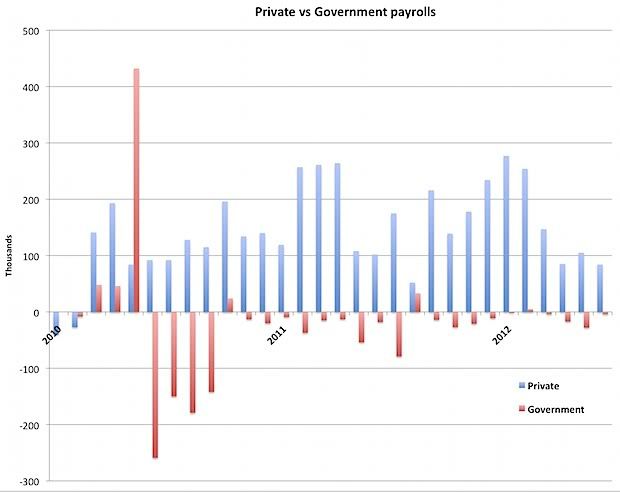
It’s the cuts in government employment, stupid!
Yes, yesterday initial claims improved a bit yesterday , but today’s monthly job figures are horrible, with unemployment (U-3) staying at 8.2%, and only 80K jobs, less than needed to match population growth.
As Felix Salmon notes, the real problem is that government payrolls have been slashed for the past year or so, as people make invocations to the austerity fairy.
BTW, while the U-3 unemployment rate was flat, but the less conservative, and to my mind more representative, U-6 unemployment rate rose to 14.9%.
Not good news.