Category: Economy

Why a French Economist has So Many Wingers Terrified

Paul Krugman has an interesting OP/ED on Thomas Piketty’s book Capital in the Twenty-First Century.

Picketty makes the assertion that capital demands rates of return greater than that of the underlying economy, and that, over the long run capital will extract more and more of the overall economy, to the detriment to wages and labor.

As Krugman notes, this work has the apologists for the rent seekers apoplectic:

“Capital in the Twenty-First Century,” the new book by the French economist Thomas Piketty, is a bona fide phenomenon. Other books on economics have been best sellers, but Mr. Piketty’s contribution is serious, discourse-changing scholarship in a way most best sellers aren’t. And conservatives are terrified. Thus James Pethokoukis of the American Enterprise Institute warns in National Review that Mr. Piketty’s work must be refuted, because otherwise it “will spread among the clerisy and reshape the political economic landscape on which all future policy battles will be waged.”

Well, good luck with that. The really striking thing about the debate so far is that the right seems unable to mount any kind of substantive counterattack to Mr. Piketty’s thesis. Instead, the response has been all about name-calling — in particular, claims that Mr. Piketty is a Marxist, and so is anyone who considers inequality of income and wealth an important issue.

I’ll come back to the name-calling in a moment. First, let’s talk about why “Capital” is having such an impact.

Mr. Piketty is hardly the first economist to point out that we are experiencing a sharp rise in inequality, or even to emphasize the contrast between slow income growth for most of the population and soaring incomes at the top. It’s true that Mr. Piketty and his colleagues have added a great deal of historical depth to our knowledge, demonstrating that we really are living in a new Gilded Age. But we’ve known that for a while.

No, what’s really new about “Capital” is the way it demolishes that most cherished of conservative myths, the insistence that we’re living in a meritocracy in which great wealth is earned and deserved.

For the past couple of decades, the conservative response to attempts to make soaring incomes at the top into a political issue has involved two lines of defense: first, denial that the rich are actually doing as well and the rest as badly as they are, but when denial fails, claims that those soaring incomes at the top are a justified reward for services rendered. Don’t call them the 1 percent, or the wealthy; call them “job creators.”

Needless to say, the defenders of oligarchy are unamused by this.

The book, which, if reports are true, uses rather traditional economic tools, makes a compelling argument that excessive wealth is not synonymous with virtue.

I’m putting Capital in the Twenty-First Century on my summer reading list.

The Rich are not the Best of Us, they are the Worst of Us

An interesting study finds that the more money you have, the more likely you are to ignore rules and endanger others:

What defines low socioeconomic status? Objectively, it means fewer economic resources and educational opportunities, less access to elite schools and clubs, more subordinate positions in the workplace, and increased levels of stress. For the upper-class, it’s just the inverse: more resources, more leisure, less stress.

From the realities facing each group, you might assume that members of the lower-class would be more focused on meeting their own survival needs and, thereby, prioritize their needs over those of others. As a result, you might also expect them to be less trustworthy as compared to members of the upper-class who, given their greater resources, have the luxury to trust. But if you do, you’re missing a central point about how trust really works. Trust isn’t a luxury. It’s a tool we need to get by when we can’t make it on our own; it’s a means of survival for those who must depend on others. Viewed this way, predictions about trust and class get turned on their heads.

………

To relate that to social class, consider this experiment. You’re standing on a corner in downtown San Francisco. It’s a four-way stop, meaning cars are supposed to pause before entering the intersection. As you’re sipping your latte, you look to your left before stepping off the curb. The car approaching is a shiny BMW. Do you cross? How about if it’s a Ford Fusion? The model of trust I’ve been describing suggests you might want to pause if it’s the BMW. There’s really only one way to tell, though. You’ve got to put yourself out there. And that’s just what Paul Piff and colleagues from the University of California at Berkeley did.

As cars approached this busy intersection in San Francisco, a researcher would enter the crosswalk. Unbeknownst to drivers, he also noted the make of their car and their perceived age and gender. The main datum for each car was whether the driver paused to let the researcher cross at the stop sign (as is required by the California Vehicle Code) or sped up to cut him off and thereby proceed more quickly toward the driver’s goals. Paul and colleagues divided drivers into five SES categories based on their cars—think Hyundais on one end and Ferraris on the other. The results were quite remarkable.

At the lowest end of the class gradient, every single driver stopped to let the pedestrian entering the crosswalk continue on his way. Midway up the class ladder, about 30 percent of drivers broke the law and cut off the pedestrian so that they could keep going. At the upper end of SES, almost 50 percent of drivers broke the law to put their own needs first. At the most basic level, these findings offer a provocative warning. When you’re vulnerable, upper-class individuals are more likely to disregard the trust you place in them if doing so furthers their own ends.

This is the first of a number of tests executed by Professor Piff did.

The better off someone was, the more likely to act in a completely self-absorbed and untrustworthy manner.

It applied to cars, lying to a potential job applicant about a job, or cheating at a gambling game.

It is precisely the opposite of the Calvanist ethos that grips the right wing.

Economics Says that You Should Throw Money at the Problem

It appears that the shale/fracking boom had created a wee labor shortage:

How high is demand for welders to work in the shale boom on the U.S. Gulf Coast?

So high that “you can take every citizen in the region of Lake Charles between the ages of 5 and 85 and teach them all how to weld and you’re not going to have enough welders,” said Peter Huntsman, chief executive officer of chemical maker Huntsman Corp.

So high that San Jacinto College in Pasadena, Texas, offers a four-hour welding class in the middle of the night.

So high that local employers say they’re worried there won’t be adequate supply of workers of all kinds. Just for construction, Gulf Coast oil, gas and chemical companies will have to find 36,000 new qualified workers by 2016, according to Industrial Info Resources Inc. in Sugar Land, Texas. Regional estimates call for even more new hires once those projects are built.

The processing and refining industries need so many workers to build new facilities in Texas and Louisiana because of the unprecedented rise over the last three years in U.S. oil and gas production, much of it due to shale. Labor shortages, causing delays in construction, threaten to slow the boom and push back the date when the country can meet its own energy needs, estimated by BP Plc to be in 2035.

So, in the next two years, you need 36,000 welders.

It’s pretty simple if you want to frack your world:

  • Pay to train your welders.
  • Pay your welders more.
  • Treat your employees better than the other guy.

This sh%$ ain’t rocket science.

The problem is that the “processing and refining industries” want workers who are well trained on someone else’s dollar that are cheap, and readily disposable.

What they want fails economics 101.

So Not Surprised

Getting away from the mindless contrarianism* that Nate Silver’s rebooted Fivethirtyeight dot com seems to specialize in, Ben Casselman actually does some meaningful statistics, and discovers that the end of extended unemployment benefits has not led to more people finding jobs:

The cutoff of federal unemployment benefits doesn’t seem to be helping the long-term unemployed get back to work.

More than a million Americans saw their unemployment benefits expire at the start of the year, after Congress failed to renew the Emergency Unemployment Compensation program. The program, which Congress created in 2008, had provided federally funded payments to unemployed workers when their state-funded benefits ran out, usually after 26 weeks.
The Senate recently voted to restore the benefits, but the House shows little sign of following suit.

Some economists had argued that the program was doing more harm than good by discouraging recipients from looking for work or taking jobs. They said that because the job market was improving, the time had come to cut off benefits. That would prod the unemployed to get back to work, perhaps leading them to accept offers that seem less than ideal.
So far, however, the evidence doesn’t seem to support that theory. Rather than finding jobs, the long-term unemployed continue to be out of luck.

We now have three months’ worth of job market data since the benefits program expired. The chart below shows job-finding rates for the long-term and short-term unemployed. Notice three things: First, the short-term unemployed have a much better chance of finding a job than the long-term unemployed and always have. Second, the short-term unemployed are seeing a steady improvement in their prospects, but the long-term jobless are not. And third, there’s been no major shift since the benefits program expired at the end of last year. (The chart shows the data as a 12-month rolling average, which could obscure a sudden shift. The un-smoothed data, however, doesn’t show a jump either.)

What a surprise.

The right wing economists, and those who listen to them, people who have been wrong about everything since at least 1929 are wrong again.

* AKA Michael Kinsley disease.

Meh

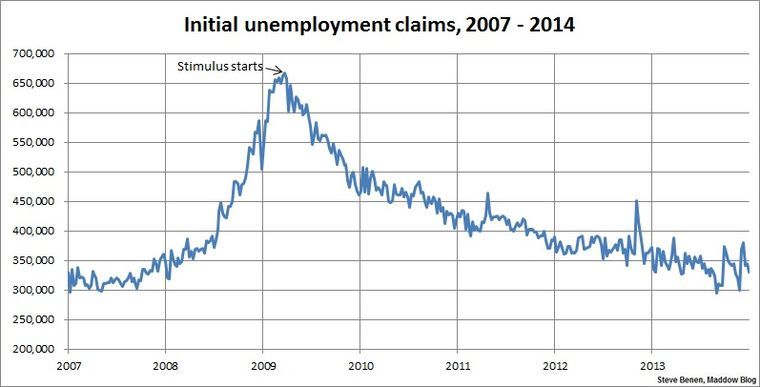
Once again, we have a jobs report that is only a bit better than treading water:

Employers are hiring at a more aggressive pace again after a winter cold snap, but the pace of job gains is only slowly making up for years of lost ground in the labor market.

Nearly five years after the end of the Great Recession, the total number of private sector jobs is finally back to where it was as the downturn began in early 2008, the Labor Department reported on Friday.

But that level is still far below what is needed to fully accommodate the millions of people who have joined the work force since then, or relieve the backlog of jobless workers anytime soon.

Still, the addition of 192,000 jobs last month, all from private employers, represented an uptick from the anemic rate of job creation recorded at the turn of the year. That encouraged optimists, who foresee a slight strengthening as the wintry weather in many parts of the country in late 2013 and early 2014 yields to a more inviting spring.

In addition, while the unemployment rate remained flat at 6.7 percent in March, an increase in the number of Americans looking for work also offered up some modest hope that better times could lie ahead in 2014. So too did an upward revision in the number of jobs that government statisticians estimate were added in January and February.

At the current rate, we will have a pre-Great Recession workforce participation rate sometime in the 2nd half of this century.

When People Say that Addressing Inequality is Just Class Warfare, They are Either Lying of Stupid

As Paul Krugman notes, we know of specific policies (taxes, shareholder say on pay, etc.) to address inequality, but no one has cracked the secret to sustainable growth that raises all boats:

The usual answer to this is to point out that we don’t actually know much about how to produce rapid economic growth — conservatives may think they know (low taxes and all that), but there is no evidence to back up their certainty. And on the other hand, we know how to make a big difference to income distribution, especially how to reduce extreme poverty. So why not work on what we know, as at least part of our economic strategy?

He further notes that economic growth rates do not effect levels of child malnutrition, but inequality does:

But even this argument may be conceding too much. A new study finds that in poor and lower-middle-income countries, one of the most crucial aspects of well-being, child malnutrition, isn’t helped at all by faster growth:

………

Yes, rapid growth is good, but it doesn’t solve all problems even if you know how to make it happen, which you don’t.

We do know that the conservative prescriptions produce, inequality, speculation, bubbles, and panics.

The reason that we continue to hear these arguments is because it serves the rich and their lackeys, not because it has ever demonstrated that it has any relation to reality.

Quote of the Day

The Shrill One speaks:

To the extent that people have negative feelings about the one percent, the emotion involved isn’t envy — it’s anger, which isn’t at all the same thing. Envy is when you have negative feelings about rich because of what they have; anger is when you have negative feelings about the rich because of what they do.

Paul Krugman

I differ slightly, I don’t think that this is just anger, I think that it is well justified outrage.

Occupy Wall Street Might Have Actually Won

And the evidence comes from that Mecca of Capitalism, Davos, Switzerland:

Agree or disagree with the aims and means of Occupy Wall Street, but the movement changed the way we think about our world forever.

For proof, look no further than the upcoming World Economic Forum in Davos. Each year, the organization puts out a report indicating what it believes are the world’s biggest risks.

For the past three years, income inequality has been the #1 global risk.

But prior to 2012, inequality wasn’t even on the list. Those protests in 2011 clearly had a profound on global thinking, right up tot he elite level.

The corrupt capitalists at Davos appear to have learned fear.

Good.

Uh-Oh………


Labor force participation rate

It looks like the Fed was a little bit premature in its decision to ease off quantitative easing:

Today’s U.S. unemployment figures were surprisingly bad. Only 74,000 jobs were added to payrolls in December, barely half what analysts had expected. The news was a reminder of how far from normal the economy still is — and of how tricky it will be for Janet Yellen, who’s about to take over as chairman of the Federal Reserve, to explain the central bank’s policy.

That jobs number by itself is more worrisome than alarming. It’s a noisy statistic, subject to seasonal disturbances and big revisions. But it can’t be dismissed, either. It’s enough to suggest that the economic acceleration that looked to be getting under way in recent months isn’t yet a done deal. Some of the markets’ recent enthusiasm on that score needs to be reined in – – and, thanks to these numbers, it will be.

At first sight, the big fall in the unemployment rate to 6.7 percent from 7 percent tells a much happier story. Sadly, no. The fall reflects a further drop in the number of people looking for work. A shrinking labor force reduces the economy’s productive capacity, to say nothing of the effect on the dropouts’ prospects. And the proportion of long-term unemployed — the workers most at risk of dropping out of the jobs market in future months — remains close to 40 percent of the total.

In one way, the implications for policy are clear: This is no time to be tightening either fiscal or monetary policy. Extending unemployment benefits, which already made sense on economic and humanitarian grounds, is now all but mandatory. If this can be financed by extra borrowing rather than by offsetting cuts in other spending, so much the better: Some new fiscal stimulus, however modest, wouldn’t go amiss.

The bad jobs news will make the Fed think twice about its plan to phase out asset purchases — the policy of quantitative easing, which it has been using to supply unconventional monetary stimulus. Until better numbers come along, this policy may be paused or even reversed, a possibility Chairman Ben S. Bernanke mentioned in his last news conference. Financial markets will also expect a delay in any decision to start raising interest rates. On news like this, the Fed will want to avoid any suspicion of wishing to tighten monetary conditions.

It is true that these numbers can be volatile, but it has to give the Federal Reserve a case of gas.

You Have to be F%$#ing Terrified to F%$#ing Threaten the F%$#ing Pope

It appears that Pope Francis has spooked the 1%, because they are threatening the Pope and the Church:

If anyone wonders whether Pope Francis has irritated wealthy conservatives with his courage and idealism, the latest outburst from Kenneth Langone left little doubt. Sounding both aggressive and whiny, the billionaire investor warned that he and his overprivileged friends might withhold their millions from church and charity unless the pontiff stops preaching against the excesses and cruelty of unleashed capitalism.

According to Langone, such criticism from the Holy See could ultimately hurt the sensitive feelings of the rich so badly that they become “incapable of feeling compassion for the poor.” He also said rich donors are already losing their enthusiasm for the restoration of St. Patrick’s Cathedral in Manhattan – a very specific threat that he mentioned directly to Cardinal Timothy Dolan of New York.

Langone is not only a leading fundraiser for church projects but a generous donor to hospitals, universities, and cancer charities (often for programs and buildings named after him, in the style of today’s self-promoting philanthropists). Among the super-rich, he has many friends and associates who may share his excitable temperament.

While his ultimatum seems senseless – would a person of true faith stiff the church and the poor? – it may well be sincere. And Langone spends freely to promote his political and economic views, in the company of the Koch brothers and other Republican plutocrats.

Still, a Pope brave enough to face down the Mafia over his financial reform of the murky Vatican Bank shouldn’t be much fazed by the likes of Langone.

Langone, a co-founder of Home Depot, is also known for Dick Grasso’s obscene golden handshake when he left his chairmanship of the NYSE.

I have an affection for this guy; he certainly has the right enemies.

Why They are Protesting Against Democracy in Thailand


Per capita GDP


Thai vs. Australian per capita GDP


Government Debt


Social (health) spending

Look at the graphs on economic statistics for Thailand.

Why is anyone complaining about results like this?

Anti government forces Bangkok have vowed to rid Thailand of all vestiges of Thaksin — including Thaksinomics. So let’s pause to cast a medium-term eye over the country’s economic performance during the period (2001 to the present) that has been dominated by Thaksin-esque policies.

………

I’m sure there are plenty of other indicators and comparisons – good, not-so-good and bad – that could be used to plot Thailand’s economic performance since 2001 (comments on other indicators would be very welcome). But the overall point is that Thailand’s voters have some sound economic reasons to keep on electing Thaksin and his allies.

Strong economic growth, and increasing government spending on health, welfare and rural development, didn’t start with Thaksin, but he and his allies have been able to effectively place growing prosperity at the heart of their political success.

What the protesters are objecting to is not economic growth, but rather they are objecting to the fact that there are benefits accruing to the rural peasants.

So the hoi polloi are doing better.

There are new roads, new bridges, new rural clinics, and the position of the rural poor has improved.

It has improved a lot, and their lot relative to the urban elites has also improved.

So the protestors are upset that poor rural families are no longer forced to sell their daughters into prostitution in the big cities, and this is why they want to remove any vestige of Thaksin and Yingluck Shinawatra while insisting that there be no elections.

When I say that, “The Thai protesters are revolting,” I am using the last word as an adjective, not a verb.

Things That Make Me Agree with Rand Paul, and Make me Want to Have My Head Examined

In honor of the 100th anniversary of the founding of the Federal Reserve, PBS had a debate between 2 financial historians over the benefits of the central bank, and rather surprisingly, they both agreed that the Federal Reserve now sees one of its primary roles as supporting stock market prices:

Consuelo Mack’s Wealthtrack program on PBS had invited James Grant, Editor and Founder of Grant’s Interest Rate Observer, and Richard Sylla, the Henry Kaufman Professor of the History of Financial Institutions and Markets at NYU’s Stern School of Business. The opening scene for the program shows Sylla in a party hat lighting the candles on the Fed’s birthday cake while Grant snuffs them out – suggesting that Sylla would be making pro-Fed statements while Grant would take the opposing view.

What happened during the program, however, was that both men made the candid and bold accusation that the Federal Reserve, for the first time in its history, has assigned itself the job of propping up the stock market.

Grant had this to say: “New thing – it is in the business of talking up the stock market…The Fed is manipulating prices, especially on Wall Street.” To another question from Mack, Grant says: “The Fed has presided over the decay of finance.”

Professor Sylla adds more fuel to the fire, stating: “The Fed seems to have, I think almost deliberately, is trying to push the stock market up. I’ve watched this stuff for 40, 50 years now and this is the first time in my memory when it seemed to be official U.S. government policy that the stock market goes up. And the Fed likes this because it thinks that when the stock market goes up, people who own stocks feel richer, they’ll go out and spend more money, and the unemployment rate will come down.” You can watch the full program here.

Is it possible that the Federal Reserve, with its economic wizards and differential equations, doesn’t know that the more it props up the stock market and Wall Street, the more it is undermining Main Street and exacerbating wealth inequality in America?

I see sh%$ like this, and I start to agree with Rand (and Ron) Paul about the need to reign in the Fed.

The show goes further, and talks about how the rather customary expense ratio of 2% on a 401(K) means that Wall Street ends up with ⅔ of your money.

It’s why we need to cut back on Wall Street.  It’s like f%$3ing Kudzu.

Props to Krugman………

A few days ago, Paul Krugman announced that the Trans Pacific Partnership (TPP) was no big deal.

I think that he got this very wrong, because he viewed it through the lens of comparative advantage, which is, after all pretty much his specialty in economics.

It was a classic, “When all you have is a hammer, everything looks like a nail,” error.

He misses the fact that the objections to the TPP have nothing to do with so-called free trade, and everything to do with it being structured to benefit the rent seekers in IP and finance by strengthening the regulations on IP, and by preventing meaningful regulation on finance and capital flows, in addition to the very basic infringements on sovereignty that the entire regime entails.

Well, Krugman has admitted that his initial comments were hasty and a bit ill considered:

Dean Baker takes me to task over the Trans Pacific trade deal, arguing that it’s not really about trade — that the important (and harmful) stuff involves regulation and intellectual property rights.

I’m sympathetic to this argument; this was true, for example, of DR-CAFTA, the free trade agreement with Central America, which ended up being largely about pharma patents. Is TPP equally bad? I’ll do some homework and get back to you.

This reflects well on him.

It’s an admission that he did not consider the issues as comprehensively as he should have, with a promise of further comments, without any excuses.

You Know that Whole Inflation Running Wild Thing?

Not so much:

Wholesale prices in the U.S. declined for a third month in November, reflecting lower costs for energy and cars.

The 0.1 percent drop in the producer-price index followed a 0.2 percent decrease the prior month, a Labor Department report showed today in Washington. The median estimate in a Bloomberg survey of 77 economists called for no change. The so-called core measure, which excludes food and energy, rose 0.1 percent.

Prices of goods and materials used in the earlier stages of production fell for a second month as slow improvement in global markets limits demand. Scant signs of accelerating inflation indicate Federal Reserve policy makers meeting next week have more room to maintain their unprecedented $85 billion in monthly asset purchases in order to help spur the expansion.

“Inflation remains quite tame,” said Jim O’Sullivan, chief U.S. economist at High Frequency Economics Ltd. in Valhalla, New York, who correctly projected the drop in prices. “Over the course of the next year, the core numbers will drift up a little bit as the economy remains healthy and unemployment keeps falling.”

An important thing to note is that the inflation hawks have been wrong on everything this time around.

This is an Expected Consequence of Obamacare

I have repeatedly stated that the first problem with healthcare is not the price of healthcare, not the cost of healthcare.

Absent fiat regulation, it is more important to initiate price competition both in insurance and in medical services, which means that the pricing will be clear, and high price insurance will be eschewed by consumers, and high price medical services will be eschewed by the insurance companies.

Therefore, it comes of no surprise that insurance companies are cutting the big name providers who charge a premium:

Americans who are buying insurance plans over online exchanges, under what is known as Obamacare, will have limited access to some of the nation’s leading hospitals, including two world-renowned cancer centres.

Amid a drive by insurers to limit costs, the majority of insurance plans being sold on the new healthcare exchanges in New York, Texas, and California, for example, will not offer patients’ access to Memorial Sloan Kettering in Manhattan or MD Anderson Cancer Center in Houston, two top cancer centres, or Cedars-Sinai in Los Angeles, one of the top research and teaching hospitals in the country.

This was not just foreseeable, it was the inevitable consequence of the Heritage Foundation designed plan.

In the long run, this is a good thing, because the consolidation of hospitals over the past few years has not been about efficiencies, but rather about the accumulation of pricing power.

You may not like that Sloan Kettering is not in your network, but in the long run, some for of price controls are essential to fixing our broken healthcare system,

Economists Unconnected to Reality

You know the ones, the “fresh water” economists, the free-market mousketeer conservatives for whom the rational actor acting in an unconstrained laissez-faire system is king.

It is a matter of faith, completely unsupported by reality, that regulating a market will always be counter productive.

As it pertains to consumer protections for credit cards, to paraphrase the Bard, “There are more things in heaven and earth, than are dreamt of in their philosophy.

Much to ths shock of right wing economists, adding consumer protections to credit cards worked:

Four years ago, Congress decided to force down the hidden fees that credit card companies collect from their customers. It passed a law called the 2009 Credit Card Accountability Responsibility and Disclosure Act — a name chosen so the law would be known as the Card Act.

When Neale Mahoney, an economist at the University of Chicago’s Booth School of Business, set out to evaluate the effect of that law, he was confident he knew what he and his colleagues would find: It didn’t work.

“I went into the project with this sort of conventional wisdom that well-intentioned regulators would force down fees and that other fees and charges would increase in response,” he told me this week, comparing hapless rule makers to the carnival visitors playing the game known as Whac-a-Mole, where a mole springs up somewhere else as soon as one is knocked down.

But his expectation was wrong. The study came to a conclusion that surprised Mr. Mahoney and his colleagues: The regulation worked. It cut down the costs of credit cards, particularly for borrowers with poor credit. And, the researchers concluded, “we find no evidence of an increase in interest charges or a reduction to access to credit.”

The study, whose other authors are Sumit Agarwal of the National University of Singapore, Souphala Chomsisengphet of the Office of the Comptroller of the Currency and Johannes Stroebel of New York University’s Stern School of Business, estimates that the law is saving American consumers $20.8 billion a year.

There are a number of theories as to why this occurred, but the most likely is that regulation, when properly executed, simply works, though an argument could be made (though probably not by the credit card companies) that this worked because much of the credit card companies’ business model is parasitic, and as such they are unwilling to walk from “free” money.