Category: employment

Why We Need Unions, Aggressive Anti-Trust Enforcement, and Former CEOs Behind Bars

Because without all of these, those in power conspire to impoverish and humiliate the rest of us:

Back in January, I wrote about “The Techtopus” — an illegal agreement between seven tech giants, including Apple, Google, and Intel, to suppress wages for tens of thousands of tech employees. The agreement prompted a Department of Justice investigation, resulting in a settlement in which the companies agreed to curb their restricting hiring deals. The same companies were then hit with a civil suit by employees affected by the agreements.

This week, as the final summary judgement for the resulting class action suit looms, and several of the companies mentioned (Intuit, Pixar and Lucasfilm) scramble to settle out of court, Pando has obtained court documents (embedded below) which show shocking evidence of a much larger conspiracy, reaching far beyond Silicon Valley.

Confidential internal Google and Apple memos, buried within piles of court dockets and reviewed by PandoDaily, clearly show that what began as a secret cartel agreement between Apple’s Steve Jobs and Google’s Eric Schmidt to illegally fix the labor market for hi-tech workers, expanded within a few years to include companies ranging from Dell, IBM, eBay and Microsoft, to Comcast, Clear Channel, Dreamworks, and London-based public relations behemoth WPP. All told, the combined workforces of the companies involved totals well over a million employees.

According to multiple sources familiar with the case, several of these newly named companies were also subpoenaed by the DOJ for their investigation. A spokesperson for Ask.com confirmed that in 2009-10 the company was investigated by the DOJ, and agreed to cooperate fully with that investigation. Other companies confirmed off the record that they too had been subpoenaed around the same time.

Although the Department ultimately decided to focus its attention on just Adobe, Apple, Google, Intel, Intuit, Lucasfilm and Pixar, the emails and memos clearly name dozens more companies which, at least as far as Google and Apple executives were concerned, formed part of their wage-fixing cartel.

Heads, I win, tails, you lose, klepto-capitalism at its finest.

The fact that the victims of this organized wage-theft conspiracy are well paid does not make it better, neither does the fact that many of the people involved are techno-libertarians, which does not make it just that they are a victim of their own laissez-faire philosophy.

The DoJ has secured a settlement, slap on the wrist fines, and no one will go to jail.

At the most, there will be a court judgement, and penalties, but the executives in question won’t pay that, they are indemnified by their corporations, so it’s shareholders, pension funds and the like, end up paying for this.

This is contemptible.

Gee, You Think?

In the Armed Forced Journal, Army lieutenant colonel Daniel L. Davis calls for the forced retirement of most of the US general officer corps:

The U.S. Army’s generals, as a group, have lost the ability to effectively function at the high level required of those upon whom we place the responsibility for safeguarding our nation. Over the past 20 years, our senior leaders have amassed a record of failure in major organizational, acquisition and strategic efforts. These failures have been accompanied by the hallmarks of an organization unable and unwilling to fix itself: aggressive resistance to the reporting of problems, suppression of failed test results, public declarations of success where none was justified, and the absence of accountability.

………

Events have granted us a short window of time in which we might address the problem. America is drawing down after two intense wars, while the potential threats of the future are not quite upon us. Seven decades ago, Army Chief of Staff Gen. George Marshall surveyed an officer corps similarly ill-suited for the tasks to come. He forced into retirement scores of generals, clearing the way for the ones who would help win World War II.

Today’s times, like Marshall’s, call for a reformation of the general officer corps.

………

After each of these failures, one might expect the Army and program leaders to have suffered censure. Instead, the opposite seems generally to have been the case. The leaders of failed programs and other efforts received prestigious medals, promotion to higher ranks, and plum follow-on jobs; others retired and went to work for defense contractors, often with companies that had profited from the failed acquisition effort.

………

Shrink the general officer corps. In 1945, about 2,000 general and flag officers led a total of about 12 million citizens in uniform. Today, we have about 900 generals and admirals and 1.4 million troops, and the ratio of leader-to-led has accelerated upward in the two decades since the end of the Cold War. In an age of unprecedented communications technology and with the education and training opportunities for today’s soldiers, this is indefensible. Many general officer billets are redundant and should be eliminated; others can effectively be filled by colonels or even lieutenant colonels.

I highly remommend this as a read, though I would argue that the “Up or Out” officer promotion and retention policies have also contributed to these problems.

It makes the consequences to challenging the Pentagon’s group think to be the end of a career.

Best Resignation Letter Ever

Matt Taibbi writes a goodbye letter to Rolling Stone that should make his former bosses proud:

Today is my last day at Rolling Stone. As of this week, I’m leaving to work for First Look Media, the new organization that’s already home to reporters like Glenn Greenwald, Jeremy Scahill and Laura Poitras.

I’ll have plenty of time to talk about the new job elsewhere. But in this space, I just want to talk about Rolling Stone, and express my thanks. Today is a very bittersweet day for me. As excited as I am about the new opportunity, I’m sad to be leaving this company.

More than 15 years ago, Rolling Stone sent a reporter, Brian Preston, to do a story on the eXile, the biweekly English-language newspaper I was editing in Moscow at the time with Mark Ames. We abused the polite Canadian Preston terribly – I think we thought we were being hospitable – and he promptly went home and wrote a story about us that was painful, funny and somewhat embarrassingly accurate. Looking back at that story now, in fact, I’m surprised that Rolling Stone managing editor Will Dana gave me a call years later, after I’d returned to the States.

I remember when Will called, because it was such an important moment in my life. I was on the American side of Niagara Falls, walking with friends, when my cell phone rang. Night had just fallen and when Will invited me to write a few things in advance of the 2004 presidential election, I nearly walked into the river just above the Falls.

At the time, I was having a hard time re-acclimating to life in America and was a mess personally. I was broke and having anxiety attacks. I specifically remember buying three cans of corned beef hash with the last dollars of available credit on my last credit card somewhere during that period. Anyway I botched several early assignments for the magazine, but Will was patient and eventually brought me on to write on a regular basis.

It was my first real job and it changed my life. Had Rolling Stone not given me a chance that year, God knows where I’d be – one of the ideas I was considering most seriously at the time was going to Ukraine to enroll in medical school, of all things.

………

No journalist has ever been luckier than me. Thank you, Rolling Stone.

Read the whole thing.

It’s funny and gracious, and everyone at Rolling Stone should be proud of what he said.

I did Not Expect this From the New York Times

The Times when writing about the debate about raising the minimum wage, calls out a so called “think tank” as being a subsidiary of the hospitality industry:

Just four blocks from the White House is the headquarters of the Employment Policies Institute, a widely quoted economic research center whose academic reports have repeatedly warned that increasing the minimum wage could be harmful, increasing poverty and unemployment.

But something fundamental goes unsaid in the institute’s reports: The nonprofit group is run by a public relations firm that also represents the restaurant industry, as part of a tightly coordinated effort to defeat the minimum wage increase that the White House and Democrats in Congress have pushed for.

“The vast majority of economic research shows there are serious consequences,” Michael Saltsman, the institute’s research director, said in an interview, before he declined to list the restaurant chains that were among its contributors.

The campaign illustrates how groups — conservative and liberal — are again working in opaque ways to shape hot-button political debates, like the one surrounding minimum wage, through organizations with benign-sounding names that can mask the intentions of their deep-pocketed patrons.

Those are the first 4 paragraphs.

Seriously, the New York Times led with the fact that that a lot of the think tanks are little more than whores for their donors.

And then they name the lead pimp:

………

The Employment Policies Institute, founded two decades ago, is led by the advertising and public relations executive Richard B. Berman, who has made millions of dollars in Washington by taking up the causes of corporate America. He has repeatedly created official-sounding nonprofit groups like the Center for Consumer Freedom that have challenged limits like the ban on indoor smoking and the push to restrict calorie counts in fast foods.

………

The sign at the entrance is for Berman and Company, as the Employment Policies Institute has no employees of its own. Mr. Berman’s for-profit advertising firm, instead, “bills” the nonprofit institute for the services his employees provide to the institute. This arrangement effectively means that the nonprofit is a moneymaking venture for Mr. Berman, whose advertising firm was paid $1.1 million by the institute in 2012, according to its tax returns, or 44 percent of its total budget, with most of the rest of the money used to buy advertisements.

Disclosure reports filed by individual foundations show that its donors in recent years have included the Lynde and Harry Bradley Foundation, a longtime supporter of conservative causes. Mr. Berman and Mr. Saltsman would not identify other donors, but did say they included the restaurant industry. But its tax return shows that the $2.4 million in listed donations received in 2012 came from only 11 contributors, who wrote checks for as much as $500,000 apiece.

I am not sure why the New York Times has decided to stop channeling Claude Rains, but it is a refreshing change for the “paper of record”.

Normally this sort of “business as usual” is studiously ignored by the Washington press corps(e).

Not Enough Bullets………

After JP Morgan had to pay billions of dollars in fines and restitution, the board of directors took decisive action, and doubled JP Morgan CEO’ Jamie Dimon’s salary.

I guess in finance, everyone gets a gold star, kind of like kindergarten, only with less accountability:

JP Morgan Chase has almost doubled chairman and CEO Jamie Dimon’s pay for 2013, rewarding the executive for settling probes against the bank.

Dimon will receive total compensation of $20m in 2013, consisting of $18.5m in stock options and a base salary of $1.5m, the bank said in a statement Friday.

That compares with total compensation of $11.5m a year earlier, down from $23m in each of the previous two years.

The bank says it took several factors into account when deciding on Dimon’s pay, including the “sustained long-term performance” of the bank, gains in market share and customer satisfaction as well as his handling of the legal issues facing the lender.

Seriously, we need to start jailing these people post haste.

Uh-Oh………


Labor force participation rate

It looks like the Fed was a little bit premature in its decision to ease off quantitative easing:

Today’s U.S. unemployment figures were surprisingly bad. Only 74,000 jobs were added to payrolls in December, barely half what analysts had expected. The news was a reminder of how far from normal the economy still is — and of how tricky it will be for Janet Yellen, who’s about to take over as chairman of the Federal Reserve, to explain the central bank’s policy.

That jobs number by itself is more worrisome than alarming. It’s a noisy statistic, subject to seasonal disturbances and big revisions. But it can’t be dismissed, either. It’s enough to suggest that the economic acceleration that looked to be getting under way in recent months isn’t yet a done deal. Some of the markets’ recent enthusiasm on that score needs to be reined in – – and, thanks to these numbers, it will be.

At first sight, the big fall in the unemployment rate to 6.7 percent from 7 percent tells a much happier story. Sadly, no. The fall reflects a further drop in the number of people looking for work. A shrinking labor force reduces the economy’s productive capacity, to say nothing of the effect on the dropouts’ prospects. And the proportion of long-term unemployed — the workers most at risk of dropping out of the jobs market in future months — remains close to 40 percent of the total.

In one way, the implications for policy are clear: This is no time to be tightening either fiscal or monetary policy. Extending unemployment benefits, which already made sense on economic and humanitarian grounds, is now all but mandatory. If this can be financed by extra borrowing rather than by offsetting cuts in other spending, so much the better: Some new fiscal stimulus, however modest, wouldn’t go amiss.

The bad jobs news will make the Fed think twice about its plan to phase out asset purchases — the policy of quantitative easing, which it has been using to supply unconventional monetary stimulus. Until better numbers come along, this policy may be paused or even reversed, a possibility Chairman Ben S. Bernanke mentioned in his last news conference. Financial markets will also expect a delay in any decision to start raising interest rates. On news like this, the Fed will want to avoid any suspicion of wishing to tighten monetary conditions.

It is true that these numbers can be volatile, but it has to give the Federal Reserve a case of gas.

Who Hit the Democrats with a Clue Stick?

It seems that Democrats are looking to stop running away from Obamacare, (a good idea, the Dems own it whether they like it or not) and instead want to push for a minimum wage increase as their signature issue for 2014:

Democratic Party leaders, bruised by months of attacks on the new health care program, have found an issue they believe can lift their fortunes both locally and nationally in 2014: an increase in the minimum wage.

The effort to take advantage of growing populism among voters in both parties is being coordinated by officials from the White House, labor unions and liberal advocacy groups.

In a series of strategy meetings and conference calls among them in recent weeks, they have focused on two levels: an effort to raise the federal minimum wage, which will be pushed by President Obama and congressional leaders, and a campaign to place state-level minimum wage proposals on the ballot in states with hotly contested congressional races.

With polls showing widespread support for an increase in the $7.25-per-hour federal minimum wage among both Republican and Democratic voters, top Democrats see not only a wedge issue that they hope will place Republican candidates in a difficult position, but also a tool with which to enlarge the electorate in a nonpresidential election, when turnout among minorities and youths typically drops off.

“It puts Republicans on the wrong side of an important value issue when it comes to fairness,” said Dan Pfeiffer, the president’s senior adviser. “You can make a very strong case that this will be a helpful issue for Democrats in 2014. But the goal here is to actually get it done. That’s why the president put it on the agenda.”

This is good politics, and good policy, though having your hired guns run to the press (I’m talking to you, Mr. Pfeiffer) crowing about how this is such good politics does not serve to reinforce their message.

The minimum wage fight is an opportunity to create a space for the discussion about political values on a terrain that favors Democrats, it’s not about allowing self important political consultants crow about their genius.

Not Enough Bullets


Image from Because Finance is Boring

If you look at direct and indirect subsidies to the big banks, it appears that taxpayers are paying for the Bankster’s bonuses:

Earlier this year, Bloomberg calculated that the top 10 U.S. banks receive a $83 billion a year in subsidies from the government, due to their cheap cost of funding & the preferential treatment creditors give them because they assume the government sees them as TBTF.

In November, a NYT analysis of a Johnson Associates survey found that the top eight U.S. banks set aside $91.44 billion for bonuses in 2013.

Note that this does not include other subsides (hello, Federal Reserve, etc.)

To paraphrase Samuel L. Jackson, I’m sick of these motherf%$#ing bonuses in this motherf%$#ing economy.

H/t Crooks & Liars.

Pope Francis Walks the Walk

For all that Pope Francis has said about changing the focus of the church from right wing agitprop to helping the poor and doing good, it is in the bureaucracy, particularly the personnel structures where change has to be made.

Well the rubber has officially met the road, as he canned a notoriously right wing Cardinal from his position on the Congregation for Bishops, which is responsible for selecting new Bishops:

Pope Francis moved on Monday against a conservative American cardinal who has been an outspoken critic of abortion and same-sex marriage, by replacing him on a powerful Vatican committee with another American who is less identified with the culture wars within the Roman Catholic Church.

The pope’s decision to remove Cardinal Raymond L. Burke from the Congregation for Bishops was taken by church experts to be a signal that Francis is willing to disrupt the Vatican establishment in order to be more inclusive.

Even so, many saw the move less as an effort to change doctrine on specific social issues than an attempt to bring a stylistic and pastoral consistency to the church’s leadership.

“He is saying that you don’t need to be a conservative to become a bishop,” said Alberto Melloni, the director of the John XXIII Foundation for Religious Studies in Bologna, Italy, a liberal Catholic research institute. “He wants good bishops, regardless of how conservative or liberal they are.”

………

Cardinal Burke still serves as the prefect of the Vatican’s highest canonical court, but analysts say his removal from the Congregation for Bishops will sharply reduce his influence, especially over personnel changes in American churches.

“The Congregation for Bishops is the most important congregation in the Vatican,” said the Rev. Thomas J. Reese, a Jesuit priest and the author of “Inside the Vatican: The Politics and Organization of the Catholic Church.”

“It decides who are going to be the bishops all over the world,” he added. “This is what has the most direct impact on the life of the local church.”

Note that when Archbishop of S. Louis, Burke publicly announced that he was refusing communion to John Kerry.

This is a substantive change, assuming that he lives long enough,* for them to take.

*I am not suggesting a Da Vinci Code type conspiracy, I am merely observing that he is 75 years old.

It’s Jobless Thursday!!!!!

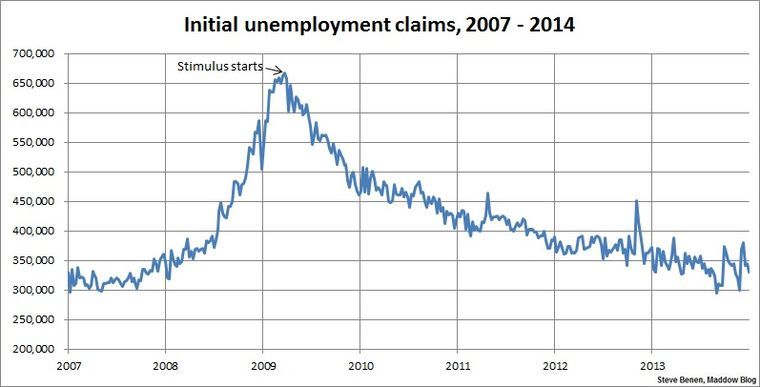
Initial unemployment claims fell to below 300,000, 298000, beating expectations, though the holidays have a lot of noise in there.

More significantly, 3rd quarter GDP was revised upward by a large amount:

The U.S. economy grew faster than initially estimated in the third quarter but weak demand and a pile-up in business inventories buoyed the case for the Federal Reserve to keep up its bond-buying stimulus for now.

Gross domestic product grew at a 3.6 percent annual rate instead of the 2.8 percent pace reported a month ago, the Commerce Department said on Thursday.

It was the biggest gain since the first quarter of 2012, but inventories accounted for almost half of the increase in growth.

“The strong third-quarter growth pace masks the more subdued tone in domestic activity, and as the bloated level of inventory is worked off, we are likely to see a much softer performance in growth in the fourth quarter,” said Millan Mulraine, senior economist at TD Securities in New York.

So, what happened was that more stuff was made, but it just filled up warehouse shelves.

The holiday shopping season could be make or break for the economy.

Any Guess as to Which SEC Senior Official is About to Jump to the Private Sector

Because the Securities and Exchange Commission has delayed a revolving door regulation:

Months ago, bowing to concern about regulators who leave government and then work their former colleagues on behalf of industry, the Securities and Exchange Commission (SEC) announced that it was tightening restrictions on the revolving door.

Specifically, the SEC decided to close a loophole in the ethics rules that allowed some “senior” SEC personnel to lobby the agency immediately after leaving instead of staying on the sidelines for a year or more, as employees at other federal agencies must do. The change in the rules—revoking a longstanding exemption for some SEC officials—appeared to be a rare stand against the revolving door at an agency that has long blurred the lines between the regulators and the regulated.

But not so fast.

A notice published in Monday’s edition of the Federal Register said that the Office of Government Ethics (OGE) was withdrawing the new rule at “the request of the SEC” so that the agency could have more time to “effectively educate affected employees before the exemption revocation takes effect.”

The rule, which was published as “final” on October 3, had been scheduled to take effect on January 2.

The ethics office said it expects to republish the rule in January 2014, but it then would take another 90 days for the rule to go into effect, according to Monday’s announcement. As a result, SEC employees who would be affected by the rule change—including supervisory accountants, attorneys, economists, analysts, and administrative specialists—will have even more time to take advantage of the loophole. As long as they leave before the rule change takes effect, they’ll still be able to lobby the agency during their first year out.

For the ethics office to withdraw a rule after it had been adopted but before it could take effect appeared to be an unusual event. POGO searched the Federal Register going back to 1994 (the earliest year available in the Government Printing Office’s online archives) and found no other OGE notice containing the phrase “Withdrawal of Final Rule.” We asked an OGE spokesman how frequently this has happened, but he declined to comment.

Not feeling hope and change here.

It Could Not Happen to a More Deserving Bunch of Rat F%$#ers

It appears that all is not well at the Heritage Foundation,*.

Former Senator DeMint has taken the helm, and in addition to making its so-called scholarship secondary to its electoral litmus tests, DeMint has embraced his MBA ethos, and started to enforce rigorous performance standards and metrics on its employees.

The employees are not amused. They see themselves as professionals, and they find it demeaning that they will be treated in the same way that they insist that the professionals who teach our children:

Julia Ioffe has a piece in the New Republic explaining the recent history of the Heritage Foundation, once the most influential conservative think tank in Washington, D.C. — perhaps the most influential think tank of any kind anywhere, for a few years — and now essentially a very large email list and activist PAC/pressure group.

Many people noticed how much the organization had changed during the recent government shutdown/”defund Obamacare” fight, a giant waste of everyone’s time and general self-inflicted disaster engineered and designed by Heritage Action, the 501(c)(4) “pressure group” Heritage launched in 2010. On the right, there was much consternation over the direction this once-respected think tank had taken. Truth be told, Heritage was always mostly political hacks, they just used to be effective political hacks with a realistic agenda. What was different now was the cheerful absense of any coherent and/or achievable goal — beyond fundraising and image-boosting for Heritage Action itself. Many blamed this on new Heritage president Jim DeMint, a former congressman not particularly known for his intellect, but Ioffe says the new tone at Heritage, and the tactics of Heritage Action, were both largely directed by Michael Needham, a 31-year-old former Giuliani staffer brought on to be the CEO of Heritage Action when it launched.

It seems that the folks at Heritage do not feel that they are being properly respected:

“I was always struck at how they felt absolutely no intellectual modesty,” says the former veteran Heritage staffer. “They felt totally on par with people who had spent thirty years in the field and had Ph.D.s.”

 Kind of like how turning over public schools to hedge fund managers, and the results are the same, MBA morons using the skills that blew up our financial system to f%$# their latest endeavor:

Since Needham and Chapman and DeMint have been in charge, a number of scholars and academic think tank types have left the organization, presumably distressed by the new regime’s management methods. Those methods do sound quite annoying, though:

DeMint also shared another bond with the two men: unlike the Heritage ruling class of yore, none of them had Ph.D.s. All three, however, had MBAs. Their preference for incentivizing behavior on the Hill with scorecards and primary challenges was “a very MBA approach to politics,” the former scholar noted ruefully. “There’s really no room there for deliberation or argument.”

Once he took the helm, DeMint set about reorganizing the business. Under Feulner, the Heritage Foundation ran as a decentralized confederation of so-called research silos—health care, national security, education—whose staffers each focused on a specific area. DeMint instituted a system of multidisciplinary teams that sprung up depending on the issue of the day that Heritage happened to be pushing. Moreover, now a Heritage staffer’s career trajectory was tied to the success or failure of that team.


You mean … compensation and advancement were tied to performance? That sounds like standard corporate management best-practices to me. It also sounds like something Heritage has spent years trying to implement in public schools.

You know, the Heritage Foundation just loved private equity pump and dump before it was applied to them.

My f%$#ing heart f%$#ing bleeds f%$#ing borscht for these bastards.

F%$#ing sauce for the f%$#ing gander.
*Full disclosure, a friend of mine was fired for having cancer from the Heritage Foundation, so I am not favorably inclined toward these bastards.

Bummer


Here are the historical US numbers through the years

The proposed regulations on CEO pay were defeated by referendum:

Swiss voters rejected a proposal to limit executives’ pay to 12 times that of junior employees yesterday, a measure that would have gone further than any other developed nation.

The measure was opposed by 65 percent of voters, the government in Bern said yesterday. Polls, including one by consulting firm gfs.bern, had signaled that outcome as probable. Voter turnout was 53 percent, the highest in three years.

“It’s a big relief,” Valentin Vogt, president of the Swiss Employers’ Association, said in an interview on Swiss national television SRF. “It’s a signal that it’s not up to the state to have a say in pay.”

Switzerland is the home to at least five of Europe’s 20 best-paid chief executive officers. Opposition to excessive pay has stiffened among the traditionally pro-business Swiss following the government bailout of UBS AG (UBSN), Switzerland’s biggest bank, in 2008 and a plan — later scrapped — by Novartis AG (NOVN) to pay outgoing Chairman Daniel Vasella as much as $78 million.

In March, Swiss voters approved the so-called fat-cat initiative that gave company shareholders a binding vote on managers’ pay and blocked golden handshakes and severance packages.

The problem here is that you need to get a foot in the door.

If they you had made it 100x, or 500x, it probably have won, but 12x seems to be too restrictive, even to a rabid liberal like me.

After all, depending on how you count, the ratio of the average worker to a CEO was between 18.3-20.1:1, so the ratio to lowest paid was probably in the range of 40:1. 

Note that the $78 million parachute divided by 100 is still more than $¾ million, so the most extreme examples would be shut down, and we would stop seeing the CEO dick swinging over obscene pay packages.

How About F%$#ing Paying Your Employees a F%$#ing Decent Wage Instead?

Walmart just held a food drive for its own employees:

The storage containers are attractively displayed at the Walmart on Atlantic Boulevard in Canton. The bins are lined up in alternating colors of purple and orange. Some sit on tables covered with golden yellow tablecloths. Others peer out from under the tables.

This isn’t a merchandise display. It’s a food drive – not for the community, but for needy workers.

“Please Donate Food Items Here, so Associates in Need Can Enjoy Thanksgiving Dinner,” read signs affixed to the tablecloths.

The food drive tables are tucked away in an employees-only area. They are another element in the backdrop of the public debate about salaries for cashiers, stock clerks and other low-wage positions at Walmart, as workers in Cincinnati and Dayton are scheduled to go on strike Monday.

Is the food drive proof the retailer pays so little that many employees can’t afford Thanksgiving dinner?

Norma Mills of Canton, who lives near the store, saw the photo circulating showing the food drive bins, and felt both “outrage” and “anger.”

“Then I went through the emotion of compassion for the employees, working for the largest food chain in America, making low wages, and who can’t afford to provide their families with a good Thanksgiving holiday,” said Mills, an organizer with Stand Up for Ohio, which is active in foreclosure issues in Canton. “That Walmart would have the audacity to ask low-wage workers to donate food to other low-wage workers — to me, it is a moral outrage.”

Gee, you think?

Don’t shop Walmart.