Category: Finance

Troof

Writer Jamie Malanowski gets to the heart of the matter when he says that if Obama loses, his refusal to prosecute the criminals at the big banks will be a major cause of this:

This much is clear: if President Obama loses this election, the failure to hold financial titans legally, financially and morally responsible for this financial meltdown will be the factor that will have cost him re-election.

I would argue that this was is also much of the reason for the 2010 debacle.

Malanowski talks about bravery, and how Obama has the courage to take down bin Laden, but not the courage to face the banksters.

I don’t think that this is a a matter of courage, but a matter of tribalism.

I am not making a Kenyan Muslim reference here, but rather an Ivy League reference.

I think that Barack Obama (Columbia and then Harvard Law) is simply unwilling to confront the old boy network which he joined when he went to college.

Saroff’s Rule Again

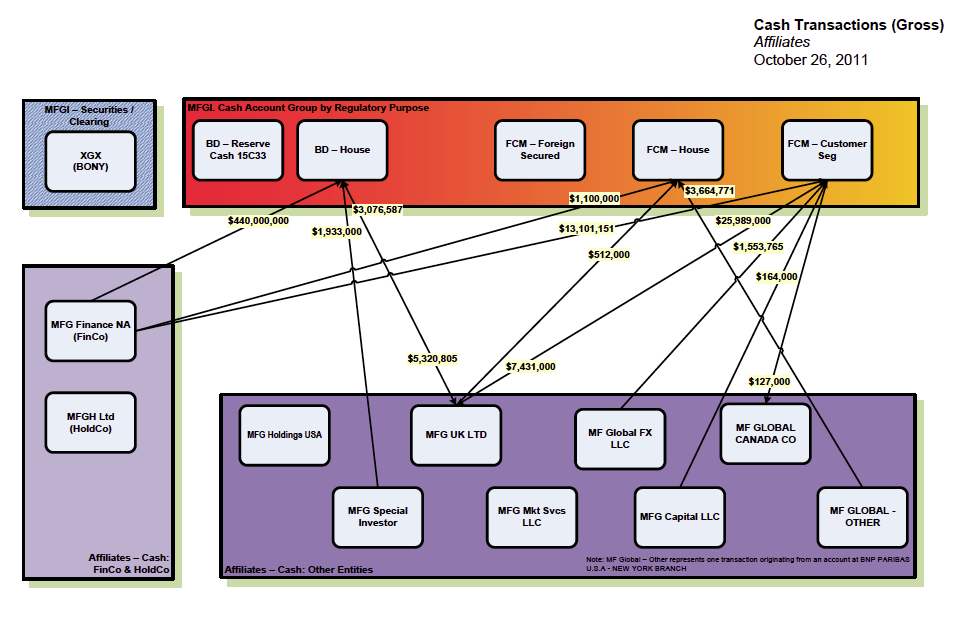
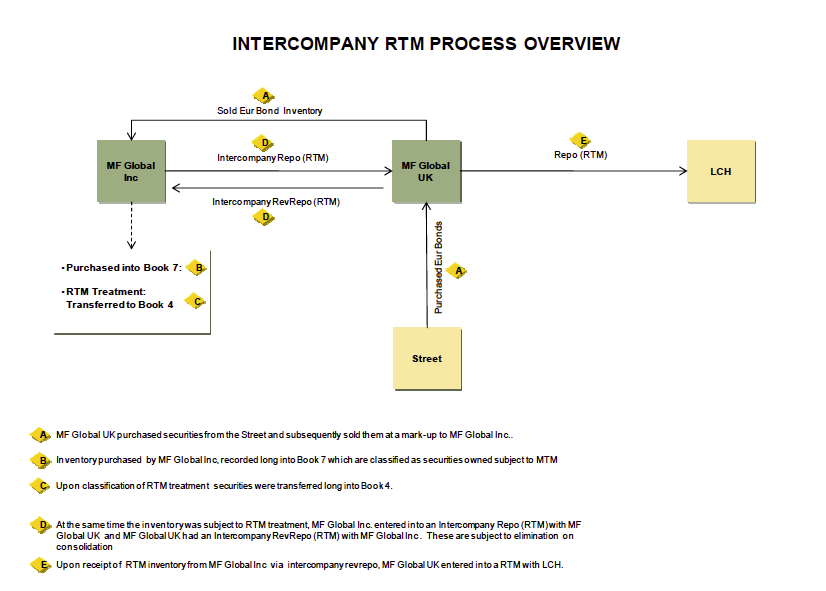
Click for full size


How they shuffled around funds to create the appearance of liquidity


And this is how they covered up their exposure

Yves Smith is all over the report by the bankruptcy trustee for MF Global.

I suggest that you read it, so I will show you to two graphics from the report, and remind you of “Saroff’s Rule”, “If a financial transaction is complex enough to require that a news organization use a cartoon to explain it, its purpose is to deceive.”

It appears that this applies to bankruptcy trustees as well as news orgs.

Go read, and wonder why John Corzine isn’t being frog marched out of his mansion in hand cuffs.

Billions for the Banksters, But Not One Cent for the Citizens

The European Commission is recommending a massive bailout for the banks, but nothing to help the citizens:

The European Commission has proposed that money set aside for helping governments should be used to bail out ailing banks directly.

The commission also pushed for more integration through a euro-wide “banking union” and a single deposit protection scheme to protect savers.

“Flexibility and speed are of the essence,” its head Jose Manuel Barroso said.

The call comes as fears over the health of Spanish banks have shaken markets.

Bankia, Spain’s fourth largest bank, has asked for another 19bn euros recently from Madrid, which itself is struggling to get spending under control to meet its deficit targets.

“To sever the link between banks and the sovereigns, direct recapitalisation… might be envisaged,” the commission said.

The commission’s comments are part of its analysis of Europe’s response to the debt crisis. “The economic situation in the euro area deteriorated significantly over the last year,” the commission said.

But the answer real pain of ordinary people is for them to suck it up.

This is f%$#ed up.

We Are Doomed

Felix Salmon explains how the insurance that is not insurance has wiped out the banks and turned them into casinos:

Entities who want to really take on credit risk are called banks, and they do so by lending. People who sell credit protection in the markets, by contrast, are traders and speculators who trust in the liquidity of the CDS market and who are sure that they will be able to get out quickly if things turn against them. And thus is the CDS market used shunt risks off, unseen, into the tails.

Liquidity isn’t just dangerous in the loan market. Look at houses, which used to be highly-illiquid investments characterized by a long-term relationship between a homeowner and a lender. When did things fall apart? When that relationship was replaced by a frenzy of securitization and refinancings, with even 30-year mortgages lasting for just a year or two before they were paid off by someone flipping their house or deciding they needed a cash-out refinance. The more liquid housing became — the closer it came to being piggy bank, to be tapped for cash at any time — the more dangerous it became, as well.

Mr. Salmon does not believe that the CDS will be banned, but I’d like to see them regulated as real insurance, which would prohibit the naked CDS, for the same reason that they don’t allow you to buy insurance that pays you when you torch your neighbor’s home.

That’s been the law of the land for 266 years, but about 20 years ago, we let it slide, with disastrous results.

Spain weighs Bankia debt issue – FT.com

Spain has nationalized the failing bank Bankia and it proposed recapitalizing it with Spanish government debt:

Spain is considering directly injecting its own government debt into BFA-Bankia to help fund the stricken lender’s €19bn nationalisation, in an attempt to sidestep borrowing money directly from the bond markets.

The plan, viewed as highly unorthodox by analysts, involves Madrid issuing Spanish government guaranteed debt to Bankia in return for equity, with the bank then able to deposit the bonds with European Central Bank as collateral for cash.

On Friday Bankia, Spain’s third-biggest lender by assets, announced that the state would invest €19bn in what will be the country’s largest ever bailout, with the government expected to control about 90 per cent of its shares.

This would have the effect of the ECB purchasing Spanish debt, which the ECB (the German Bundesbank) is opposed to.

It would be a win win for everyone, but since there is no pain for the ordinary Spaniard involved, the European Central Bank has rejected the deal:

A Spanish plan to recapitalise Bankia, the troubled lender, by indirectly tapping the European Central Bank for cash, was bluntly rejected as unacceptable by the ECB, European officials said.

News of the rejection came as Spain faces elevated borrowing costs in the bond markets, tries to persuade investors it can contain problems in a banking sector weighed down by €180bn of bad property loans and, on Tuesday, saw its central bank governor stand down early.

Madrid had floated the unorthodox idea over the weekend of recapitalising Bankia by injecting €19bn of sovereign bonds into its parent company, which could then be swapped for cash at the ECB’s three-month refinancing window, avoiding the need to raise the money on bond markets.

The ECB told Madrid that a proper capital injection was needed for Bankia and its plans were in danger of breaching an EU ban on “monetary financing,” or central bank funding of governments, according to two European officials.

At this point, the best action for the Spanish government is to allow the bank to default on its bonds (not its deposits), where I am certain that German bank exposure is high.

The Spanish should not make the same mistake as the Irish.  Do not make the bondholders whole.

If you do, you are simply taxing your citizens to fund foreign investors bets.

There is no obligation, either legally or morally, to do so.

H/t Eschaton

You Have It Backwards

Howie Klein wonders, “Do ALL The Members Of The House Financial Services Committee Take Bribes From The Banksters?

He has it backwards. The HFCS is a bloated and overstaffed committee, with two or three times the members that it actually needs, and it does this, because it’s known as a “money” committee.

Basically, people are put on it so that they can fund raise from the banksters.

It’s less of a bribe than it is a shakedown.

The purpose of the committee at its current size is to facilitate taking legalized bribes from the financial services industry.

Pass the Popcorn…


Pass the Popcorn

It looks like former TARP Inspector General Neil Barofsky is writing a tell-all memoir about his experiences with the Bush and Obama administration:

From December 2008 until March 2011, Barofsky was the Special Inspector General charged with oversight of TARP, working to ensure against fraud and abuse in the spending of the $700 billion allocated for the bailouts. From the start he was in constant conflict with the officials at the Treasury Department in charge of the bailouts who were in thrall to the interests of the big banks and steadfastly failed to hold them accountable, even as they disregarded major job losses caused by the auto bailouts and failed to help struggling homeowners. Barofsky recounts how his reports of a wave of criminal mortgage fraud and other abuses being perpetrated against homeowners in connection with programs that the Treasury itself set up were ignored time and again.

Barofsky offers detailed accounts of the behind-the-scenes conflicts and his struggles with Treasury Secretary Timothy Geithner, the Bush appointed “TARP Czar” Neel Kashkari and his successor, the Obama appointed Herb Allison, and others. His revelations show in stark detail just how captured by Wall Street our political system is; why the banks have not been held accountable; and how the failure to enact effective regulation has put the country in danger of an even bigger crisis in the future.

I can’t imagine that either Obama or Geithner are happy about this.

DINOs, F%$# ‘Em

Gee, a bunch of the Democrats In Name Only are objecting to the Obama campaign’s ads criticizing Romney’s tenure as head of Bain Capital.

You know, if you took their dicks out of your mouth, and realized that campaign donations from rich looters are not the be all and end all, you would realize that this is a political winner:

Some influential Democrats on and off Capitol Hill are refusing to give President Obama political cover for his attacks on Mitt Romney’s record at Bain Capital.

Despite pushback from more than a half-dozen Democrats, the Obama campaign on Tuesday defended how it has scrutinized Romney’s business background.

The business model of private equity firms is to make money by either flipping, or leveraging firms, to extract value.

They are the financial equivalent of automotive chop shops.

Two …… Three … Seven Billion

It looks like their losses for JP Morgan’s bad day at the casino might increasing.

In any case, it’s bad enough that they are dropping a stock buyback,:

The crisis at JP Morgan escalated yesterday as it emerged its trading losses in London could rise to as much as $7bn (£4.5bn) and the US bank cancelled a share buyback. Fears were growing that the losses could spiral from an initial $2bn, which was declared on 10 May, as JP Morgan struggles to unwind the massive bets made by the so-called “London Whale” trader Bruno Iksil.

In a further blow, chairman and chief executive Jamie Dimon has suspended plans to use the US bank’s own funds to buy back $15bn worth of shares. Buybacks are a popular way for firms to use up cash sitting on the balance sheet and prop up the share price.

I’m inclined to believe that the losses are going to get a lot worse.

Stock buybacks are all about management making sure that shareholders won’t feel inclined to try to fire them.

They are bailing out the boat, and they decided that they needed to toss out the life-jackets to lighten the load.

Not good.

Trust Timothy “Eddie Haskell” Geithner to Do the Right Think…

When there is absolutely no alternative to doing the right thing.

It looks like little Timmy is Treasury Secretary speak to tell Jamie Dimon to get the f%$# off the board of the New York Bank of the Federal Reserve following his little $2 billion (actually $3 billion) screw-up at JP Morgan Chase:

In an interview Thursday on PBS NewsHour, Jeffrey Brown and Treasury Secretary Tim Geithner had the following exchange:

“JEFFREY BROWN: Do you think Jamie Dimon should be off the board [of the New York Federal Reserve Board]?

TIMOTHY GEITHNER: Well, that’s a question he’ll have to make and the Fed will have to make. But again, on the basic point, which is it is very important, particularly given the damage caused by the crisis, that our system of oversight and safeguards and the enforcement authorities have not just the resources they need, but they are perceived to be above any political influence and have the independence and the ability to make sure these reforms are tough and effective so we protect the American people, again, from a crisis like this. And we’re going to, we’re going to do that.”

In the diplomatic language of Treasury communications, Mr. Geithner just told Jamie Dimon to resign from the New York Fed board (here is the current board composition).  It looks bad – and it is bad – to have him on the board of this key part of the Federal Reserve System at a time when his bank is under investigation with regard to its large trading losses and the apparent failure of its risk management system.  (Update: Mr. Dimon is on the Management and Budget Committee of the NY Fed board; here is the committee’s charter, which includes reviewing and endorsing “the framework for compensation of the Bank’s senior executives (Senior Vice President and above)”.)

Simon Johnson thinks that Dimon will ignore him, and I agree.

Geithner is the banksters bitch, and is not sincere in his request.  He just wants the appearance of getting tough on malfeasance in the financial sector, not the reality.

Another Shoe Drops for JP Morgan

That $2 billion that they lost in obscure casino games? Well now it’s at least 3 billion:

The trading losses suffered by JPMorgan Chase have surged in recent days, surpassing the bank’s initial $2 billion estimate by at least $1 billion, according to people with knowledge of the losses.

When Jamie Dimon, JPMorgan’s chief executive, announced the losses last Thursday, he indicated they could double within the next few quarters. But that process has been compressed into four trading days as hedge funds and other investors take advantage of JPMorgan’s distress, fueling faster deterioration in the underlying credit market positions held by the bank.

A spokeswoman for the bank declined to comment, although Mr. Dimon has said the total paper trading losses will be volatile depending on day-to-day market fluctuations.

We’re going to end up bailing out these ratf%$#s in the next few years, mark my words.

It will either be directly, or indirectly through their counter-parties.

The EU Bureaucracy Isn’t Completely Stupid

The EU’s financial services regulator is proposing allowing for a binding shareholder vote on executive compensation:

Shareholders in Europe’s listed companies will be given a binding vote on pay while those who invest in banks will gain powers to set a cap on bonus levels, under plans being drawn up by senior EU officials.

The initiative from Michel Barnier, the EU’s top financial services regulator, would hand bank investors the voting power to curb “morally indefensible” pay and limit the gap between the lowest and highest paid. Banks would also be forced to disclose their top 20-30 earners.

The French commissioner outlined his plans in an interview with the Financial Times in which he laid out his response to pay rebellions that have rattled executives at Barclays , Citigroup and AstraZeneca .

“I like that expression – the shareholder spring – or even a regulation spring, a rule-making spring,” he said. “I’m very attentive to this movement which I see as very positive. It corresponds with what I’ve been doing for the last two years. We need to put responsibility and transparency everywhere.”

Your mouth to God’s ear, Mr. Barnier.

How the ECB Will Destroy the Euro Zone

It’s now beginning to look like Greece will end up leaving Euro Zone.

The problem is that the EU is a consensus body, so Greece would have to agree to leave.

The solution is therefore to create conditions that are so onerous that Greece will have to leave.

The problem is that the only way that they can really do this is by crashing their banking system so that the only alternative is to leave the currency union.

The problem is that everyone knows this, and so we are seeing a slow-motion bank run in Greece, and we’re likely to see one in the rest of the peripheral nations:

Clever, huh? The only hitch is that, now that the game plan is becoming clear, rational Greeks are not choosing to wait for an EZ attack before withdrawing their funds from Greek banks and transferring them somewhere, anywhere, else. There is a gradually accelerating bank run taking place which is likely to reach criticality before a Greek-EZ policy showdown can take place.

There is a broader lesson here. By threatening to choke the Greek banking system, the EZ implicitly threatens to do the same for Spain or even Italy. They can say otherwise, but why should depositors in shaky peripheral banks believe them? Withholding euros from peripheral banking systems is a gun that goes off before it is fired. Simply brandishing this weapon is causing havoc and speeding the demise of the entire zone.

Better to put the gun away and do what should have been done all along: have the ECB assume the lender of last resort function for all EZ banks, with centralized financing of deposit insurance in particular. Don’t use the threat of a financial panic as a policy tool.

Greece should never have been a part of the Euro Zone, and considering the fact that they have more in common with the 3rd (corruption, dynastic politics, tax evasion, huge underground economy, etc.) world than they do with Western Europe, it’s arguable that they should never have been brought into the EU.

But most of the problems here, and what will cause the collapse of the Euro if it is not corrected, is that the basic system is fundamentally flawed.

It is pro-cyclical, it seems to be structured primarily for the financial industry, and it has no mechanism to address imbalances between member states.

If they continue on this path, it won’t just end the Euro Zone, it could cause a breakup of the EU.

So Not Shocking

Matt Taibbi is looking at documents from the Overstock.com case against the banksters, and discovers some remarkably informative unintentional release of information:

The lawyers for Goldman and Bank of America/Merrill Lynch have been involved in a legal battle for some time – primarily with the retail giant Overstock.com, but also with Rolling Stone, the Economist, Bloomberg, and the New York Times. The banks have been fighting us to keep sealed certain documents that surfaced in the discovery process of an ultimately unsuccessful lawsuit filed by Overstock against the banks.

Last week, in response to an Overstock.com motion to unseal certain documents, the banks’ lawyers, apparently accidentally, filed an unredacted version of Overstock’s motion as an exhibit in their declaration of opposition to that motion. In doing so, they inadvertently entered into the public record a sort of greatest-hits selection of the very material they’ve been fighting for years to keep sealed.+

………

The lawsuit between Overstock and the banks concerned a phenomenon called naked short-selling, a kind of high-finance counterfeiting that, especially prior to the introduction of new regulations in 2008, short-sellers could use to artificially depress the value of the stocks they’ve bet against. The subject of naked short-selling is a) highly technical, and b) very controversial on Wall Street, with many pundits in the financial press for years treating the phenomenon as the stuff of myths and conspiracy theories.

Now, however, through the magic of this unredacted document, the public will be able to see for itself what the banks’ attitudes are not just toward the “mythical” practice of naked short selling (hint: they volubly confess to the activity, in writing), but toward regulations and laws in general.

“F%$# the compliance area – procedures, schmecedures,” chirps Peter Melz, former president of Merrill Lynch Professional Clearing Corp. (a.k.a. Merrill Pro), when a subordinate worries about the company failing to comply with the rules governing short sales.

We also find out here how Wall Street professionals manipulated public opinion by buying off and/or intimidating experts in their respective fields. In one email made public in this document, a lobbyist for SIFMA, the Securities Industry and Financial Markets Association, tells a Goldman executive how to engage an expert who otherwise would go work for “our more powerful enemies,” i.e. would work with Overstock on the company’s lawsuit.

(%$# mine)

Here’s the nickel version.

Short selling works as follows:

  • Locate the requisite shares of stocks.
  • Borrow them (and pay a fee).
  • Sell the borrowed shares.
  • Wait.
  • Buy shares, and return to borrower.

If the share price falls in the interim, you make money.

If it rises, you lose money.

Fairly simple and straightforward, and legal.

What isn’t legal is naked shorting, where you sell the shares, but have never borrowed them.

At one point, because of naked shorts, 107% of all outstanding shares were for sale, with the obvious effect of depressing the stock price (supply and demand), which pretty much guarantees a profit by short sellers, and you do not have to pay fees to borrow the stock.

It’s a win-win for everyone, except of course, the poor dupes who think that they won’t get ripped off by the banksters when they try to invest.

JP Morgan Chase Goes Wile E. Coyote

So, JP Morgan Chase just lost at least $2 billion in ill conceived derivatives trades:

JPMorgan Chase & Co. (JPM) Chief Executive Officer Jamie Dimon said the firm suffered a $2 billion trading loss after an “egregious” failure in a unit managing risks, jeopardizing Wall Street banks’ efforts to loosen a federal ban on bets with their own money.

The firm’s chief investment office, run by Ina Drew, 55, took flawed positions on synthetic credit securities that remain volatile and may cost an additional $1 billion this quarter or next, Dimon told analysts yesterday. Losses mounted as JPMorgan tried to mitigate transactions designed to hedge credit exposure.

“There were many errors, sloppiness and bad judgment,” Dimon said as the company’s stock fell in extended trading. “These were egregious mistakes, they were self-inflicted.”

The chief investment office was thrust into the debate over U.S. efforts to ban proprietary trading when Bloomberg News reported last month that the unit had taken bets so big that JPMorgan, the largest and most profitable U.S. bank, probably couldn’t unwind them without losing money or roiling financial markets. Dimon, 56, had transformed the unit in recent years to make bigger and riskier speculative trades with the bank’s money, five former employees said.

Just so you know, the “Synthetic credit securities” mentioned means that this is basically pure gambling.  There is no ownership or insurance interest in the underlying investment.

It’s not surprising that the SEC has decided to look at this.

As a result of this blowup, Fitch’s and S&P have downgraded the bank.

Henry Blodgett accurately obaserves that, “It’s Just Kids Playing With Dynamite“.

Rather unsurprisingly, advocates of more regulation of the financial industry, are calling for an aggressive implimentation of the Volker rule.

Of course, Jamie Dimon does not think that this shows a need for more regulations, because, “Just because we’re stupid doesn’t mean everybody else was.”

No, actually,  you’re all stupid f%$3s, and you blew up our economy 4 years ago, and the taxpayer dumped more money into you keeping you afloat than we spent on the WW II.

Why no senior banksters have been indicted is beyond me.

Buh Bye Sarko (and Greece)

In what has been forecast in the polls for weeks (months?) Francois Holland defeated president “Bling Bling”:

Socialist Francois Hollande defeated conservative incumbent Nicolas Sarkozy today to become France’s next president, heralding a change in how Europe tackles its debt crisis and how France flexes its military and diplomatic muscle around the world.

Exuberant, diverse crowds filled the Place de la Bastille, the iconic plaza of the French Revolution, to fete Hollande’s victory, waving French, European and labor union flags and climbing its central column. Leftists are overjoyed to have one of their own in power for the first time since Socialist Francois Mitterrand was president from 1981 to 1995.

“Austerity can no longer be inevitable!” Hollande declared in his victory speech Sunday night after a surprising campaign that saw him transform from an unremarkable, mild figure to an increasingly statesmanlike one.

It helps to be standing next Nicolas Sarkozy. Standing next to him, I would look “increasingly statesmanlike.”

I think that the money quote is toward the end:

People of all ages and different ethnicities celebrated Hollande’s victory at the Bastille. Ghylaine Lambrecht, 60, who celebrated the 1981 victory of Mitterrand at the Bastille, was among them.

“I’m so happy. We had to put up with Sarko for 10 years,” she said referring to Sarkozy’s time as interior and finance minister and five years as president. “In the last few years the rich have been getting richer. Now long live France, an open democratic France.”

I think that Sarkozy showed everyone who he really was when he decided pander to bigots when it looked like he was losing.

It’s also a referendum on Angela Merkel, who, in a real breach of the political norms, openly endorsed Sarko in the election.

That being said (I really use that phrase too much, don’t I), if the French rejected the idea of Merkel as ally, the Greeks pretty much firebombed the Reichstag:

Alexis Tsipras became the surprise package of the Greek election by telling Angela Merkel to get lost.

“The people of Europe can no longer be reconciled with the bailouts of barbarism,” Tsipras, 37, said on state-run NET TV late yesterday after his Syriza party unexpectedly came second in the country’s election. “European leaders, and especially Ms. Merkel, should realize that her policies have undergone a crushing defeat.”

Tsipras’s calls to tax the rich, delay debt repayments and cut defense spending struck a chord with voters angry at austerity measures imposed by the European Union and the International Monetary Fund in return for bailouts. As far as euro membership is concerned, Tsipras told voters that a Greek exit would put the currency itself in jeopardy and they shouldn’t feel “blackmailed” into more austerity.

The result put Syriza ahead of the Socialist Pasok party, potentially derailing efforts to implement the terms of the country’s financial lifeline. Syriza, which means Coalition of the Radical Left, won 16 percent of the vote, projections showed. That exceeded the 13 percent won by Pasok, one of the two pillars of the political establishment since 1974. New Democracy, led by Antonis Samaras, topped the poll with 20 percent.

The result, the best since the party was founded in 2004, puts Tsipras in a position to try and form a government should New Democracy fail to put a coalition together in the first round of talks.

BTW, New Democracy has already given up on forming a government, because together they can’t get anyone but the Socialists (Pasok) to agree to continuing austerity.  (Merkel and the EE demanded that both leading parties agree to the terms in order to get the loans, with the predictable result that both together got about ⅓ of the vote.)

It’s pretty complex, because, in order to make a coalition without New Democracy and Pasok, almost all the other parties have to join the coalition, and somehow I don’t think that the Leftist Tsipras, the Communists, and the Neo-Nazi in everything but name Golden Dawn will find common ground.