Category: Food

Get Ready to Eat Tainted Meat from China

The WTO has just ruled that country of origin labels on meat are a violation of trade agreements:

Today’s ruling by a World Trade Organization (WTO) compliance panel against U.S. country-of-origin meat labeling (COOL) policies sets up a no-win dynamic, and the Obama administration should appeal the ruling, Public Citizen said.

If the administration were to weaken COOL, U.S. consumers would lose access to critical information about where their meat comes from at a time when consumer interest in such information is at an all-time high and opposition would only grow to the administration’s beleaguered trade agenda. If the administration again were to seek to comply with the WTO by strengthening COOL, then Mexico and Canada – the two countries that challenged the policy – likely would continue their case, even though cattle imports from Canada have increased since the 2013 strengthening of the policy.

The ruling further complicates the Obama administration’s stalled efforts to obtain Fast Track trade authority for two major agreements, the Trans-Pacific Partnership and the Trans-Atlantic Free Trade Agreement. Both of these pacts would expose the United States to more such challenges against U.S. consumer, environmental and other policies.

What Public Citizen does not get is that, “More such challenges against U.S. consumer, environmental and other policies,” is a feature, not a bug.

It is a goal of the neoliberal policy makers who create such deals to create a regulation free world.

They see it as leading to the Garden of Eden.

Me, I think that it’s more likely to lead to Lord of the Flies.

It Ain’t the Salt in the Pasta Water, and it Ain’t the Bread Sticks, It’s the Looting

Have you read the story about the hedge fund that criticized the Olive Garden restaurants for how they boiled their pasta and complained that they served too many bread sticks?

Read further, past the cute suggestions about food prep, and it becomes clear that the Starboard Value hedge fund was interested in srtip mining the real casual dining chain and leaving nothing behind but its bleached bones:

Last week, you may have noticed a kooky story about a hedge fund named Starboard Value chastising Olive Garden for handing out too many unlimited breadsticks at a time, and failing to salt its pasta water. The snarky 294-page presentation highlighted everything wrong with Olive Garden, along with recommendations to fix it. And there was much laughter.

………

Except Starboard Value does not spend its time crusading for better mid-market Italian meals for no reason. It owns a bunch of shares in Olive Garden’s parent company, Darden Restaurants, and wants to take control of the company’s board. The scheme it’s concocted to increase its share price has little to do with breadsticks and pasta water. It really wants to steal Olive Garden’s real estate, and make a billion dollars in the process.

Starboard Value doesn’t try to hide this. Right in the executive summary, it talks up Darden’s real estate holdings the way a starving man sizes up a steak. Darden, owner of LongHorn Steakhouse, Capital Grille and other chains, “has the largest real estate portfolio in the casual dining industry, owning both the land and buildings on nearly 600 stores and the buildings on another 670,” Starboard Value writes. “We believe that a real estate separation could create approximately $1 billion in shareholder value.” Here’s the actual slide:

This is a more common technique than you might realize. Private equity firms often buy businesses with lots of real estate assets, like nursing homes, restaurants or retail outlets. They then split the company in two: one owns all the real estate, and one manages the rest of the business. The operating company now has to lease back the real estate from the property company, paying rent on what it used to own. The private equity firm, meanwhile, can take profits from the lease payments or by selling the entire real estate portfolio, making back its initial investment. The more expensive the leases, the more the private equity firm makes.

………

A sale-leaseback arrangement may make sense for a company with lots of real estate holdings, if it needs quick cash to make investments and cannot access a loan. Think of it like a company making a reverse mortgage. But Eileen Appelbaum of the Center for Economics and Policy Research, co-author of a recent book called “Private Equity at Work: When Wall Street Manages Main Street,” explains the key difference. “If the company does this themselves, they get to keep the money from the sale,” Appelbaum told Salon. “And they get to spend it to make improvements. In this case and the private equity case, the shareholders see the value.” Basically, Starboard Value wants to strip Darden’s assets, the Wall Street equivalent of pocketing the silverware.

Starboard Value has a history of asset-stripping. Earlier this year, it forced Wausau Paper to change CEOs and consolidate mills, moving out of the century-old headquarters that gave the company its name. Starboard Value demanded the company use some of those savings from laying off workers to pay Starboard a dividend.

In May, Starboard Value forced Darden to sell another of its chains, Red Lobster, to private equity fund Golden Gate Capital for $2.1 billion. The same day, Golden Gate sold the real estate of 500 Red Lobster locations to a real estate investment trust (REIT) for $1.5 billion. Darden used proceeds of the sale to give dividend payments to shareholders like Starboard Value. And Golden Gate made back most of the investment in a blink with the real estate sale. But Red Lobster now has to pay exorbitant rents on its restaurants. “The sale-leaseback will cut their net earnings roughly in half,” Eileen Appelbaum estimated.

If Olive Garden has to cut its earnings in half to pay rent on properties it previously owned, you can forget about upgrading the menu or making any of the other improvements Starboard Value suggests. The restaurants will barely be able to keep afloat. But Olive Garden’s continued existence is of minimal importance to Starboard Value. “These are shareholders, they don’t really care what happens once they make their money,” said Eileen Appelbaum.

Note here that the ratf%$S who want to dismantle the chain, and sell it for parts, much like an chop shop for stolen cars.

This is what tools like Timothy Geithner call financial innovations. It’s not. It’s a pernicious form of parasitism.

As the old saying goes, “The best way to rob a bank is to own one.”

While a modern economy need a way to get capital from people who have it to people who need it, this has nothing to do with that.

I’m not sure what the whole solution is, but a Tobin Tax on financial transactions would be a good start.

Locking up some of these crooks would be nice too.

It’s July 4th

We just finished watching the Catonsville fireworks show, and before that, we did a cookout at Patapsco State Park.

The weather was glorious, clear and with a high in the 70s.

It actually got a bit nippy while we were watching the fireworks.

It’s the coolest Independence Day I can remember since moving to Maryland.

Posted via mobile.

LambBaaacon, It’s Amazing

As I mentioned earlier, I competed at the Trial by Fire cooking competition.

The cooking went well, but the time limits, juxtaposed with some chronic lateness issues, did me in on the competition part.

There was also a separate competition specific to bacon, called the Bacon Challenge.

I stumbled upon a kosher lamb bacon, Lambbaaacon, which is pretty remarkable.

It is very much an an artisinal bacon, which means that it has some layers of flavor that one would not expect from stuff from the store.

Also note, no nitrites, and thus no carcinogenic nitrosamines, but it also means that it does not have the characteristic reddish hue of normal bacon.

It is an amazing piece of work, because the Silberberg brothers have absolutely nailed the mouth feel of bacon, and added to the normal flavor (strong hints of lamb, of apple, and their amazing spice cure).

In any case, I decided to go with a somewhat older, and more Irish version of New England Boiled dinner, bacon and cabbage.  (pictured)

It came out very nicely, and gave a marvelous flavor to the cabbage (and potatoes, and carrots, and rutabegas, and onions).

Win.

Recipe (and funny cartoon) after the break


Ingredients:

  • 2-3 lbs of lamb bacon (Baaacon)
  • 2 medium heads of cabbage, cut into eights.
  • 2 rutabagas, peeled and cut in eights.
  • 8 carrots peeled and cut to 1″ lengths.
  • 15 small red potatoes
  • 2 medium onions, cut in quarters.
  • 2 tbsp pickling spice
  • 2 Bay leaves
  • 1 tbsp peppercorns
  • 2 tbsp minced garlic

Place the meat in a large pot along with enough hot water to cover it by at least 1″, and add spices.

Bring to a boil, then simmer bacon until fork tender , then remove from pot, and wrap in aluminum foil, and place on pot to keep warm.

Remove floating bits of spice if so desired.

Add carrot and rutabaga and simmer for 20 minutes, then add cabbage, onions, and potatoes for an additional 15-20 minutes, until the potatoes are fork tender.

Remove vegetables with a slatted spoon, and place on a platter, and with the bacon.

I am a F&@#ing Moron

The Cornish pastys did not cook properly last night.

They just were not getting done.

This morning, it hit me:  the recipe called for them to be cooked at 210° (165° with a convection oven).

Only the recipe is METRIC, not English, so 210°/165° C is 410°/330° F.

So I will be taking my not particularly cooked pastys from the fridge and putting it in the oven at the appropriate temperature.

Posted via mobile.

Trying New Things………

Cornish (Devonian) pastys just went into the oven.

First time I’ve ever tried them.

I used a very basic recipe (PDF).

To the Americans out there, “Swede” is Rutabaga.

We will see how it goes.

Filling (beef, swede, potatoes, and onions with salt and pepper) seems pretty simple, but I am concerned about the theoretically but not really as simple crust (flour, water, various fats, salt).

As an FYI, the oldest record of a pasty is in neighboring Devon, not Cornwall, so, notwithstanding the EU’s Protected Geographical Indication (PGI) designation of the savory pastry.

But Remember, By Law this Vote is Non-Binding

Following an abysmal performance, Chipotle shareholders voted against pay raises for senior executives:

Investors in Chipotle Mexican Grill voted overwhelmingly on Thursday against the company’s executive compensation plans, sending a strong rebuke to a company that had awarded more than $300 million to its co-chief executives in recent years.

More than 75 percent of investors voted against Chipotle’s say-on-pay measure, which asked investors to ratify a compensation plan that would continue such payments to Steve Ells, Chipotle’s founder, and his co-chief, Montgomery F. Moran, over the next few years. That was the highest vote against any say-on-pay measure among the country’s largest 3,000 companies this year.

Though the vote is nonbinding, Chipotle said it was taking investor sentiment into consideration.

“We take this very seriously,” a Chipotle spokesman, Chris Arnold, said in a statement. “It has always been, and continues to be, a top priority that our compensation programs are driving the creation of shareholder value. We thank our investors for the feedback we have received on this issue and will continue to engage with our investors as we review our compensation programs that build value for all of our investors.”

Shareholder discomfort with Chipotle’s multimillion-dollar executive compensation plans has grown. At last year’s meeting, 27 percent of shareholders voted against the say-on-pay measure. But in recent months, smaller investors, including the CtW Investment Group, have lobbied big institutional investors to join them in trying to rein in Chipotle’s executive pay.

Note however, this is a non-binding vote.

Binding shareholder votes on executive pay are forbidden by US law.

H/t Crooks and Liars.

I Want to be Sephardic

First, there is the food.

They got olive oil, we got schmaltz.

They sit on the spice road, and we got ……… schmaltz.

Over Passover, they get to eat rice and beans, legumes are known as kitniyot, which Ashkenazic rabbis have ruled could be made into something too close to flour, though this does not apply to things like chestnuts, whose flour is actually used to make pastries. (Go figure)

Well, Rabbis have now declared marijuana to be kitniyot, and hence forbidden on Pesach, so no 420 on 4/20:

It’s that time of the year again — Passover and 4/20, the unofficial marijuana celebration day. On the same day.

The celebration of all things green poses a particular problem for the chosen people. Namely, is smoking pot kosher for Passover?

Sorry to disappoint, but it seems not.

In 2007, Israel’s Green Leaf Party, which supports the legalization of marijuana, declared that cannabis is among the substances Jews are forbidden to consume during Passover.

“You shouldn’t smoke marijuana on the holiday, and if you have it in your house you should get rid of it,” Michelle Levine, a spokeswoman for the party, said at the time.

Why? Because hemp seeds are considered to be kitniyot.

While biblical law prohibits eating leavened foods, rabbis have since extended the rules to apply to foods like beans, corn and rice. Hemp seeds, found in marijuana, falls under that category. So voila, no Mary-Jane for you — if you’re Ashkenazi that is.

Sephardic Jews have traditionally been allowed to eat kitniyot during Passover, so when it comes to 4/20, they’re in the clear.

I’m seriously bumming, even if I have not indulged in over 20 years. (The joys of a pee in a cup career)

H/t my hairier brother, who posted this to Facebook.

Would You Like a Loss of Civil Rights with Your Breakfast Cereal?

General Mills is looking to make binding arbitration mandatory for people who take their lives into their hands when they eat their food:

Might downloading a 50-cent coupon for Cheerios cost you legal rights?

General Mills, the maker of cereals like Cheerios and Chex as well as brands like Bisquick and Betty Crocker, has quietly added language to its website to alert consumers that they give up their right to sue the company if they download coupons, “join” it in online communities like Facebook, enter a company-sponsored sweepstakes or contest or interact with it in a variety of other ways.

Instead, anyone who has received anything that could be construed as a benefit and who then has a dispute with the company over its products will have to use informal negotiation via email or go through arbitration to seek relief, according to the new terms posted on its site.

In language added on Tuesday after The New York Times contacted it about the changes, General Mills seemed to go even further, suggesting that buying its products would bind consumers to those terms.

“We’ve updated our privacy policy,” the company wrote in a thin, gray bar across the top of its home page. “Please note we also have new legal terms which require all disputes related to the purchase or use of any General Mills product or service to be resolved through binding arbitration.”

………

The change in legal terms, which occurred shortly after a judge refused to dismiss a case brought against the company by consumers in California, made General Mills one of the first, if not the first, major food companies to seek to impose what legal experts call “forced arbitration” on consumers.

“Although this is the first case I’ve seen of a food company moving in this direction, others will follow — why wouldn’t you?” said Julia Duncan, director of federal programs and an arbitration expert at the American Association for Justice, a trade group representing plaintiff trial lawyers. “It’s essentially trying to protect the company from all accountability, even when it lies, or say, an employee deliberately adds broken glass to a product.”

You have problem with Corporate Capitalist ™®©, comrade?*

We really need to pass Al Franken’s Arbitration Fairness Act, and put an end to this bullsh%$.

*H/t CZ at the Stellar Parthenon BBS for this quote.

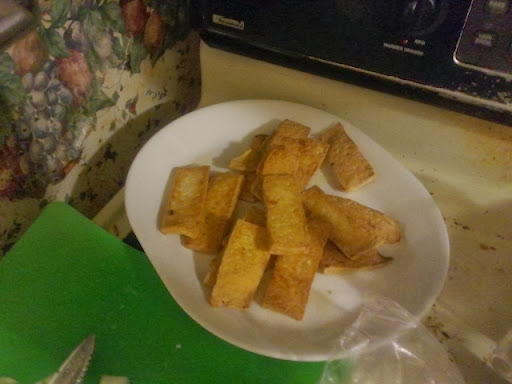
Tofu Fingers

Whenever I do tofu stir-fry, a common dish at Chez Saroff, I find it hard to get a proper crust on the it.

The extremely high water content of bean curd makes it tough to brown, at least not without one of those huge stove burners that you find in Chinese restaurants.

I have come up with a solution:  Instead of cubing the tofu, I cut it into fish-stick sized pieces, which meant that they could be laid flat against a screaming hot skillet.

The greater surface area allows for proper browning.

Dafuque?!?!?!?


This is a sign of the apocalypse

I went to UMass from 1983 to 1987.

I got my degree there.

There was a fair amount of weirdness there when I went there.  I imagine that there is still a fair amount of weirdness there now.

At least, there is symmetry.

Still, nothing could prepare me fopr tne news that UMass was rated as having the best college food in the nation.*

I remember eating there.

I remember when my friends ordered pizza delivered to the cafeteria.

I remember when they served chicken pucks.  I remember when they served chicken pucks with tomato sauce and mystery cheese, and they called it “chicken parmesan.”  (I called it “scabs”, which my table partners did not appreciate.)

What the f%$# has happened to my alma mater?

*And yes, “having the best college food in the nation,” is a lot like being the, “World’s tallest midget,” or being the, “Nation’s most ethical Republican.”

Making Latkes for Thanksgivukah

Latkes from scratch at my mother-in-law’s.  (THANK GOD FOR FOOD PROCESSORS)

Unfortunately, because this is a collaborative cooking experience, there is a shortage of pans, so I am relegated to a tiny pan which can only handle 3 latkes at a time.

Chanukah in Thanksgiving, gotta love it.

No specific recipe for the latkes, just potatoes, onions, eggs, matzoh meal, salt, and pepper in proportions dictated by my gut.

My only specific advice is to grate the onions first, because the onions have a chemical that prevents the grated potatoes from changing color in the air.

Posted via mobile.