Category: Helicopters

X2 Advancing Blade Helo Proceeds Toward First Flight

Basically, the folks at Sikorski think that technological advances have made the advancing blade helicopter viable, most notably composites, active fly by wire control systems to reduce vibration, and improved propulsion (the late 1970s version X-59A ABC used two turbojets for forward thrust) (see also here)

By offloading the retreating blade, they hope to achieve cruise speeds in excess of 250 kts, and improved range.

I’m rather more sanguine on this than I am on the tilt rotor concept myself, because the tilt-rotor is really a plane that can take off vertically, while this is a helicopter that can fly faster.

It appears to have fewer compromises, and should have superior performance in the hover and low speed flight regime, which is the helicopter’s raison d’etre.

As Sikorski is self-funding this, I expect progress to be slow, they can’t afford a crash.

They’ve already pushed back first flight a couple of years from 2006, and now there is talk of pushing it back to 2009.

Also, Av Week‘s Bill Sweetman noticed a special ops mockup model of the concept at Farnborough:

Finally Found a DoD Project That’s On Budget and On Schedule

It’s the AH-64 Apache Block III Upgrade.

This is actually a non trivial upgrade:

The Block 3 improvements are pretty fundamental, requiring a new airframe, more than 1 million lines of code, a new transmission system, longer range and automatic recognition radar, UAV connectivity, the ability to communicate with a much wider range of platforms (but not stealthy aircraft), software that will help the air crew make rapid decisions and a host maintenance management systems that are expected to reduce the average flight hours lost to fixing and maintaining things by 30 percent.

And it appears that it’s working because of the basics, keeping up good lines of communications and avoiding requirement creep.

That last one seems to be the biggie in defense procurement fiascoes, which is why the entire spiral development model is problematic.

Stopped Rotor Still Being Pursued

Boeing has been working on stopped rotor concept helos, where the rotor is stopped and functions as a wing at high speed, for years, despite the crashes of both of its prototype X-50 canard rotor wing (CRW) demonstrators.

Well, it looks like they folks at Boeing, Mesa* have come up with a a less ambitious take on this concept that has not yet crashed.

It is significantly simplified, dispensing with the tip jet power for the main rotor, and using a conventional tail rotor, and the wings pivot, so as to reduce the amount that they reduce lift during takeoff.

Here we have:

Takeoff


Transition to low speed forward flight.


High speed compound helicopter mode.


Stopped rotor

*Formerly McDonnell Douglas helicopters, formerly Hughes Helicopter. They make the Apache.

Heavy Lift Helo/Blimp Hybrid

The idea of using balloons to make a helicopter arrangement lift more, because the rotors carry only the load, the airframe is neutrally buoyant, was tried before in the late 1986s, with the Piasecki PA-97, but it was a shoestring job with a seat of the pants attitude towards engineering, and on its maiden flight, a helo broke lose, and destroyed the aircraft, killing one of the 4 pilots.

This Boeing /Skyhook joint venture appears to be more thought out, and it offers good performance, with an estimated 200 mile range with a 40t payload.

That being said, I have always said that the first problem with lighter than air craft is that landing, even in a mild wind, becomes problematic.

When you consider that this is designed for operations in the, “niche market of commercial oil and mining companies operating in Canada’s far north,” I would also add the problem of operations in inclement weather.

I would also note that the cost of helium is going through the roof (been to a party supply store lately?), which will further crimp the project.

Russian Advanced Helo Concepts

The Russians are looking at advanced high speed helicopter concepts too (Paid Subscription Required):


Mil Mi-X1

Among the concepts are:

  • The Mi-X1, a 5 ton class aircraft with a top speed of around 450-500 km/h.
  • The Kamov Ka-92 which uses a coaxial rotor with retreating blades offloaded, much like Sikorsky’s X2 demonstrator.
  • The Ka-90, which has a rotor which folds down along the fuselage for high speed (700 km/h) flight.

Innovative Helo Update

Flight International is reporting that Sikorski’s X2 technology demonstrator is doing ground tests on its rotor system, and that Boeing’s A160T helo drone set an endurance record (18.7 hours) this month.

The former uses coaxial blades to offload the retreating blades, and allows for increased top speed, and the latter uses a variable speed rotor to increase efficiency to match the needs of the specific flight regime.

X2 technology demonstrator


A160 T

Defense Procurement Humor Down in Oz

It’s a rare thing when you can put the term together the term defense* procurement with humor in a coherent manner, but this press release from the Australian Department of Defence regarding the cancellation of the Seasprite Helicopter program, which was 5 years late, well over budget, and simply did not work:

SEASPRITE HELICOPTERS TO BE CANCELLED

In late 2007 the Rudd Labor Government initiated a review of the Seasprite helicopter project, in line with the promises made prior to the election.

After careful consideration of all the issues involved, the Government has decided that it intends to cancel the project. Discussions will be commenced immediately with the contractor in relation to the legal and financial arrangements to facilitate this.

The Government will announce the details of arrangements with the contractor once mutual agreement on these matters has been reached, subject to any confidentiality issues.

Minister for Defence Joel Fitzgibbon said the decision was not one taken easily, but the Government was left with little option.

“Today’s announcement demonstrates our determination to make tough decisions whenever required for the security of the nation and the safety and capability of our Defence Force,” Mr Fitzgibbon said.

“The decision taken by the Rudd Labor Government is one that should have been taken by the Leader of the Opposition, Brendan Nelson, when he had the opportunity last year, but his Government decided to put its own political interests ahead of the national interest. Consequently, the responsibility of cleaning up the mess they created falls to us,” Mr Fitzgibbon said.

To ensure the Navy maintains an effective naval aviation capability, the Government has decided on two measures. First, our interim approach will focus on improving the operational availability of the current Seahawk fleet. Second, the Government will investigate the planned replacement of the Seahawk during its White Paper deliberations.

“The new Government will continue to work through the long list of Defence capability nightmares it has inherited from the former government. We are determined to ensure that the Defence Force receives the capability it needs, and Australian taxpayers receive value for their money,” Mr Fitzgibbon said.

(Emphasis mine)

*DefenCe for those down in Oz.

Sikorsky’s REveals Successor to It’s ABC Concept

In the 1980s, Sikorsky had a test aircraft that they called the ABC (Advancing Blade Concept) helicopter. It used a coaxial rotor, and offloaded the retreating blades to eliminate retreating blade stall (as a helicopter goes faster, the blade going backwards goes more slowly relative to the air stream).

Sikorsky unveiled its successor, the X2 test aircraft at Heli-Expo:


It’s certainly a lot cleaner and more developed than its predecessor.

It also promises performance close to that of a tilt-rotor with the low speed handling and auto rotation of a helicopter.

After a 30 Year Absense, the Advancing Blade Helicopter Returns

I remember reading about this in my teens.

Eventually they went with the V-22 Osprey.

This is definitely better helicopter technology than the V-22, which is more a VTOL aircraft than a helo.

It remains to be seen where this might fit in.

My guess would be for an A-10 replacement that would be under army control, as it is not fixed wing.

One interesting fact, the ABC concept is well out of patent, so if the demonstrator works, other vendors could reverse engineer this technology.

X2 marks the spot for radical rotor designs-12/06/2007-Flight International

Sikorsky’s X2 helicopter programme has a mixed R&D heritage, and could be the model for the next generation of rotorcraft designs.

Along with broadening the realm of vertical lift, first flight of Sikorsky’s internally funded X2 compound helicopter demonstrator in the fourth quarter this year will also spotlight what may become the best model for introducing new civil and military rotorcraft designs – do it yourself.
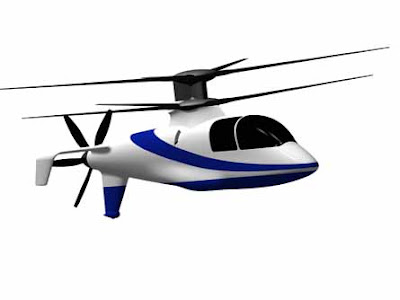

Sikorsky is hoping its X2 technologies will increase helicopter cruise speeds by nearly 100kt

The US government continues to invest in the basic and applied research that helps manufacturers create breakthrough aircraft. However, the prime focus for most funding has become results-oriented incremental component or operational efficiency improvements to aid the US military on the battlefield.

Though the X2 concept is the result of much of that government-funded R&D, the demonstrator itself is 100% Sikorsky funded, and features a frugality and simplicity that reflects who is paying the bill. The aircraft is being built from numerous off-the-shelf components scavenged from near and far to keep costs low so much so that Peter Grant, Sikorsky advanced programmes manager, affectionately refers to the two-seater as a “mongrel”. It uses dual rigid counter-rotating coaxial main rotors and a pusher propeller to reach cruise speeds of 250kt (462km/h), well beyond the 170kt maximum speed for conventional helicopters.

The X2 has a mixed heritage of government and industry R&D in rotor systems, propulsion, aerodynamics and controls technologies that will help it meet performance goals of high speed and “low” vibration – about the same vibration level as a traditional helicopter at its top speed of 140kt.

The X2’s chief predecessor, the XH-59A advancing blade concept (ABC) helicopter, was built by Sikorsky and funded by the US Army, NASA, Sikorsky and others. Two vehicles were built and readied in two years, starting in 1971, a time when the US government funded such experimental aircraft.

The goal was to test the premise that rigid counter-rotating main rotors, where the advancing blade on each side produces lift while both retreated blades are feathered, could be used reduce drag and tip velocities to allow for cruise speeds well above the norm for helicopters. During testing from 1973 to 1977, Sikorsky pilots reached 240kt with the help of two fuel-thirsty auxiliary turbojets.

Though it was successful, the flight-test programme proved that the concept was ahead of its time because the technologies needed to solve key issues – high vibration levels, tedious mechanical control mechanisms and inefficient power management – have only recently become available.

“We believe it now makes this configuration feasible for next generation helicopter flight,” says Grant.

The maturation was due in large part to government-funded research on military contracts, among them the Boeing-Sikorsky Comanche advanced light attack helicopter, cancelled by the US military in 2004, and its precursor, the Shadow programme, an S-76 with fly-by-wire (FBW) flight controls. Both provided the knowledge base for the X2’s flight controls.

The means to control vibrations came partly from the military-funded UH-60M Black Hawk upgrade programme. Coaxial rotor design expertise came partly from the Cypher programme, a vertical takeoff and landing unmanned air vehicle demonstrator that Sikorsky developed under a US Marine Corps contract.

Solving specific problem areas through directed research, rather than funding whole demonstrator aircraft, continues to be the R&D focus for the US government. Its research is largely provided by the US Army and NASA for basic and applied research, and the Defence Advanced Research and Projects Agency (DARPA) for long-term, high-risk and potentially lucrative projects.

….

X2 joint heavylift

Many key foundation technologies for Sikorsky’s JHL entrant, a much larger version of the X2, will be tested when the X2 demonstrator takes flight later this year. Included are active vibration control centralised around the transmission, a method designed to “short circuit vibrations at their origin”, says Grant. Sikorsky currently uses distributed active vibration damping systems for its production helicopters.

Once first flight is completed, Grant says his goal will be to get to high speed flight as quickly as possible. The company plans four phases of flight tests, beginning with hover and low-speed work later this year, followed by phases 2 to 4 throughout next year.