Category: IP

Why Friends Do Not Let Friends Link to the Associated Press

So, the AP continues on its jihad against fair use of its work.

They are looking at including “beacons,” which will track just who reads which article, in their work.

When they appeared on Facebook, there was a revolt over this.

I would also note that it appears that their target appears to be Google News, “”The problem we have now is that our stories are getting scraped and reused in large quantities by aggregators who haven’t paid any license fees,” according to Jane Seagrave, Senior VP for global product development at the AP.

You know, if they get what they want, Google news, and other news search pages, will drop them, and they will vanish from the public consciousness with barely a ripple, so go ahead, commit Seppuku.

The problem here is two fold, their clients, the newspapers, are getting their asses kicked by Craigslist and its ilk, and 2nd, major news sources, including the AP, have decided that having the one side tell the truth, and having the other side lie, in an article is balanced journalism.

It’s not, it’s stenography.

This sort of sh&% is why whenever I come across an AP story, I look for an alternate source, using those “aggregators” that they hate so much.

That Sound is George Orwell Spinning in His Grave at 4800 RPM

Amazon sold copies of 1984 and Animal Farm in E-Book format for use on its Kindle reader, and when the publisher objected, it removed the books from its store, and from the Kindles of people who had already purchased the books.

The people bought these books, and thought that they owned them, albeit without the option of donating them at a later time, etc., but they were wrong, and all traces were removed from their readers.

As both David Pogue and Boing Boing note, this mirrors a number of concerns that people have with the new IP regime, and how it will apply to digital data.

Of course, the fact that these books were consigned to the “memory hole”, a term created by George Orwell in his book 1984, the irony here is obvious:

In the walls of the cubicle there were three orifices. To the right of the speakwrite, a small pneumatic tube for written messages, to the left, a larger one for newspapers; and in the side wall, within easy reach of Winston’s arm, a large oblong slit protected by a wire grating. This last was for the disposal of waste paper. Similar slits existed in thousands or tens of thousands throughout the building, not only in every room but at short intervals in every corridor. For some reason they were nicknamed memory holes. When one knew that any document was due for destruction, or even when one saw a scrap of waste paper lying about, it was an automatic action to lift the flap of the nearest memory hole and drop it in, whereupon it would be whirled away on a current of warm air to the enormous furnaces which were hidden somewhere in the recesses of the building.

As I am wont to say, “Who says that irony is dead?”

Who Obama Is On “Free Trade”

Cap and trade barely passes the house, and Barack Obama is wringing his hands about how the tariff against nations with weaker measures, “At a time when the economy world-wide is still deep in recession, and we’ve seen a significant drop in global trade, I think we have to be very careful about sending any protectionist signals out there.”

Barack Obama is a smart guy. He knows that there are similar tariffs in countries that have a VAT, so that you cannot evade the tax by outsourcing production, and he knows that the economic consensus is that the absence of such measures distort free trade by subsidizing foreign manufacture of goods.

He also has to know that the WTO just signed off on these tariffs as legal, so long as they are not, “a means of arbitrary or unjustifiable discrimination or a disguised restriction on international trade”.”

He expresses these “concerns” because he believes that any restriction on the flow of goods and services,* is dangerous and bad.

He is a free market mousketeer who believes that free trade will, inexorably spread democracy throughout the world, raise everyone’s standard of living, keep ants away from your picnic, and keep your daughter from dating the guy with the tattoos and piercings.

Do not expect meaningful labor or environmental measures as a part of his free trade deals. They won’t happen.

*Except for IP, where excessive US copyright and patent restrictions must be adopted world wide.

ACLU Challenges Gene Patent

The ACLU is arguing that Myriad Genetics’ holding a patent on two genes associated with various forms of cancer, BRCA1 and BRCA2, is not a legal use of the patent process.

I got some training in engineering schools on patents, and it was always made clear to us, by our non-lawyer professors, that a patent was for an invention, not a discovery, and it seems to me that these genes are the latter, not the former, but I’m an engineer, not a lawyer, dammit!*

Among other things, they are arguing not just that the patent should not have been granted, and I agree with that, because at its core IP is an infringement on every one’s rights in order to, “To promote the Progress of Science and useful Arts,” as it says int he constitution, and it is clear that by patenting a gene, they are not doing this.

Additionally, the ACLU is saying that the way that Myriad is violating the first amendment:

As the A.C.L.U. explored the restrictions on competition that companies like Myriad had put in place — blocking alternatives to the patented tests, and even the practice of interpreting or comparing gene sequences that involved those genes — the restrictions started to look like not just a question of patent law, Mr. Hansen said, but of the First Amendment’s guarantee of free speech as well.

I’m not sure if that would fly, since, after all, IP has at its core the restrictions of the rights of everyone for a perceived public benefit.

As to the reason as to why the patent examiners approved it?

The decision to allow gene patents was controversial from the start; patents are normally not granted for products of nature or laws of nature. The companies successfully argued that they had done something that made the genes more than nature’s work: they had isolated and purified the DNA, and thus had patented something they had created — even though it corresponded to the sequence of an actual gene.

This is bullsh%$. They are arguing that they can patent a discovery, because it’s hard work.

Here’s hoping that they win, because the current patent regime in the US is hamstringing economic development and innovation in our society, which is the exact opposite of its intended purpose.

*I LOVE IT when I get to go all Doctor McCoy!!!

EU Parliament Votes for Sanity

A number of copyright numnuts, in particular Nicholas Sarkozy, want the law to require ISPs to take down an account on an accusation from a license holder, but the Euro Parliament passed language saying that any take-down has to be in court:

But a battle has exploded in the last few weeks over a parliamentary amendment that aimed to prevent countries from passing legislation similar to France’s ‘three-strikes’ bill that would cut off internet access if users are repeatedly caught downloading music, films and other content without permission of the copyright holder.

France, wanting to save what has become a flagship piece of legislation for President Nicholas Sarkozy, whose wife is a pop star, lobbied other member states heavily on the issue.

Catherine Trautmann, the deputy responsible for shepherding the legislation through the parliament, said she was confident that the wording in the compromise meant that a court order was required before access could be cut.

French culture minister Christine Albanel meanwhile believed that the compromise meant that websurfers who had their internet access cut had a right to judicial appeal – but only after the deed had been done.

The deal unravelled on Wednesday morning however, when the full sitting of the parliament supported a late amendment 407 to 57, with 171 abstentions, re-inserting stronger language requiring governments to obtain a court ruling before access can be cut.

(emphasis mine)

I guess Sarko is big on this because he just knows that record distributors and movie studios are such honest and empathic people that they would never abuse this power.

This will probably push the bill into the next session, which promises to have even more consumer advocates.

Two snaps up.

Copyright Maximalists Lose One

CBS runs a fantasy football league, and the NFL, and NFLPA were threatening a lawsuit over the ownership of the statistics and player names so CBS got to court first, and won a judgment:

BS Corp.’s Internet unit won the right to use National Football League players’ names and statistics for free in fantasy sports leagues it sponsors after a judge ruled the information is in the public domain.

A federal appeals court decision in 2007 that companies operating fantasy leagues have a First Amendment right to use names and data of baseball players without paying a licensing fee applies to football as well, U.S. District Judge Ann Montgomery said in Minneapolis.

This is really basic stuff. You cannot copyright information in the United States, only unique expression or arrangement of that data, such as Westlaw’s citation system for court cases.

The statistics, and the attachment of them to player names, teams, and player numbers, is simply not a unique arrangement or expression of data.

That being said, restrictions of data under an IP regime is the end goal of copyright maximalists, and would make all of society a far poorer place.

F$#@ Kindle, This is Something that Will Revolutionize Publishing

It’s called the Espresso Book Machine, and it prints books on demand.

It literally prints the book and binds it in about 5 minutes from an order.

If you were to integrate a scanner/shredder to do book “returns”, you could eventually run a bookstore without any physical delivery, and only stock those books you sell, plus preprinting stock to put out on your shelves for the things that move faster.

Right now, it’s primarily handling out of copyright works, but the manufacturer is looking to add in copyright works.

List for the machine is about $175,000.00, but that should pay for itself fairly quickly, if just by generating sales that take 5 minutes to deliver, as opposed to 2 weeks, so the customer goes elsewhere.

The big problem, of course, is that book publishers will insist that this new technology will require an even higher profit margin on their part, just like record distributors did with CDs when they came out, even though they were cheaper than vinyl.

Unlike Amazon’s® Kindle®, they can’t turn a book into a $359.00 doorstop because you have a billing or return dispute.

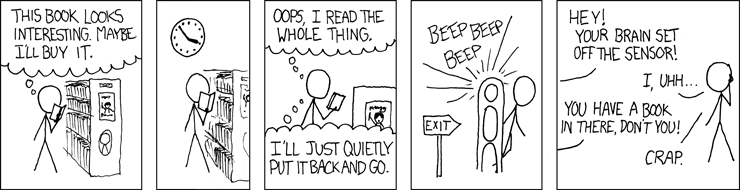
Of course, XKCD was all over this:

Or not, but it’s funny.

Pirate Bay Trial Judge Had Conflict of Interest

He belonged to 2 copyright advocacy organizations that one of the witness headed:

Norstrom is a member of The Swedish Association for Copyright, an organisation whose board includes Peter Danowsky, who represented the music and film industry in the trial, the group said on its website.

Norstrom said he did not believe his memberships had made him ineligible to preside over the trial.

Yeah, sure…..The head of the organization to which you belong is the lawyer litigating in front of you….

In any case, the defense is now asking for a new trial, and they are likely to get it.

Uruguay Round Agreements Act Held Unconstitutional

The case is Golan v. Holder (originally filed when Gonzalez was Attorney General), and challenged the provision of the URAA that restored copyright to out of copyright works, and rendered derivative works that had been made when there was no copyright illegal, and now a Federal District Court has ruled it an unconstitutional violation of the first amendment, after a remand from the appeals court (PDF of opinion at link).

This is the first time ever that, “a court has held any part of the Copyright Act violates the First Amendment and the first time any court has placed specific constitutional limits on the government’s ability to erode the public domain,” so it is very significant.

This differs from Eldred, in which the Supreme Court allowed copyright extension, in that the speech of the plaintiffs was already legally created, and so the change was an infringement on their legally created speech (derivative works of then public domain items).

It is my understanding, that this applies only to legally created derivative works, and one would assume, newly created derivatives of those derivatives, but not new derivatives of these works, but I’m an engineer, not a lawyer, dammit!*

In either case, this is a recognition that IP law is a restriction of the rights of the rest of society, and as such there needs to be a showing a serious state interest in order to override that, and this is IMHO, a major step forward.

*I LOVE IT when I get to go all Doctor McCoy!!!

Senate Judiciary Committee Approves Patent Update

It looks to me like the Patent Reform Act of 2009, is an improvement, the patent troll crowd are generally negative on it, and Senator Feingold’s statement in opposition suggests that it weakens patents too much, which is a good thing.

The real question is what happens in conference.

In my dream scenario, the patenting of software algorithms, tax deductions, business plans, genes, and species would be invalidated, and a litigant could file a suit against a patent as a plaintiff without having to infringe, as is done with civil rights suits.

Wanker of the Day: Henry Porter

Mr. Porter is complaining about Google and Youtube, because in negotiating with Performing Rights Society, the UK music licensing organization, Google, “took down the videos of the artists concerned,” when the PRS demanded £0.22, about $0.40, for each video watched.

I would be surprised if Google grosses $0.04 per video watched on Youtube, and they are demanding nearly half a dollar, so Google tells you to pound sand, and it appears that he’s also angry because Google “only” takes down infringing material promptly when notified, when required by law, as opposed to…well, it’s not clear, but he thinks it’s bad.

Tough.

This is where the idea of IP as “property” as opposed to “temporary exclusive license” gets us, and it does not encourage the useful sciences and arts, which is what it’s there for, at least in the USA.

I Guess that the AP Boycott by Blogs is Back On Again

Truth be told, I never ended mine, and have used alternate sources for stories where ever possible.

In any case, I try to post a link and a summary, and perhaps a sentence or two, which should fall under fair use.

The article, though is rather odd, as it keeps mentioning Google News and Yahoo, which runs no ads, and is a search service, which would generally be construed as fair use, and Huffington post, which licenses what it publishes from the AP.

Google Adopts Take No Prisoner Policy Against Patent Trolls

About 2 years ago, Google made a policy decision to stop settling law suits with patent trolls, including going after them for legal fees.

I think that we will see a lot more of this from companies with deep pockets, because paying people to make them go away has resulted in an explosion of law firms whose business model is to find dodgy undeveloped patents, and then use those to extract nuisance money.

It’s a protection racket.

It’s a good development, but the real solution is to change the law:

  • Eliminate the patent court, because when you create a body that just handles patents, patents handle everything.
  • Eliminate software, business plan, species, gene, and tax deduction patents (yes, you can patent a tax deduction).
    • Note that genetic technology can and should remain patentable, it’s the genes and the species that were not patentable until about a decade ago.
  • Treat patents like civil rights laws, allow the person who is restricted by the to file suit against the holder of the patent.

Patents are not about property, they are about encouraging innovation,* and our current regime is discouraging innovation.

*The Copyright Clause of the Constitution, “To promote the Progress of Science and useful Arts, by securing for limited Times to Authors and Inventors the exclusive Right to their respective Writings and Discoveries.” (emphasis mine)

The EU Gets a Major Case of the Stupids

The European parliament’s legal affairs committee just voted to extend copyright on music performances to 95 years. It was 50 years.

It has to go to the full parliament, but it’s likely to pass next month.

Stupid.

This won’t create any more performances, people don’t perform in the expectation of revenues on year 51, so it won’t create any more music, but what it will do is ensure that obscure works will be lost over time, because the difficulties of preserving and reproducing them will be too great.

Under the rules that they are proposing….Hell under the rules that they have now, Shakespeare’s works would have been forever lost to decay.

They would be gone, but we have to protect the f^%$ing mouse for another 45 f^%$ing years.

Friends Don’t Let Friends Link to the AP

__AP Photo__________“Hope” Poster

For a while now, I have been boycotting the Associated Press, because they established a policy to threaten legal action over copyright for people who link to them and quote a sentence or two.

With one notable exception,* I have avoided their stories, and used Google News to find an alternate when I found a story of theirs.

Well, the Associated Press moron brigade is at it again, with their suing Shepard Fairey, the artist who created the Obama “Hope” poster, because he based the poster on an AP Photo.

As you can see, it’s not a tracing, it’s based on a photo, and clearly fair use. The author took the expression, and you can find dozens of pictures with a similar expression, and little else from the photograph, and what’s more, it appears that the AP may not even have right to the photograph, as the photographer, a stringer named Mannie Garcia, never signed a contract with the AP:

2) Where you either an employee, or a freelance photographer, as defined by their contract, for the AP when you took this image?

I was a temporary hire, filling in for a staffer at the AP. It is my understanding that I was neither a freelancer nor a staffer, but rather a temporary hire. I have never been an AP staff employee, and no, I have never signed an AP contract.

3) So, you own the copyright to the image?

The ownership of the copyright is in dispute, as per the AP. It is my understanding that since I was not a staffer, and was not a freelancer, and did not sign any contract, that I am the owner of the copyright, but I am in discussions with the AP over this issue.

Needless to say, I will continue not linking to Associated Press stories, and using a Google® News search to find alternates.

*When via typo, they referred to Joe Lieberman as the 2000 Vice Presidential pRick.