Category: IP

India Rejects Evergreening Pharmaceuticals

The Indian Supreme Court has rejected a patent for a slightly modified drug, on the basis that it was not a significant change.

The drug companies do this all the time, in order to extend their patents on drugs nearly indefinitely:

People in developing countries worldwide will continue to have access to low-cost copycat versions of drugs for diseases like H.I.V. and cancer, at least for a while.

Production of the generic drugs in India, the world’s biggest provider of cheap medicines, was ensured on Monday in a ruling by the Indian Supreme Court.

The debate over global drug pricing is one of the most contentious issues between developed countries and the developing world. While poorer nations maintain they have a moral obligation to make cheaper, generic drugs available to their populations — by limiting patents in some cases — the brand name pharmaceutical companies contend the profits they reap are essential to their ability to develop and manufacture innovative medicines.

Specifically, the decision allows Indian makers of generic drugs to continue making copycat versions of the drug Gleevec, which is made by Novartis. It is spelled Glivec in Europe and elsewhere. The drug provides such effective treatment for some forms of leukemia that the Food and Drug Administration approved the medicine in the United States in 2001 in record time. The ruling will also help India maintain its role as the world’s most important provider of inexpensive medicines, which is critical in the global fight against deadly diseases. Gleevec, for example, can cost as much as $70,000 a year, while Indian generic versions cost about $2,500 a year.

The ruling comes at a challenging time for the pharmaceutical industry, which is increasingly looking to emerging markets to compensate for lackluster drug sales in the United States and Europe. At the same time, it is facing other challenges to its patent protections in countries like Argentina, the Philippines, Thailand and Brazil.

“I think other countries will now be looking at India and saying, ‘Well, hold on a minute — India stuck to its guns,’ ” said Tahir Amin, a director of the Initiative for Medicines, Access and Knowledge, a group based in New York that works on patent cases to foster access to drugs.

………

In Monday’s decision, India’s Supreme Court ruled that the patent that Novartis sought for Gleevec did not represent a true invention. The ruling is something of an anomaly. Passed under international pressure, India’s 2005 patent law for the first time allowed for patents on medicines, but only for drugs discovered after 1995. In 1993, Novartis patented a version of Gleevec that it later abandoned in development, but the Indian judges ruled that the early and later versions were not different enough for the later one to merit a separate patent.

Leena Menghaney, a patient advocate at Doctors Without Borders, said that the ruling was a reprieve from more expensive medicines, but only for a while.

“The great thing about this ruling is that we don’t have to worry about the drugs we’re currently using,” Ms. Menghaney said. “But the million-dollar question is what is going to happen for new drugs that have not yet come out.”

Others decried the ruling, saying it was further evidence that India does not respect the intellectual property rights of pharmaceutical companies. Last year, India granted what is known as a compulsory license to a generic drug manufacturer to begin making copies of Bayer’s cancer drug Nexavar, and revoked Pfizer’s patent for another cancer drug, Sutent. Both companies have appealed the decisions.

First, evergreening does not serve to create new products, it encourages minor, non-functional, changes to existing products to maintain a monopoly.

Second, compulsory licensing is specifically allowed for under all major international IP and trade regimes.

Unfortunately, when you look at intellectual protections (IP) as property it means that the holder of that monopoly has a God given right to extract unreasonable rents forever.

There is no place where our patent system is more broken than in the evergreening of pharmceuticals, and that is saying a lot.
Scotus Gets One Very Right

They reaffirmed the right of first sale of a copyrighted work:

The Court at last seems to have reached a consensus on a seemingly intractable problem of copyright law: whether a U.S. copyright holder can prevent the importation of “gray-market” products manufactured for overseas markets.  When the Court tried to address this question two Terms ago – in Costco Wholesale Corp. v. Omega, S.A. – the Court was equally divided (with Justice Kagan recused).  However, in today’s opinion in Kirtsaeng v. John Wiley & Sons, Inc., Justice Breyer, writing for a strong majority of six, emphatically rejected the publisher’s control over the importation of such products.

The facts are almost too good to be true.  A Thai national (Kirtsaeng) came to this country to study at Cornell and U.S.C.  To subsidize his educational expenses, he resold textbooks purchased by his family at bookstores in Thailand.  All in all, he sold several hundred thousand dollars’ worth of textbooks imported in this way, reaping a net profit in the range of $100,000.  When his activities came to the attention of Wiley (a major American textbook publisher), a suit for copyright infringement predictably ensued.  The district court found for Wiley and imposed statutory damages of $600,000.   The Second Circuit affirmed.

The case turns on a provision of the Copyright Act that permits the owner of a copy that was “lawfully made under this title” to resell the work. The publisher argues that the Thai books, printed in Thailand, were not made “under this title,” and thus that Kirtsaeng cannot lawfully resell them. Kirtsaeng, on the other hands, argues that the books were “lawfully made,” because they were made under a license from Wiley.

………

The issue in Kirtsaeng was whether the first-sale doctrine applies to copyrighted works manufactured overseas. Kirtsaeng bought textbooks in Thailand, where they are cheap, brought them to the United States, and resold them at a large profit. The lower courts said he couldn’t do this, and ordered him to pay damages to the publisher (John Wiley). The Supreme Court disagreed. The Justices said that the first-sale doctrine applies to all books, wherever made. So even if you buy a book made in England, you can resell it without permission from the publisher.

Normally, this is a close thing, but this time it was 6-3, and the opinion was strident, describing the consequences of ruling for the publisher to be a, “parade of horribles”, where people owning foreign made cars, or tablets, or cell phones would need permission from the publisher in order to resell the products.

I also think that the court was aware that if they allowed the restriction on the right first sale, that the copyright holders would set up manufacturing offshore so as to extort additional revenue by prohibiting resales, or demanding blackmail money licensing fees.

Rather unsurprisingly, the dissent was written by Ruth Bader Ginsburg, who never saw a draconian power that she did not want to give IP holders.

As an aside, we are seeing a change in the public view of IP. 

The Supreme Court, with this decision, did not ask, “How can we stop piracy of protected works,” but instead asked, “What are the reasonable limits to the exclusive license we grant to IP holders.”

This is a rather significant change in the tenor of the discussion, and we not just seeing it at the Supreme Court, but among an increasing number of Congressmen.  (The White House is still firmly in the pocket of the the MPAA, the RIAA, and the rest of that hive of scum and villainy)

F%$# the F%$#ing Yankees

The New York Yankees are claiming in court that they should hold the trademark on the term evil empire, at least as it applies to baseball:

Fans of the New York Yankees might bristle when they hear their team referred to as the “Evil Empire.” But the team itself doesn’t seem to mind, at least judging from a recent legal dust-up over the phrase.

A panel of trademark judges in Washington, D.C., earlier this month denied a request from a private entrepreneur, known as Evil Enterprises, Inc., to register the trademark for the phrase “Baseballs Evil Empire.”

Evil Enterprises wanted the exclusive right to market merchandise using that phrase, which was coined in regard to the Yankees by Larry Lucchino, the president and chief executive of the Boston Red Sox, back in 2002. Upon learning that the Yankees had signed sought-after Cuban pitcher Jose Contreras, Lucchino was widely reported as saying: “The evil empire extends its tentacles even into Latin America.”

Evil Enterprises initially applied for a trademark back in July of 2008.

But the Yankees objected, arguing that they had the rights to the phrase—at least when used in connection with baseball.

This is a level of truth telling by the Yankees that rivals that of the satirical publication The Onion.

This is Your Moment of Schadenfreude

For the past 7 years, fans of the libertarian icon Congressman Ron Paul have run RonPaul.com, and now the batsh%$ insane iconoclastic politico has decided that he wants the domain.

So, is he offering to buy the site?  Nope, he is appealing to the United Nations to seize the domain:

Ron Paul is feuding with his rabid fan base over the ownership of RonPaul.com. Paul wants it, but his fans own it. They’re willing to sell it to him… for a price Paul doesn’t agree with. So now he’s taken the dispute all the way to the United Nations.

………

The proprietors of RonPaul.com say they reached out to the retired politicain and offered him RonPaul.org as a free gift, but if he “insisted” on owning RonPaul.com then they would sell it to him. There was a catch, though. It would be part of a “liberty package” with the site’s 170,000 person mailing list for… wait for it… $250,000. They think the price is totally worth it:

The value we put on the deal was $250k; we are getting our mailing list appraised right now but we are confident it is easily worth more than $250k all by itself. Claims that we tried to sell Ron Paul “his name” for $250k or even $800k are completely untrue, and there is little doubt that our mailing list would have enabled Ron Paul to raise several million dollars for the liberty movement this year. It would have been a win/win/win situation for everyone involved.

But Paul did not respond to their generous offer. Instead, he went to the United Nations’ World Intellectual Property Organization to file a 13 page complaint asking for control of both domains. Oops! Paul’s opting for legal action is notable because he’s spoken out against the U.N. in the past. They generally aren’t very popular among libertarians. They aren’t so bad now that he wants control of his own name’s website.

(Emphasis mine)

The United f%$#ing Nations????? Seriously?

I guess that it’s Libertarianism for thee, and not for me.

I think that Ron Paul has officially entered into the world of the “leeches”, as Ayn Rand would put it.

Here’s Hoping that The Farmer Wins

An Indiana soybean farmer, bought seeds from the local elevator and replanted them, and was promptly sued by the axis of evil Monsanto, and the Supreme Court has agreed to hear the case:

As David versus Goliath battles go it is hard to imagine a more uneven fight than the one about to play out in front of the US supreme court between Vernon Hugh Bowman and Monsanto.

On the one side is Bowman, a single 75-year-old Indiana soybean farmer who is still tending the same acres of land as his father before him in rural south-western Indiana. On the other is a gigantic multibillion dollar agricultural business famed for its zealous protection of its commercial rights.

Not that Bowman sees it that way. “I really don’t consider it as David and Goliath. I don’t think of it in those terms. I think of it in terms of right and wrong,” Bowman told The Guardian in an interview.

Either way, in the next few weeks Bowman and Monsanto’s opposing legal teams will face off in front of America’s most powerful legal body, weighing in on a case that deals with one of the most fundamental questions of modern industrial farming: who controls the rights to the seeds planted in the ground.

………

As David versus Goliath battles go it is hard to imagine a more uneven fight than the one about to play out in front of the US supreme court between Vernon Hugh Bowman and Monsanto.

On the one side is Bowman, a single 75-year-old Indiana soybean farmer who is still tending the same acres of land as his father before him in rural south-western Indiana. On the other is a gigantic multibillion dollar agricultural business famed for its zealous protection of its commercial rights.

Not that Bowman sees it that way. “I really don’t consider it as David and Goliath. I don’t think of it in those terms. I think of it in terms of right and wrong,” Bowman told The Guardian in an interview.

Either way, in the next few weeks Bowman and Monsanto’s opposing legal teams will face off in front of America’s most powerful legal body, weighing in on a case that deals with one of the most fundamental questions of modern industrial farming: who controls the rights to the seeds planted in the ground.

I really, really, hope that Bowman cleans their clock in the Supreme Court.

The idea that the right of farmers to replant seeds, a right that is literally thousands of years old, and this right should not be, to paraphrase William Jennings Bryan, “Crucified on a cross of patent law.”

My guess is that it is likely that Bowman will prevail, as Monsanto prevailed at the district court, and then at the patent court, and these days, the Supreme Court only takes these cases when it wants to throw a brush back pitch at the patent court being nuts.

The case is Vernon Hugh Bowman v. Monsanto.

Stupidest Idea in Maryland

While Maryland is not generally considered a good government state, witness the regular indictments of Maryland politicos, but the Prince George’s County Board of Education takes the cake:

There are some absolutely ridiculous situations created by the fact that all creative works are automatically granted a copyright on being put into a fixed form. Mostly, we just ignore these situations, because the vast majority of them never matter. But, as copyright has become more and more ridiculous, some people are beginning to start to make use of the stupid fact that all kinds of things can be “owned” that probably shouldn’t be “ownable.” Take, for example, school work. If a student creates something, it is covered by copyright, though most people never really consider or care about that. However, the board of education for Prince George [sic] County in Maryland is apparently considering a new “copyright policy” in which all students and staff would have to assign all of those copyrights over to the school system itself.

(emphasis original)

I don’t see how they have a leg to stand on with the children, who are not employees, and so could not be seen as producing work for hire.

This is nucking futs.

Patent Troll Loses Big

Newegg has prevailed against a patent troll claiming patents on an online shopping court:

Anyone who visited Soverain Software’s website could be forgiven for believing it’s a real company. There are separate pages for “products,” “services,” and “solutions.” There’s the “About Us” page. There are phone numbers and e-mail addresses for sales and tech support. There’s even a login page for customers.

It’s all a sham. Court records show Soverain hasn’t made a sale—ever. The various voice mailboxes were all set up by Katherine Wolanyk, the former Latham & Watkins attorney who is a co-founder and partial owner of Soverain. And the impressive list of big corporate customers on its webpage? Those are deals struck with another company, more than a decade ago. That was OpenMarket, a software company that created these patents before going out of business in 2001. It sold its assets to a venture capital fund called divine interVentures, which in turn sold the OpenMarket patents to Soverain Software in 2003.

………

Soverain isn’t in the e-commerce business; it’s in the higher-margin business of filing patent lawsuits against e-commerce companies. And it has been quite successful until now. The company’s plan to extract a patent tax of about one percent of revenue from a huge swath of online retailers was snuffed out last week by Newegg and its lawyers, who won an appeal ruling [PDF] that invalidates the three patents Soverain used to spark a vast patent war.

………

For Newegg’s Chief Legal Officer Lee Cheng, it’s a huge validation of the strategy the company decided to pursue back in 2007: not to settle with patent trolls. Ever.

“We basically took a look at this situation and said, ‘This is bullsh%$,'” (%$ mine) said Cheng in an interview with Ars. “We saw that if we paid off this patent holder, we’d have to pay off every patent holder this same amount. This is the first case we took all the way to trial. And now, nobody has to pay Soverain jack squat for these patents.”

………

Soverain’s plans were always bigger than Amazon and Newegg. It wanted nothing less than to extract a patent tax from the entire retail sector, using three patents it claimed covered pretty much any use of “shopping cart” technology.

Just saying “do it on the Internet” isn’t a novel invention, the appeals court ruled [PDF]. The three-judge panel found that all of the “shopping cart” patent claims were rendered obvious in light of the CompuServe Mall.

I think that in the future, I’ll Newegg will be at the top of my list for shopping.

Contemptible

Biotech firms are aggressively lobbying to ban the use of generic alternatives to their ruinously expensive drugs:

In statehouses around the country, some of the nation’s biggest biotechnology companies are lobbying intensively to limit generic competition to their blockbuster drugs, potentially cutting into the billions of dollars in savings on drug costs contemplated in the federal health care overhaul law.

The complex drugs, made in living cells instead of chemical factories, account for roughly one-quarter of the nation’s $320 billion in spending on drugs, according to IMS Health. And that percentage is growing. They include some of the world’s best-selling drugs, like the rheumatoid arthritis and psoriasis drugs Humira and Enbrel and the cancer treatments Herceptin, Avastin and Rituxan. The drugs now cost patients — or their insurers — tens or even hundreds of thousands of dollars a year.

Two companies, Amgen and Genentech, are proposing bills that would restrict the ability of pharmacists to substitute generic versions of biological drugs for brand name products.

Bills have been introduced in at least eight states since the new legislative sessions began this month. Others are pending.

Seriously. We need to move away from proprietary IP licensed drug development leveraging government research to another model.

The current one is not working.

They use monopoly rents to further expand their monopoly rents by capturing the political process, and we all pay, over, and over, and over, and over again.

Awsome!!!!!

The WTO has just granted Antigua and Barbuda the right to ignore U.S. Copyrights because of our clamp-down on gambling:

A long-simmering trade conflict between the United States and Antigua and Barbuda appears to be boiling over.

Antigua and Barbuda, which has a $1 billion economy, is planning on getting legal retribution from the United States’ $15 trillion economy over its refusal to let Americans gamble at online sites based in the Caribbean nation — perhaps by offering downloads of American intellectual property, like Hollywood films, network television shows or hit pop songs. On Monday, the World Trade Organization gave its go-ahead for Antigua and Barbuda’s tentative plan.

“The economy of Antigua and Barbuda has been devastated by the United States government’s long campaign to prevent American consumers from gambling,” Harold Lovell, Antigua’s finance minister, said in a statement. “These aggressive efforts to shut down the remote gaming industry in Antigua have resulted in the loss of thousands of good-paying jobs and seizure by the Americans of billions of dollars belonging to gaming operators and their customers.”

The conflict’s roots are a decade old. The World Trade Organization said that the United States had violated its trade agreements by preventing Americans from betting at sites based in Antigua and Barbuda. Because Washington is unwilling to make the betting legal, the countries have been locked in a dispute over what constitutes fair trade practices and fair compensation.

The online gambling industry was at one point the second-largest employer in the Caribbean country, its government has said, and economists estimated its worth at $3.4 billion. Gambling employment has dropped to fewer than 500 people from more than 4,000 as a result of the United States’ trade policy, it said.

On Monday, a dispute settlement body in Geneva gave Antigua and Barbuda the nod to, in essence, violate American intellectual property rights to make up its losses, calculated at $21 million a year.

It remains murky just how the Antigua and Barbuda government might go about it. But trade watchers suggested it might set up a site where viewers could pay a pittance to watch a film or television show with an American copyright. The United States might not be able to shut the site down under international law.

BTW, it was the US that insisted on having cross-retaliation, where misbehavior in one industry could result in penalties at another industry.

In a best case scenario, I hope that this doesn’t get resolved, and the “content owners”  (actually the holders of exclusive licenses) find their stuff on the internet for next to nothing.

Hollywood and Silicon Valley will doubtless freak out, but if this continues down this path, and Antigua does distribute IP protected content, the US is forbidden from retaliating, so we see what happens if a bit of IP sanity breaks out.

My guess is that it won’t be the apocalypse that the MPAA and the RIAA predicts, and maybe they will be viewed like the proverbial “Boy Who Cried Wolf.”

My previous posts about this are here, and it appears to me that this is moving very slowly, my earliest post is from 2007(!), and the complaint, and the remedy, remain the same as my original post, but we now finally have a ruling.

Murder by Prosecutor

Aaron Swartz, age 26, suicide.

We cannot know all the reasons behind this, but his harassment by prosecutors was likely a contributing factor.

He was probably targeted because of his high profile opposition to SOPA (see vid). (To its shame, the New York Times does not mention this in the obit)

We have developed a regime where anyone can be harassed, and likely convicted, basically for being “troublesome.”

The term I used a while back, “Live in Obedient Fear, Citizen,” describes this phenomenon.

More IP Insanity

In the latest case, we have patent trolls trying to extort money from small businesses for using scanners:

When Steven Vicinanza got a letter in the mail earlier this year informing him that he needed to pay $1,000 per employee for a license to some “distributed computer architecture” patents, he didn’t quite believe it at first. The letter seemed to be saying anyone using a modern office scanner to scan documents to e-mail would have to pay—which is to say, just about any business, period.

If he’d paid up, the IT services provider that Vicinanza founded, BlueWave Computing, would have owed $130,000.

………

“[Hill] was very cordial and very nice,” he told Ars. “He said, if you hook up a scanner and e-mail a PDF document—we have a patent that covers that as a process.”

t didn’t seem credible that Hill was demanding money for just using basic office equipment exactly the way it was intended to be used. So Vicinanza clarified:

“So you’re claiming anyone on a network with a scanner owes you a license?” asked Vicinanza. “He said, ‘Yes, that’s correct.’ And at that point, I just lost it.”

The kicker is that the these folks were using newspapers’ “best places to work” lists to send out dunning letters.

Seriously, we need to just stop issuing patents until the system is fixed.

H/t Kevin Drum.

Why We Need to Kill Big Pharma, Part LVXXI

So, a company buys the rights to a drug for 100 Grand, and takes the price of a vial from $50 to $28,000:

THE doctor was dumbfounded: a drug that used to cost $50 was now selling for $28,000 for a 5-milliliter vial.

The physician, Dr. Ladislas Lazaro IV, remembered occasionally prescribing this anti-inflammatory, named H.P. Acthar Gel, for gout back in the early 1990s. Then the drug seemed to fade from view. Dr. Lazaro had all but forgotten about it, until a sales representative from a company called Questcor Pharmaceuticals appeared at his office and suggested that he try it for various rheumatologic conditions.

“I’ve never seen anything like this,” Dr. Lazaro, a rheumatologist in Lafayette, La., says of the price increase.

How the price of this drug rose so far, so fast is a story for these troubled times in American health care — a tale of aggressive marketing, questionable medicine and, not least, out-of-control costs. At the center of it is Questcor, which turned the once-obscure Acthar into a hugely profitable wonder drug and itself into one of Wall Street’s highest fliers.

At least until recently, that is. Now some doctors, insurance companies and investors are beginning to have doubts about whether the drug is really any better than much cheaper alternatives. Short-sellers have written scathing criticisms of the company, questioning its marketing tactics and predicting that its shareholders are highly vulnerable.

………

But Questcor did almost no research or development to bring Acthar to market, merely buying the rights to the drug from its previous owner for $100,000 in 2001. And while the manufacturing of Acthar is complex, it accounts for only about 1 cent of every dollar that Questcor charges for the drug.

Moreover, the tiny “orphan” market soon became much bigger. Before long, Questcor began marketing the drug for multiple sclerosis, nephrotic syndrome and rheumatologic conditions, even though there is little evidence that Acthar is more effective for those other conditions than alternatives that are far cheaper. And the company did so without being required to prove that the drug actually works. That is because Acthar was approved for use in 1952, before the Food and Drug Administration required clinical trials to show a drug is effective for a particular disease. Acthar is essentially grandfathered in.

How the F%$# does a drug that was approved for use in 1952 remain under IP protection?

I’m increasingly convinced that our current IP regime is an iron triangle between rent-seekers who produce nothing of value, politicians who take their campaign donations, and the the rest of us, who provide the ill-gotten gains that the rent-seekers use to protect their business models.

Why We Need to Destroy Big Pharma

Well, the first answer is a utilitarian answer, we do not need them.

If the government spends 5 out of every 6 dollars spent on medical research, then there is no reason to pay the excessive monopoly rents that they extract from out economy.

But there is also a moral argument, and it is that the large pharmaceutical firms are ineluctably evil.

We have yet another example of this when we discover that they colluded with the government of East Germany to turn their citizenry into unwilling Guinea Pigs:

Major Western pharmaceutical companies carried out tests of medications in the 1980s on patients in communist East Germany, in some cases without the subjects’ knowledge, a media report said Friday.

“We have documents showing there were contracts between Western drug companies and East German institutions for medical tests,” a staff member at the German national archive told AFP, partially confirming a report in the daily Der Tagesspiegel.

The newspaper, which examined the documents, reported that more than 50 Western firms had contracts with East Germany’s Health Ministry to carry out a total of 165 medical tests between 1983 and 1989.

In exchange, the communist authorities were paid up to 860,000 deutschmarks (around 430,000 euros today or $567,000), according to the report, at a time when East Germany was desperate for hard currency.

Der Tagesspiegel said the companies involved included Bayer, Schering, Hoechst (now Sanofi), Boehringer Ingelheim and Goedecke (today owned by Pfizer).

It said the test subjects often were not informed, citing seven specific cases in which patients said later they had been unaware they were involved in testing. The national archive said it could not confirm this.

The taxpayers front ⅚ of the money to do the research, but out of some sort of need to “set the free market loose, we give away the property rights so that they can extract monopoly rents.

Enough.

This is an industry that exists only through the grant of exclusive rights by the government.  This is not free enterprise.

We need to make sure that if the taxpayers pay for the research, then the taxpayers own the research.

Jack Klugman Did the Wrong Thing for the Right Reasons

When actor Jack Klugman died recently, much was said about his career, but special note was given to his role in the passage of the Orphan Drug Act of 1983.

There can be no doubt here that his motives were good.  He wanted to see that diseases for which there was a limited number of sufferers, and hence limited profit, had drugs developed and produced.

Unfortunately, what seemed like a wonderful idea, subsidies and exclusivity granted to pharma, which had the added allure of providing a free market aura, has made things worse.

About ⅚ of the money spent on medical research is government money.  When one considers the subsidies present under the Orphan Drug Act, that number undoubtedly tops ⁹⁄₁₀ of the funds being from the taxpayers.

BTW, some of the Orphan drugs in question are such “blockbusters” as, “Abilify, Provigil, Vioxx, Botox, and Cialis.”

You see a similar effect with the Drug Price Competition and Patent Term Restoration Act and Colcicine, where a drug that had been in use for 3500 years (no that number is not a typo, the first documented use of the drug is from ≈1500 BCE) went from 9¢ to $4.85 a pill, a 5200+% increase.

The underlying flaw here is the idea that private business is an unalloyed good, so if there is something it will not do, the solution is to subsidize private businesses to do it, even when all indications are that having the government provide this function would provide the most benefit.

This is wrong, and we have seen nearly 40 years of this philosophy, it really became mainstream during the Carter years, has harmed society as a whole.

Well, That Didn’t Take Long………

2 weeks ago, a staffer at the Republican Study Committee published a study calling for common sense reductions in copyright regulation.

It was retracted in less than a day.

Now the author of this paper has been fired:

The Republican Study Committee, a [right wing even by the standards of Congressional Republicans(!)] caucus of Republicans in the House of Representatives, has told staffer Derek Khanna that he will be out of a job when Congress re-convenes in January. The incoming chairman of the RSC, Steve Scalise (R-LA) was approached by several Republican members of Congress who were upset about a memo Khanna wrote advocating reform of copyright law. They asked that Khanna not be retained, and Scalise agreed to their request.

The release and subsequent retraction of Khanna’s memo has made waves in tech policy circles. The document argues that the copyright regime has become too favorable to the interests of copyright holders and does not adequately serve the public interest. It advocates several key reforms, including reducing copyright terms and limiting the draconian “statutory damages” that can reach as high as $150,000 per infringing work.

The interesting thing is that it is likely that the real effect of the briefly released memo may be that it moved the Overton Window, because the proposals appear to have gone from unthinkable to merely radical, which is a very significant move.

Big Brother is Arlington Hewes*

Verizon has just patented a set top box with cameras that spy on you so that they can serve up targeted ads:

Verizon has filed a patent for a DVR that can watch and listen to the goings-on in your living room. In the application, the company proposes to use the technology to serve targeted ads appropriate to whatever you’re doing in the, uh, privacy of your own home—fighting, cuddling, or hanging out with your cats.

Verizon is far from the first company to think of this unassailably creepy use for a set-top box. Comcast patented similar monitoring technology in 2008 for recommending content based on people it recognizes in the room; Google proposed yet another patent for Google TV that would use audio and video recorders to figure out how many people in a room are watching the current broad

I am appalled by the very concept, and I am also appalled by the fact that the USPTO granted a patent for a television that spies on you, when George Orwell published this idea in his novel Nineteen Eighty-Four published in 1949.

The estate of Eric Arthur Blair should sue.

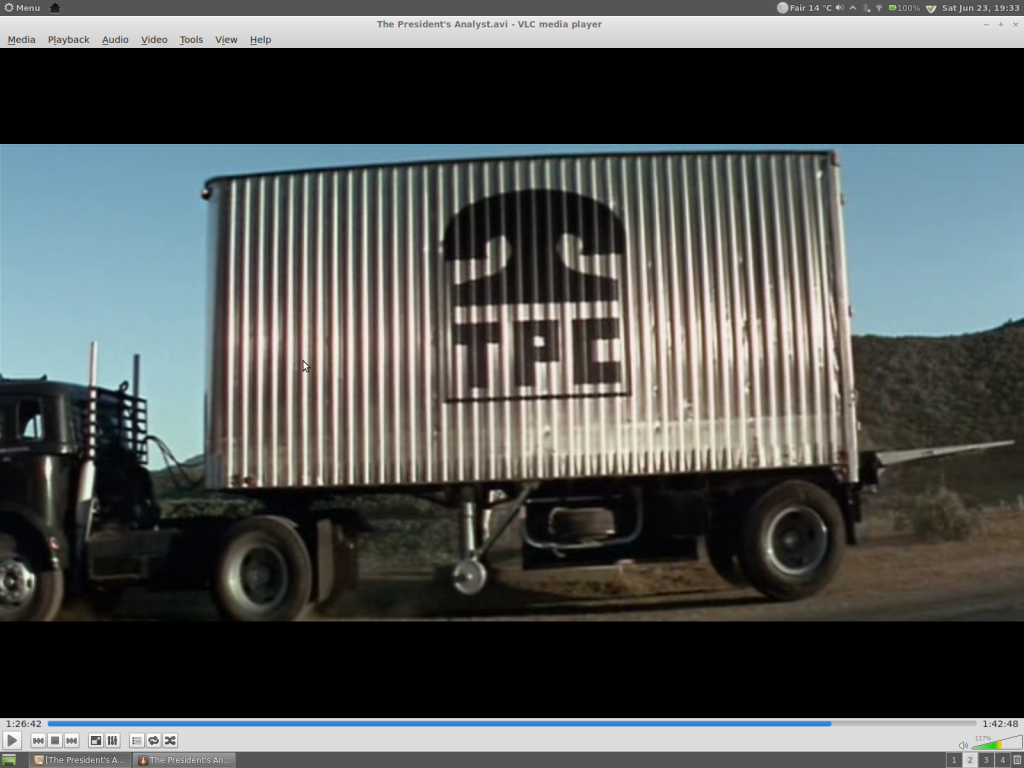
*The President’s Analyst, James Coburn, Godfrey Cambridge, 1967. Arlington Hewes is the president of The Phone Company, which is involved in an evil conspiracy.

I Don’t Know Whether to Feel Schadenfreude, or to be Appalled

I’m not q big fan the USPTO’s tendency to grant a patent to everything these days, and I’m even less of a fan of Apples use of its patent portfolio as an alternative new ideas, but the folks at Cuppertino just got hit with a completely bogus patent claim:

An apparent shell company has filed a $3 million patent infringement lawsuit against Apple for including headphones with its iPhones.

A company called Intelligent Smart Phones Concepts sued Apple last week in U.S. District Court for the Northern District of California, alleging that Apple infringed on U.S. Patent No. 7,373,182. The abstract for “Wireless Mobile Phone Including a Headset” describes an interface that allows a removable headset “to receive at least telephony audio signals from the phone, and to provide audio signals to the phone.”

Seriously, keep patent examiners away from toilet paper, because they will sign off on anything.

Someone Here Should Be Going to Jail, and It Ain’t Kim Dotcom

It turns out that most of the evidence in the case against Kim Dotcom and Megaupload was kept on their servers at the request of the US government:

A fresh legal bid to throw out the case against Kim Dotcom in the United States is being made after claims of an FBI double-cross.

Evidence has emerged showing the Department of Homeland Security served a search warrant on Mr Dotcom’s file-sharing company Megaupload in 2010 which he claims forced it to preserve pirated movies found in an unrelated piracy investigation.

The 39 files were identified during an investigation into the NinjaVideo website, which had used Megaupload’s cloud storage to store pirated movies.

………

Mr Dotcom said Megaupload co-operated with the US Government investigation into copyright pirates NinjaVideo and was legally unable to delete the 39 movies identified in the search warrant.

Mr Dotcom said: “We were informed by (the US Government) we were not to interfere with the investigation. We completely co-operated.

………

The FBI application to seize the sites said the “Mega Conspiracy” members were told by “criminal search warrant” in June 2010 “that 39 infringing copies of copyrighted motion pictures were present on their leased servers”. The application was approved to allow the seizure of the domain names.

Someone was outright lying to judges in both the United States and New Zealand in order to do a favor for the pukes at the MPAA.

This is what happens when you make the conscious decision to use the powers of government as the enforcement arm of private interests.

It is inherently corrupt, and inherently corrupting.

(on edit)

If you want to make the argument that the MPAA is just being a zealous protector of its client studios, it’s not.  It’s about power.

If the movie studios were to look at the effect of low levels of file sharing, like that which was done by some Megaupload customers, they would know that shutting down the file storage site cost them money:

A new paper suggests that box office revenues were negatively impacted after the shutdown of Megaupload. The dip in revenues was most visible for average size and smaller films. According to the researchers this may have been caused by the loss of word-of-mouth promotion by people who used the popular file-hosting site to share movies. For blockbuster movies the Megaupload shutdown had the opposite effect.

In common with every file-sharing service, Megaupload was used by some of its members to host copyright-infringing movies.

For this reason the MPAA was one of the main facilitators of the Megaupload investigation, which ultimately led to the shutdown of the company in January.

The movie industry was quick to praise the government’s actions, but a new report suggests that Megaupload’s demise actually resulted in lower box office revenues.

Researchers from Munich School of Management and Copenhagen Business School published a short paper titled “Piracy and Movie Revenues: Evidence from Megaupload.” The study analyzes weekly data from 1344 movies in 49 countries over a five-year period, to asses the impact of the Megaupload shutdown on movie theater visits.

The researchers theorize that some films may actually benefit from piracy due to word of mouth promotion, and their findings partly support this idea.

So some level of file sharing can help, particularly with smaller films, like indie films.

There appears to be less/no benefit to larger films, probably because most of the studio blockbusters are crap, and so word of mouth is a bad thing.

This is not about protecting the artist. This is about protecting the do-nothing job of the studio chief’s brother in law.

Or, to be a little bit less flip, it’s about shutting down potential distribution and publicity channels that threaten the movie and record distributors’ ability act as an intermediary and charge a toll.

I’m Surprised that It Made It a Full Day

The far right wing caucus of the Republican Party (I know, it buggers the mind), released a paper saying that the current copyright regime destroys markets, and needs to be reformed:

Right after the Presidential election last week, Chris Sprigman and Kal Raustiala penned an opinion piece suggesting that one way the Republicans could “reset”, and actually attract the youth vote, would be to become the party of copyright reform. We had actually wondered if that was going to happen back during the SOPA fight, when it was the Republicans who bailed on the bill, while most of those who kept supporting it were Democrats. Since then, however, there hadn’t been much movement. Until now. Late on Friday, the Republican Study Committee, which is the caucus for the House Republicans, released an amazing document debunking various myths about copyright law and suggesting key reforms.

Among other things, it stated that the purpose of copyright is to benefit society, not to provide a revenue stream to content owners, and among other things, calls for an expansion of fair use.

Basically, they said all the things that I have been saying for years.

Have no fear though. Less than 24 hours later, the IP Mafia browbeat them into withdrawing the report.

Well, there’s another chance to pick up the youth vote that they just pissed away.

H/t Firedog Lake;

A copy of the Report from the Republican Study Committee after the break:

rsc_policy_brief_–_three_myths_about_copyright_law_and_where_to_start_to_fix_it_–_november_16_2012

Cloud Computing, RIP

The Department of Justice is now arguing that you have no property rights whatsoever to your data if you use cloud storage:

Yesterday, EFF, on behalf of its client Kyle Goodwin, filed a brief proposing a process for the Court in the Megaupload case to hold the government accountable for the actions it took (and failed to take) when it shut down Megaupload’s service and denied third parties like Mr. Goodwin access to their property. The government also filed a brief of its own, calling for a long, drawn-out process that would require third parties—often individuals or small companies—to travel to courts far away and engage in multiple hearings, just to get their own property back.

Even worse, the government admitted that it has accessed Mr. Goodwin’s Megaupload account and reviewed the content of his files. By doing so, the government has taken a significant and frightening step. It apparently searched through the data it seized for one purpose when its target was Megaupload in order to use it against Mr. Goodwin, someone who was hurt by its actions but who is plainly not the target of any criminal investigation, much less the one against Megaupload. This is, of course, a bald attempt to shift the focus to Mr. Goodwin, trying to distract both the press and the Court from the government’s failure to take any steps, much less the reasonable steps required by law, to protect the property rights of third parties either before a warrant was executed or afterward. And of course, if the government is so well positioned that it can search through Mr. Goodwin’s files and opine on their content—and it is not at all clear that this second search was authorized—presumably it can also find a way to return them. .

But in addition, the government’s approach should terrify any user of cloud computer servicesnot to mention the providers.  The government maintains that Mr. Goodwin lost his property rights in his data by storing it on a cloud computing service.  Specifically, the government argues that both the contract between Megaupload and Mr. Goodwin (a standard cloud computing contract) and the contract between Megaupload and the server host, Carpathia (also a standard agreement), “likely limit any property interest he may have” in his data.  (Page 4). If the government is right, no provider can both protect itself against sudden losses (like those due to a hurricane) and also promise its customers that their property rights will be maintained when they use the service. Nor can they promise that their property might not suddenly disappear, with no reasonable way to get it back if the government comes in with a warrant. Apparently your property rights “become severely limited” if you allow someone else to host your data under standard cloud computing arrangements. This argument isn’t limited in any way to Megaupload — it would apply if the third party host was Amazon’s S3 or Google Apps or or Apple iCloud.  

(emphasis original)

So basically, if a prosecutor decides to go after one person using a cloud service, then they could take down the entire service, and if you do not like it, tough, you have no property rights.

Having your property seized at the whim of a prosecutor is antithetical to the very idea of the rule of law.

Still bullish on cloud storage?

H/t Ecop at the Stellar Parthenon BBS.