Category: Justice

Good News Everyone!


I invented a device that makes you read this in your head using my voice!

In response to yet another attempted shakedown by a patent troll, the courts,  in response to recent Supreme Court rulings, have started to issue significant sanctions:

This summer, the Supreme Court made it easier for defendants to collect fees when they win patent cases. The decision is starting to have an effect—the nation’s largest patent troll just got slapped with an order to pay $1.4 million in attorneys’ fees to NetApp, which it sued in 2010.

The case brought by Summit Data Systems, a branch of Acacia Research Corp., hinged on an accusation that NetApp infringed when its server-based software interacted with an end user on a Microsoft operating system. The two patents-in-suit, 7,392,291 and 7,428,581, relate to “block-level storage access over a computer network.”

But just two months before Summit filed its lawsuit, it sold licenses for those patents to 43 companies that were member companies of defensive patent aggregator RPX—including Microsoft.

“Nonetheless, Summit brought suit against NetApp barely two months after executing the Licensing Agreement,” wrote US District Judge Gregory Sleet in his order (PDF), which was unsealed on Tuesday. “It then took Summit 18 months to disclose the existence of the Licensing Agreement to NetApp.”

Summit’s expert said that Microsoft users infringe the patents, but he couldn’t determine whether Linux or UNIX systems infringed because he “didn’t have time.”

Sleet continued:

The facts of this case demonstrate that Summit pursued an action against NetApp without any basis for infringement, delayed disclosing the existence of the Licensing Agreement for eighteen months, extracted settlements from co-defendants worth a fraction of what it would actually cost them to defend the lawsuit, and then voluntarily dismissed its claims with prejudice prior to the court issuing a ruling on the merits… The claims were frivolous—Microsoft’s initiator software [was] licensed, so no system employing it could infringe the asserted patents. Summit’s motivation was to extract quick settlements that were dwarfed by the costs to litigate. Summit was objectively unreasonable in bringing a lawsuit against NetApp mere months after executing the Licensing Agreement that effectively eliminated its theory of infringement. Finally, the court is convinced that an award of attorneys’ fees in this case is necessary to deter this sort of reckless and wasteful litigation in the future.

………

Acacia is a patent-holding company that’s publicly traded on NASDAQ, and it’s sometimes considered the largest “patent troll,” since its various subsidiaries have filed more patent lawsuits than any other single company. The NetApp fee order is Acacia’s second major setback in recent months. In July, an Acacia unit holding an old Polaroid digital imaging patent lost a big case in which it was seeking royalty payments from 31 companies.

Here is the pertinent bit about the recent Supreme Court decision:

The Supreme Court overruled the lower courts. In their unanimous opinion for Octane Fitness v. Icon Health & Fitness, the justices found the Federal Circuit had taken a wrong turn in 2005 when it rejected the “holistic, equitable” approach toward attorneys’ fees and took up a “more rigid and mechanical formulation.” In order to get fees in a case, a party had to show that a litigation is both “objectively baseless” and “brought in subjective bad faith.”

That’s almost an impossible standard to meet, Octane’s lawyer Rudy Telscher told Ars in an interview before the February oral arguments. “You’ve got to show that the plaintiff brought a ‘zero merit’ case, and they knew that’s what they were doing.”

Instead, the Supremes said today that fees should be awarded in an “exceptional” case. That’s what the statute calls for, and the word “exceptional” should be given its ordinary meaning. “An ‘exceptional’ case is simply one that stands out from others with respect to the substantive strength of a party’s litigating position… or the unreasonable manner in which the case was litigated,” wrote Sotomayor.

The “Federal Circuit Court” above is formally known as the United States Court of Appeals for the Federal Circuit, but is probably better known as the “Patent Court,” which has had a ridiculously broad view of IP rights, they have literally allowed the patenting of a rainy day.

Thankfully, SCOTUS has begun routinely overturning the more extreme rulings of the patent court.

Nope, No Partisan Politics Here

In another 5-4 decision split along ideological lines, the Supreme Court has blocked early voting in Ohio, at least until an appeals court rules:

With just sixteen hours before polling stations were to open in Ohio, the Supreme Court on Monday afternoon blocked voters from beginning tomorrow to cast their ballots in this year’s general election. By a vote of five to four, the Justices put on hold a federal judge’s order providing new opportunities for voting before election day, beyond what state leaders wanted.

The order will remain in effect until the Court acts on an appeal by state officials. If that is denied, then the order lapses. It is unclear when that scenario will unfold. The state’s petition has not yet been filed formally.

The practical effect of the order will mean that, at the least, early voting will not be allowed this week — a period that supporters of early balloting have called “Golden Week.” That permits voters to register and cast their ballots on the same day.

Depending upon the timing of the state’s filing of a petition for review and the Court’s action on it, Monday’s order may also mean that early voting will not be permitted on most Sundays between now and election day, November 4, and will not be permitted during evening hours — that is, after 5 p.m.

I will make a note here any suggestion that Justice Kennedy is anything but a partisan hack has been thoroughly debunked.

Then again, we knew that after his vote in Bush v. Gore in 2000.

Damn. No Jail Time

Conservative author and filmmaker Dinesh D’Souza avoided prison on Tuesday when a U.S. judge sentenced him to serve eight months in a community confinement center after he pleaded guilty to violating campaign finance law.

D’Souza, 53, was ordered by U.S. District Judge Richard Berman in Manhattan to live in a center, which would allow him to leave during non-residential hours for employment, for the first eight months of a five-year probationary period.

Berman also ordered D’Souza to perform one day of community service a week during probation, undergo weekly therapy and pay a $30,000 fine.

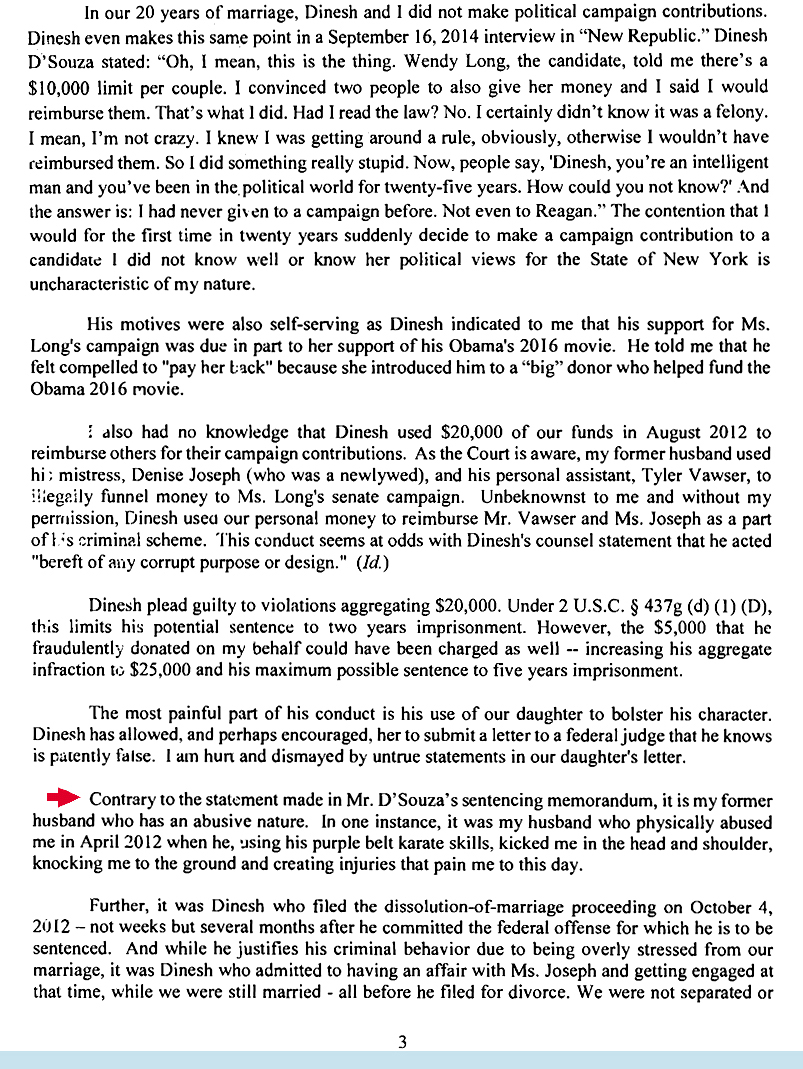
This is a guy whose wife wrote a letter to the judge that condemned him for forging her signature and being abusive:

During the sentencing hearing, Berman read from a blistering letter submitted to the court by D’Souza’s estranged wife. In the missive, Dixie D’Souza alleged that her ex-spouse forged her signature on one campaign contribution form, and that he had an “abusive nature.”

D’Souza, who was married to the defendant for 20 years, wrote, “In one instance, it was my husband who physically abused me in April 2012 when he, using his purple belt karate skills, kicked me in the head and shoulder, knocking me to the ground and creating injuries that pain me to this day.” Click here to download a PDF of Dixie D’Souza’s five-page letter to Berman.

Seriously.  What does a Republican have do to get thrown in jail these days?

Finally!

The FTC is suing brand name drug makers over their payments to generic drug manufacturers to delay their production:

For the first time since the U.S. Supreme Court ruled last year that so-called pay-to-delay deals may be subject to greater antitrust scrutiny, the U.S. Federal Trade Commission has filed a lawsuit charging drug makers with violating anti-trust laws and hurting consumers in their collective pocketbooks.

Specifically, the agency charged several drug makers – including AbbVie ; Abbott Laboratories , which spun off AbbVie, and Teva Pharmaceuticals – for striking deals that delayed the availability of the widely promoted AndroGel testosterone replacement therapy, a $1 billion seller.

“We believe the defendants’ anticompetitive conduct has forced consumers to overpay hundreds of millions of dollars for this medication,” FTC chairwoman Edith Ramirez told the media in a briefing, in which she noted the agency hopes to force the drug makers to disgorge “their ill-gotten gains.”

In these deals, a brand-name drug maker settles with a generic rival in exchange for ending patent litigation and launching a copycat medicine at a future date. The pharmaceutical industry contends the deals are not only legal, but actually allow drugs to reach consumers faster than if litigation continued.

Also known as reverse payment settlements, the deals emerged as an unintended consequence of the Hatch-Waxman Act that was designed to accelerate access to lower-cost generics. An FTC report in 2012 found there 40 potential pay-to-deals, up from 28 the year before.

The Supreme Court ruling, which reviewed a lawsuit brought by the FTC against Actavis, was a boost to the agency, because it supported the contention that pay-to-delay deals may violate antitrust laws and, effectively, allowed the FTC to pursue lawsuits against drug makers.

………

In its lawsuit, the FTC charges that AbbVie, Abbott and Bevins Healthcare filed “sham” patent litigation against potential generic rivals, including Teva, and then entered into an allegedly illegal patent settlement in order to thwart competition.

I’ve said it before (like the post just before this one):  Our current model of capitalism is a harmful and corrupt system that resembles nothing more than the book Lord of the Flies.

Not Enough Bullets………


Disgraceful

Various regulators tell us that there is no t need to send the banksters to jail, because the fines are deterrence enough.

Guess what? Those same regulators end up never collecting those fines:

On a plane earlier this week, I watched The Wolf of Wall Street. The film’s outsized antics—public masturbation, the tossing of little people, lots and lots of Quaaludes—seemed too big for a seatback screen, or, for that matter, reality. As despicable as some of Jordan Belfort’s behavior was, I was able to occasionally laugh at Leonardo DiCaprio’s version of him knowing that, by now, more than 10 years after his real-life sentencing, Belfort has been sufficiently punished.

But in fact, that’s hardly the case: After pleading guilty to fraud and money laundering, Belfort was ordered in 2003 to pay out about $110 million to those he wronged. Since then, he’s only paid $11.8 million. He was also sentenced to four years in federal prison, but he only ended up serving just shy of two years.

………

Belfort’s relatively consequence-free story is only one of the more prominent ones in a parade of aggravating numbers reported on earlier this week by The Wall Street Journal. There’s still $97 billion out there in penalties that the Justice Department has failed to recover, and between September 2012 and September 2013, the department collected only 22 percent of penalties doled out. One particularly demoralizing figure was that the Commodity Futures Trading Commission had collected about a tenth of a percent of the $3.7 billion owed to wronged investors.

So how do convicted felons go about avoiding their payments? Take the case of Paul Bilzerian, who owed the Securities and Exchange Commission $62 million and paid only $3.7 million over the course of 25 years. (The Journal reported a few days ago that the SEC was officially giving up on getting any more money from him, after having spent $8.6 million to get the meager amount that they did obtain.)

Bilzerian has systematically thwarted federal prosecutors by building a web of trusts, partnerships, and corporations established in sketchy tropical locales. He has passed on cash and assets to his sons. He delayed prosecutors for years with a bankruptcy filing. And he has transferred ownership of his 28,000 square-foot home to trusts that were owned by, at various times, his in-laws and his neighbor’s mom. “Do you think I’d be stupid enough to have a bank account?” Bilzerian told a Journal reporter.

So, someone gets caught selling a dime bag, they take everything through asset forfeiture, but this guy is living in the lap of luxury.

You know, these guys are economic terrorists.

Why can’t we drone them?

Kansas Supreme Court Slaps Down Kris Korbach’s Election Shenanigans

The court ruled unanimously that Democrat Chad Taylor’s name has to be dropped from the ballot as he requested:

The Kansas Supreme Court on Thursday sided with the Democratic candidate for Senate in his attempt to drop off the November ballot, creating a tougher contest for the Republican incumbent, Pat Roberts, in a race with a strong independent candidate.

But the Kansas secretary of state, Kris Kobach, a Republican who had fought the withdrawal, said afterward that Democrats would have to pick another candidate, adding to the uncertainty about whose names would appear on the ballot.

Noticed the last bit?

Where Korbach is now insisting that the Democrats will have to nominate a replacement, something he never brought up during arguments?

I understand the electoral dynamics. 

The current polls show that Pat Roberts wins in a 3-way race,  and gets demolished in a 2-way race, but this is not an excuse for the secretary of state to be so blatantly corrupt.

Here is hoping that Kris Korbach ends up like disgraced former Kansas AG Phill Kline, who was disbarred.

Bullsh%$

Eric holder is now saying that the DoJ will finally start prosecuting bankers:

The Justice Department has launched criminal fraud investigations of individuals at Wall Street firms, with the hopes of filing formal charges in the coming months, Attorney General Eric H. Holder Jr. said Wednesday.

“We are making good progress in these cases, which involve conduct that has undermined the integrity of our markets,” Holder said at New York University Law School.

The nation’s top prosecutor did not go into detail about the inquiries, but people familiar with the cases say the probes involve the possible manipulation of the $5.3 trillion global foreign-exchange markets.

At least seven banks, including JPMorgan Chase, Citigroup and Barclays, disclosed in regulatory filings last year that “various government authorities” had requested information about their trading activities. Bank employees have turned over information to U.S. authorities about the trading scheme, according to people who were not authorized to speak publicly about the ongoing investigations.

If any person is criminally prosecuted, it will be the little fish, and any settlement will be small enough to be dismissed as a cost of doing business, and any admission will be minor enough that no bank will lose their dollar clearing privileges.

This is theater.

Lucy will pull away the football, again.

If Eric “Place” Holder or Barack Obama were interested in prosecuting law breakers on Wall Street, they would already have done it.

There is no interest in this administration in prosecuting the general criminality that is the US financial industry.

H/t CT at the Stellar Parthenon BBS.

The Prosecutor for the Ferguson Shooting is Throwing the Grand Jury Investigation

It has become patently transparent that even inside the beltway know-nothing Dana Milbank feels compelled to call this out:

What happened in Ferguson, Mo., last month was a tragedy. What’s on course to happen there next month will be a farce.

October is when a grand jury is expected to decide whether to indict the white police officer, Darren Wilson, who killed an unarmed black teenager by firing at least six bullets into him. It’s a good bet the grand jurors won’t charge him, because all signs indicate that the St. Louis County prosecutor, Robert McCulloch, doesn’t want them to.

The latest evidence that the fix is in came this week from The Post’s Kimberly Kindy and Carol Leonnig, who discovered that McCulloch’s office has declined so far to recommend any charges to the grand jury. Instead, McCulloch’s prosecutors handling the case are taking the highly unusual course of dumping all evidence on the jurors and leaving them to make sense of it.

McCulloch’s office claims that this is a way to give more authority to the grand jurors, but it looks more like a way to avoid charging Wilson at all — and to use the grand jury as cover for the outrage that will ensue. It is often said that a grand jury will indict a ham sandwich if a prosecutor asks it to. But the opposite is also true. A grand jury is less likely to deliver an indictment — even a much deserved one — if a prosecutor doesn’t ask for it.

McCulloch has done this before:

……… During his tenure, there have been at least a dozen fatal shootings by police in his jurisdiction (the roughly 90 municipalities in the county other than St. Louis itself), and probably many more than that, but McCulloch’s office has not prosecuted a single police shooting in all those years. At least four times he presented evidence to a grand jury but — wouldn’t you know it? — didn’t get an indictment.

This is rather unsurprising.

DA’s don’t want to prosecute cops in the first place, they have to work with them, and McCulloch has a particularly bad record in terms of prosecuting police misconduct .

The fix is in.

When the Supreme Court Gets it Right ………

In this case, it is patents, where the Supreme Court ruling in  Alice v. CLS Bank has created a new legal landscape, which has seen regular reversals of “do it on a computer” patents:

The Supreme Court’s June ruling on the patentability of software — its first in 33 years — raised as many questions as it answered. One specific software patent went down in flames in the case of Alice v. CLS Bank, but the abstract reasoning of the decision didn’t provide much clarity on which other patents might be in danger.

Now a series of decisions from lower courts is starting to bring the ruling’s practical consequences into focus. And the results have been ugly for fans of software patents. By my count there have been 11 court rulings on the patentability of software since the Supreme Court’s decision — including six that were decided this month. Every single one of them has led to the patent being invalidated. 

This doesn’t necessarily mean that all software patents are in danger — these are mostly patents that are particularly vulnerable to challenge under the new Alice precedent. But it does mean that the pendulum of patent law is now clearly swinging in an anti-patent direction. Every time a patent gets invalidated, it strengthens the bargaining position of every defendant facing a lawsuit from a patent troll.

Until the supreme court slapped down the patent court, it had been routing for people to get patents for existing processes by adding, “We are doing it through the internet,” as the magic words.

Not any more.

A typical patent being overturned was, “A patent on the concept of using a computer to help users plan meals while achieving dieting goals.”

Because using a notebook to diet is so completely unlike using a computer, I guess.

In any case, it’s nice to see the patent trolls on the wrong side of this trend.

Ha-Ha!

Dinesh D’Sousa pled guilty in May for laundering political donations, and now we are getting to the sentencing, and it appears that the prosecutors are not amused by his constant bleatings claiming that it was a politically motivated prosecution:

The U.S. government wants conservative author and filmmaker Dinesh D’Souza to be sentenced to as much as 16 months in prison, following his guilty plea to a campaign finance law violation.

In a Wednesday court filing, federal prosecutors rejected defense arguments that D’Souza was “ashamed and contrite” about his crime, had “unequivocally accepted responsibility,” and deserved a sentence of probation with community service.

D’Souza, 53, admitted in May to illegally reimbursing two “straw donors” who donated $10,000 each to the unsuccessful 2012 U.S. Senate campaign in New York of Wendy Long, a Republican he had known since attending Dartmouth College in the early 1980s.

The government said a 10- to 16-month prison sentence was appropriate for D’Souza, and necessary to deter others from abusing the election process, including “well-heeled individuals who are tempted to use their money to help other candidates.”

It also said D’Souza waited to “the last possible moment” prior to trial before admitting guilt, and then went on TV shows and the Internet to complain about being “selectively” targeted for prosecution, and having little choice but to plead guilty.

“Based on the defendant’s own post-plea statements, the court should reject the defendant’s claims of contrition on the eve of sentencing,” prosecutors led by U.S. Attorney Preet Bharara in Manhattan said in the filing.

Arrogance is as arrogance does, I guess.

I’m hoping for jail time. 

Not only will it do the rest of us some good, but it might provide an opportunity for him to learn penitence (in the penitentiary).

Seriously, this guy is starting to sound like the David Koresh of movement conservatism and needs a serious dose of reality.

Lamest Man in Massachusetts New Hampshire

Scott Brown, of course, who, after losing to Elizabeth Warren, went to work for a law and lobbying firm, got his tits in a bundle with Lawrence Lessig who put out a flyer that criticized Brown as a lobbyist.

The Scott Brown campaign sent a cease and desist letter to Lessig’s campaign finance reform PAC:

Former Massachusetts Senator Scott Brown has attempted to revive his political career by running for Senate in New Hampshire. But in the final days before his September 9 primary, he’s squaring off against another opponent — Harvard professor Lawrence Lessig, who advocates against money in politics. Lessig’s Mayday PAC endorsed Brown’s GOP primary challenger Jim Rubens, and is now sending out a mailer calling Brown a “Washington lobbyist.”

The mailer led to an angry response from the Brown campaign. “This is a flat-out lie. Scott Brown is not nor has he ever been a lobbyist. Ever,” campaign manager Colin Reed wrote, calling on Lessig to “immediately cease and desist with the mailer in question.”

In response, Lessig posted the letter on his blog, and linked to an article from The Hill about Brown joining the Boston office of “Nixon Peabody, a law and lobby firm.” The firm itself said Brown would work on “business and governmental affairs,” including those related to “the financial services industry.” Lessig writes:

Yes, according to the Senate, Scott Brown isn’t a “lobbyist.” But I submit to anyone else in the world, a former Senator joining a “law and lobbying firm” to help with Wall St’s “business and governmental affairs” is to make him a lobbyist. Because to anyone else in the world, when you sell your influence to affect “business and governmental affairs,” you are a lobbyist.

You would think that a man who is a lawyer who has spent much of his life as a public figure would understand just what it means to be a public figure after New York Times Co. v. Sullivan, which required actual malice or a reckless disregard for the truth for libel and defamation suits.

Of course, in the process of making this demand, the hapless former Cosmo centerfold has served to generate publicity for the flyer.

See, “Streisand Effect, The”.  (Heh)

Welcome to the Handmaiden’s Tale

We are now throwing mothers in jail for getting their daughters an abortion:

A Pennsylvania woman has been sentenced to up to 18 months in prison for obtaining so-called abortion pills online and providing them to her teenage daughter to end her pregnancy.

Jennifer Ann Whalen, 39, of Washingtonville, a single mother who works as a nursing home aide, pleaded guilty in August to obtaining the miscarriage-inducing pills from an online site in Europe for her daughter, 16, who did not want to have the child.

Whalen was sentenced on Friday by Montour County Court of Common Pleas Judge Gary Norton to serve 12 months to 18 months in prison for violating a state law that requires abortions to be performed by physicians.

………

Matthew Bingham Banks, Whalen’s lawyer, previously told Reuters criminal prosecutions of this kind were not common.

Whalen told authorities there was no local clinic available to perform an abortion and her daughter did not have health insurance to cover a hospital abortion, the Press Enterprise newspaper of Bloomsburg reported.

Her daughter experienced severe cramping and bleeding after taking the pills and Whalen took her to a hospital hear her home for treatment, the newspaper said.

The closest abortion clinic to Whalen’s home is about 74 miles away in Harrisburg.

The right wing woman haters are chuckling about this right.

First, they make it impossible to get a abortion by legal means, and they they start prosecuting when desperate women do desperate things.

Such is the way of the ISIS of the American body politic.

Sucks to be British Petroleum Right Now


Bummer of a birth mark, BP

A federal judge has ruled that not only was BP negligent,  BP was grossly negligent in the Deepwater Horizon blowout and oil spill.

This has the effect of increasing their fines by a factor of 4:

In the four years since the blowout on the Deepwater Horizon oil rig killed 11 workers and sent millions of barrels of oil gushing into the Gulf of Mexico, BP has spent more than $28 billion on damage claims and cleanup costs, pleaded guilty to criminal charges and emerged a shrunken giant.

But through it all, the company has maintained that it was not chiefly responsible for the accident, and that its contractors in the operation, Halliburton and Transocean, should shoulder as much, if not more, of the blame.

On Thursday, a federal judge here for the first time bluntly rejected those arguments, finding that BP was indeed the primary culprit and that only it had acted with “conscious disregard of known risks.” He added that BP’s “conduct was reckless.”

By finding that BP was, in legal parlance, grossly negligent in the disaster, and not merely negligent, United States District Court Judge Carl J. Barbier opened the possibility of $18 billion in new civil penalties for BP, nearly quadruple the maximum Clean Water Act penalty for simple negligence and far more than the $3.5 billion the company has set aside.

Note, however, even at $18 billion, that is less than last year’s profits, which were just under $24 billion.

It ain’t enough.

DC Circuit Will Hear Obamacare Subsidy Case En Banc

After a three judge panel of the U.S. Court of Appeals for the District of Columbia Circuit, in which Federalist type Neander-Conservative were the majority, ruled against subsidies for states that used the federal insurance exchanges, the DoJ asked for a hearing from the full court, an en banc hearing.

Well the court has agreed to this hearing, and they have stayed the decision of the original panel:

A vital part of the federal health care law will get a new review before the full bench of the U.S. Court of Appeals for the District of Columbia Circuit. In a two-page order released Thursday, a majority of the eleven-member court granted the Obama administration’s request to consider en banc the legality of subsidies being given to consumers to help them afford health care insurance, if they shop for it at a federal marketplace (“exchange”). Such exchanges exist in thirty-four states, and nearly five million consumers have already received subsidies.

By granting further review of the controversy, the en banc court wiped out a three-judge panel’s two-to-one ruling on July 22 finding that such subsidies under the Affordable Care Act can only be provided to those who seek insurance on an exchange directly operated by a state government — a potentially crippling blow to the new law. Only sixteen states have set up exchanges.

By granting further review, the D.C. Circuit has raised the chances that the administration will win in that court, as it did previously in the U.S. Court of Appeals for the Fourth Circuit. If there is then no conflict among appeals courts on the question, that could reduce the chances that the Supreme Court would feel a need to step in. However, the issue is pending in other lower courts, so a conflict remains a possibility.

In the en banc hearing, unlike the original hearing, will not be stacked with partisan hacks, so it’s pretty much certain that they rule as the 4th Circuit.

The question now is whether the Supreme Court is going to hear this case.

Rick Perry is Toast

This story predates Governor Perry’s indictment by about 4 months, but this goes straight from abuse of power to outright bribery:

Aides to Gov. Rick Perry offered Travis County District Attorney Rosemary Lehmberg continued employment in the district attorney’s office if she resigned her elected post following a drunk-driving arrest, officials familiar with the offer said Thursday.

The offer came after Perry threatened and then vetoed $7.5 million in funding for the office’s anti-corruption unit, known as the Public Integrity Unit, because Lehmberg had refused to step down.

But several officials and sources told the Express-News that Perry — through intermediaries — offered various options to Lehmberg to entice her resignation, culminating in promises to restore funding to the unit, another position in the District Attorney’s office, and selection of her top lieutenant to serve as the new district attorney.

The offer was explicit; “they were clear,” the elected official said.

Something that Rachel Maddow has always said is that if you want to look at local corruption, you need to check the local press, in this case, The San Antonio News Express.

This is an explicit quid pro quo, but if you read the national press, it’s pundits complaining about the criminalization of ordinary politics.

It isn’t. It’s a classic bribery attempt.

Governor Ultrasound is Completely Fornicated

After just 17 hours deliberation, despite having an epic set of instructions from the judge, the jury found former Virginia Governor Bob McDonnell  and his wife Maureen of every major charge:

A federal jury on Thursday found former Virginia governor Robert F. McDonnell and his wife, Maureen, guilty of public corruption — sending an emphatic message that they believed the couple sold the office once occupied by Patrick Henry and Thomas Jefferson to a free-spending Richmond businessman for golf outings, lavish vacations and $120,000 in sweetheart loans.

After three days of deliberations, the seven men and five women who heard weeks of gripping testimony about the ­McDonnells’ alleged misdeeds unanimously found that the couple conspired to lend the prestige of the governor’s office to Jonnie R. Williams Sr. in a nefarious exchange for his largesse.

The verdict means that Robert McDonnell, the first governor in Virginia history to be charged with a crime, now holds an even more unwanted distinction — the first to be convicted of one.

He and his wife face decades in federal prison, although their actual sentences are likely to fall well short of that. U.S. District Judge James R. Spencer set a sentencing hearing for Jan. 6.

The former governor, a onetime Republican rising star considered for the 2012 vice-presidential nomination, was convicted of all 11 corruption-related counts brought against him. In a small victory, he was acquitted of lying on loan documents.

………

It was a stunning outcome for the couple, all the more so because in December, McDonnell declined to accept a plea agreement in which he would have been found guilty of just one felony count of lying on a loan document, according to people familiar with the case. Maureen McDonnell would have faced no charges.

He was unbelievably guilty, and he somehow figured that he would get out of it, so he now faces many more years in jail, and he sold the mother of his  children down the river.

I’m not surprised. 

He thought that he was on the proverbial “Mission from God” only, unlike the Blues Brothers movie, he wasn’t joking.

It’s the same cycle as one sees in ancient Greek tragedies: Koros to Hubris to Ate to Nemesis.  (Success to arrogance to madness to comeuppance)

Arbitration is a Corrupt Fraud

This little story of the corruption that is a feature, not a bug, of the arbitration process has made it to the New York Times:

Five years ago, Sean Martin, a registered representative at Deutsche Bank Securities in New York, saw something troubling on his trading desk.

A few of his colleagues, he said, were letting preferred hedge fund clients listen in on confidential market commentary by the firm’s analysts before their views were made public. He alerted his superiors and was almost immediately given a negative review, a first in more than 10 years at the firm, he said. His bosses also removed him from the group he’d been working with and cut his compensation.

Mr. Martin, who continues to work at Deutsche Bank, said he believed that he was being punished for reporting misconduct and took the one avenue of redress that was open to him. In August 2012, he brought an arbitration case against the firm, contending retaliation and asking to recover his lost earnings. As is typical in the financial industry, his employment contract required that any dispute between him and his employer go through private arbitration, not the courts. Mr. Martin’s matter is being heard by three arbitrators associated with the Financial Industry Regulatory Authority, a self-regulatory organization that operates the largest dispute resolution forum in the securities industry.

But Mr. Martin’s experience with arbitration, both he and his lawyer say, has raised questions of fairness in the process. The three-member panel hearing his case has barred him from testifying about certain crucial aspects of what he saw at Deutsche Bank and disallowed the introduction of documents that bolster his claims. This led his lawyer to conclude that the panel was not interested in specifics of the behavior at the heart of his accusations — and to ask a state court to step in.

“When I filed this arbitration, I expected that Finra would resolve the dispute between Deutsche Bank and me in a fair way,” Mr. Martin, 41, said in a statement provided by his lawyer. “I was surprised and disappointed when the arbitrators refused to listen to important parts of what I wanted to say and rejected or redacted my exhibits. I can’t see how a dispute can be fairly resolved if one party is not even allowed to tell their side.”

………

“How can a panel of arbitrators for the regulator justify not hearing evidence of wrongdoing?” asked Robert Kraus, a partner at Kraus & Zuchlewski in New York, who represents Mr. Martin. “It is completely upside-down.”

………
But Mr. Kraus, worried that his client would not get a fair hearing, last week filed a motion in New York State Supreme Court asking to stay the arbitration hearings. Arguments are on the docket for Wednesday in Manhattan. If the judge grants Mr. Kraus’s request, the court will hear arguments on whether the arbitrators should be removed.

………

Mr. Kraus said he did not take the decision lightly to file his request with the court. He said he’s had success in other Finra arbitrations over the years but that this case was different.

“Unlike other hearings where you question a ruling here and there, these arbitrators repeatedly excluded evidence that lies at the heart of our case,” Mr. Kraus said. “From time to time, you get these panels that go off the rails, and then the question is how do you remedy that?”

This is not surprising.

The private arbitration system is inherently corrupt.

The continued employment of arbitrators is dependent upon satisfaction the firms, and not the employees of customers, so their rulings invariably favor the big corps, at the expense of due process for the little guys.

Dumbass of the Day

Michael Lind.

It’s a completely incoherent analysis of the Rick Perry indictment.

Well, Mr. Lind in particular, and the self described “Radical Centrist” New America Foundation in general.

BTW, as a interesting note, the papers in Texas, from the the Dallas Morning News the flagship newspaper of the journalistic cancer that is A,H, Belo Corporation, to the relatively liberal Austin American-Statesman, have thought that the indictment was justified, and they are the ones who have been following this sh%$.

A Fact of Ferguson that is Finally Getting Mainstream Notice

The fact that more than 20% of the budget of the town of Ferguson comes from tickets and warrants issued by police shows that the police are not there to protect the populace, they are there to extract tribute from them:

Scratch any social crisis, and you’re likely to find economics not far below the surface. Via ArchCity Defenders, a St. Louis legal-aid nonprofit, we can see how this has worked to create the dismaying spectacle of the breakdown of justice in Ferguson. (H/t Alex Tabarrok, via Kevin Drum.)

According to the group’s recent report on the municipal court system in St. Louis County, the Ferguson court is a “chronic offender” in legal and economic harassment of its residents. There’s not much of a secret why: the municipality collects some $2.6 million a year in fines and court fees, typically from small-scale infractions like traffic violations. This is the second-largest source of income for that small, fiscally-strapped municipality.

………

For a low-income community–and for a black community subjected to the racial profiling, as the report documents–these fines can gather force like a boulder rolling downhill. 

Tabarrok points to the report’s observation that the Ferguson court processed the equivalent of three warrants and $312 in fines per household in 2013.

“You don’t get $321 in fines and fees and 3 warrants per household from an about-average crime rate,” he notes. “You get numbers like this from [B.S.] arrests for jaywalking” and what the report calls “low level harassment involving traffic stops, court appearances, high fines, and the threat of jail for failure to pay without a meaningful inquiry into whether an individual has the means to pay.”

The reason that the minorities in Ferguson do not see the police as their defenders and their protectors, it’s because they aren’t.

This arrangement, where peace officers have as their primary function tax collections, is fundamentally pathological and corrupt, and it needs to stop.

The Twinkie Defense, The Chewbacca Defense, and now the Bitches be Crazy Defense

Dan White got away with murdering George Moscone and Harvey Milk through the Twinkie Defense, Chef got put sentenced to jail, and sprung from jail with the Chewbacca defense, and in the Bob McDonnell bribery case, the defense has become even more ludicrous with the “Bitches be Crazy” defense.

That’s right, the former governor of Virginia’s defense team has become even more absurd than the minds of Tray Parker and Matt Stone.

His defense is that he didn’t take any bribes, it was all his wife, a technically private citizen is unbalanced, and had a crush on the man who bribed the governor, and that he had nothing to do with it. I guess the loan of a Ferrari, and the golf outing worth something in excess of $10,000.00, and thousands of dollars of loans from tobacco based “medicine” mogul Jonnie Williams, were just ……… “stuff”

As Eugene Robinson notes, the technical term for this is “throwing his his wife under the bus.”

How far would you go to stay out of jail? Would you publicly humiliate your wife of 38 years, portraying her as some kind of shrieking harridan? Would you put the innermost secrets of your marriage on display, inviting voyeurs to rummage at will?

For Robert McDonnell, the former Virginia governor on trial for alleged corruption, the answers appear to be: “As far as necessary,” “Hey, why not?” and “Sounds like a plan.”

McDonnell’s testimony this week in a federal courtroom in Richmond about his wife’s psychological turmoil has been both cringe-worthy and compelling. It has been clear for some time that McDonnell’s strategy for winning acquittal amounted to what could be called the “crazy wife” defense. But only when he took the stand did it become apparent how thoroughly he intended to humiliate the “soul mate” he still claims to love.

McDonnell disclosed Thursday that he moved out of the family’s home shortly before the trial began. “I knew there was no way I could go home after a day in court and have to rehash the day’s events with my wife,” he testified.

I guess not. Anyone who said such things in public about his or her spouse would be advised to clear out.

McDonnell testified that Maureen McDonnell was so volatile that the entire staff at the governor’s mansion signed a petition threatening to quit if her behavior didn’t improve. “She would yell at me,” he told the court. “She would tell me I was taking staff’s side, that I didn’t know what was really going on over there.”

He said he believed his wife needed professional counseling, though it was unclear whether he tried very hard to convince her to seek it. He spoke of the family’s severe financial problems, which included large credit card bills, and said that “it just seemed like there was too much stuff that she was buying.” Prior testimony has indicated, however, that unwise real estate investments caused most of the problem — and that Robert McDonnell, not Maureen, ran the family finances.

There are also tens of thousands of dollars of loans from the snake oil salesman, but hizonner the governor thought that nothing war wrong with that:

Testifying for the third day in his public corruption trial, former Gov. Bob McDonnell said today he saw nothing inappropriate about $70,000 in loans he negotiated with businessman Jonnie Williams in 2012.

The loans were extended by the diet supplement maker to a real estate company the governor operated with his sister to manage rental properties they owned in the Sandbridge area of Virginia Beach. Rents on the properties were falling short of covering expenses, and the McDonnells needed to make up the deficit.

McDonnell said he saw nothing wrong with the loans because Williams hadn’t asked him to do anything on his behalf and his administration hadn’t done the businessman any favors.

Williams testified earlier that he and the governor agreed the loans would be granted on a handshake and kept just between the two of them.

McDonnell today denied that claim. “There was no such discussion with Mr. Williams,” he said.

He said he tried to get the terms of the loans in writing, but that never occurred.

He said he did not disclose the Williams loans on his annual financial disclosure statement because they were corporate loans for which he had no personal liability.

Yeah. Nothing shady here.

Seriously, I half expect the jury to take a page from the original version of the Mel Brooks film The Producers, and announce that, “We find the defendants incredibly guilty.”

Dude, you are going to jail.  The decision that you made is to go without a shred of dignity.