Category: Military

News Flash: Air Force Hates Helping Soldiers On the Ground

The real story here is that the USAF really, REALLY, REALLY hate doing anything that smacks of close air support. They have since the creation of the USAF.

It’s fighters, and strategic bombing, with perhaps a bit of tactical bombing that they want to do.

It’s embarrassing to do close air support. After all, some sergeant is telling an officer what to hit and where to drop bombs.

UAVs, Other Aircraft Being Misused, ACC chief Says

Jun 21, 2007

Michael Fabey/Aerospace Daily & Defense Report

Using unmanned aerial vehicles (UAVs) and pod-equipped combat jets to find improvised explosive devices (IEDs) is often a misuse of time and resources, said U.S. Air Force Gen. Ronald Keys, commander of Air Combat Command.

Often, requests for airborne surveillance are based on the assumption that such aircraft help find IEDs and save ground forces from such attacks, he said. Certain military leaders feel they need the full-motion video feeds to locate the explosives. The truth, he said, is much different.

Based on Air Force analysis, the number of IEDs found by UAVs, surveillance aircraft or combat jets outfitted with advanced targeting pods per 100,000 flight hours is very low, according to Keys. “It’s a waste,” Keys said June 20 during a morning keynote speech at the Transformation Warfare 07 conference and exhibit in Virginia Beach, Va.

“People come to me and tell me they want a Predator,” he said. “I ask, ‘What are you looking for?’ Tell me what you’re looking for, don’t just tell me you want a J-STARS.”

Unfortunately, the military is basing some of its decisions on anecdotes instead of real metrics, he said. Indeed, the only metric being used is whether the Air Force is meeting certain tasking orders, instead of making sure those assets and flights are effective and the best use of time and aircraft. “This is no way to fight a war,” he said.

Keys said ACC has developed a “concept of deployment” to help fight IEDs that is air-centric “to a certain point.” Without going into specifics, he said, “We ought to be attacking the system – to the left of ‘the bang,'” meaning the process before the IED is emplaced. What needs to be looked at is the network, “not the thing that’s buried out there,” he said.

RuAf to Acquire Updated Flanker.

The aircraft is expected to carry the Novator K-100 missiles, which are to have a range in excess of 200km (some reports say 300 km).

Sukhoi Pushes Ahead With Revamped Flanker(subscription required)
Aviation Week & Space Technology
06/25/2007, page 43

Douglas Barrie
Le Bourget

Sukhoi plans aggressive flight test and weapons integration schedule for latest Flanker version

Printed headline: Family Affair

Fighter manufacturer Sukhoi is trying to persuade the Russian government to contribute development funds for its latest version of the Su-27 Flanker family, the Su-35, with indications that the air force has already decided to acquire the aircraft.

Three Su-35 prototypes are initially being manufactured, with a first flight planned by the end of September, according to a senior Sukhoi executive involved in the program. “Currently, there’s no government funding,” he says. “The program so far is being funded by industry participants.”

The first aircraft, No. 901, is now complete and undergoing ground tests. It’s slated to be at the Moscow air show in August, before beginning flight trials. The company has an ambitious flight test and initial weapons integration plan that it aims to finish by 2010, followed by the first aircraft being handed over to the air force.

The first prototype of Sukhoi’s Su-35 is due to appear at the Moscow air show on the flight line, rather than only as a display model.Credit: DOUGLAS BARRIE/AW&ST

….
The Su-27 derivative will certainly include systems also destined for the T-50. It will also provide the air force with an interim fighter should–a distinct possibility–the time scale for introducing the PAK FA into service be extended. First flight of the T-50 is penciled in for 2009.

It’s not clear in the picture, but there appears to be a fairing on the aft end of the large missile hanging on the right hand (left of picture) pylon. This might be an air intake.

Given the Russian experience with solid fuel ramjets, the SA-6 had one in the early 1970s, the range of this AIM-54 sized Phoenix sized missile could be rather long.

Indian Navy prepares for MiG-29-21/06/2007-Paris-Flight Daily News

It’s beginning to look like the Russians may have a growing business in providing low cost carrier capability to nations like India.

Indian Navy prepares for MiG-29

Only the first prototype of the Indian Navy’s new MiG-29s has flown, but the force’s preparations for the new aircraft are proceeding apace.
The Indian Navy has not operated conventional carrier -based aircraft since the withdrawal of the Hawker Sea Hawk in 1983, after which the STOVL BAE Systems Sea Harrier became the service’s only carrier-based fighter.
Captain GM Gopakumar of the Indian Navy told Flight Daily News that Indian Navy pilots are already flying exchange tours on Indian Air Force MiG-29s, and though delivery of the first INAS MiGs has been delayed from November 2007 until March or April 2008, pilot conversion training in Russia will commence in August.

More power and more payload for Gripen demo-21/06/2007-Paris-Flight Daily News

The Gripen can already supercruise clean, and the additional thrust should allow it to do so while carrying more.

More power and more payload for Gripen demo-21/06/2007

By Jon Lake
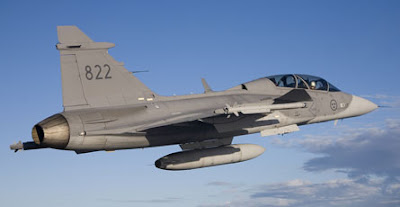
Saab chose the Paris Air Show to reveal details of its new Gripen Demonstrator programme. The Gripen Demo aircraft will act as a technology demonstrator and testbed for an upgrade configuration for the Swedish air force, and as the prototype for planned ‘Future Gripens’, including the Gripen N for Norway, the Gripen DK for Denmark, and perhaps even for a variant to meet India’s MMRCA requirement.

….

The Gripen Demo aircraft will have a revised configuration, with a new forward-retracting main landing gear that frees up internal volume for extra fuel, and with distinctive bulged wingroot fairings underwing providing further increases in internal volume. The use of these fairings replaces the upper fuselage conformal tanks seen on previous studies, and will provide an extra 38% of internal fuel, taking the total to 3,130 kg.

The relocated and beefed-up undercarriage will allow a 2-tonne increase in maximum take off weight, to 16t. This in turn will allow the aircraft to carrier heavier warloads (up to 6,000kg), and to facilitate this, the Gripen Demo will have new side by side under-fuselage pylons (augmenting the single centreline pylon) and underwing hardpoints capable of carrying twin pylons.

The aircraft will be powered by a new 22,000lb engine, provisionally dubbed the F414G. ….. The F414G will deliver some 4,000lb more thrust than the RM-12, giving a useful boost in performance. Some sources give the new engine a 26,000lb thrust rating – doubling the advantage.

The aircraft will also be fitted with an AESA radar, probably based on Ericsson’s long-running NORA and Saab/Selex’ M-AESA programmes.

Missing Soldier’s Wife Faces Deportation

I am appalled.

Missing Soldier’s Wife Faces Deportation, As Military Searches For Kidnapped Soldier In Iraq, U.S. Threatens To Send Wife Back To Dominican Republic

(CBS/AP) While the U.S. military searches for a soldier missing in Iraq, kidnapped by insurgents possibly allied with al Qaeda, his wife back home in Massachusetts may be deported by the U.S. government.

Army Spec. Alex Jimenez, who has been missing since his unit was attacked by insurgents in Iraq on May 12, had petitioned for a green card for his wife, Yaderlin Hiraldo, whom he married in 2004.

Their attorney, Matthew Kolken, said 23-year-old Hiraldo illegally entered the United States in 2001 to reunite with her husband, whom she had met in her native Dominican Republic and later married at his New York State Army base in 2004.

Her husband’s request for a green card and legal residence status for his wife alerted authorities to her status, Kolken said.

She now faces deportation, reports CBS station WBZ correspondent Beth Germano, and would be barred from applying for a green card for 10 years.

Her attorney is seeking a hardship waiver, which so far the government won’t grant.

“I can’t imagine a bigger injustice than that, to be deporting [the wife of] someone who is fighting and possibly dying for our country,” Kolken told WBZ.

Gripen to get AESA

I’ve always thought that the Gripen has the possibility of being the Mirage III of its generation, as it is the smallest, cheapest, and cheapest to operate of the 4th generation aircraft.

Gripen to get AESA in mid-life upgrade
Keeping pace with the technology trend, Saab’s JAS39 Gripen is to be fitted with a multi-channel active electronically scanned array (AESA) radar, likely to be introduced under a planned mid-life upgrade (MLU) that could come along as early as 2010.

Development of the AESA radar for Gripen started out under the Saab Ericsson NORA (Not Only a RAdar) programme, and has been underway for several years, including test flying aboard a specially-retained Saab JA-37 Viggen testbed. One of the main benefits of the NORA concept was the provision of improved long-range tracking as a result of the combination of longer detection range and electronically-steered beam control. The AESA radar programme is directly linked to MIDAS (Multifunction Integrated Defensive Avionics System), which will also add electronic attack and advanced datalinking capabilities.

F-22 superjets could act as flying Wi-Fi hotspots | The Register

One of the reasons that this is of interest is that the current version of the F-22 does not have a good data path out. It was designed to operate nearly autonomously over Warsaw Pact integrated air-defense networks, so the idea is that data would go in, but not out.

This hack to the radar fixes this.

F-22 superjets could act as flying Wi-Fi hotspots
By Lewis Page
Published Tuesday 19th June 2007 15:20 GMT

US defence contractors have carried out the first flight tests in which America’s latest cutting-edge fighter targeting radars have been put to novel use – as high-capacity wireless datalinks. This crafty use of existing hardware has the potential to ease military bandwidth bottlenecks, and could offer a chance for expensive superfighters to be of use even in the absence of serious aerial opposition.


The most expensive Wi-Fi hotspot in the world?

The latest generation of US military aircraft carry so-called Active Electronically Scanned Array* (AESA) radars, which are made up of many separate transmit-receive elements. AESA radars have long been heralded as miraculous multi-tasking kit, capable of acting as electronic-warfare scanners, jammers, or even electromagnetic weapons capable of frying enemy circuitry from afar.

There have also been ground trials in which the radar from America’s ultra-advanced, hyper-expensive F-22 “Raptor” stealth superfighter has been used as a kind of Wi-Fi card on steroids, able to transmit data at a blistering 548 Mbit/sec and receive it at Gigabit speed.

Pentagon’s raygun-packing 747 to visit DC

I’m dubious of the technology.

Pentagon’s raygun-packing 747 to visit DC
By Lewis Page
Published Wednesday 20th June 2007 13:14 GMT

The Airborne Laser, the US Missile Defence programme’s raygun-equipped jumbo jet, is to visit Washington tonight in an attempt to drum up support on Capitol Hill.

Airborne Laser aircraft

The Airborne Laser aircraft, intended to explode ICBMs shortly after liftoff.

The Missile Defence Agency says (pdf) the flying energy-weapon platform will fly into Andrews airforce base outside DC from its normal home at Edwards AFB in California. The 747 is expected to make a night landing, before being shown off to politicos, officials, and the media. It will return to the west coast on 21 June.

The Airborne Laser is a modified Boeing 747-400 freighter aircraft intended to use a Chemical Oxygen Iodine Laser (COIL) to destroy a hostile ballistic missile during the highly-vulnerable “boost phase” of its trajectory — the first few minutes after it is launched.

Missiles in boost are full of pressurized explosive fuel, so even a relatively feeble zapping could cause them to explode. Also, attacking a multiple-warhead ICBM at this point will take out all its re-entry vehicles in one shot.

Actually, the missiles are not full of “pressurized explosive fuel”. The last US missile to do this was the Atlas, retired in the 1960s, which used LOX.

Modern missiles use storable liquid propellants, and the most modern, solid fuel, which do not present the same structural vulnerablitiex.

Nope…No Coverup Here.

NPR : Abu Ghraib Investigator Says He Was Forced to Retire

Audio link.

Ret. Army Maj. Gen. Antonio Taguba, who was the lead investigator of military personnel working at Iraq’s Abu Ghraib prison, tells New Yorker magazine that he was forced into retirement because of his findings. Seymour Hersh, investigative reporter for the magazine, talks with Michele Norris about his interview with Taguba, who gave some details that were not made public before his comments were published this week in the magazine.

Europe Looking for Operational Independence of the US

This is a part of a continuing trend of our NATO allies looking for the ability to conduct operations independently of the US.

Not surprising, when one considers just how badly people have gotten burnt by the Bush admin.

The US is no longer viewed as a dependable ally. We are viewed as a mad dog.

Italy Starts Work on Second-Generation CosmoSkyMed (Subscription Required)

Italy Starts Work on Second-Generation CosmoSkyMed
Aviation Week & Space Technology
06/18/2007, page 72

Andy Nativi
Vandenberg AFB, Calif.
Michael A. Taverna
Paris

With X-band radar satellite safely in orbit, Italy starts work on second-generation design

Printed headline: Cosmo Calling

The first of four CosmoSkyMed radar observation satellites will became operational in December, following a successful launch last week.

Together with Germany’s SARLupe imaging system, the first of which was orbited in December, the Italian X-band satellite will add an all-weather adjunct to Europe’s day/night optical intelligence satellite capacity, based on France’s Helios 2. The combined systems will provide a full space-based intelligence, surveillance and reconnaissance (ISR) capability to support troops deployed in overseas theaters and reinforce immigration control, drug interdiction and other security activities.

The radar network was due to be expanded late last week by a German metric commercial radar spacecraft, TerreSAR-X, and next month by a second SARLupe.

Under a series of agreements dating back to 2001, Italy and France will share access to CosmoSkyMed, Helios 2 and France’s twin-satellite, dual-use Pleiades submetric optical-imaging system, which is to be deployed in 2009-10. An Italian hyperspectral optical instrument may be added to the mix.

Israeli Large Drone Made Public

I showed some blurry pix of this a few weeks back.

I’m a bit dubious of it being used for aerial refuelling. I think that pilots will want a man in the loop.

After months of being coy(Subscription Requited)

After months of being coy, Israeli defense and aerospace officials have admitted their huge new unmanned aircraft–the Eitan or Heron TP–does exist and will be on public display this week at the Paris air show.

A few poor-quality bootleg pictures of the unmanned, missile-carrying aircraft leaked out last month (AW&ST May 21, p. 32). Now the Defense Ministry has given Israel Aerospace Industries permission to release pictures. The UAV has been test flown sufficiently since its first flight last July that IAI says it is ready for serial production.

TP stands for the Eitan’s 1,200-hp. turboprop engine, which will give the UAV an operational altitude above the 45,000-ft. limit for commercial aircraft. The 10,230-lb. aircraft has a wingspan of 85.28 ft. and loiter time of 36 hr. Descriptions of its capabilities and missions are vaguely worded. The “multi-payload, multi-mission” aircraft carries “front end technologies to meet . . . a large variety of operational missions,” IAI and Israeli Defense Forces officials say.

But there are hints about the capabilities. The high-altitude capability, emphasis on reliability and long loiter time, as well as large internal payload volume and weight, indicate the UAV could serve at least three key missions: defense against ballistic missile launchers and, later, ballistic missiles in boost phase; long-term surveillance and intelligence collection; and as a refueling tanker to operate in areas where large manned aircraft would be vulnerable.


Non-NATO Tactical Data Link Developed

Thales can’t be the only people offering this sort of capability.

I imagine that the British or Germans have something similar, and that there was a similar system that dates back to the USSR.

Thales Develops LX16 Tactical Data Link for Non-NATO Countries

Aviation Week & Space Technology
06/18/2007, page 114

Joris Janssen Lok
Paris

Link 16-equivalent data link gives nations option for tactical network

Printed headline: Non-NATO Network

Thales is proposing a tactical data link that gives nations not currently allowed to use the NATO-standard Link 16 the option to acquire a similar capability, which Thales calls LX16.

At least one Asian country is in negotiations to equip all of its armed forces (air, land and maritime) with LX16, say company sources, while declining to identify the customer.

Thales is also receiving “strong interest” in LX16 from several other nations as well as from “aircraft manufacturers who are not in NATO countries and who sell outside NATO.”

“Non-NATO air customers often love to get a Link 16 capability, but they can’t–so we developed an equivalent tactical data link that uses the same message set, grammar and vocabulary,” says Patrice Caine, vice president for communications, navigation and identification activities in Thales Land & Joint Systems.

Once installed, the equipment behind LX16 can be modified “virtually overnight” to support Link 16 proper, Caine suggests. Such an upgrade could be considered if an LX16 user becomes eligible to join the Link 16 user community–for example, when there’s a need to participate in Link 16 networks during coalition operations.

The change from an LX16 to a Link 16 configuration can be achieved by adding a MIDS-LVT (Multifunctional Information Distribution System-Low Volume Terminal) to each aircraft, ship or land asset that needs to participate in the Link 16 network.

Thales is also working to make LX16 interoperable with Link 16 without having to add MIDS-LVT terminals to all platforms. That would be a gateway system that allows the LX16 network to interface with Link 16.

While Link 16 operates in the 960-1215-MHz. frequency range (L-band), Thales’s LX16 operates at 300-600 MHz.

The lower frequency implies that there would be lower throughput, but I’m not up on radio Frequency stuff, so I’m not sure how much.

MAV goes into battle in the hunt for IEDs

I worked on the Manned Ground Vehicles (MGV) of the FCS “system of systems“, not this, though some of the “stowage envelopes might have included this.

MAV goes into battle in the hunt for IEDs

Honeywell’s Micro Air Vehicle (MAV) is being deployed in Iraq to help US troops hunt for improvised explosive devices (IED). This is the first time a ducted-fan unmanned aerial vehicle (UAV) has been used in combat missions.

Developed for the US Army’s Future Combat System (FCS) programme, MAV is designed to be man-pack portable. It operates like a small remote-controlled helicopter and can take off and land vertically without runways or helipads. Information from its electro-optical and infra-red (IR) video cameras relay information back to hand-held terminals on the ground.

Deployment takes less than five minutes, and lifting power for the 13in (325mm) device comes courtesy of an RCV-supplied engine-driven ducted fan. The MAV has a 50kt (90km/h) top speed and an operating ceiling of 10,500ft.

And in The OTHER War….

This is why the Iraq debacle is so damaging.

As a result, we are now losing TWO wars, not just one.

Taliban fighters seize south Afghan area – Yahoo! News

By NOOR KHAN, Associated Press Writer 13 minutes ago

KANDAHAR, Afghanistan – Taliban militants overran a district in southern
Afghanistan and are pushing for control of another key area, sparking fierce clashes with
NATO and Afghan forces that have left more than 100 people dead over three days, officials said Tuesday.

Hundreds of Taliban fighters launched raids on police posts near the strategic town of Chora in Uruzgan province Saturday, forcing NATO, backed by fighter jets, to respond. Fighting was continuing Tuesday, and some officials reported there have been dozens of civilian casualties.

Also late Monday, Taliban occupied Miya Nishin district in neighboring Kandahar province, said provincial police chief Esmatullah Alizai. Authorities were planning an operation to retake the remote area, he said.

The insurgent push in the south appears to be the biggest Taliban offensive of the year and marks a change in tactics.

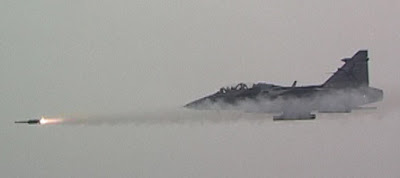
Picture: Saab Gripen fires first IRIS-T air-to-air missile-18/06/2007-London-Flightglobal.com

Everything I’ve read about the new Sidewinder, the AIM-9X implies that it’s hot stuff.

The seeker may be very good, but it has a 5″ diameter missile body, and is competing against missiles with 6″ missile bodies, like the IRIS-T, ASRAAM, Python 5, and Vympel R-73 (AA-11 Archer).

It has to have inferior kinematics to these missiles.

Picture: Saab Gripen fires first IRIS-T air-to-air
By Craig Hoyle

Saab conducted the first test firing of a Diehl BGT Defence IRIS-T short-range air-to-air missile from a Gripen fighter over Sweden’s Vidsel test range on 12 June, during the 6,000th test flight of a JAS39.

Involving high-speed weapon release from a JAS39B test aircraft flying at around 2,000ft (610m), the unguided test was “a complete success”, says Saab test pilot Fredrik Müchler.

…..

France and UK to Co-Develop New Carriers

This should significantly improve power projection capabilities of both navies, particularly the Royal Navy.

Britain and France Develop New Carriers (Subscription Required)

Jun 13, 2007

Christina Mackenzie/Defense Technology International

Britannia rules the waves, the old standard declares, but now it looks like it’s going to share them with France–at least when it comes to launching the next generation of aircraft carriers.

Britain and France are on the verge of signing an agreement calling for three carriers to be designed and built in an Anglo-French partnership. The deal would be a milestone in cooperation between two countries with major differences in naval strategies and operational needs.

The reason for rapprochement is economics: At a total projected price of around $10 billion for three ships, the cost of developing and building the 65,000-ton carriers alone is too expensive for Britain and France to bear separately.

The program calls for Britain to take delivery of two aircraft carriers, the first and third, and for France to get one. The ships are slated to start entering service by 2015.

An interesting note:

Meanwhile, France and the U.K. have invested a lot of money in studies to reduce the number of personnel needed to man and operate the carriers. The French ship, for example, will have around 20% less manpower than the Charles de Gaulle, although it is significantly larger and has greater operational capability.

This would appear to imply that reports of problems with the CdG are justified.

US Arming Sunni Insurgents In Iraq

What is going on here is desparation as the situation collapses faster than the World Trade Centers did on September 11, 2001.

Gen. Petraeus concerned about US arming insurgents

06/17/2007 @ 11:34 am
Filed by David Edwards and Josh Catone

On Fox News Sunday General David H. Petraeus expressed concern about the new US plan to arm Iraqi Sunnis who promise only to fight al Qaeda.

“How do you know, or do you worry, that they are going to end up using those weapons to either attack US forces or to fight their civil war against the Shiites?” asked host Chris Wallace.

“Those are legitimate concerns,” replied Petraeus, but said that the US was taking precautions to prevent that from happening.

The Iraqi government has strongly objected to to the US strategy of arming Sunni insurgents. In a Newsweek interview published Saturday, Iraqi Prime Minister Nuri al-Maliki blasted that strategy, saying that it “will create new militias.”

….

BTW, the reason that al-Maliki objects is because it’s HIS militias, particularly those in Iraqi security forces uniforms, and not al Sadr’s that are engaging in most of the ethnic cleansing, and he is afraid that this will become more difficult because of arming the Sunnis.

El Paso Times – Gen. Pace says he declined to voluntarily retire

I don’t translate military speak with any great facility, but I think that the good general just called Gates and Bush C**ksuckers.

I dunno, maybe he’s calling Harry Reid a c**ksucker, but given that he’s quoting what the Bush admin said to him, and doing so in a way that makes them look weak, I’m going with him dissing Gates and Bush.

Gen. Pace says he declined to voluntarily retire

By Robert Burns / AP Military Writer
El Paso Times

WASHINGTON – In his first public comments on the Bush administration’s surprise decision to replace him as chairman of the U.S. Joint Chiefs of Staff, Marine Gen. Peter Pace disclosed that he had turned down an offer to voluntarily retire rather than be forced out.

To quit in wartime, he said, would be letting down the troops.

Pace, responding to a question from the audience after he spoke at the Joint Forces Staff College on Thursday, said he first heard that his expected nomination for a second two-year term was in jeopardy in mid-May. Defense Secretary Robert Gates on June 8 announced Pace was being replaced.

“One thing that was discussed was whether or not I should just voluntarily retire and take the issue off the table,” Pace said, according to a transcript released Friday by his office at the Pentagon.

“I said I could not do that for one very fundamental reason,” which is that no soldier or Marine in Iraq should “think _ ever _ that his chairman, whoever that person is, could have stayed in the battle and voluntarily walked off the battlefield.

“That is unacceptable as a leadership thing, in my mind,” he added.

Pace, whose current term ends Oct. 1, said he intended to remain on the job as President George W. Bush’s main military adviser until then. Navy Adm. Michael Mullen has been announced as Bush’s choice to succeed Pace, who is the first Marine ever to hold the military’s top post.

Israel Launches Spy Satellites

The fact that the increasing number of satellites will allow them to be used tactically now is VERY important.

I rather imagine that there will be applications in terms of real time intel in the disputed territories.

Analysis: Eyes in the sky

Israel’s successful launch of the Ofek 7 on Monday should not be taken lightly. While Israel has proven numerous times that it has the ability to independently develop, manufacture and launch satellites into space, the timing of Monday’s launch was difficult to ignore.

But beyond the contribution the new satellite will make to IDF operations and to the work being done at Military Intelligence, it also places Israel at the forefront of global satellite development.

Israel is one of seven countries with independent satellite launch capabilities and is part of an exclusive club that includes the United States, France, Japan, China, India and Russia.

Despite the tiny budget, Israel has had some great successes and last year doubled the US in the number of academic articles Israelis wrote about space and satellites. Ofek 7, defense officials pointed out, would work in conjunction with Ofek 5, launched in 2004 and would grant the IDF the capability to use the satellites as tactical tools during operations and not just strategic tools that gathered intelligence and assisted Israel in assessing its neighbors’ intentions.

Fort Leavenworth Chaplains Accused of Anti-Semitic Publishing

This needs to be dealt with aggressively.

This sort of behavior is antithetical to good order and discipline of the military, and this behavior is becoming more common.

Fort Leavenworth Chaplains Accused of Anti-Semitic Publishing

By Jason Leopold
t r u t h o u t | Report

Monday 11 June 2007

At the Fort Leavenworth, Kansas Army base, military chaplains have been holding Bible classes for US soldiers using study guides that appear to be anti-Semitic.

The Fort Leavenworth chaplains have posted these lesson plans on the Internet under a web address that is maintained by the federal government, giving off the appearance that the religious materials in question are endorsed by the Pentagon. Moreover, disseminating the ideology via a government funded web site may violate the law mandating the separation between church and state.

The nonprofit watchdog group, the Military Religious Freedom Foundation, an organization that seeks to enforce the law mandating the separation between church and state in the US military, discovered the documents late last week. The anti-Semitic materials are posted as PDF files at the web site, Command Chaplain Bible Studies, which is maintained by the US Army’s Combined Arms Center at Fort Leavenworth.

The Officers Christian Fellowship Neighborhood Study Guides quote portions of the New Testament and were written by Major George Kuykendall, the leader of Fort Leavenworth’s Officer’s Christian Fellowship (OCF) who died in 1998, according to Chris Rodda, a senior researcher at the Military Religious Freedom Foundation. Rodda said, “The study guides also encourage soldiers to engage in an unconstitutional level of proselytizing to fellow military personnel in the Fort Leavenworth Community.”

In one of the study guides, Galatians, posted on the Fort Leavenworth chaplain web site, the materials refer to Jews as “Judaizers” – persons who without being Jews follow in whole or in part the Jewish religion or claim to be Jews – and claim that “the Judaizers were zealous people much like the zealous Moslems have become today.”

The 34-page Galatians study guide deals primarily with “Paul,” who the Jews “persecuted,” according to the study guide.

“Why did the Jews persecute Paul? Because of his teachings,” the study guide says. “The cross was an offense to the Jews. Jesus had victory over the cross (death).”

The study guide then says that anyone who turns from Christianity to Judaism “should be condemned to spiritual death and hell.”

“The Judaizers attempted to destroy the two foundations of the Christian religion: a. The Grace of God, and b. The Death of Christ,” the Galtatian study guide says, adding that Judaism is a religion of “bondage” and Christianity a religion of “freedom.”

In discussing modern day Jerusalem, chaplains ask soldiers to provide an answer to the following question: “How does the present Jerusalem represent slavery?”

A person who answered the telephone at the Fort Leavenworth chaplains’ office refused to disclose his name when contacted for comment. The individual, a male, said there have not been prior complaints to the Bible study guides and that “I would not characterize the material as anti-Semitic.”

“I guess if you’re Jewish you may see it that way, but we’re discussing the gospels as it appears in the New Testament,” this person said, who added that there was no plan to remove the study guides from the web site. Messages left at the public affairs office at Fort Leavenworth were not returned. Calls to a Pentagon spokesperson were also not returned.

But for Mikey Weinstein, the founder of the Military Religious Freedom Foundation, the religious teachings are not only blatantly anti-Semitic, but he believes disseminating it over the Internet tramples upon the Constitution.

“It’s illegal for an arm of the federal government to push this ideology,” Weinstein, who is Jewish, said in an interview. “This is the official web site of the US Army, and this is here for everyone to see. Anyone would easily come away with the belief that the US Army endorses these teachings. The last time someone talked about a Jewish problem the way these chaplains are talking about it was in Europe in the 1930s. What these Bible teachings say to me or to anyone participating in these classes is that the US government loves the military but Jews are bad.”

Weinstein said he intends to file a lawsuit against the US Army alleging Constitutional violations.

“I’m sick of writing letters,” Weinstein said. “This type of fundamentalism needs to stop. This particular violation propagates every vile and wretched stereotype of the Jewish faith.”

Weinstein, a former White House counsel who defended the Reagan administration during the Iran-Contra probe, has been waging a one-man war against the Department of Defense for what he says is a blatant disregard of the Constitution. He recently published a book on the issue: “With God on Our Side: One Man’s War Against an Evangelical Coup in America’s Military.” Weinstein is also an Air Force veteran and a graduate of the Air Force Academy. Three generations of his family have attended US military academies.

Since he launched his watchdog organization 18 months ago, Weinstein said he has been contacted by more than 4,000 active duty and retired soldiers, many of whom served or serve in Iraq, who told Weinstein that they were pressured by their commanding officers to convert to Christianity.

Weinstein said a right-wing fundamentalist Christian agenda under President Bush has hijacked the military.

“The rise of evangelical Christianity inside the military went on steroids after 9/11 under this administration and this White House,” Weinstein said in an interview. “This administration has turned the entire Department of Defense into a faith-based initiative.”

Over Memorial Day weekend, Weinstein lashed out at the Air Force for co-sponsoring, along with evangelical Christian organizations, a three-day event celebrating the Air Force’s 60th anniversary.

The event, sponsored by Task Force Patriot USA, an evangelical organization, and LifeWay Christian Resources, the publishing house of the Southern Baptist Convention (SBC), was described by the official publication of the Robins Air Force Base as “an official US Air Force 60th Anniversary event.” The paper stated that the religious groups and the United States Air Force “have joined together to create a three-day celebration….”

Plans for the event prompted a forceful response from watchdog groups. In a letter to Air Force Secretary Michael W. Wynne and Acting Secretary of the Army Peter Geren, the Reverend Barry Lynn, executive director of Americans United for Separation of Church and State (AU), called the event “a stunning display of the federal government using vast resources to trumpet a religious celebration.”

Lynn added: “Military personnel and veterans come from many religious traditions and no religion at all. So it is wholly disingenuous for the organizers of this evangelical Christian gathering to promote it as a salute to all our troops. It is anything but.”

Weinstein is quick to point out that the issues his organization is tackling are not about “Christianity versus Judaism.” Rather, they’re about keeping rampant fundamentalism out of the military.

But the Biblical teachings at Fort Leavenworth certainly appear to lean heavily on an anti-Semitic and pro-Christian agenda.

In the 14-page study guide Nehemiah, chaplains discuss a portion of the Sanballat, the first high priest of the temple at Samaria, who, according to the Bible study, had to deal with a “Jewish problem.” He mocked the Jews’ efforts to rebuild the walls of Jerusalem in the hopes that they would give up.

The study guide then poses the following questions for soldiers: “How do you interpret Sanballat’s reaction to the Jews progress? Anxiety and fear? In light of what we know about the Jews performance today, were his fears reasonable?”

Another question in the same study guide asks soldiers to offer suggestions on a title for the portion of the scripture discussing Nehemiah.

“How would you short-title this portion of scripture?” the study guide asks. “Jews take advantage of Jews?”