Seriously neat tech, it uses tiny embedded wires to measure deformation, basically strain gauges, but they are small and light enough that they can be part of an aircraft’s basic equipment.

Seriously neat tech, it uses tiny embedded wires to measure deformation, basically strain gauges, but they are small and light enough that they can be part of an aircraft’s basic equipment.
They intend to make the automated cargo vehicle a manned space capsule in the next 12 years.
The ESA is already working on the Advanced Return Vehicle (ARV), which add a 1.5 tonne return capability to the existing Automated Transfer Vehicle (ATV), and the manned vehicle would be similar to the ARV, though it would likely have a smaller propulsion section, as it would not be expected to boost the space station orbit.

Well, the GE-SNECMA joint venture CFM gas announced that they will be working on an advanced engine for the next generation of narrow body airliner (A320 and B-737) replacements using what they call Leap-X technologies.
In addition they are teaming with NASA to apply these technoligies involved in this engine to an advanced open rotor concept (Paid Subscription Required):


It’s clearly the same no-gearbox path that GE took in the late 1980s with its “un-ducted fan”, which was killed by lower oil costs and noise concerns regarding the counter-rotating fan interaction.
The research, at least for now is about keeping the pressure ratio low on the fans to minimize noise levels.
Rolls Royce is also working on open rotor studies (Paid Subscription Required), though it’s concept is more conventional, with a gearbox.
It’s applying the EU funded DREAM research program, and will probably borrow quite a lot from the 10,000+ hp TP400 turboprop used on the A400 military transport.

One of the interesting things here is that both concepts show the same number of blades front and rear, which I think will change, because you get simultaneous interaction pulses from all the blades at once then, which means lots o’ noise.
Well, NASA dropped ground landings from their new Orion capsule, because it was too expensive, but they felt that there was still the need for an emergency gound landing capability (Paid Subscription Required), so as opposed to an air bag collar around the base, they will place a smaller number of air bags on the “corner” of the capsule.
I think that I’ll fly Russian, thank you very much.
There were crumbs in the trenches that Phoenix dug, and they appear to have melted.
Cool.
Wicked cool.
Well, it’s beginning to look like NASA is mismanaging the Orion CEV as badly as it did the space shuttle.
It appears that the whiz kids at NASA are going back to the drawing board on requirements.
At the rate this is going, the US will be out of the manned space business for a very long time.
NASA Ad Astra Ink Second Space Act Agreement in “Vasimr” Engine (subscription required)
NASA is working with Ad Astra Rocket Co. on it’s Vasimr engine. It uses radio waves to heat electrically charged fluids to extremely high temperatures for fuel efficiency, controlling the resulting plasmas for thrust and insulating nearby structures with magnetic fields.
ISP appears to be in the 5K-12K seconds range (PDF), or more than 10 to more than 30x that of chemical rockets.
Unlike Ion, it’s supposed to support higher thrust levels, on the order of 100+ N, compared to the millinewton levels for Ion drives.
They are working on the magnetohydrodynamic (MHD) energy bypass engine.
Basically, it uses MHD to extract energy from the air stream, which can keep the inlet temperatures for a turbojet manageable well beyond the normal limit of about Mach 3. They are claiming Mach 7.
Still, I’d like to see the first A in NASA doing more non-space related work, as this is clearly intended to be used with a booster.
A while back, NASA surveyed 24,000 pilots about safety. The results were grim, with a much higher number of things like runway incursions, etc. than had been previously recorded, so NASA suppressed the survey because it “could materially affect the public confidence in, and the commercial welfare of, the air carriers and general aviation companies whose pilots participated in the survey.”
In other words, it would scare the hell out of people. Sorry, but covering the ass of the Airline industry should not be a reason for an official coverup, except of course when Bush and His Evil Minions™ are in charge, I guess.
They have the nuclear warhead experience.
I don’t trust NASA to make a reliable asteroid intercept system, or the sort to intercept Apophis* (It’s due to pass inside the orbits of geostationary satellites in 2029) type asteroids that might strike the earth.

*Am I the only one who thinks that NASA has some fans of the Stargate TV series?
It appears that NASA has lost nearly 100 million of taxpayer purchased equipment in the past decade.
It appears that there are few controls in place for about $35 billion of assets.
That being said, the story of the lost laptop is my favorite:
It cites one employee who excused himself (or herself) of losing a laptop worth $4,000 with the explanation that the machine had burned up in the atmosphere.
The lost equipment report included the following explanation: “This computer, although assigned to me, was being used on board the International Space Station. I was informed that it was tossed overboard to be burned up in the atmosphere when it failed.”
That sure as hell beats, “the dog ate my homework”.
You know, if I were in orbit, that’s what I’d do to a computer that was #$%%ing up badly. I’d watch it all the way down.
Bummer.
NASA Mission to Asteroid Belt Rescheduled for September Launch
WASHINGTON – The launch of NASA’s Dawn spacecraft, a mission that will explore the two largest objects in the asteroid belt in an effort to answer questions about the formation of our solar system, has been rescheduled to September.
The decision was made today to move the launch to September after careful review by NASA’s Science Mission Directorate officials, working with Dawn mission managers, the Dawn principal investigator, and with the concurrence of the NASA Administrator.
Primary reasons for the move were a combination of highly limited launch opportunities for Dawn in July and the potential impact to launch preparations for the upcoming Phoenix Mars Lander mission, set for early August. A September launch for Dawn maintains all of the science mission goals a July launch would have provided.…
This is a significant development. It could lead to an explosion of planetary probes, and perhaps a meaningful space tug for transfer from LEO or GTO to GEO.
That being said the fact that the phony Next Generation Enterprise and ion drives both turn blue is not a reason to make stupid analogies that turn the stomach.
Interesting story. Lousy writing.
Dawn Spacecraft Ready To Turn Science Fiction into Reality (Subscription Required)
Aviation Week & Space Technology
07/02/2007, page 56Craig Covault
Cape CanaveralDawn ready to turn science fiction into reality on mission to orbit two infant planets
Printed headline: Blue Light Special
In the classic television series Star Trek, the Starship Enterprise speeds around the galaxy on blue light propulsion beams, then maneuvers into orbit around many different worlds before zooming off again to do more exploration.
Such science fiction becomes fact here as the $446-million NASA Dawn mission is readied for liftoff on an eight-year, 3-billion-mi. journey to the protoplanets Vesta and Ceres (see cover).
Powered by glowing blue beams from its own revolutionary solar electric ion propulsion system (IPS), Dawn is to fly to, then orbit, these two separate bodies hundreds of millions of miles apart. Only science fiction spacecraft have done such things before; Star Trek’s Enterprise did it using antimatter propulsion.
With 935 lb. of xenon fuel, the 2,696-lb. Dawn spacecraft has far more propulsion capability than any previous real spacecraft.
Dawn’s solar electric propulsion system has the ability to accelerate the spacecraft by nearly 7 mi. per sec. over the course of its mission. This is as much velocity change in deep space as it will receive from its entire Delta launch vehicle to reach space, then depart Earth orbit.
Like Star Trek come true, the NASA Dawn spacecraft and its Dutch Space solar arrays spanning nearly 65 ft. (left) will accelerate by about 7 mi. per sec. on blue beams of ion propulsion to orbit two different bodies.Credit: (LEFT SIDE OF SPREAD) NASA/JPL, (RIGHT) STAR TREK BETHSOFT.COM“That is huge for a planetary mission, it is really incredible velocity capability,” says Mike Mook, the Dawn Orbital Sciences project manager.
A conventional interplanetary spacecraft may burn roughly 660 lb. of propellants during a total of 20 min. of operation in an entire mission, achieving a velocity change of perhaps 3,300 fps. This compares with Dawn’s far greater solar electric capability to increase velocity—to nearly 7 mi. per sec.—over its longer mission life.
…
If useful work were being done there, they would be fighting applicants off with a stick.
They are begging for people to find uses for that white elephant.
NASA Seeks Outside ISS Users (Subscription Required)
NASA Seeks Outside ISS Users
Aviation Week & Space Technology
07/02/2007, page 24Frank Morring, Jr.
WashingtonHalf of U.S. rack space on station unfilled; NASA seeks outside users
Printed headline: Space Available
NASA is giving away half of its space on the International Space Station. The question is whether anyone will be able to get there to use it.
As the ISS enters the final stretch of its buildout to completion before the space shuttle fleet is retired in 2010, NASA managers are offering the use of roughly 11 refrigerator-sized experiment racks inside the station’s pressurized modules, and perhaps four external sites, free of charge. The catch is that users will have to get their experiments to the ISS at their own expense.
“We’re not going to require users of the station to pay a fee for access to the laboratories,” says Mark Uhran, assistant associate administrator for ISS in NASA’s Space Operations Mission Directorate. “What we expect the new entities to cover is the cost of their own research, the cost of the payload devices. We’re still working the challenges with the transportation costs because obviously we don’t know precisely what those transportation costs are going to be.”
…
This is a highly ambitious project with a real possibility of finding signs of extra-terrestrial life.
Let’s hope that NASA does not screw this up.
Phoenix Mars Lander Readied for Launch(Subscription Required)
Aviation Week & Space Technology
06/11/2007, page 56Craig Covault
Denver, Colo. & Tuscon, Ariz.The Phoenix lander—with U.S., Canadian and European technology—will broaden the search for life’s clues beyond Earth
Printed headline: Back to Mars
The NASA Phoenix Mars lander, carrying the most ambitious laboratory hardware ever sent to another planet, is ready for launch on a mission to taste Martian water and search for the organic carbon building-blocks of life near the planet’s north pole.
The spacecraft’s nearly 8-ft.-long robotic arm will dig trenches up to 3 ft. deep for imagery of subsurface layers and the retrieval of soil and ice samples for its complex mini-laboratories. This should enable Phoenix to determine what’s happening now, relative to the suitability for life, at a specific landing site where scientists know there’s water in the form of permafrost or ice. This is in contrast to the Mars rovers Spirit and Opportunity, which are equipped with geology sensors to determine what happened in the past, back to billions of years ago at their respective landing sites.
And Phoenix, with advanced technology from the U.S., Canada and Europe, will conduct much more complex sample processing and climate studies than was possible on the 1976 twin Viking landers that had a less capable arm and different analysis labs.
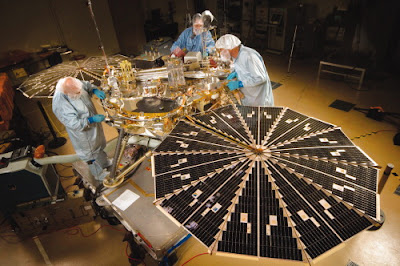
The Phoenix lander will lift off in August on a Delta II headed for touchdown in the north polar region of Mars. It will sample Martian water, ice and soil, searching for organic compounds critical to life. The circular Phoenix solar arrays, spanning 18 ft., were designed by ATK and adopted by Lockheed Martin for its winning Crew Exploration Vehicle design.Credit: PAT CORKERY/LOCKHEED MARTIN
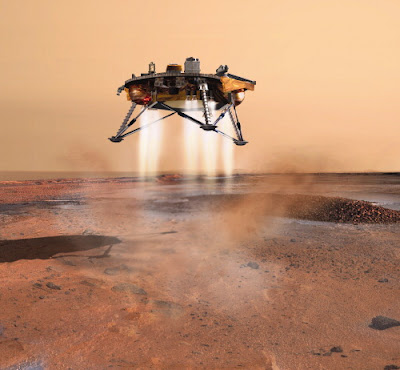
Phoenix will land on 12 Aerojet hydrazine-powered rocket engines. They will be fired after separation from the spacecraft’s parachute at 1,870-ft. altitude 26 sec. before touchdown—171 million mi. from Earth. Phoenix is too large to use airbags, as did the Mars rovers and earlier Pathfinder lander. The 1976 Vikings also used powered descents.Credit: NASA JPL/UNIVERSITY OF ARIZONA
Water blasts through 12 descent engines on nonflight engineering model of spacecraft in critical test of propellant-line stresses as engines cycle on and off on split-second basis.Credit: PAT CORKERY/LOCKHEED MARTIN
Robotic arm (A) equipped with lights and scoop (B) will deposit water, ice and soil samples in eight TEGA ovens (C) that will bake out organic signatures at up to 1,800F. The arm will also deposit soil in MECA wet chemistry lab (D) that will add water to four cells. MECA also has 10 atomic force microscope slides. Canadian weather station (E) includes laser ranging beam and silver temperature/wind mast (center). Stereo imager (F) will take detailed images of trench layers. Lander must relay all data by UHF antenna (G) to Mars orbiters.
Phoenix in launch configuration is encased in aeroshell with heat shield at blunt end for a Mars atmospheric entry. It will employ Mars hypersonic guidance using a segment of the Apollo Earth-reentry algorithm.Credit: PAT CORKERY/LOCKHEED MARTIN
Maybe, it’s happenstance, but I think that it’s the turtles.
Think about it, Leonardo, Donatello, and Raphaelo. Some Italian turtles fan?
NASA Nears Decision on Permanently Attached MPLM
Aviation Week & Space Technology
06/11/2007, page 33Michael A. Taverna
Turin, ItalyNASA nears decision on MPLM; European inflatable and robot concepts advance
Printed headline: Housecleaning
Thales Alenia Space says it’s close to clinching a deal with the European Space Agency and NASA to modify a Multi-Purpose Logistics Module so it can be permanently moored to the International Space Station once the shuttle is retired.
Such a plan–intended to add pressurized storage space needed to reduce clutter in living and working areas of the ISS–has been “kicking around for a while,” says Dino Brondolo, the company’s director of infrastucture programs, but has grown in priority as NASA confirmed its decision to phase out the shuttle by 2010. A green light would have to be given by the fall in order to complete modifications in time for the final MPLM mission, he says.
This X-45C tailless flying wing represents the fourth generation of stealth that protects against detection by low-frequency radars as well as it does against traditional high-frequency air defense sensors.Credit: BOEINGNASA is working out final specifications and discussing a barter acquisition arrangement with ESA and Italian space agency (ASI) for the plan, along the lines of previous agreements involving two new interconnecting modules, Node 2 and 3, and the Cupola astronaut viewing station, all of which, like MPLM, were built by Thales Alenia. Brondolo rates the chances for a go-ahead as “good.”
Carried in the shuttle cargo bay, the 21-ft.-dia., 15-ft.-long MPLM can supply up to 10 metric tons of pressurized cargo to and from the station, arranged on 16 standard racks. Attached to the ISS, it would provide an additional 70 cu. meters of volume–comparable to the Columbus or U.S. habitation modules–freeing up storage space for other functions.
Three vessels were initially procured from Thales Alenia, for a design life of 25 missions each. However, because of the drastic reduction in shuttle missions, only two–Rafaelo and Leonardo–have flown since their inaugural flight in March 2001, and they have totaled only seven missions between them. The third ship, Donatello, is set for a sole mission in January 2009. Only two other flights are currently planned–Leonardo in October 2008 and Rafaelo in July 2009.
If there had been 4, it would have been named Michaelangelo.
NASA’s boondoggle is having trouble.
I worked on equipment for the space shuttle while at Lockheed Missiles and Fire Control in Grand Prairie, TX, on the radiators, and I saw the specifications.
There were Minimum sizes for components.
The only reason for this was to ensure that only the shuttle could carry them into orbit.
So, to paraphrase a The Daily Show correspondent, we need to have the shuttle to service the space station, and we need the space station to give the shuttle a mission.
What a clusterf%$#.
Space station oxygen, water computers fail
HOUSTON, Texas (AP) — Russian computers that control the international space station’s orientation and supply of oxygen and water have failed, potentially extending the space shuttle’s mission — or cutting it short.
Russian engineers aren’t sure why the computers stopped working. A failure of this type has never occurred before on the space station.
The station is operated primarily by the Russian and U.S. space agencies, with contributions from the Canadian, European and Japanese space agencies.
“We have plenty of resources, so we have plenty of time to sort this out,” said Mike Suffredini, NASA manager of the space station program.
But the computer failure could extend space shuttle Atlantis’ mission by at least a day and, in a worst-case scenario, force the space station’s three crew members to return to Earth early if the computers aren’t fixed.
…