Category: Science

My Spice Rub Has Been Upgraded to Dietary Supplement

I have a Curry Spice Rub. In addition to being great on Lamb, Veal, Chicken and Beef, it now turns out that it may combat Alzheimer’s:

“Dr Milan Fiala of the University of California Los Angeles and colleagues note in the Proceedings of the National Academy of Sciences that they’d already shown that curcumin ‘may affect the brain cells of Alzheimer’s patients’, but wanted to pinpoint the ‘precise factor’ responsible.”

I’m feeling so virtuous right now. If I try it on fish, with the Omega 3s, it may be the fountain of bloody youth.

Hydrocarbons on Saturn’s Moon Hyperion

Straight from the NASA Pages. The more we study the solar system, the more we find of “the stuff of life”.

I think that there are a lot of planets out there supporting life currently, though not in our solar system. (Mars might have at one time)

NASA Finds Hydrocarbons on Saturn’s Moon Hyperion

PASADENA , Calif. – NASA’s Cassini spacecraft has revealed for the first time surface details of Saturn’s moon Hyperion, including cup-like craters filled with hydrocarbons that may indicate more widespread presence in our solar system of basic chemicals necessary for life.

Hyperion yielded some of its secrets to the battery of instruments aboard Cassini as the spacecraft flew close by in September 2005. Water and carbon dioxide ices were found, as well as dark material that fits the spectral profile of hydrocarbons.

Organics Sprinkled on Hyperion Image right:This map shows the composition of a portion of Hyperion’s surface. Blue shows the maximum exposure of frozen water, red denotes carbon dioxide ice (“dry ice”), magenta indicates regions of water plus carbon dioxide, yellow is a mix of carbon dioxide and an unidentified material. Image credit: NASA/JPL/University of Arizona/Ames/Space Science Institute
+ Full image and caption
Related images: + Hyperion’s Kaleidoscope of Color
+ Hyperion’s Icy Surface
+ Related story

A paper appearing in the July 5 issue of Nature reports details of Hyperion’s surface craters and composition observed during this flyby, including keys to understanding the moon’s origin and evolution over 4.5 billion years. This is the first time scientists were able to map the surface material on Hyperion.

“Of special interest is the presence on Hyperion of hydrocarbons–combinations of carbon and hydrogen atoms that are found in comets, meteorites, and the dust in our galaxy,” said Dale Cruikshank, a planetary scientist at NASA’s Ames Research Center, Moffett Field, Calif., and the paper’s lead author. “These molecules, when embedded in ice and exposed to ultraviolet light, form new molecules of biological significance. This doesn’t mean that we have found life, but it is a further indication that the basic chemistry needed for life is widespread in the universe.”

Cassini’s ultraviolet imaging spectrograph and visual and infrared mapping spectrometer captured compositional variations in Hyperion’s surface. These instruments, capable of mapping mineral and chemical features of the moon, sent back data confirming the presence of frozen water found by earlier ground-based observations, but also discovered solid carbon dioxide (dry ice) mixed in unexpected ways with the ordinary ice. Images of the brightest regions of Hyperion’s surface show frozen water that is crystalline in form, like that found on Earth.

“Most of Hyperion’s surface ice is a mix of frozen water and organic dust, but carbon dioxide ice is also prominent. The carbon dioxide is not pure, but is somehow chemically attached to other molecules,” explained Cruikshank.

Prior spacecraft data from other moons of Saturn, as well as Jupiter’s moons Ganymede and Callisto, suggest that the carbon dioxide molecule is “complexed,” or attached with other surface material in multiple ways. “We think that ordinary carbon dioxide will evaporate from Saturn’s moons over long periods of time,” said Cruikshank, “but it appears to be much more stable when it is attached to other molecules.”

“The Hyperion flyby was a fine example of Cassini’s multi-wavelength capabilities. In this first-ever ultraviolet observation of Hyperion, the detection of water ice tells us about compositional differences of this bizarre body,” said Amanda Hendrix, Cassini scientist on the ultraviolet imaging spectrograph at NASA’s Jet Propulsion Laboratory, Pasadena, Calif.

Hyperion, Saturn’s eighth largest moon, has a chaotic spin and orbits Saturn every 21 days. The July 5 issue of Nature also includes new findings from the imaging team about Hyperion’s strange, spongy-looking appearance. Details are online at: http://ciclops.org/view.php?id=3303 .

The Cassini-Huygens mission is a cooperative project of NASA, the European Space Agency and the Italian Space Agency. JPL, a division of the California Institute of Technology in Pasadena, manages the Cassini-Huygens mission for NASA’s Science Mission Directorate, Washington.

More information on the Cassini mission is available at: http://www.nasa.gov/cassini .


Media contact: Carolina Martinez 818-354-9382
Jet Propulsion Laboratory, Pasadena, Calif.

Ruth Dasso Marlaire 650-604-4709
Ames Research Center, Moffett Field, Calif.

Note to Aerospace Journalists: Star Trek Analogies Make You Look Like a Wanker

This is a significant development. It could lead to an explosion of planetary probes, and perhaps a meaningful space tug for transfer from LEO or GTO to GEO.

That being said the fact that the phony Next Generation Enterprise and ion drives both turn blue is not a reason to make stupid analogies that turn the stomach.

Interesting story. Lousy writing.

Dawn Spacecraft Ready To Turn Science Fiction into Reality (Subscription Required)
Aviation Week & Space Technology
07/02/2007, page 56

Craig Covault
Cape Canaveral

Dawn ready to turn science fiction into reality on mission to orbit two infant planets

Printed headline: Blue Light Special

In the classic television series Star Trek, the Starship Enterprise speeds around the galaxy on blue light propulsion beams, then maneuvers into orbit around many different worlds before zooming off again to do more exploration.

Such science fiction becomes fact here as the $446-million NASA Dawn mission is readied for liftoff on an eight-year, 3-billion-mi. journey to the protoplanets Vesta and Ceres (see cover).

Powered by glowing blue beams from its own revolutionary solar electric ion propulsion system (IPS), Dawn is to fly to, then orbit, these two separate bodies hundreds of millions of miles apart. Only science fiction spacecraft have done such things before; Star Trek’s Enterprise did it using antimatter propulsion.

With 935 lb. of xenon fuel, the 2,696-lb. Dawn spacecraft has far more propulsion capability than any previous real spacecraft.

Dawn’s solar electric propulsion system has the ability to accelerate the spacecraft by nearly 7 mi. per sec. over the course of its mission. This is as much velocity change in deep space as it will receive from its entire Delta launch vehicle to reach space, then depart Earth orbit.


Like Star Trek come true, the NASA Dawn spacecraft and its Dutch Space solar arrays spanning nearly 65 ft. (left) will accelerate by about 7 mi. per sec. on blue beams of ion propulsion to orbit two different bodies.Credit: (LEFT SIDE OF SPREAD) NASA/JPL, (RIGHT) STAR TREK BETHSOFT.COM

“That is huge for a planetary mission, it is really incredible velocity capability,” says Mike Mook, the Dawn Orbital Sciences project manager.

A conventional interplanetary spacecraft may burn roughly 660 lb. of propellants during a total of 20 min. of operation in an entire mission, achieving a velocity change of perhaps 3,300 fps. This compares with Dawn’s far greater solar electric capability to increase velocity—to nearly 7 mi. per sec.—over its longer mission life.

Rubber Ducky, You’re the one.

Cool.

Thousands of rubber ducks to land on British shores after 15 year journey
By BEN CLERKIN – More by this author » Last updated at 22:00pm on 27th June 2007

Comments Comments (9)
They were toys destined only to bob up and down in nothing bigger than a child’s bath – but so far they have floated halfway around the world.

The armada of 29,000 plastic yellow ducks, blue turtles and green frogs broke free from a cargo ship 15 years ago.

Since then they have travelled 17,000 miles, floating over the site where the Titanic sank, landing in Hawaii and even spending years frozen in an Arctic ice pack.

And now they are heading straight for Britain. At some point this summer they are expected to be spotted on beaches in South-West England.

While the ducks are undoubtedly a loss to the bath-time fun of thousands of children, their adventures at sea have proved an innvaluable aid to science”

The toys have helped researchers to chart the great ocean currents because when they are spotted bobbing on the waves they are much more likely to be reported to the authorities than the floats which scientists normally use.

Phoenix Mars Lander Readied for Launch

This is a highly ambitious project with a real possibility of finding signs of extra-terrestrial life.

Let’s hope that NASA does not screw this up.

Phoenix Mars Lander Readied for Launch(Subscription Required)

Aviation Week & Space Technology
06/11/2007, page 56

Craig Covault
Denver, Colo. & Tuscon, Ariz.

The Phoenix lander—with U.S., Canadian and European technology—will broaden the search for life’s clues beyond Earth

Printed headline: Back to Mars

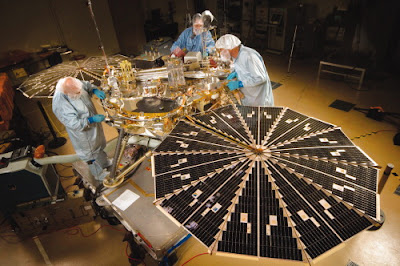
The NASA Phoenix Mars lander, carrying the most ambitious laboratory hardware ever sent to another planet, is ready for launch on a mission to taste Martian water and search for the organic carbon building-blocks of life near the planet’s north pole.

The spacecraft’s nearly 8-ft.-long robotic arm will dig trenches up to 3 ft. deep for imagery of subsurface layers and the retrieval of soil and ice samples for its complex mini-laboratories. This should enable Phoenix to determine what’s happening now, relative to the suitability for life, at a specific landing site where scientists know there’s water in the form of permafrost or ice. This is in contrast to the Mars rovers Spirit and Opportunity, which are equipped with geology sensors to determine what happened in the past, back to billions of years ago at their respective landing sites.

And Phoenix, with advanced technology from the U.S., Canada and Europe, will conduct much more complex sample processing and climate studies than was possible on the 1976 twin Viking landers that had a less capable arm and different analysis labs.


The Phoenix lander will lift off in August on a Delta II headed for touchdown in the north polar region of Mars. It will sample Martian water, ice and soil, searching for organic compounds critical to life. The circular Phoenix solar arrays, spanning 18 ft., were designed by ATK and adopted by Lockheed Martin for its winning Crew Exploration Vehicle design.Credit: PAT CORKERY/LOCKHEED MARTIN


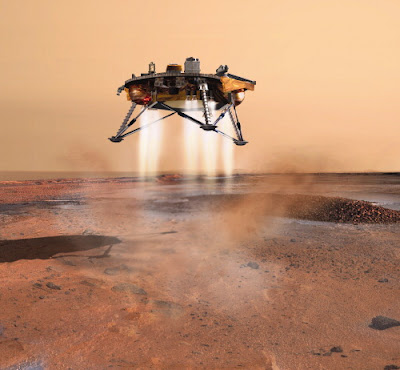
Phoenix will land on 12 Aerojet hydrazine-powered rocket engines. They will be fired after separation from the spacecraft’s parachute at 1,870-ft. altitude 26 sec. before touchdown—171 million mi. from Earth. Phoenix is too large to use airbags, as did the Mars rovers and earlier Pathfinder lander. The 1976 Vikings also used powered descents.Credit: NASA JPL/UNIVERSITY OF ARIZONA


Water blasts through 12 descent engines on nonflight engineering model of spacecraft in critical test of propellant-line stresses as engines cycle on and off on split-second basis.Credit: PAT CORKERY/LOCKHEED MARTIN


Robotic arm (A) equipped with lights and scoop (B) will deposit water, ice and soil samples in eight TEGA ovens (C) that will bake out organic signatures at up to 1,800F. The arm will also deposit soil in MECA wet chemistry lab (D) that will add water to four cells. MECA also has 10 atomic force microscope slides. Canadian weather station (E) includes laser ranging beam and silver temperature/wind mast (center). Stereo imager (F) will take detailed images of trench layers. Lander must relay all data by UHF antenna (G) to Mars orbiters.


Phoenix in launch configuration is encased in aeroshell with heat shield at blunt end for a Mars atmospheric entry. It will employ Mars hypersonic guidance using a segment of the Apollo Earth-reentry algorithm.Credit: PAT CORKERY/LOCKHEED MARTIN

Study supports existence of Martian Ocean

If this is true, Mars must have had life at some point.

New study supports existence of Mars ocean shoreline

WASHINGTON – Long, undulating features on the northern plains of Mars probably are remnants of shorelines of an ocean that covered a third of the planet’s surface at least 2 billion years ago, scientists said today.

The geological features, stretching thousands of kilometres, were first revealed in the 1980s in Viking spacecraft images. But topographical data collected by Nasa’s Mars Global Surveyor in the 1990s cast doubt on whether the features truly marked a long-gone sea coast.


An illustration shows how Mars might have appeared more than 2 billion years ago, with an ocean filling the lowland basin. Photo / Reuters

Don Herbert, ‘Mr. Wizard’ to Science Buffs, Dies at 89 – New York Times

He was before my time, but he will be missed.

Don Herbert, ‘Mr. Wizard’ to Science Buffs, Dies at 89

RICHARD GOLDSTEINPublished: June 13, 2007

Don Herbert, who unlocked the wonders of science for youngsters of the 1950s and ’60s as television’s Mr. Wizard, died yesterday at his home in the Bell Canyon section of Los Angeles. He was 89.

Don Herbert, around 1955.

The cause was bone cancer, his son-in-law Tom Nikosey told The Associated Press in confirming the death.

Mr. Herbert held no advanced degree in science, he used household items in his TV lab, and his assistants were boys and girls. But he became an influential showman-science teacher on his half-hour “Watch Mr. Wizard” programs, which ran on NBC from 1951 to 1965.

Millions of youngsters may have been captivated by Howdy Doody and the Lone Ranger, but many were also conducting science experiments at home, emulating Mr. Wizard.

Christofascist/Talibaptist Creation Museum Hires Man Who Did Sexually Explicit Vids

Let me repeat: HA HA!!!!

Fundies, this is God’s way of saying that you are blithering idiots.

Actor’s Risque Past Halts ‘Adam’ Film By JULIE CARR SMYTH, Associated Press Writer

Thursday, June 7, 2007

(06-07) 17:50 PDT Columbus, Ohio (AP) —

The man who plays Adam in a video aired at a Bible-based creationist museum has led a different life outside the Garden of Eden, flaunting his sexual exploits online and modeling for a clothing line that promotes free love.

After learning about his activities Thursday, the Creation Museum in Kentucky pulled the 40-second video in which he appears.

“We are currently investigating the veracity of these serious claims of his participation in projects that don’t align with the biblical standards and moral code upon which the ministry was founded,” Answers for Genesis spokesman Mark Looy said in a written statement.

The actor, Eric Linden, owns a graphic Web site called Bedroom Acrobat, where he has been pictured, smiling alongside a drag queen, in a T-shirt brandishing the site’s sexually suggestive logo. The Web site, which has a network of members, allows users to post explicit stories and photos.

He also sells clothing for SFX International, whose initials appear on clothing to spell “SEX” from afar. It promotes “free love,””pleasure” and “thrillz.”

Linden, a graphic designer, model and actor who grew up in Columbus, said he is no longer affiliated with the Bedroom Acrobat site, and had handed the domain name off to somebody. Ownership records available through the NetworkSolutions database show Linden registered the site 18 months ago.