Neil Armstrong made one small step at Tranquility Base.
Also cat blogging.


Neil Armstrong made one small step at Tranquility Base.
Also cat blogging.
It appears that the Russians have made a significant advance in pulse-detonation engines (PDE).
A PDE is similar in concept to the pulse jet that powered the V1.
The differences are as follows:
Here is the cycle for the engine:
It appears that astronomers have found water on an extrasolar planet.
While this planet, HD 189733b, probably does not support life, it’s a gas giant, this implies that water is rather common in the system, and life of some sort might be found on other planets.
This sounds very similar to the HOTOL concept in the early 1980s, and it appears that they are using cryogenic separation. They might save space and weight by using another form of oxygen separation, but they would still need the heat exchangers for making LOX.
ESA study finds in-flight oxidiser collection possible
By Rob CoppingerIn-flight oxidiser collection possible, says ESA study
A European Space Agency-funded study has concluded that air liquefaction plants for a space transportation system’s first-stage carrier aircraft are possible within the mass limits required.
The first stage would collect air, liquefy it and separate the nitrogen, producing 10kg/s (22lb/s) with a 10,000kg (22,000lb) on-board liquefaction plant.
The advantage of such a system is that the preferred liquid-oxygen propellant does not have to be carried from the ground. Once collected, the oxygen-enriched liquefied air is stored in the second-stage reusable orbiter vehicle.
The plant’s main mass drivers are the heat exchangers, of which there would be three. These have been a focus of the ESA study.
The study, involving Universite Libre de Bruxelles (ULB), developed the two-stage launch system concept that incorporates liquefaction.
That system has a dual-hull, hydrogen-fuelled aircraft using six General Electric 90b engines as the carrier aircraft. Between its two fuselages under the wing, it would carry an orbiter vehicle fuelled only with liquid hydrogen with a total mass of 90,000kg.
….
I’ve heard talk about it for a while, but this is the most I’ve seen in terms of public hard facts.
Of interest is how the name describes the vehicle. The antenna does resemble the business end of a Lacrosse stick.
Russian Telescope Images Top-Secret NRO Lacrosse (Subscription Required)
Aviation Week & Space Technology
07/09/2007, page 28Craig Covault
Cape CanaveralTop-secret U.S. space-based radar imaged by Russian telescope
Printed headline: Lacrosse Revealed
After 20 years of secrecy, the overall design of the 15-ton U.S. National Reconnaissance Office Lacrosse space-based radar and its remarkable 25-ft.-dia. imaging radar antenna are revealed in images of Lacrosse-2 at 400 mi. altitude taken by a Russian military ground-based telescope.
The images (above) were taken by a 28-channel adaptive optical system at the Russian Altay Laser/Optical Center. The site is one of several operated by the Science Research Institute for Precision Instrument Engineering. The line-of-sight distance from the Russian optics to the Lockheed Martin Lacrosse was more than 500 mi.
Views taken by a Russian ground-based telescope of a 15-ton NRO Lacrosse space-based imaging radar satellite reveal its secret 25-ft. mesh synthetic aperture radar antenna, developed by Harris Corp. near Cape Canaveral.Credit: RUSSIAN SCIENCE RESEARCH INSTITUTE FOR PRECISION INSTRUMENT ENGINEERING…
No unclassified imagery of a complete Lacrosse has ever been released by the NRO in nearly 20 years of radar satellite operations. The design matches the drawing at center. Credit: CHARLES P. VICK/GLOBALSECURITY.ORG
…
Bummer.
NASA Mission to Asteroid Belt Rescheduled for September Launch
WASHINGTON – The launch of NASA’s Dawn spacecraft, a mission that will explore the two largest objects in the asteroid belt in an effort to answer questions about the formation of our solar system, has been rescheduled to September.
The decision was made today to move the launch to September after careful review by NASA’s Science Mission Directorate officials, working with Dawn mission managers, the Dawn principal investigator, and with the concurrence of the NASA Administrator.
Primary reasons for the move were a combination of highly limited launch opportunities for Dawn in July and the potential impact to launch preparations for the upcoming Phoenix Mars Lander mission, set for early August. A September launch for Dawn maintains all of the science mission goals a July launch would have provided.…
Straight from the NASA Pages. The more we study the solar system, the more we find of “the stuff of life”.
I think that there are a lot of planets out there supporting life currently, though not in our solar system. (Mars might have at one time)
NASA Finds Hydrocarbons on Saturn’s Moon Hyperion
PASADENA , Calif. – NASA’s Cassini spacecraft has revealed for the first time surface details of Saturn’s moon Hyperion, including cup-like craters filled with hydrocarbons that may indicate more widespread presence in our solar system of basic chemicals necessary for life.
Hyperion yielded some of its secrets to the battery of instruments aboard Cassini as the spacecraft flew close by in September 2005. Water and carbon dioxide ices were found, as well as dark material that fits the spectral profile of hydrocarbons.
Image right:This map shows the composition of a portion of Hyperion’s surface. Blue shows the maximum exposure of frozen water, red denotes carbon dioxide ice (“dry ice”), magenta indicates regions of water plus carbon dioxide, yellow is a mix of carbon dioxide and an unidentified material. Image credit: NASA/JPL/University of Arizona/Ames/Space Science Institute
+ Full image and caption
Related images: + Hyperion’s Kaleidoscope of Color
+ Hyperion’s Icy Surface
+ Related storyA paper appearing in the July 5 issue of Nature reports details of Hyperion’s surface craters and composition observed during this flyby, including keys to understanding the moon’s origin and evolution over 4.5 billion years. This is the first time scientists were able to map the surface material on Hyperion.
“Of special interest is the presence on Hyperion of hydrocarbons–combinations of carbon and hydrogen atoms that are found in comets, meteorites, and the dust in our galaxy,” said Dale Cruikshank, a planetary scientist at NASA’s Ames Research Center, Moffett Field, Calif., and the paper’s lead author. “These molecules, when embedded in ice and exposed to ultraviolet light, form new molecules of biological significance. This doesn’t mean that we have found life, but it is a further indication that the basic chemistry needed for life is widespread in the universe.”
Cassini’s ultraviolet imaging spectrograph and visual and infrared mapping spectrometer captured compositional variations in Hyperion’s surface. These instruments, capable of mapping mineral and chemical features of the moon, sent back data confirming the presence of frozen water found by earlier ground-based observations, but also discovered solid carbon dioxide (dry ice) mixed in unexpected ways with the ordinary ice. Images of the brightest regions of Hyperion’s surface show frozen water that is crystalline in form, like that found on Earth.
“Most of Hyperion’s surface ice is a mix of frozen water and organic dust, but carbon dioxide ice is also prominent. The carbon dioxide is not pure, but is somehow chemically attached to other molecules,” explained Cruikshank.
Prior spacecraft data from other moons of Saturn, as well as Jupiter’s moons Ganymede and Callisto, suggest that the carbon dioxide molecule is “complexed,” or attached with other surface material in multiple ways. “We think that ordinary carbon dioxide will evaporate from Saturn’s moons over long periods of time,” said Cruikshank, “but it appears to be much more stable when it is attached to other molecules.”
“The Hyperion flyby was a fine example of Cassini’s multi-wavelength capabilities. In this first-ever ultraviolet observation of Hyperion, the detection of water ice tells us about compositional differences of this bizarre body,” said Amanda Hendrix, Cassini scientist on the ultraviolet imaging spectrograph at NASA’s Jet Propulsion Laboratory, Pasadena, Calif.
Hyperion, Saturn’s eighth largest moon, has a chaotic spin and orbits Saturn every 21 days. The July 5 issue of Nature also includes new findings from the imaging team about Hyperion’s strange, spongy-looking appearance. Details are online at: http://ciclops.org/view.php?id=3303 .
The Cassini-Huygens mission is a cooperative project of NASA, the European Space Agency and the Italian Space Agency. JPL, a division of the California Institute of Technology in Pasadena, manages the Cassini-Huygens mission for NASA’s Science Mission Directorate, Washington.
More information on the Cassini mission is available at: http://www.nasa.gov/cassini .
Media contact: Carolina Martinez 818-354-9382
Jet Propulsion Laboratory, Pasadena, Calif.Ruth Dasso Marlaire 650-604-4709
Ames Research Center, Moffett Field, Calif.
This is a significant development. It could lead to an explosion of planetary probes, and perhaps a meaningful space tug for transfer from LEO or GTO to GEO.
That being said the fact that the phony Next Generation Enterprise and ion drives both turn blue is not a reason to make stupid analogies that turn the stomach.
Interesting story. Lousy writing.
Dawn Spacecraft Ready To Turn Science Fiction into Reality (Subscription Required)
Aviation Week & Space Technology
07/02/2007, page 56Craig Covault
Cape CanaveralDawn ready to turn science fiction into reality on mission to orbit two infant planets
Printed headline: Blue Light Special
In the classic television series Star Trek, the Starship Enterprise speeds around the galaxy on blue light propulsion beams, then maneuvers into orbit around many different worlds before zooming off again to do more exploration.
Such science fiction becomes fact here as the $446-million NASA Dawn mission is readied for liftoff on an eight-year, 3-billion-mi. journey to the protoplanets Vesta and Ceres (see cover).
Powered by glowing blue beams from its own revolutionary solar electric ion propulsion system (IPS), Dawn is to fly to, then orbit, these two separate bodies hundreds of millions of miles apart. Only science fiction spacecraft have done such things before; Star Trek’s Enterprise did it using antimatter propulsion.
With 935 lb. of xenon fuel, the 2,696-lb. Dawn spacecraft has far more propulsion capability than any previous real spacecraft.
Dawn’s solar electric propulsion system has the ability to accelerate the spacecraft by nearly 7 mi. per sec. over the course of its mission. This is as much velocity change in deep space as it will receive from its entire Delta launch vehicle to reach space, then depart Earth orbit.
Like Star Trek come true, the NASA Dawn spacecraft and its Dutch Space solar arrays spanning nearly 65 ft. (left) will accelerate by about 7 mi. per sec. on blue beams of ion propulsion to orbit two different bodies.Credit: (LEFT SIDE OF SPREAD) NASA/JPL, (RIGHT) STAR TREK BETHSOFT.COM“That is huge for a planetary mission, it is really incredible velocity capability,” says Mike Mook, the Dawn Orbital Sciences project manager.
A conventional interplanetary spacecraft may burn roughly 660 lb. of propellants during a total of 20 min. of operation in an entire mission, achieving a velocity change of perhaps 3,300 fps. This compares with Dawn’s far greater solar electric capability to increase velocity—to nearly 7 mi. per sec.—over its longer mission life.
…
If useful work were being done there, they would be fighting applicants off with a stick.
They are begging for people to find uses for that white elephant.
NASA Seeks Outside ISS Users (Subscription Required)
NASA Seeks Outside ISS Users
Aviation Week & Space Technology
07/02/2007, page 24Frank Morring, Jr.
WashingtonHalf of U.S. rack space on station unfilled; NASA seeks outside users
Printed headline: Space Available
NASA is giving away half of its space on the International Space Station. The question is whether anyone will be able to get there to use it.
As the ISS enters the final stretch of its buildout to completion before the space shuttle fleet is retired in 2010, NASA managers are offering the use of roughly 11 refrigerator-sized experiment racks inside the station’s pressurized modules, and perhaps four external sites, free of charge. The catch is that users will have to get their experiments to the ISS at their own expense.
“We’re not going to require users of the station to pay a fee for access to the laboratories,” says Mark Uhran, assistant associate administrator for ISS in NASA’s Space Operations Mission Directorate. “What we expect the new entities to cover is the cost of their own research, the cost of the payload devices. We’re still working the challenges with the transportation costs because obviously we don’t know precisely what those transportation costs are going to be.”
…
If you reference some of the links off this page, a nuclear powered engine of this type does give a higher ISP 875 vs 350 for the very efficient SSMEs.
Of course, other technologies, Ion and plasma are much higher (a quick google gives an ISP of 3300 for early ion drives).
Of course, Ion and plasma are low thrust, and cannot be used for ascent or descent, but neither can NERVA class motors, as their exhaust is radioactive.
Space nuke boffin: NASA Moonbase needs nuclear rockets
By Lewis Page
Published Saturday 30th June 2007 07:02 GMTOne of America’a top nukes-in-space boffins says it’s time to consider nuclear-powered rockets again. He reckons atomic boosters could cut the cost of NASA’s upcoming Moonbase plan.
….
This guy runs the premier RTG battery (nuclear batteries) manufacturer in the US, The Center for Space Nuclear Research, and he is someone who has a hammer, and sees everything as a nail.
But Howe reckons that there’s more to nukes in space than just providing electricity. He says that nuclear power should be used for propulsion, too. According to an article in New Scientist, his plan is to update a 1960s design called Nuclear Engine for Rocket Vehicle Application (NERVA) to carry payloads from Earth orbit to the Moon.
NERVA-type rockets use a fission reactor to heat up hydrogen and blast it out of the thrust nozzle at extremely high speed, faster than can be achieved by normal chemical-powered boosters. This allows a nuclear-driven spacecraft to achieve more with a given amount of liquid fuel, or “reaction mass.” The NERVA test programme had its problems – not least the fact that the reactor tended to come apart and fire itself out of the exhaust – and was terminated in 1972 during NASA budget cuts.
Howe and his team reckon that the greater efficiency of nuclear drive would allow each Moon shot to carry an additional eight tons of payload, which would mean fewer launches being needed. He thinks the savings from a lower number of launches would more than offset the cost of updating the original NERVA design, perhaps yielding overall savings of as much as $2bn.
…
It’s nice to see a multi billion dollar program canceled when it’s way behind schedule and over budget.
Spy chief scraps satellite program
June 21, 2007: 04:55 PM EST
Jun. 21, 2007 (AFX International Focus) —
WASHINGTON (AP) – Spy chief Mike McConnell has junked a multibillion-dollar spy satellite program that engineers hoped would someday pass undetected through the space above other nations.
The move from the director of national intelligence comes after several years of congressional efforts to kill the program, known publicly as the next generation of ‘Misty’ satellites. The new satellite was to be a stealthy intelligence spacecraft designed to take pictures of adversaries and avoid detection.
Little is known about the nation’s classified network of satellites, which represent some of the most expensive government programs and receive almost no public oversight. Because of their multibillion-dollar price tags, sensitive missions and lengthy development schedules, spy agencies go to great pains to keep details from becoming public.
McConnell gave no reason for his recent decision. Despite the program’s secrecy, he almost dared further inquiry into it.
Speaking Tuesday to an intelligence conference on workplace diversity, McConnell changed the subject and ended his speech by saying: ‘I have been advised when I was getting ready (OTCBB:GTRY) for this job, you have to do two things: kill a multibillion-dollar program. Just did that. Word is not out yet. You’ll see soon.
…
Obviously, it will need to deal with the humidity at the launch site, but the boost from being the equator is significant.
Soyuz rockets set to blast off from Kourou
By Steve Nichols
Arianespace has signed a contract with Roskosmos, the Russian space industry, to buy the first four Soyuz rockets that will be launched from the Guiana Space Centre (GSC) in Kourou.
Jean-Yves Le Gall, chairman and CEO of Arianespace, and Anatoly Perminov, managing director of Roskosmos, signed the contract at the show, and confirmed launches will start in 2009.
…
The medium-launch Soyuz fits in well between the existing Vega light launcher and the heavy lift Ariane 5.
….it is expected to become the most cost-effective path to orbit for commercial satellites in the 3 tonne class.
Very true. The Russian boosters are very mature technology, and most of the costs of their development have been amortized long ago.
This is a part of a continuing trend of our NATO allies looking for the ability to conduct operations independently of the US.
Not surprising, when one considers just how badly people have gotten burnt by the Bush admin.
The US is no longer viewed as a dependable ally. We are viewed as a mad dog.
Italy Starts Work on Second-Generation CosmoSkyMed (Subscription Required)
Italy Starts Work on Second-Generation CosmoSkyMed
Aviation Week & Space Technology
06/18/2007, page 72Andy Nativi
Vandenberg AFB, Calif.
Michael A. Taverna
ParisWith X-band radar satellite safely in orbit, Italy starts work on second-generation design
Printed headline: Cosmo Calling
The first of four CosmoSkyMed radar observation satellites will became operational in December, following a successful launch last week.
Together with Germany’s SARLupe imaging system, the first of which was orbited in December, the Italian X-band satellite will add an all-weather adjunct to Europe’s day/night optical intelligence satellite capacity, based on France’s Helios 2. The combined systems will provide a full space-based intelligence, surveillance and reconnaissance (ISR) capability to support troops deployed in overseas theaters and reinforce immigration control, drug interdiction and other security activities.
The radar network was due to be expanded late last week by a German metric commercial radar spacecraft, TerreSAR-X, and next month by a second SARLupe.
Under a series of agreements dating back to 2001, Italy and France will share access to CosmoSkyMed, Helios 2 and France’s twin-satellite, dual-use Pleiades submetric optical-imaging system, which is to be deployed in 2009-10. An Italian hyperspectral optical instrument may be added to the mix.
…
This is a highly ambitious project with a real possibility of finding signs of extra-terrestrial life.
Let’s hope that NASA does not screw this up.
Phoenix Mars Lander Readied for Launch(Subscription Required)
Aviation Week & Space Technology
06/11/2007, page 56Craig Covault
Denver, Colo. & Tuscon, Ariz.The Phoenix lander—with U.S., Canadian and European technology—will broaden the search for life’s clues beyond Earth
Printed headline: Back to Mars
The NASA Phoenix Mars lander, carrying the most ambitious laboratory hardware ever sent to another planet, is ready for launch on a mission to taste Martian water and search for the organic carbon building-blocks of life near the planet’s north pole.
The spacecraft’s nearly 8-ft.-long robotic arm will dig trenches up to 3 ft. deep for imagery of subsurface layers and the retrieval of soil and ice samples for its complex mini-laboratories. This should enable Phoenix to determine what’s happening now, relative to the suitability for life, at a specific landing site where scientists know there’s water in the form of permafrost or ice. This is in contrast to the Mars rovers Spirit and Opportunity, which are equipped with geology sensors to determine what happened in the past, back to billions of years ago at their respective landing sites.
And Phoenix, with advanced technology from the U.S., Canada and Europe, will conduct much more complex sample processing and climate studies than was possible on the 1976 twin Viking landers that had a less capable arm and different analysis labs.
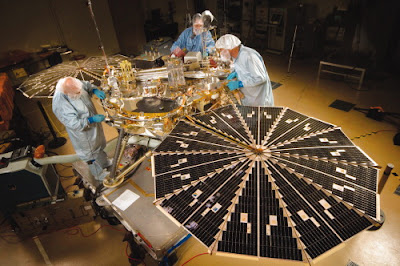
The Phoenix lander will lift off in August on a Delta II headed for touchdown in the north polar region of Mars. It will sample Martian water, ice and soil, searching for organic compounds critical to life. The circular Phoenix solar arrays, spanning 18 ft., were designed by ATK and adopted by Lockheed Martin for its winning Crew Exploration Vehicle design.Credit: PAT CORKERY/LOCKHEED MARTIN
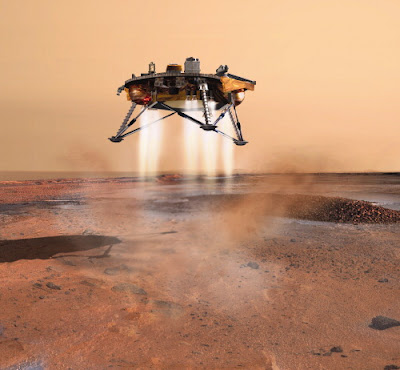
Phoenix will land on 12 Aerojet hydrazine-powered rocket engines. They will be fired after separation from the spacecraft’s parachute at 1,870-ft. altitude 26 sec. before touchdown—171 million mi. from Earth. Phoenix is too large to use airbags, as did the Mars rovers and earlier Pathfinder lander. The 1976 Vikings also used powered descents.Credit: NASA JPL/UNIVERSITY OF ARIZONA
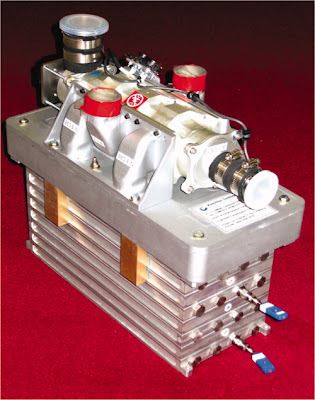
Water blasts through 12 descent engines on nonflight engineering model of spacecraft in critical test of propellant-line stresses as engines cycle on and off on split-second basis.Credit: PAT CORKERY/LOCKHEED MARTIN
Robotic arm (A) equipped with lights and scoop (B) will deposit water, ice and soil samples in eight TEGA ovens (C) that will bake out organic signatures at up to 1,800F. The arm will also deposit soil in MECA wet chemistry lab (D) that will add water to four cells. MECA also has 10 atomic force microscope slides. Canadian weather station (E) includes laser ranging beam and silver temperature/wind mast (center). Stereo imager (F) will take detailed images of trench layers. Lander must relay all data by UHF antenna (G) to Mars orbiters.
Phoenix in launch configuration is encased in aeroshell with heat shield at blunt end for a Mars atmospheric entry. It will employ Mars hypersonic guidance using a segment of the Apollo Earth-reentry algorithm.Credit: PAT CORKERY/LOCKHEED MARTIN
Maybe, it’s happenstance, but I think that it’s the turtles.
Think about it, Leonardo, Donatello, and Raphaelo. Some Italian turtles fan?
NASA Nears Decision on Permanently Attached MPLM
Aviation Week & Space Technology
06/11/2007, page 33Michael A. Taverna
Turin, ItalyNASA nears decision on MPLM; European inflatable and robot concepts advance
Printed headline: Housecleaning
Thales Alenia Space says it’s close to clinching a deal with the European Space Agency and NASA to modify a Multi-Purpose Logistics Module so it can be permanently moored to the International Space Station once the shuttle is retired.
Such a plan–intended to add pressurized storage space needed to reduce clutter in living and working areas of the ISS–has been “kicking around for a while,” says Dino Brondolo, the company’s director of infrastucture programs, but has grown in priority as NASA confirmed its decision to phase out the shuttle by 2010. A green light would have to be given by the fall in order to complete modifications in time for the final MPLM mission, he says.
This X-45C tailless flying wing represents the fourth generation of stealth that protects against detection by low-frequency radars as well as it does against traditional high-frequency air defense sensors.Credit: BOEINGNASA is working out final specifications and discussing a barter acquisition arrangement with ESA and Italian space agency (ASI) for the plan, along the lines of previous agreements involving two new interconnecting modules, Node 2 and 3, and the Cupola astronaut viewing station, all of which, like MPLM, were built by Thales Alenia. Brondolo rates the chances for a go-ahead as “good.”
Carried in the shuttle cargo bay, the 21-ft.-dia., 15-ft.-long MPLM can supply up to 10 metric tons of pressurized cargo to and from the station, arranged on 16 standard racks. Attached to the ISS, it would provide an additional 70 cu. meters of volume–comparable to the Columbus or U.S. habitation modules–freeing up storage space for other functions.
Three vessels were initially procured from Thales Alenia, for a design life of 25 missions each. However, because of the drastic reduction in shuttle missions, only two–Rafaelo and Leonardo–have flown since their inaugural flight in March 2001, and they have totaled only seven missions between them. The third ship, Donatello, is set for a sole mission in January 2009. Only two other flights are currently planned–Leonardo in October 2008 and Rafaelo in July 2009.
If there had been 4, it would have been named Michaelangelo.
Another case of a headline abuse. The “Accent Graves” thing in the printed version is a bad French pun.
FWIW, Sarkosy will be big on the ability to do this independently, the Gaullists, and his party is one of their descendants have always been bigger on this than the socialists.
France Pushes Operational Space Surveillance, Elint Capabilities
Aviation Week & Space Technology
06/18/2007, page 70Michael A. Taverna
Broye-les-Pesmes and Rennes, FranceFrance pushes Europe to develop operational space surveillance, elint capabilities
Printed headline: Accent Graves
France is inviting its European neighbors to collaborate on a ground-based space surveillance system as part of a proposed military space buildup that could include operational signals intelligence and data relay networks.
Since December 2005, the French air force’s air defense/air operations command has been operating a space surveillance facility that was initially intended as a technology demonstrator. Unlike existing systems in the U.S. and Russia, which rely on an array of sensors, the French installation, called Graves, uses a single bistatic radar and a powerful 60-Gflop/sec. processing system to detect the angular and radial velocity measurements of orbiting spacecraft and–using patented algorithms–determine their orbital parameters. A four-transmitter array is located at Broye-les-Pesmes, east of Dijon; receivers are on the Plateau d’Albion, 400 km. (250 mi.) south.
…
The fact that the increasing number of satellites will allow them to be used tactically now is VERY important.
I rather imagine that there will be applications in terms of real time intel in the disputed territories.
Israel’s successful launch of the Ofek 7 on Monday should not be taken lightly. While Israel has proven numerous times that it has the ability to independently develop, manufacture and launch satellites into space, the timing of Monday’s launch was difficult to ignore.
…
But beyond the contribution the new satellite will make to IDF operations and to the work being done at Military Intelligence, it also places Israel at the forefront of global satellite development.
Israel is one of seven countries with independent satellite launch capabilities and is part of an exclusive club that includes the United States, France, Japan, China, India and Russia.
…
Despite the tiny budget, Israel has had some great successes and last year doubled the US in the number of academic articles Israelis wrote about space and satellites. Ofek 7, defense officials pointed out, would work in conjunction with Ofek 5, launched in 2004 and would grant the IDF the capability to use the satellites as tactical tools during operations and not just strategic tools that gathered intelligence and assisted Israel in assessing its neighbors’ intentions.
…
If this is true, Mars must have had life at some point.
New study supports existence of Mars ocean shoreline
WASHINGTON – Long, undulating features on the northern plains of Mars probably are remnants of shorelines of an ocean that covered a third of the planet’s surface at least 2 billion years ago, scientists said today.
The geological features, stretching thousands of kilometres, were first revealed in the 1980s in Viking spacecraft images. But topographical data collected by Nasa’s Mars Global Surveyor in the 1990s cast doubt on whether the features truly marked a long-gone sea coast.
An illustration shows how Mars might have appeared more than 2 billion years ago, with an ocean filling the lowland basin. Photo / Reuters
NASA’s boondoggle is having trouble.
I worked on equipment for the space shuttle while at Lockheed Missiles and Fire Control in Grand Prairie, TX, on the radiators, and I saw the specifications.
There were Minimum sizes for components.
The only reason for this was to ensure that only the shuttle could carry them into orbit.
So, to paraphrase a The Daily Show correspondent, we need to have the shuttle to service the space station, and we need the space station to give the shuttle a mission.
What a clusterf%$#.
Space station oxygen, water computers fail
HOUSTON, Texas (AP) — Russian computers that control the international space station’s orientation and supply of oxygen and water have failed, potentially extending the space shuttle’s mission — or cutting it short.
Russian engineers aren’t sure why the computers stopped working. A failure of this type has never occurred before on the space station.
The station is operated primarily by the Russian and U.S. space agencies, with contributions from the Canadian, European and Japanese space agencies.
“We have plenty of resources, so we have plenty of time to sort this out,” said Mike Suffredini, NASA manager of the space station program.
But the computer failure could extend space shuttle Atlantis’ mission by at least a day and, in a worst-case scenario, force the space station’s three crew members to return to Earth early if the computers aren’t fixed.
…
Here is an interesting rundown on the technologies that NASA is looking at:
Rovers, reactors and ‘green’ rockets all on NASA’s future-technology list
Aviation Week & Space Technology
06/04/2007, page 50
Frank Morring, Jr.
WashingtonSome advanced technology for long-term human space exploration is already getting on-orbit checkout as NASA targets about $350 million from its tight exploration budget this year on the long-lead items that may enable a return to the Moon en route to Mars.
There is some neat stuff here, but also some scary stuff.
But the program also is funding advanced-technology research ranging from composite space radiators that might save weight on Orion to a 5-ton nuclear reactor that would generate power for the outpost NASA plans to build on the Moon as a proving ground for expeditions to Mars.
The reactor is one of the scary things. The tech is described below, and I’ll explain why it’s scary (it’s notbecause it’s a nuclear reactor) after that.
One such system is getting a workout on the Orbital Express mission being conducted by the Defense Advanced Research Projects Agency (Darpa). Although the satellite-servicing testbed has had problems in orbit (AW&ST May 28, p. 22), they were unrelated to the Advanced Video Guidance Sensor provided by NASA.
Evolved over the past decade at Marshall Space Flight Center in Huntsville, Ala., and previously space-tested on two space shuttle flights and the failed Demonstration of Autonomous Rendezvous Technology mission in 2004, the sensor is designed for short-range rendezvous guidance between cooperating spacecraft.
I worked at the battery manufacturer for DART and did some (very) minor work on the batteries. It should be noted that the batteries worked just fine.
If it turns out that such a large piece of PICA can’t handle the lunar-reentry heat flux, which is four to five times greater than that experienced by a reentering space shuttle, NASA will turn to two more contracts for backup heat-shield material. Boeing’s Huntington Beach, Calif., facility will receive as much as $10 million to conduct early studies of a proprietary material known as the Boeing Phenolic Ablator (BPA). Textron Systems of Wilmington, Mass., won a contract worth as much as $24 million for preliminary work on two proprietary materials–Dual Layer, and a material called Avcoat that was used on the Apollo capsule.
“We’re trying to relearn how to make that material,” Moore says. “It’s been a generation, and a lot of the people have retired who have done the Apollo heat shield, so we have lost a lot of that expertise.”
They could also talk to the Russians.
Also under study are new fluids to carry the heat away from Orion electronics into the radiators–a mixture of propylene glycol and water is the baseline.
Don’t confuse Ethylene Glycol and Propylene Glycol. The former is normal poisonous anti-freeze, the the latter is an alternative anti-freeze that is in the “pet safe” stuff, which is so non-toxic that you see it added to salad dressing.
Other advanced technologies under study for Orion include lightweight parachute material that can also fit into a smaller volume, and an amine swing-bed for carbon dioxide and moisture removal from the crew compartment. A bed of very small plastic beads is coated with chemicals that absorb CO2 and water vapor, and then release it when vented to the space vacuum.
NASA is developing a prototype amine swing-bed system to remove carbon dioxide and moisture from the Orion crew compartment.Credit: NASA/JSC
I think that this is of more concern for the Mars missions than the moon missions, where the use of conventional CO2 sorbents might require too much weight and volume.
For crew safety, a team at NASA’s Glenn Research Center in Cleveland is working on a “green” Orion attitude-control thruster system. Instead of requiring storage of highly toxic hydrazine fuel near the crew compartment, the system would burn gaseous oxygen and methane.
I think that this might be more of an issue of ISP (fuel economy) than environmental friendliness. The room temp propellants typically have a lower ISP, but Methane is much easier to store than liquid hydrogen, having a higher boiling point.
The dual propellant thrusters are more difficult to control precisely, but much more efficient.
Advanced preparations for the shuttle-derived Ares I crew launch vehicle that will carry Orion to orbit are also underway, piggybacking at times on routine shuttle-program tests to gather data. A case in point was the May 24 static test of a four-segment shuttle Reusable Solid Rocket Motor (RSRM) in Utah, which provided motor-signature data for a study at Ames Research Center on ways to detect impending failure in the five-segment RSRM that will serve as the Ares I first-stage.
Good move, but a better move is not to use solid rockets on man-rated systems. I continue to be dubious of solid rocket boosters on manned systems.
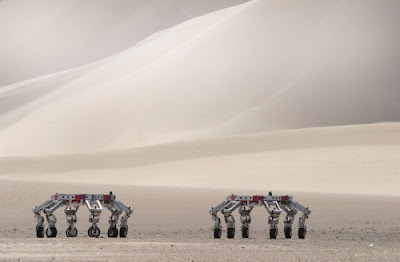
To help astronauts establish a lunar outpost and explore the surrounding terrain, the advanced-technology program is studying rovers, a nuclear power source and in situ resource utilization (ISRU) techniques. One promising activity at the Pasadena, Calif.-based Jet Propulsion Laboratory has field tested the All-Terrain Hex-Legged Extra-Terrestrial Explorer (Athlete), a six-legged vehicle as tall as a man that can move heavy payloads such as habitats around the surface either on wheels or by “walking.” Another project at Houston-based Johnson Space Center, dubbed Scout, is an updated version of the unpressurized moon buggy that hauled Apollo astronauts around the lunar surface.
Two Athlete rovers undergo testing in California’s Dumont Dunes. Athlete can roll over rough terrain using its wheels or its six legs, transporting heavy payloads during construction of the planned lunar outpost.Credit: JET PROPULSION LABORATORY
I think that this just looks cool, so here is the picture.
A big objective of the lunar outpost will be to test exploration technologies and techniques that can enable subsequent human exploration on Mars. Engineers at JSC are working on a variety of ISRU techniques to extract oxygen from the lunar regolith, as much for the experience as the resource.
Along the same lines, NASA and the Energy Dept. are working under a scaled-back version of the old Project Prometheus to advance some of the technologies that would be needed for a five-metric-ton, 40-kw. fission reactor that would take over from the solar power plant scheduled to provide initial power for the outpost. It would be fueled with uranium dioxide and cooled with a sodium/potassium liquid alloy.
This scares the hell out of me. Based on discussions with a Naval Nuke over a decade ago, metal cooled reactors are VERY twitchy things, with reaction times so fast that you can’t operate them manually.
They are much more compact though, hence their use in the Soviet’s Alpha class boats, where they worked (though their nuclear personnel glowed in the dark), and the unsuccessful use in the USN’s original Seawolf, which was our 2nd nuclear boat.
They replaced it with a pressurized water reactor a few years after it was installed.