Category: technology

Defense Boondoggle, June 24 Edition

I see an IP lawsuit. They are using my likeness (sort of) without my permission.

A more pressing question is how is Lockheed getting its cut of this?

Sentient world: war games on the grandest scale

By Mark Baard
Published Saturday 23rd June 2007 09:02 GMT

Perhaps your real life is so rich you don’t have time for another.

Even so, the US Department of Defense (DOD) may already be creating a copy of you in an alternate reality to see how long you can go without food or water, or how you will respond to televised propaganda.

The DOD is developing a parallel to Planet Earth, with billions of individual “nodes” to reflect every man, woman, and child this side of the dividing line between reality and AR.

Called the Sentient World Simulation (SWS), it will be a “synthetic mirror of the real world with automated continuous calibration with respect to current real-world information”, according to a concept paper for the project.

More power and more payload for Gripen demo-21/06/2007-Paris-Flight Daily News

The Gripen can already supercruise clean, and the additional thrust should allow it to do so while carrying more.

More power and more payload for Gripen demo-21/06/2007

By Jon Lake
Saab chose the Paris Air Show to reveal details of its new Gripen Demonstrator programme. The Gripen Demo aircraft will act as a technology demonstrator and testbed for an upgrade configuration for the Swedish air force, and as the prototype for planned ‘Future Gripens’, including the Gripen N for Norway, the Gripen DK for Denmark, and perhaps even for a variant to meet India’s MMRCA requirement.

….

The Gripen Demo aircraft will have a revised configuration, with a new forward-retracting main landing gear that frees up internal volume for extra fuel, and with distinctive bulged wingroot fairings underwing providing further increases in internal volume. The use of these fairings replaces the upper fuselage conformal tanks seen on previous studies, and will provide an extra 38% of internal fuel, taking the total to 3,130 kg.

The relocated and beefed-up undercarriage will allow a 2-tonne increase in maximum take off weight, to 16t. This in turn will allow the aircraft to carrier heavier warloads (up to 6,000kg), and to facilitate this, the Gripen Demo will have new side by side under-fuselage pylons (augmenting the single centreline pylon) and underwing hardpoints capable of carrying twin pylons.

The aircraft will be powered by a new 22,000lb engine, provisionally dubbed the F414G. ….. The F414G will deliver some 4,000lb more thrust than the RM-12, giving a useful boost in performance. Some sources give the new engine a 26,000lb thrust rating – doubling the advantage.

The aircraft will also be fitted with an AESA radar, probably based on Ericsson’s long-running NORA and Saab/Selex’ M-AESA programmes.

Gripen to get AESA

I’ve always thought that the Gripen has the possibility of being the Mirage III of its generation, as it is the smallest, cheapest, and cheapest to operate of the 4th generation aircraft.

Gripen to get AESA in mid-life upgrade
Keeping pace with the technology trend, Saab’s JAS39 Gripen is to be fitted with a multi-channel active electronically scanned array (AESA) radar, likely to be introduced under a planned mid-life upgrade (MLU) that could come along as early as 2010.

Development of the AESA radar for Gripen started out under the Saab Ericsson NORA (Not Only a RAdar) programme, and has been underway for several years, including test flying aboard a specially-retained Saab JA-37 Viggen testbed. One of the main benefits of the NORA concept was the provision of improved long-range tracking as a result of the combination of longer detection range and electronically-steered beam control. The AESA radar programme is directly linked to MIDAS (Multifunction Integrated Defensive Avionics System), which will also add electronic attack and advanced datalinking capabilities.

Boeing: Boeing Completes First Flight of A160T Hummingbird Unmanned Helicopter

Obviously, this is a Boeing press release, and should be viewed as such, but it bears watching, particularly their variable speed rotor technology.

Boeing: Boeing Completes First Flight of A160T Hummingbird Unmanned Helicopter

LE BOURGET, France, June 18, 2007 — The Boeing Company [NYSE: BA] successfully completed the first flight of the A160T Hummingbird unmanned rotorcraft June 15 from an airfield near Victorville, Calif.

The A160T, a turbine-powered version of the innovative piston-powered A160 helicopter, features unmatched range, endurance, payload and altitude for an unmanned rotorcraft.

“Today’s Hover-In-Ground Effect flight is our first step in providing the warfighter the key element of our approach to providing persistent intelligence, surveillance and reconnaissance coverage that only an unmanned helicopter of this type can provide,” said Jim Martin, Boeing Advanced Systems A160 program manager, after the flight.

During the 12-minute hover flight to verify vehicle and subsystem operation, the A160T met all test objectives and collected extensive flight control, propulsion and subsystem operation data.

The test marked the 37th flight overall for the A160 program and the first in a series of flights that will demonstrate endurance levels greater than 18 hours. The aircraft used during the tests is the first of 10 A160Ts Boeing Advanced Systems is building for the Defense Advanced Projects Research Agency and the U.S. Special Operations Command.

The Hummingbird features a unique optimum speed rotor technology that significantly improves overall performance efficiency by adjusting the rotor system’s revolutions per minute at different altitudes, gross weights and cruise speeds. The autonomous unmanned aircraft, measuring 35 feet long with a 36-foot rotor diameter, eventually will fly more than 140 knots with a ceiling of 25,000 to 30,000 ft. (high hover capability up to 15,000 ft.) for up to 20 hours. Operational A160Ts will be capable of persistent intelligence, surveillance and reconnaissance; target acquisition; direct action; communication relay and precision re-supply missions.

DARPA scramjet nudges Mach 10 | The Register

It should be noted that DARPA is late to this game. Most of the heaby lifting was done by the DSTO before the US DoD got involved.

The US has a number of FAR MOER EXPENSIVE projects in this area that have not gotten to this point.

DARPA scramjet nudges Mach 10

By Lester Haines
Published Monday 18th June 2007 09:26 GMT

Australia’s Woomera Test Facility last Friday hosted the successful launch and firing of a scramjet engine which reached speeds of “up to Mach 10”, the country’s Defence Science and Technology Organisation (DSTO) has announced.

The HyCAUSE vehicle – a joint project between DSTO, the US’s Defense Advanced Research Projects Agency (DARPA), and the Australian Hypersonics Initiative (AHI)- took off atop a TALOS rocket and reached a heady 530km before firing its way to around 11,000km/h (6,800mph), according to Oz’s parliamentary secretary to the Minister for Defence, Peter Lindsay.

F-22 superjets could act as flying Wi-Fi hotspots | The Register

One of the reasons that this is of interest is that the current version of the F-22 does not have a good data path out. It was designed to operate nearly autonomously over Warsaw Pact integrated air-defense networks, so the idea is that data would go in, but not out.

This hack to the radar fixes this.

F-22 superjets could act as flying Wi-Fi hotspots
By Lewis Page
Published Tuesday 19th June 2007 15:20 GMT

US defence contractors have carried out the first flight tests in which America’s latest cutting-edge fighter targeting radars have been put to novel use – as high-capacity wireless datalinks. This crafty use of existing hardware has the potential to ease military bandwidth bottlenecks, and could offer a chance for expensive superfighters to be of use even in the absence of serious aerial opposition.


The most expensive Wi-Fi hotspot in the world?

The latest generation of US military aircraft carry so-called Active Electronically Scanned Array* (AESA) radars, which are made up of many separate transmit-receive elements. AESA radars have long been heralded as miraculous multi-tasking kit, capable of acting as electronic-warfare scanners, jammers, or even electromagnetic weapons capable of frying enemy circuitry from afar.

There have also been ground trials in which the radar from America’s ultra-advanced, hyper-expensive F-22 “Raptor” stealth superfighter has been used as a kind of Wi-Fi card on steroids, able to transmit data at a blistering 548 Mbit/sec and receive it at Gigabit speed.

Phoenix Mars Lander Readied for Launch

This is a highly ambitious project with a real possibility of finding signs of extra-terrestrial life.

Let’s hope that NASA does not screw this up.

Phoenix Mars Lander Readied for Launch(Subscription Required)

Aviation Week & Space Technology
06/11/2007, page 56

Craig Covault
Denver, Colo. & Tuscon, Ariz.

The Phoenix lander—with U.S., Canadian and European technology—will broaden the search for life’s clues beyond Earth

Printed headline: Back to Mars

The NASA Phoenix Mars lander, carrying the most ambitious laboratory hardware ever sent to another planet, is ready for launch on a mission to taste Martian water and search for the organic carbon building-blocks of life near the planet’s north pole.

The spacecraft’s nearly 8-ft.-long robotic arm will dig trenches up to 3 ft. deep for imagery of subsurface layers and the retrieval of soil and ice samples for its complex mini-laboratories. This should enable Phoenix to determine what’s happening now, relative to the suitability for life, at a specific landing site where scientists know there’s water in the form of permafrost or ice. This is in contrast to the Mars rovers Spirit and Opportunity, which are equipped with geology sensors to determine what happened in the past, back to billions of years ago at their respective landing sites.

And Phoenix, with advanced technology from the U.S., Canada and Europe, will conduct much more complex sample processing and climate studies than was possible on the 1976 twin Viking landers that had a less capable arm and different analysis labs.


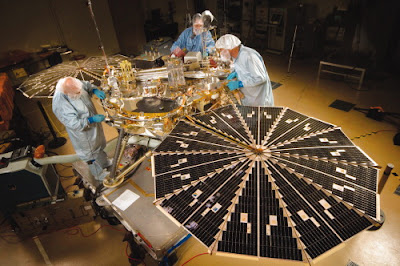
The Phoenix lander will lift off in August on a Delta II headed for touchdown in the north polar region of Mars. It will sample Martian water, ice and soil, searching for organic compounds critical to life. The circular Phoenix solar arrays, spanning 18 ft., were designed by ATK and adopted by Lockheed Martin for its winning Crew Exploration Vehicle design.Credit: PAT CORKERY/LOCKHEED MARTIN


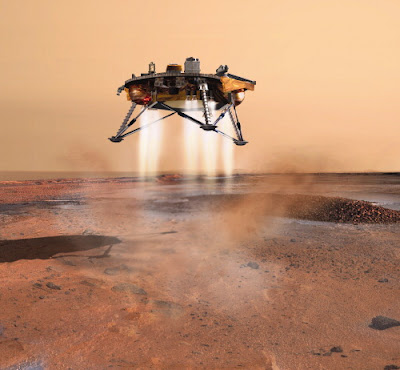
Phoenix will land on 12 Aerojet hydrazine-powered rocket engines. They will be fired after separation from the spacecraft’s parachute at 1,870-ft. altitude 26 sec. before touchdown—171 million mi. from Earth. Phoenix is too large to use airbags, as did the Mars rovers and earlier Pathfinder lander. The 1976 Vikings also used powered descents.Credit: NASA JPL/UNIVERSITY OF ARIZONA


Water blasts through 12 descent engines on nonflight engineering model of spacecraft in critical test of propellant-line stresses as engines cycle on and off on split-second basis.Credit: PAT CORKERY/LOCKHEED MARTIN


Robotic arm (A) equipped with lights and scoop (B) will deposit water, ice and soil samples in eight TEGA ovens (C) that will bake out organic signatures at up to 1,800F. The arm will also deposit soil in MECA wet chemistry lab (D) that will add water to four cells. MECA also has 10 atomic force microscope slides. Canadian weather station (E) includes laser ranging beam and silver temperature/wind mast (center). Stereo imager (F) will take detailed images of trench layers. Lander must relay all data by UHF antenna (G) to Mars orbiters.


Phoenix in launch configuration is encased in aeroshell with heat shield at blunt end for a Mars atmospheric entry. It will employ Mars hypersonic guidance using a segment of the Apollo Earth-reentry algorithm.Credit: PAT CORKERY/LOCKHEED MARTIN

AMD To Challenge Intel on Ultra Mobile PC Chips

I’m rooting for AMD on pretty every thing that they challenge Intel on.

AMD ‘Bobcat’ to challenge Intel next-gen UMPC platform

By Tony Smith
11 Jun 2007 09:43
Rival for ‘Silverthorne’

AMD will next year launch a processor specifically designed for ultra-mobile PCs (UMPCs), the chip maker revealed last week at the Computex show in Taipei.

Details remain scarce, but the chip is currently codenamed ‘Bobcat’, a feline moniker that perhaps aligns it with ‘Puma’, AMD’s upcoming notebook platform. Puma comprises new mobile chipsets and AMD’s ‘Griffin’ processor, the first CPU it has designed specifically for mobile applications rather than a tweaked version of its desktop processors.

It’s not hard to envisage Bobcat as a combination of processor and GPU with both of these components bonded together in a single package. But that’s just conjecture at this point.

Non-NATO Tactical Data Link Developed

Thales can’t be the only people offering this sort of capability.

I imagine that the British or Germans have something similar, and that there was a similar system that dates back to the USSR.

Thales Develops LX16 Tactical Data Link for Non-NATO Countries

Aviation Week & Space Technology
06/18/2007, page 114

Joris Janssen Lok
Paris

Link 16-equivalent data link gives nations option for tactical network

Printed headline: Non-NATO Network

Thales is proposing a tactical data link that gives nations not currently allowed to use the NATO-standard Link 16 the option to acquire a similar capability, which Thales calls LX16.

At least one Asian country is in negotiations to equip all of its armed forces (air, land and maritime) with LX16, say company sources, while declining to identify the customer.

Thales is also receiving “strong interest” in LX16 from several other nations as well as from “aircraft manufacturers who are not in NATO countries and who sell outside NATO.”

“Non-NATO air customers often love to get a Link 16 capability, but they can’t–so we developed an equivalent tactical data link that uses the same message set, grammar and vocabulary,” says Patrice Caine, vice president for communications, navigation and identification activities in Thales Land & Joint Systems.

Once installed, the equipment behind LX16 can be modified “virtually overnight” to support Link 16 proper, Caine suggests. Such an upgrade could be considered if an LX16 user becomes eligible to join the Link 16 user community–for example, when there’s a need to participate in Link 16 networks during coalition operations.

The change from an LX16 to a Link 16 configuration can be achieved by adding a MIDS-LVT (Multifunctional Information Distribution System-Low Volume Terminal) to each aircraft, ship or land asset that needs to participate in the Link 16 network.

Thales is also working to make LX16 interoperable with Link 16 without having to add MIDS-LVT terminals to all platforms. That would be a gateway system that allows the LX16 network to interface with Link 16.

While Link 16 operates in the 960-1215-MHz. frequency range (L-band), Thales’s LX16 operates at 300-600 MHz.

The lower frequency implies that there would be lower throughput, but I’m not up on radio Frequency stuff, so I’m not sure how much.

Neat Tech, Two Mics for Clearer Sound

It sounds obvious when you hear about it, but this one actually sounds patentable.

Bluetooth headsets to get dual mics
Aussie developers use secondary mics for noise suppression
By Bryan Betts → More by this author
Published Sunday 10th June 2007 09:02 GMT

Adding a second microphone to a Bluetooth headset significantly improves its ability to capture speech by making it more effective at noise cancellation and suppression, according to Australian audio software developer Dynamic Hearing.

The company has added a multi-mic feature called VoiceField to its Atlas audio processing software for CSR’s Bluetooth silicon. VoiceField uses two microphones, one in the usual place to capture the user’s speech, and the other located elsewhere to pick up the background noise.

The software in effect subtracts the latter from the former, leaving what Dynamic Hearing’s CEO, Dr Elaine Saunders, called “an extremely clean transmit signal”.

The YouTube – uTube Lawsuit

The suit is just plain silly. It’s clear that Utube had real damage as a result of Youtube, intentional or not, and Google could have made this all go away for a few bucks.

See the website screen capture below. All they have done is to put up a banner to cover the costs of clueless people who can’t type in a web site correctly.

A screen shot of Utube: Free Image Hosting at www.ImageShack.us

YouTube – uTube showdown stays alive in federal court

A website by any other name
By Kevin Fayle in San Francisco
Published Tuesday 12th June 2007 22:14 GMT

Silicon Justice What’s in a name, right?

For the Universal Tube & Rollform Equipment Corporation, operator of uTube.com, its domain name means cash – and with a federal court’s recent refusal to dismiss the company’s suit against YouTube, the possibility of even more cash in the future.

The company has operated uTube.com as a means to sell used pipe and tube mills and rollform machinery since 1996. After YouTube’s launch in 2005, the sleepy little Ohio website went from around 1,500 visitors a month to roughly 70,000 per day. The company alleges that this caused its web host’s servers to crash, which disrupted its business and sullied its reputation. It also claims that bandwidth overages bumped its hosting fees from $100 a month to $2,500.

In true Midwestern fashion, the company made the best of a bad situation by adding a ringtone search engine to the site, as well as links to dating, insurance and gambling sites. These new features now pull in $1,000 a day or more, according to one report.

In addition to capitalizing on the name confusion by hawking Internet crap, uTube has also sued YouTube in federal court. The company has asked for monetary damages, as well as injunctions to stop YouTube’s operation and for the court to transfer the YouTube.com domain to uTube.

The judge hearing the case just dismissed a number of uTube’s complaints, but also refused to grant YouTube’s motion to dismiss the entire suit. The judge also gave uTube permission to amend its complaint to see if it can revive any of the dismissed causes of action.

This guy is Too Stupid to Cut His Own Meat

In fact, I’d be worried if he knows how to consume oatmeal.

Never heard of Rand McNally, huh. Or the fact that this imagery is available through third parties for less than the cost of a air of expensive chows.

Why the hell is he a Democrat? It’s too f&^%ing stupid to be a Democrat.

There are real issues of privace with some of the stuff that Google is doing, like it’s new “Street” program, and they seem have lost the word “Don’t” from their motto*, but this objection is just asinine.

Google Maps aids terrorists, NY lawmaker warns

‘It’s only a matter of time’
By Dan Goodin in San Francisco
Published Monday 11th June 2007 20:24 GMT

Adding to the chorus of critics who say detailed images on Google Earth can aid and abet terrorists and snoops, a New York state lawmaker is calling on the company to blur potential terrorist targets.

The plea from Assemblyman Mike Gianaris follows the alleged discovery earlier this month of a plot by a Muslim terrorist cell to blow up fuel tanks and a jet fuel pipeline at John F. Kennedy International Airport. Some of the suspects planning the attack had used Google-produced images clearly depicting airport infrastructure after surveillance video they secured proved inadequate, according to an indictment in the case.

“It’s only a matter of time before someone uses the information Google Earth provides to do this country harm,” Gianaris was quoted as saying in an article in the New York Post. He objects to the satellite images carried on Google Earth and Google Maps that gives detailed views of skyscrapers, airports and other potential terror targets.

Gianaris is only the latest individual to criticize Google for making available images that have the potential to violate national security, privacy or other vital interests. In addition to officials in the US, Australia, India and South Korea complaining about sensitive facilities being clearly visible in online mapping services, other critics warn the rich detail could trample civil liberties.

*“Don’t be evil.” Is the Google motto.

Our Interconnected World

So there I was, at work, sitting on the toilet, and my cell phone rings.

It’s Natalie’s friend, Samantha. I believe that I had Natalie call her on our cell phone to say that we were going to be late, and she called back to my phone.

While I am taking a dump.

A show of hands please about our connected society:

How many of you would like to line our bathrooms with tin-foil to block cell phones?

How about movie theaters?

How many have begun to consider tinfoil hats?

Anti-Hacking Laws Put Security at Risk

This does not protect companies. Openness is the route to computer security. Security through obscurity is a sham.

Anti-hacking laws ‘can hobble net security’

Good Samaritans discouraged by threat of prosecution
By Robert Lemos, SecurityFocus
Published Monday 18th June 2007 09:52 GMT
Mobile computing: Opportunities and risk – Free whitepaper

Jeremiah Grossman has long stopped looking for vulnerabilities in specific websites, and even if he suspects a site to have a critical flaw that could be compromised by an attacker, he’s decided to keep quiet.

The silence weighs heavily on the web security researcher. While ideally he would like to find flaws, and help companies eliminate them, the act of discovering a vulnerability in any site on the internet almost always entails gaining unauthorised access to someone else’s server – a crime that prosecutors have been all too willing to pursue.

“I have long since curtailed my research,” said Grossman, who serves as the chief technology officer for website security firm WhiteHat Security. “Any web security researcher that has been around long enough will notice vulnerabilities without doing anything. When that happens, I don’t tell anyone, rather than risk reputational damage to myself and my company.”

Technical Pranks

Stuff like this is why The Register is on my link list.

It’s kind of like Mad Magazine for tech nerds.

Fancy some hot buttered storage?
Bringing new meaning to pop-ups
By Lucy Sherriff
Published Monday 18th June 2007 12:00 GMT

Competition It is a Monday, and we’re all looking at another five days of miserable toil before the glory of the weekend beckons once more. We can’t do much about that, but how’s this for a way to ease the pain of a new week?

Reg reader Alan Howlett sent us word of a very silly tech prank, and we’ve decided to turn it into a competition. As you read on, keep in mind that there will be a test at the end.

Over to Alan:

I bought a Synology DS-207 Network-Attached-Storage (NAS) device and it arrived yesterday. I have set it up as the primary file server for my office and am totally in love with it. It’s fantastic- it does nearly everything our Windows 2000 Server PC did…

Yes, yes. you like your new shiny bit of kit. Enough eulogising, and on with the story, please…

Is it a toaster? Is it a NAS? Too many questions…

It does, however, look like a toaster and I have been informally calling it “the toaster” in the office.

Anyway, I had also bought an actual toaster that arrived on the same day. The real toaster has some slots on the top, and the synology has lights, but apart from that they are very similar.

…..

Here’s the test: can you do any better? In a Jackass-meets-BOFH style contest, we want to see photographic evidence of silly stuff like this.
…..

You can kind of see where this is going.

The Conventional Realtor is Disappearing

There are an awful lot of people who decided to become realtors. The bust will wipe a lot of them out, and many of the rest will be taken out by cheaper web based services.

At 6% on a $200,000 house, you can just hire a lawyer to draw up the paper work and do a title search 3 or 4 times.

It’s going to go fee for service.

Old realtors vs. young Web threat

The Internet can make home sellers more self-sufficient, but is it really time for your real estate agent to look for a new line of work?
By Les Christie, CNNMoney.com staff writer
June 13 2007: 4:21 PM EDT

NEW YORK (CNNMoney.com) — If there’s a lesson to be learned from the Internet, it’s that old business models can’t rely on past results – just ask your neighborhood travel agent.

Like stock brokerages, travel agencies have watched their customers migrate to do-it-yourself sites like Orbitz and eTrade because of easy service and low charges.

But what about real estate? Agents collect sizeable commissions for what looks like little effort. And now, for-sale-by-owner Web sites promise to eliminate the middleman and put more money in your pocket. So are realtors worried they’re going to be replaced by masses of home sellers infected with the D.I.Y. spirit?

“Selling without using a real estate agent is like representing yourself in court,” said Walter Molony, a spokesman for the National Association of Realtors.

No. There is now Zillow, title searches are increasingly being done online, and people increasingly realize that the realtor has an interest in juicing the price of the home, so buyers are less interested in those services.

USAF Looking at Alternative Fuels

The problem is that the likely sources of fuel.

Air Force Hopes to Cut Oil’s Role in Fuel

By DON PHILLIPS
Published: June 18, 2007

The United States Air Force has decided to push development of a new type of fuel to power its bombers and fighters, mixing conventional jet fuel with fuels from nonpetroleum sources that could eventually limit military dependence on imported oil.

The decision will open a contest between fuel refiners and other companies to produce a jet fuel composed of no more than 50 percent petroleum. The plan is to be announced at the Paris Air Show by the secretary of the Air Force, Michael W. Wynne; the administrator of the Federal Aviation Administration, Marion C. Blakey; and other American officials.

“The goal is to certify the entire fleet by 2010 with a 50-50 mix,” said Paul Bollinger, an Air Force official who is working on a shift to synthetic fuels.”

Today’s most popular alternative fuel, made from corn, is not suitable for use in aviation. “Corn doesn’t have the B.T.U.’s for jet fuel,” Mr. Bollinger said, referring to the British thermal unit, a measure of energy. Richard L. Altman, executive director of an industrywide group called the Commercial Aviation Alternative Fuels Initiative, said fuels would most likely be developed in three phases, beginning with a focus on creating liquid fuels from nonrenewable resources like coal and natural gas.

Natural gas’s greatest utility is that it can be piped to point of use with very low losses, and coal liquification releases more C02 than burning it to generate electricity.

Blockbuster expands Blu-ray rentals – Jun. 18, 2007

I still believe that HD-DVD will be the winning format in the next DVD wars, given Blu-Ray’s higher costs, Sony’s traditionally incompetent marketing, and it’s Jihad against Pr0n studios, who are universally jumping on board the HD-DVD format, but this indicates that I may be wrong.

We’ll know in 2-3 years.

Blockbuster expands Blu-ray rentals – Jun. 18, 2007
The movie-rental chain says it will expand the high-definition DVDs to 1,700 stores by July.
June 18 2007: 7:20 AM EDT

NEW YORK (CNNMoney.com) — Blockbuster Inc. announced Monday it is expanding the inventory of high-density Blu-Ray discs to 1,700 stores by July, in response to the rising popularity of high-definition DVDs.

The movie-rental chain said the stores will carry more than 170 titles in Blu-ray, releasing more as they are distributed by studios Also, the store will continue to offer both Blu-ray and HD DVDs through its online rental service and its initial 250 stores that currently carry the discs.”

After a 30 Year Absense, the Advancing Blade Helicopter Returns

I remember reading about this in my teens.

Eventually they went with the V-22 Osprey.

This is definitely better helicopter technology than the V-22, which is more a VTOL aircraft than a helo.

It remains to be seen where this might fit in.

My guess would be for an A-10 replacement that would be under army control, as it is not fixed wing.

One interesting fact, the ABC concept is well out of patent, so if the demonstrator works, other vendors could reverse engineer this technology.

X2 marks the spot for radical rotor designs-12/06/2007-Flight International

Sikorsky’s X2 helicopter programme has a mixed R&D heritage, and could be the model for the next generation of rotorcraft designs.

Along with broadening the realm of vertical lift, first flight of Sikorsky’s internally funded X2 compound helicopter demonstrator in the fourth quarter this year will also spotlight what may become the best model for introducing new civil and military rotorcraft designs – do it yourself.


Sikorsky is hoping its X2 technologies will increase helicopter cruise speeds by nearly 100kt

The US government continues to invest in the basic and applied research that helps manufacturers create breakthrough aircraft. However, the prime focus for most funding has become results-oriented incremental component or operational efficiency improvements to aid the US military on the battlefield.

Though the X2 concept is the result of much of that government-funded R&D, the demonstrator itself is 100% Sikorsky funded, and features a frugality and simplicity that reflects who is paying the bill. The aircraft is being built from numerous off-the-shelf components scavenged from near and far to keep costs low so much so that Peter Grant, Sikorsky advanced programmes manager, affectionately refers to the two-seater as a “mongrel”. It uses dual rigid counter-rotating coaxial main rotors and a pusher propeller to reach cruise speeds of 250kt (462km/h), well beyond the 170kt maximum speed for conventional helicopters.

The X2 has a mixed heritage of government and industry R&D in rotor systems, propulsion, aerodynamics and controls technologies that will help it meet performance goals of high speed and “low” vibration – about the same vibration level as a traditional helicopter at its top speed of 140kt.

The X2’s chief predecessor, the XH-59A advancing blade concept (ABC) helicopter, was built by Sikorsky and funded by the US Army, NASA, Sikorsky and others. Two vehicles were built and readied in two years, starting in 1971, a time when the US government funded such experimental aircraft.

The goal was to test the premise that rigid counter-rotating main rotors, where the advancing blade on each side produces lift while both retreated blades are feathered, could be used reduce drag and tip velocities to allow for cruise speeds well above the norm for helicopters. During testing from 1973 to 1977, Sikorsky pilots reached 240kt with the help of two fuel-thirsty auxiliary turbojets.

Though it was successful, the flight-test programme proved that the concept was ahead of its time because the technologies needed to solve key issues – high vibration levels, tedious mechanical control mechanisms and inefficient power management – have only recently become available.

“We believe it now makes this configuration feasible for next generation helicopter flight,” says Grant.

The maturation was due in large part to government-funded research on military contracts, among them the Boeing-Sikorsky Comanche advanced light attack helicopter, cancelled by the US military in 2004, and its precursor, the Shadow programme, an S-76 with fly-by-wire (FBW) flight controls. Both provided the knowledge base for the X2’s flight controls.

The means to control vibrations came partly from the military-funded UH-60M Black Hawk upgrade programme. Coaxial rotor design expertise came partly from the Cypher programme, a vertical takeoff and landing unmanned air vehicle demonstrator that Sikorsky developed under a US Marine Corps contract.

Solving specific problem areas through directed research, rather than funding whole demonstrator aircraft, continues to be the R&D focus for the US government. Its research is largely provided by the US Army and NASA for basic and applied research, and the Defence Advanced Research and Projects Agency (DARPA) for long-term, high-risk and potentially lucrative projects.

….

X2 joint heavylift

Many key foundation technologies for Sikorsky’s JHL entrant, a much larger version of the X2, will be tested when the X2 demonstrator takes flight later this year. Included are active vibration control centralised around the transmission, a method designed to “short circuit vibrations at their origin”, says Grant. Sikorsky currently uses distributed active vibration damping systems for its production helicopters.

Once first flight is completed, Grant says his goal will be to get to high speed flight as quickly as possible. The company plans four phases of flight tests, beginning with hover and low-speed work later this year, followed by phases 2 to 4 throughout next year.

Rovers, reactors and ‘green’ rockets all on NASA’s future-technology list

Here is an interesting rundown on the technologies that NASA is looking at:

Rovers, reactors and ‘green’ rockets all on NASA’s future-technology list

Aviation Week & Space Technology
06/04/2007, page 50
Frank Morring, Jr.
Washington

Some advanced technology for long-term human space exploration is already getting on-orbit checkout as NASA targets about $350 million from its tight exploration budget this year on the long-lead items that may enable a return to the Moon en route to Mars.

There is some neat stuff here, but also some scary stuff.

But the program also is funding advanced-technology research ranging from composite space radiators that might save weight on Orion to a 5-ton nuclear reactor that would generate power for the outpost NASA plans to build on the Moon as a proving ground for expeditions to Mars.

The reactor is one of the scary things. The tech is described below, and I’ll explain why it’s scary (it’s notbecause it’s a nuclear reactor) after that.

One such system is getting a workout on the Orbital Express mission being conducted by the Defense Advanced Research Projects Agency (Darpa). Although the satellite-servicing testbed has had problems in orbit (AW&ST May 28, p. 22), they were unrelated to the Advanced Video Guidance Sensor provided by NASA.

Evolved over the past decade at Marshall Space Flight Center in Huntsville, Ala., and previously space-tested on two space shuttle flights and the failed Demonstration of Autonomous Rendezvous Technology mission in 2004, the sensor is designed for short-range rendezvous guidance between cooperating spacecraft.

I worked at the battery manufacturer for DART and did some (very) minor work on the batteries. It should be noted that the batteries worked just fine.

If it turns out that such a large piece of PICA can’t handle the lunar-reentry heat flux, which is four to five times greater than that experienced by a reentering space shuttle, NASA will turn to two more contracts for backup heat-shield material. Boeing’s Huntington Beach, Calif., facility will receive as much as $10 million to conduct early studies of a proprietary material known as the Boeing Phenolic Ablator (BPA). Textron Systems of Wilmington, Mass., won a contract worth as much as $24 million for preliminary work on two proprietary materials–Dual Layer, and a material called Avcoat that was used on the Apollo capsule.

“We’re trying to relearn how to make that material,” Moore says. “It’s been a generation, and a lot of the people have retired who have done the Apollo heat shield, so we have lost a lot of that expertise.”

They could also talk to the Russians.

Also under study are new fluids to carry the heat away from Orion electronics into the radiators–a mixture of propylene glycol and water is the baseline.

Don’t confuse Ethylene Glycol and Propylene Glycol. The former is normal poisonous anti-freeze, the the latter is an alternative anti-freeze that is in the “pet safe” stuff, which is so non-toxic that you see it added to salad dressing.

Other advanced technologies under study for Orion include lightweight parachute material that can also fit into a smaller volume, and an amine swing-bed for carbon dioxide and moisture removal from the crew compartment. A bed of very small plastic beads is coated with chemicals that absorb CO2 and water vapor, and then release it when vented to the space vacuum.
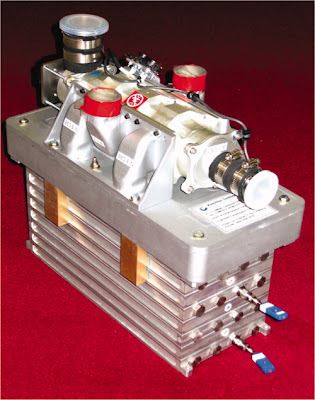

NASA is developing a prototype amine swing-bed system to remove carbon dioxide and moisture from the Orion crew compartment.Credit: NASA/JSC

I think that this is of more concern for the Mars missions than the moon missions, where the use of conventional CO2 sorbents might require too much weight and volume.

For crew safety, a team at NASA’s Glenn Research Center in Cleveland is working on a “green” Orion attitude-control thruster system. Instead of requiring storage of highly toxic hydrazine fuel near the crew compartment, the system would burn gaseous oxygen and methane.

I think that this might be more of an issue of ISP (fuel economy) than environmental friendliness. The room temp propellants typically have a lower ISP, but Methane is much easier to store than liquid hydrogen, having a higher boiling point.

The dual propellant thrusters are more difficult to control precisely, but much more efficient.

Advanced preparations for the shuttle-derived Ares I crew launch vehicle that will carry Orion to orbit are also underway, piggybacking at times on routine shuttle-program tests to gather data. A case in point was the May 24 static test of a four-segment shuttle Reusable Solid Rocket Motor (RSRM) in Utah, which provided motor-signature data for a study at Ames Research Center on ways to detect impending failure in the five-segment RSRM that will serve as the Ares I first-stage.

Good move, but a better move is not to use solid rockets on man-rated systems. I continue to be dubious of solid rocket boosters on manned systems.

To help astronauts establish a lunar outpost and explore the surrounding terrain, the advanced-technology program is studying rovers, a nuclear power source and in situ resource utilization (ISRU) techniques. One promising activity at the Pasadena, Calif.-based Jet Propulsion Laboratory has field tested the All-Terrain Hex-Legged Extra-Terrestrial Explorer (Athlete), a six-legged vehicle as tall as a man that can move heavy payloads such as habitats around the surface either on wheels or by “walking.” Another project at Houston-based Johnson Space Center, dubbed Scout, is an updated version of the unpressurized moon buggy that hauled Apollo astronauts around the lunar surface.


Two Athlete rovers undergo testing in California’s Dumont Dunes. Athlete can roll over rough terrain using its wheels or its six legs, transporting heavy payloads during construction of the planned lunar outpost.Credit: JET PROPULSION LABORATORY

I think that this just looks cool, so here is the picture.

A big objective of the lunar outpost will be to test exploration technologies and techniques that can enable subsequent human exploration on Mars. Engineers at JSC are working on a variety of ISRU techniques to extract oxygen from the lunar regolith, as much for the experience as the resource.

Along the same lines, NASA and the Energy Dept. are working under a scaled-back version of the old Project Prometheus to advance some of the technologies that would be needed for a five-metric-ton, 40-kw. fission reactor that would take over from the solar power plant scheduled to provide initial power for the outpost. It would be fueled with uranium dioxide and cooled with a sodium/potassium liquid alloy.

This scares the hell out of me. Based on discussions with a Naval Nuke over a decade ago, metal cooled reactors are VERY twitchy things, with reaction times so fast that you can’t operate them manually.

They are much more compact though, hence their use in the Soviet’s Alpha class boats, where they worked (though their nuclear personnel glowed in the dark), and the unsuccessful use in the USN’s original Seawolf, which was our 2nd nuclear boat.

They replaced it with a pressurized water reactor a few years after it was installed.