It’s a coaxial tilt rotor, and Baldwin Technology is pitching it as a cargo UAV capable of carrying a 3000 lb capacity pallet.
The first is more the test models, the 2nd more operational concept.
It’s a coaxial tilt rotor, and Baldwin Technology is pitching it as a cargo UAV capable of carrying a 3000 lb capacity pallet.
The first is more the test models, the 2nd more operational concept.
Israel continues to insists on installing its own electronic warfare gear on the F-35, and Lockheed, and the Pentagon continue to insist that they won’t allow it.
This should get interesting.
Considering the fact that the basics of stealth are public domain data, I wonder if Israel may dump it all for some sort of UAV.
The Airforce will graduate its first class of unrated pilots to operate the MQ-1 Predator drone this summer.: (paid subscription required)
The first group of nonrated U.S. Air Force pilots who are being trained to fly MQ-1 Predator missions is expected to graduate by the end of the summer.
The Air Force selected 10 active-duty nonpilot (unrated) captains to be the first of two groups to receive unmanned aircraft system (UAS) training. Once qualified, they will be a beta test group for Air Force leadership to see how nonrated pilots perform at the controls of UASs. The Army has proceeded with UAS flight operations using nonrated pilots, while the Air Force has come under fire for slow training of its UAS pilots, maintainers and sensor operators.
It makes sense.
Modern UAVs are sufficiently automated that the role of the operator is far closer to that of a gunner than it is a pilot.
It’s interesting how it’s going. My guess is that the USAF fought this every step of the way, just like they fought UAVs when they first came out.
The white scarf must cut off blood to the brain.
Well, Northrop-Grumman has rolled out its first X-47B unmanned combat air system (UCAS) demonstrator in a rather splashy debut.
Not bad for a project that was on the death watch list just 6 months ago.

It’s actually rather large, with a, ” 62.1 ft, compared to 44.7 ft. for an F/A-18″ (the E/F models), and so looks to be close to the size of the canceled A-12 attack aircraft.

Here we can see the standard robust naval landing gear.

Here is a closeup of the inlet, which the N-G folks were fine with letting people take, which surprises me, because it’s kind of the “secret sauce”.
There is still a part of me that is surprised that the US Navy is considering a tailless anything after the debacle that was the F7U Cutlass (aka “Gutless” and “Ensign Eliminator”).
NG press release here.
 Boeing has announced that it’s Hummingbird drone has has successfully changed the final drive ratio of its transmission in flight, which will allow two rotor speed settings, one being about ½ of the other.
It turns out that slower rotational speeds work better at hover and low speeds, but limit forward speed, because of retreating blade stall, and most helos therefore operate as a compromise. (The A160T set its record in slow rotor mode).
All in all, this program is moving along at a blindingly fast pace, with US special forces already making purchases of the diminutive helicopter.
Boeing’s PR is here.
 A few months back, it looked like that the Navy/Northrop-Grumman X-47 CUCAS-D (unmanned combat air system demonstration) was on the chopping block.
This is perhaps the most ambitious UAV currently in development, given that among other things, it’s supposed to make an arrested landing on a carrier deck.
It now appears that in addition to demonstrating combat capabilities and carrier ops, the program has been expanded to include autonomous air-to-air refueling, which will greatly improve the strike capability of the aircraft.
Autonomous refueling has been kind of a holy grail in the UAV community, and is really essential for any system that actually sees operational use.
 It looks like the folks at U.S. Army Research Laboratory at Aberdeen Proving Ground have come up with concepts for inflatable structures for UAVs.
The folks at the lab believe that the use of inflatable structures would allow for lighter weight, which translates into slower flight speeds and less noise, both of which are optimal for the use of UAVs in an urban scenario.
 Goodyear did actually develop and fly an inflatable aircraft, the Inflatoplane, in the 1950s, but the army decided it was too vulnerable to ground fire, and shelved the project.
 Still, it has always surprised me that someone in the ultralight community did not go further forward with this. An ultralight made using this technology could fit in the trunk of a midsized car.
About a decade ago, I put an inqwuiry into Goodyear regarding the Airmat, basically balloon material with threads running between opposite walls to provide rigidity when inflated, material they used for the structure, but there was nothing left there.
Well, let’s start with the UAVs, and the Chinese are clearly looking at matching US capabilities with large UAVs:


The Tian Yi-3 looks like a Global Hawk

As does the Soar Dragon.
We also see new antiship missiles and a trainer, which looks a lot like the russian Yak-130 trainer.


Clearly separated at birth from the Yak.

That being said, the highlight of the show tends to be the aircraft that actually, of which the canard delta J-10 was the star of the show.
There is a very good collection of pictures here, which in addition to the J-10 has pics of the henyang J-8II fighter aircraft (above), a Xian JH-7A strike aircraft, and the Xian H-6U (Beagle derivative?) tanker. But here is some canard:


Thankfully, we also get some pictures of the J-10 in flight:

We also have a review of the demonstration flights at the airshow.
What is interesting is that the review of its performance by Vladimir Karnozov is very positive, “The pilot rarely used afterburner and the degrees of canard deflection were small. Still, the airplane flew very well. I reckon it will beat F-16C or MiG-29/SMT easily.”


 I present to you the Aurora Flight Sciences Excalibur VTOL UCAV, a 40% proof of concept version, which seems to be almost as much prop as wing, paid for by DARPA.
The twist in this design is that the lift fans are driven by electric motors:
For VTOL mode, the Excalibur’s turbine engine tilts vertically and provides about 70% of the thrust, says program manager Heather Brendle. Battery-powered lift fans in the nose and wing tips provide pitch and roll control by differential rotational speed, and yaw control via vanes that deflect fan thrust. For cruise, the engine tilts horizontally, the tip fans retract into the wing, a sliding door covers the nose fan and the aircraft rolls onto its back.
The Excalibur is designed as a close-air-support UCAV. The notional 21-ft.-span full-size vehicle is designed around a 500-lb. weapons capacity—enough to carry four Hellfire missiles. This aircraft would have a VTOL takeoff weight of 4,000 lb. and useful load of 1,000 lb., increasing to 4,800 lb. and 1,900 lb., respectively, with short takeoff and vertical landing. Maximum speed would be 300 kt. at sea level, increasing to 460 kt. at 30,000 ft.; loiter speed would be 90 kt.
Aurora’s subscale, 10-ft.-span, proof-of-principle (POP) aircraft weighs in at 720 lb., with a 100-lb. useful load and 280-kt. sea-level speed. The engine is a Williams F415 turbofan from the Tactical Tomahawk cruise missile. Each common lift-fan unit is powered by four lithium polymer batteries packaged with the electric motor. The motor’s fast response allows use of a fixed-pitch fan, says Brendle.
Someone seriously thinking outside of the box here.
Or at least, they are generating PowerPoint slides with weapons loadouts:

the U.S. Air Force Research Laboratory has contracted with Defense Research Associates to create an electrically powered micro-UAVv that recharges using magnetic induction while sitting on a power line. (Paid Subscription Required)
It weigh 6 lbs, and has a wingspan of 4 feet.

The basic physics behind it was discovered by a Russian mathemetician in the 1960s, and now we see Dassault completing a completely autonomous flight of a stealthy UAV, the AVE-D (D for discretion, stealth in French).
It’s actually a fairly impressive feat. It taxied to the runway, took off, executed a series of aerial maneuvers, landed, and taxied back to its parking space without human intervention.

Yeah, they all look pretty much the same….It’s the laws of physics that do this.
The Japanese Aerospace Exploration Agency, JAXA, is planning to test an unmanned aircraft to test out supersonic passenger aircraft concepts, with the first tests in the 2012-2013 time frame.
It’s pretty clear from the design that a big part of their noise reduction is through using the airframe to shield engine noise.

Basically, we have an enthusiastiac endorsement of an unmanned combat air vehicle launched from carrier decks:
Imagine a Navy strike plane launching off the catapult as its carrier begins steaming out of its San Diego naval base. The jet refuels over Hawaii, then again over Guam; it gets updated targeting data from its mother ship 6,000 miles away and launches its strike on an enemy nuclear missile silo in East Asia — all in one sortie.
Sound impossible?
And, oh, it could turn around and land on another carrier in the Red Sea after taking some surveillance photos of a suspected terrorist training camp in Pakistan and beaming them down to commanders in Bagram.
That’s just the half of what a naval unmanned combat drone could potentially do, says a new report from a respected Washington, D.C.-based defense think tank. Why land on the carrier in the Red Sea? Why not tank over the Med, fly up to the Arctic and beam back radio transmissions from an ongoing Russian war game, then fly back to its mother carrier now a few hundred miles from its home port?
Given the increasing effectiveness of conventional submarines and anti-ship missiles, this is one way to ensure that a carrier is able to provide support from relative safety.
Of course, you could do the same thing if you launched that drown from an airfield in San Diego, and it could do the same thing, and not buy the carrier at all.
In the US Navy’s F/A-XX program, an unmanned combat air vehicle (UCAV) is looking increasingly attractive.
In comparing the loiter time at 925 KM from a carrier, a manned vehicle has a 1/2 hour loiter time, and the unmanned vehicle had a 20-1/2 hour loiter time.
I think that this is one of the points missed in this coverage of the first flight by a “loitering munition” by MBDA.(Paid Subscription Required)
The line between a UAV, either controlled or autonomous, which carries a munition, and a munition which loiters over the area looking for target, appears to be the ability to recover.
The technology is likely already there to cross that line.
What’s going on here is simple
USAF Says It Would Save 10% As UAS Executive Agent(Subscription Required)
Aviation Week & Space Technology
08/13/2007, page 27Edited by David Bond
Printed headline: UAS Promises
The U.S. Air Force says it can save as much as 10% of the budding unmanned aerial system budget if it becomes the Pentagon’s executive agent for UASs over the objections of its sister services. Savings would come from common training and sustainment processes as well as shared basing. The service also boasts it can save $400-600 million by consolidating its Predator program with the Army’s Warrior, an upgraded Predator. The Army has been furious over this plan, and the Navy and Marine Corps have expressed reservations. ….
What’s going on here is simple. The Air Force is trying a power grab.
If the future of air combat is drones, and it looks increasingly so, you will have unmanned aircraft that will take off and land on their own (the Air Force is behind the other services on this, probably because once you get that automated, you really don’t need a pilot).
The Air Force sees a future where UAVs are by the same sort of soldiers that perform as artillery spotters, i.e. reasonably well trained enlisted men, and they see irrelevance in their future.
This is their attempt to stay on top of these programs, and to keep officers operating UAVs, whether they really need to or not.
I showed some blurry pix of this a few weeks back.
I’m a bit dubious of it being used for aerial refuelling. I think that pilots will want a man in the loop.
After months of being coy(Subscription Requited)
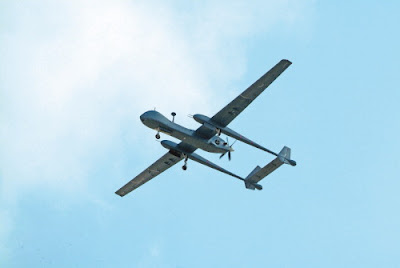
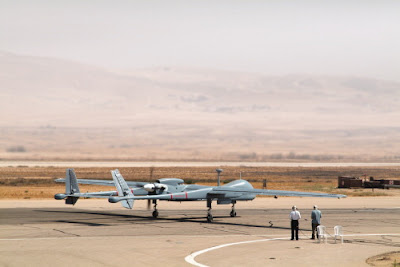
After months of being coy, Israeli defense and aerospace officials have admitted their huge new unmanned aircraft–the Eitan or Heron TP–does exist and will be on public display this week at the Paris air show.
A few poor-quality bootleg pictures of the unmanned, missile-carrying aircraft leaked out last month (AW&ST May 21, p. 32). Now the Defense Ministry has given Israel Aerospace Industries permission to release pictures. The UAV has been test flown sufficiently since its first flight last July that IAI says it is ready for serial production.
TP stands for the Eitan’s 1,200-hp. turboprop engine, which will give the UAV an operational altitude above the 45,000-ft. limit for commercial aircraft. The 10,230-lb. aircraft has a wingspan of 85.28 ft. and loiter time of 36 hr. Descriptions of its capabilities and missions are vaguely worded. The “multi-payload, multi-mission” aircraft carries “front end technologies to meet . . . a large variety of operational missions,” IAI and Israeli Defense Forces officials say.
But there are hints about the capabilities. The high-altitude capability, emphasis on reliability and long loiter time, as well as large internal payload volume and weight, indicate the UAV could serve at least three key missions: defense against ballistic missile launchers and, later, ballistic missiles in boost phase; long-term surveillance and intelligence collection; and as a refueling tanker to operate in areas where large manned aircraft would be vulnerable.
…