Category: Aviation

Indian Navy prepares for MiG-29-21/06/2007-Paris-Flight Daily News

It’s beginning to look like the Russians may have a growing business in providing low cost carrier capability to nations like India.

Indian Navy prepares for MiG-29

Only the first prototype of the Indian Navy’s new MiG-29s has flown, but the force’s preparations for the new aircraft are proceeding apace.
The Indian Navy has not operated conventional carrier -based aircraft since the withdrawal of the Hawker Sea Hawk in 1983, after which the STOVL BAE Systems Sea Harrier became the service’s only carrier-based fighter.
Captain GM Gopakumar of the Indian Navy told Flight Daily News that Indian Navy pilots are already flying exchange tours on Indian Air Force MiG-29s, and though delivery of the first INAS MiGs has been delayed from November 2007 until March or April 2008, pilot conversion training in Russia will commence in August.

More power and more payload for Gripen demo-21/06/2007-Paris-Flight Daily News

The Gripen can already supercruise clean, and the additional thrust should allow it to do so while carrying more.

More power and more payload for Gripen demo-21/06/2007

By Jon Lake
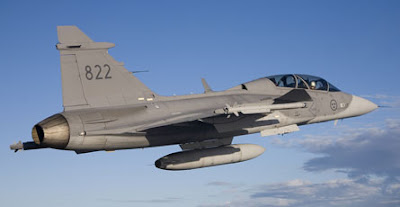
Saab chose the Paris Air Show to reveal details of its new Gripen Demonstrator programme. The Gripen Demo aircraft will act as a technology demonstrator and testbed for an upgrade configuration for the Swedish air force, and as the prototype for planned ‘Future Gripens’, including the Gripen N for Norway, the Gripen DK for Denmark, and perhaps even for a variant to meet India’s MMRCA requirement.

….

The Gripen Demo aircraft will have a revised configuration, with a new forward-retracting main landing gear that frees up internal volume for extra fuel, and with distinctive bulged wingroot fairings underwing providing further increases in internal volume. The use of these fairings replaces the upper fuselage conformal tanks seen on previous studies, and will provide an extra 38% of internal fuel, taking the total to 3,130 kg.

The relocated and beefed-up undercarriage will allow a 2-tonne increase in maximum take off weight, to 16t. This in turn will allow the aircraft to carrier heavier warloads (up to 6,000kg), and to facilitate this, the Gripen Demo will have new side by side under-fuselage pylons (augmenting the single centreline pylon) and underwing hardpoints capable of carrying twin pylons.

The aircraft will be powered by a new 22,000lb engine, provisionally dubbed the F414G. ….. The F414G will deliver some 4,000lb more thrust than the RM-12, giving a useful boost in performance. Some sources give the new engine a 26,000lb thrust rating – doubling the advantage.

The aircraft will also be fitted with an AESA radar, probably based on Ericsson’s long-running NORA and Saab/Selex’ M-AESA programmes.

Gripen to get AESA

I’ve always thought that the Gripen has the possibility of being the Mirage III of its generation, as it is the smallest, cheapest, and cheapest to operate of the 4th generation aircraft.

Gripen to get AESA in mid-life upgrade
Keeping pace with the technology trend, Saab’s JAS39 Gripen is to be fitted with a multi-channel active electronically scanned array (AESA) radar, likely to be introduced under a planned mid-life upgrade (MLU) that could come along as early as 2010.

Development of the AESA radar for Gripen started out under the Saab Ericsson NORA (Not Only a RAdar) programme, and has been underway for several years, including test flying aboard a specially-retained Saab JA-37 Viggen testbed. One of the main benefits of the NORA concept was the provision of improved long-range tracking as a result of the combination of longer detection range and electronically-steered beam control. The AESA radar programme is directly linked to MIDAS (Multifunction Integrated Defensive Avionics System), which will also add electronic attack and advanced datalinking capabilities.

Aerion refines supersonic business jet

I find it rather odd that they are using a 43 year old engine on a supersonic jet. The JT8D first flew in in64.

PICTURE: Aerion refines supersonic business jet design
Aerion has enlarged the cabin of its supersonic business jet as it continues to fine tune the design in a bid to reassure potential manufacturing partners that the aircraft will achieve its weight and performance targets.

Meanwhile the forward fuselage has been reshaped to increase cabin height and width and improve the cockpit and windshield design.

The aft fuselage has been stretched and the tail shrunk to improve take-off performance and reduce weight and cruise drag.

Electrical and pneumatic system architectures have been studied in conjunction with United Technologies, while fuel system layout and sizing has been performed by Argo-Tech under contract to Aerion.

Engine reliability, operability and noise have been studied with Pratt & Whitney, manufacturer of the aircraft’s JT8D-219 turbofans, and Aerion says the inlet and nozzle designs are ready for a series of subscale noise and performance validation tests.

Aerion has still to decide how to validate the design tools developed to predict the extent of supersonic natural laminar flow achieved in flight, and critical to meeting the performance targets.

The company conducted supersonic rocket-sled tests last year, but encountered problems (Flight International, 17-23 October 2006).

Marketplace: Some assembly still required at Boeing

And here we see the difference between Boeing and Airbus.

Airbus made its problems public as soon a they showed up.

Some assembly still required at Boeing
Boeing got a $9 billion order today, mostly for its new 787 Dreamliner aircraft. But the company’s having some problems as it prepares to deliver the jet. Jeremy Hobson reports.

Kai Ryssdal: The Paris Air Show’s in full swing this week. It’s an every-other-year aviation spectacular that functions as one big sales pitch for airplane makers.

And the pitch has been very good for Boeing. Today, the company got a nine billion dollar order from the world’s largest aircraft leasing company. Mostly the new 787 Dreamliners.

But Jeremy Hobson reports Boeing’s having a couple of teeny tiny problems as it prepares to deliver the jet.

Jeremy Hobson: You can’t make an airplane without fasteners — you know, the nuts and bolts that hold, say, the wings to the body of the plane.

Boeing needs special new ones for its Dreamliner, since the plane is not made out of aluminum like most aircraft. But the primary supplier, Alcoa, isn’t making the fasteners quick enough.

Boeing: Boeing Completes First Flight of A160T Hummingbird Unmanned Helicopter

Obviously, this is a Boeing press release, and should be viewed as such, but it bears watching, particularly their variable speed rotor technology.

Boeing: Boeing Completes First Flight of A160T Hummingbird Unmanned Helicopter

LE BOURGET, France, June 18, 2007 — The Boeing Company [NYSE: BA] successfully completed the first flight of the A160T Hummingbird unmanned rotorcraft June 15 from an airfield near Victorville, Calif.

The A160T, a turbine-powered version of the innovative piston-powered A160 helicopter, features unmatched range, endurance, payload and altitude for an unmanned rotorcraft.

“Today’s Hover-In-Ground Effect flight is our first step in providing the warfighter the key element of our approach to providing persistent intelligence, surveillance and reconnaissance coverage that only an unmanned helicopter of this type can provide,” said Jim Martin, Boeing Advanced Systems A160 program manager, after the flight.

During the 12-minute hover flight to verify vehicle and subsystem operation, the A160T met all test objectives and collected extensive flight control, propulsion and subsystem operation data.

The test marked the 37th flight overall for the A160 program and the first in a series of flights that will demonstrate endurance levels greater than 18 hours. The aircraft used during the tests is the first of 10 A160Ts Boeing Advanced Systems is building for the Defense Advanced Projects Research Agency and the U.S. Special Operations Command.

The Hummingbird features a unique optimum speed rotor technology that significantly improves overall performance efficiency by adjusting the rotor system’s revolutions per minute at different altitudes, gross weights and cruise speeds. The autonomous unmanned aircraft, measuring 35 feet long with a 36-foot rotor diameter, eventually will fly more than 140 knots with a ceiling of 25,000 to 30,000 ft. (high hover capability up to 15,000 ft.) for up to 20 hours. Operational A160Ts will be capable of persistent intelligence, surveillance and reconnaissance; target acquisition; direct action; communication relay and precision re-supply missions.

DARPA scramjet nudges Mach 10 | The Register

It should be noted that DARPA is late to this game. Most of the heaby lifting was done by the DSTO before the US DoD got involved.

The US has a number of FAR MOER EXPENSIVE projects in this area that have not gotten to this point.

DARPA scramjet nudges Mach 10

By Lester Haines
Published Monday 18th June 2007 09:26 GMT

Australia’s Woomera Test Facility last Friday hosted the successful launch and firing of a scramjet engine which reached speeds of “up to Mach 10”, the country’s Defence Science and Technology Organisation (DSTO) has announced.

The HyCAUSE vehicle – a joint project between DSTO, the US’s Defense Advanced Research Projects Agency (DARPA), and the Australian Hypersonics Initiative (AHI)- took off atop a TALOS rocket and reached a heady 530km before firing its way to around 11,000km/h (6,800mph), according to Oz’s parliamentary secretary to the Minister for Defence, Peter Lindsay.

Pentagon’s raygun-packing 747 to visit DC

I’m dubious of the technology.

Pentagon’s raygun-packing 747 to visit DC
By Lewis Page
Published Wednesday 20th June 2007 13:14 GMT

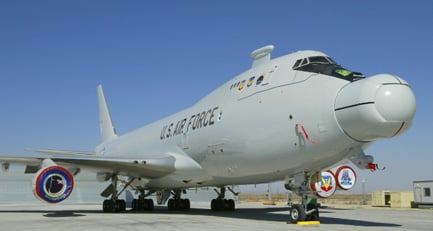
The Airborne Laser, the US Missile Defence programme’s raygun-equipped jumbo jet, is to visit Washington tonight in an attempt to drum up support on Capitol Hill.

Airborne Laser aircraft

The Airborne Laser aircraft, intended to explode ICBMs shortly after liftoff.

The Missile Defence Agency says (pdf) the flying energy-weapon platform will fly into Andrews airforce base outside DC from its normal home at Edwards AFB in California. The 747 is expected to make a night landing, before being shown off to politicos, officials, and the media. It will return to the west coast on 21 June.

The Airborne Laser is a modified Boeing 747-400 freighter aircraft intended to use a Chemical Oxygen Iodine Laser (COIL) to destroy a hostile ballistic missile during the highly-vulnerable “boost phase” of its trajectory — the first few minutes after it is launched.

Missiles in boost are full of pressurized explosive fuel, so even a relatively feeble zapping could cause them to explode. Also, attacking a multiple-warhead ICBM at this point will take out all its re-entry vehicles in one shot.

Actually, the missiles are not full of “pressurized explosive fuel”. The last US missile to do this was the Atlas, retired in the 1960s, which used LOX.

Modern missiles use storable liquid propellants, and the most modern, solid fuel, which do not present the same structural vulnerablitiex.

Israeli Large Drone Made Public

I showed some blurry pix of this a few weeks back.

I’m a bit dubious of it being used for aerial refuelling. I think that pilots will want a man in the loop.

After months of being coy(Subscription Requited)

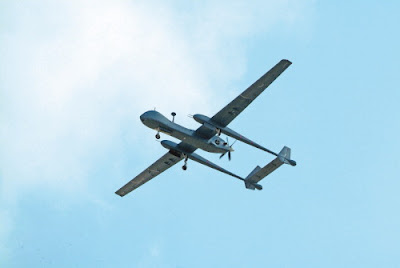
After months of being coy, Israeli defense and aerospace officials have admitted their huge new unmanned aircraft–the Eitan or Heron TP–does exist and will be on public display this week at the Paris air show.

A few poor-quality bootleg pictures of the unmanned, missile-carrying aircraft leaked out last month (AW&ST May 21, p. 32). Now the Defense Ministry has given Israel Aerospace Industries permission to release pictures. The UAV has been test flown sufficiently since its first flight last July that IAI says it is ready for serial production.

TP stands for the Eitan’s 1,200-hp. turboprop engine, which will give the UAV an operational altitude above the 45,000-ft. limit for commercial aircraft. The 10,230-lb. aircraft has a wingspan of 85.28 ft. and loiter time of 36 hr. Descriptions of its capabilities and missions are vaguely worded. The “multi-payload, multi-mission” aircraft carries “front end technologies to meet . . . a large variety of operational missions,” IAI and Israeli Defense Forces officials say.

But there are hints about the capabilities. The high-altitude capability, emphasis on reliability and long loiter time, as well as large internal payload volume and weight, indicate the UAV could serve at least three key missions: defense against ballistic missile launchers and, later, ballistic missiles in boost phase; long-term surveillance and intelligence collection; and as a refueling tanker to operate in areas where large manned aircraft would be vulnerable.


France Pushes Operational Space Surveillance, Elint Capabilities

Another case of a headline abuse. The “Accent Graves” thing in the printed version is a bad French pun.

FWIW, Sarkosy will be big on the ability to do this independently, the Gaullists, and his party is one of their descendants have always been bigger on this than the socialists.

France Pushes Operational Space Surveillance, Elint Capabilities

Aviation Week & Space Technology
06/18/2007, page 70

Michael A. Taverna
Broye-les-Pesmes and Rennes, France

France pushes Europe to develop operational space surveillance, elint capabilities

Printed headline: Accent Graves

France is inviting its European neighbors to collaborate on a ground-based space surveillance system as part of a proposed military space buildup that could include operational signals intelligence and data relay networks.

Since December 2005, the French air force’s air defense/air operations command has been operating a space surveillance facility that was initially intended as a technology demonstrator. Unlike existing systems in the U.S. and Russia, which rely on an array of sensors, the French installation, called Graves, uses a single bistatic radar and a powerful 60-Gflop/sec. processing system to detect the angular and radial velocity measurements of orbiting spacecraft and–using patented algorithms–determine their orbital parameters. A four-transmitter array is located at Broye-les-Pesmes, east of Dijon; receivers are on the Plateau d’Albion, 400 km. (250 mi.) south.

MAV goes into battle in the hunt for IEDs

I worked on the Manned Ground Vehicles (MGV) of the FCS “system of systems“, not this, though some of the “stowage envelopes might have included this.

MAV goes into battle in the hunt for IEDs

Honeywell’s Micro Air Vehicle (MAV) is being deployed in Iraq to help US troops hunt for improvised explosive devices (IED). This is the first time a ducted-fan unmanned aerial vehicle (UAV) has been used in combat missions.

Developed for the US Army’s Future Combat System (FCS) programme, MAV is designed to be man-pack portable. It operates like a small remote-controlled helicopter and can take off and land vertically without runways or helipads. Information from its electro-optical and infra-red (IR) video cameras relay information back to hand-held terminals on the ground.

Deployment takes less than five minutes, and lifting power for the 13in (325mm) device comes courtesy of an RCV-supplied engine-driven ducted fan. The MAV has a 50kt (90km/h) top speed and an operating ceiling of 10,500ft.

Sssh! Quiet SBJ design is almost ready-18/06/2007-Paris-Flight Daily News

Potentially interesting, but I don’t expect to see the demand to justify full development.

Sssh! Quiet SBJ design is almost ready

Supersonic Aerospace International (SAI) says preliminary design of its Quiet Supersonic Transport (QSST) is essentially complete, but work on development plans continues as the company seeks financial and production partners for the low-boom business jet.

“There will be more refinement of the design in Phase 2 that will allow Phase 3 systems development to begin in earnest in 2009,” says SAI chief executive Michael Paulson.

Picture: Saab Gripen fires first IRIS-T air-to-air missile-18/06/2007-London-Flightglobal.com

Everything I’ve read about the new Sidewinder, the AIM-9X implies that it’s hot stuff.

The seeker may be very good, but it has a 5″ diameter missile body, and is competing against missiles with 6″ missile bodies, like the IRIS-T, ASRAAM, Python 5, and Vympel R-73 (AA-11 Archer).

It has to have inferior kinematics to these missiles.

Picture: Saab Gripen fires first IRIS-T air-to-air
By Craig Hoyle

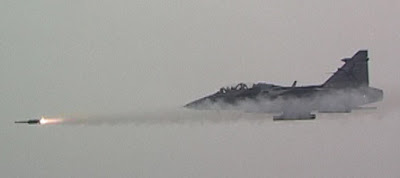
Saab conducted the first test firing of a Diehl BGT Defence IRIS-T short-range air-to-air missile from a Gripen fighter over Sweden’s Vidsel test range on 12 June, during the 6,000th test flight of a JAS39.

Involving high-speed weapon release from a JAS39B test aircraft flying at around 2,000ft (610m), the unguided test was “a complete success”, says Saab test pilot Fredrik Müchler.

…..

USAF Looking at Alternative Fuels

The problem is that the likely sources of fuel.

Air Force Hopes to Cut Oil’s Role in Fuel

By DON PHILLIPS
Published: June 18, 2007

The United States Air Force has decided to push development of a new type of fuel to power its bombers and fighters, mixing conventional jet fuel with fuels from nonpetroleum sources that could eventually limit military dependence on imported oil.

The decision will open a contest between fuel refiners and other companies to produce a jet fuel composed of no more than 50 percent petroleum. The plan is to be announced at the Paris Air Show by the secretary of the Air Force, Michael W. Wynne; the administrator of the Federal Aviation Administration, Marion C. Blakey; and other American officials.

“The goal is to certify the entire fleet by 2010 with a 50-50 mix,” said Paul Bollinger, an Air Force official who is working on a shift to synthetic fuels.”

Today’s most popular alternative fuel, made from corn, is not suitable for use in aviation. “Corn doesn’t have the B.T.U.’s for jet fuel,” Mr. Bollinger said, referring to the British thermal unit, a measure of energy. Richard L. Altman, executive director of an industrywide group called the Commercial Aviation Alternative Fuels Initiative, said fuels would most likely be developed in three phases, beginning with a focus on creating liquid fuels from nonrenewable resources like coal and natural gas.

Natural gas’s greatest utility is that it can be piped to point of use with very low losses, and coal liquification releases more C02 than burning it to generate electricity.

Bush Administration Endangers Air Travelers Over Petty Snit

Yep, bullsh&% at the expense of safety, because petty score settling.

One wonders what other self destructive stupidity might be occurring because of, say, oedipal conflicts, *COUGH* IRAQ *COUGH*.

U.S. delays exporting licenses to Syrian Air

The U.S. government is dragging its feet on exporting licenses for aviation security items to Syrian Air – and the airline thinks there is an ulterior motive. Fortune’s
Marc Perelman reports.
FORTUNE Magazine
By Marc Perelman, Fortune
June 14 2007: 5:42 AM EDT

(Fortune Magazine) — Is the Bush administration toying with aviation safety to pursue its political goals in the Middle East?

That’s what the chairman of Syria’s national airline and other experts say is the effect of extensive delays by Washington in issuing export licenses to Syrian Air for U.S.-manufactured aviation-security items – even though those items are exempt from a three-year-old export ban.

“Since the export ban has been in place, the U.S. has begun to delay the export-license process,” Syrian Air chairman Nachaat Numir told Fortune in a recent interview in Damascus. “In the past the normal export-license application process took one month, maximum. Now it takes several months, even a year.”


RAF Reinstalls Cannons all Typhoons

They decided that they needed the cannons in Afghanistan. A 500 lb bomb against a guy in a pickup near civilians will cause too much collateral damage.

They discovered this in Sierra Leone, with their Harriers, which had had the cannons pulled, and sometimes the target was just a guy on a bicycle.

It was a false economy in the first place.

Cannons will be operable on all UK RAF Eurofighter Typhoons

The 27mm Mauser cannons on all UK Royal Air Force Eurofighter Typhoons will be operable, and will only require ammunition and loading equipment for them to work, contrary to our report last week (Flight International, 17-23 August). The UK Ministry of Defence says it will spend up to £6 million ($11 million) on support equipment, training and ammunition for those aircraft needed for a deployment where cannons were necessary. The timeframe for enabling pilots to use the cannon is two weeks, or similar to the time required for a force to deploy for UN missions or similar operations, says the MoD.

Originally, only the UK’s first 55 Eurofighters were to have guns fitted (Flight International, 9-15 May 2000). The decision to not enable those guns stemmed from the UK’s current air warfare doctrine, which specifies stand-off weapons. “The decision to retain operational flexibility was made in early 2003 after a detailed assessment of the costs of ballast compared with guns,” says the MoD. Ballast would have been needed to replace the gun mass as the aircraft’s flight-control system took into account the presence of the gun. An assessment into the use of ballast for the UK’s planned remaining 177 Eurofighters, carried out by UK Eurofighter partner company BAE Systems, concluded that guns, and not ballast, was the better option. The MoD estimates the decision will save £10 million a year by avoiding training and maintenance costs and ammunition supply.

Pictures: First Australian Airbus A330 MRTT air-to-air refuelling tanker rolled out-12/06/2007-London-Flightglobal.com

This is significant in terms of the Boeing EADS competition for tankers, because both now both companies have their tankers flying, and either in deployment (Boeing), or months from deployment (EADS) with a foreign military.

Pictures: First Australian Airbus A330 MRTT air-to-air refuelling tanker rolled out

By Barbara Cockburn

The first of five Airbus A330 multi role tanker transports (MRTT) ordered by the Royal Australian Air Force has been rolled out of the hangar at the conversion centre of EADS Casa in Getafe near Madrid.”

Boeing Gives Future Away on 787

Look at the line about “with Boeing 787-based carbon-fiber construction”. The MBA suits at Boeing thought that it was a great idea to outsource critical technologies to “risk sharing partners”.

It has funded competitors in its own market.

This is stupider than when Coke decided not to buy Pepsi in 1933.

State Subsidy Plan Lifts Mitsubishi’s RJ Hopes(Subscription Required)
Aviation Week & Space Technology
06/11/2007, page 43

Bradley Perrett
Beijing

Plan for state aid buoys Mitsubishi’s aspirations for a regional jet

Printed headline: RJ Funding

A key Japanese government department plans to allocate ¥40 billion ($330 million) in subsidies for a Mitsubishi Heavy Industries project for a large regional jet, greatly increasing the likelihood of the country finally establishing itself as a supplier of commercial aircraft.

With Boeing 787-based carbon-fiber construction and new engines, the proposed Mitsubishi aircraft could present a serious challenge to Embraer, Bombardier and two other companies developing such jets, Sukhoi and China’s Avic I.”

CFM International’s Future Tech plans/

An interesting article on the conflicts between fuel economy and noise, and the technologies involved.

CFMI Trying To Anticipate New Climate Challenges (Subscription Required)
Aviation Week & Space Technology
06/04/2007, page 52

Michael Mecham
Evendale, Ohio

. . . and some new ones, as CFMI tackles fuel costs and environmental concerns

Printed headline: Some Old Plans . . .

It came as no surprise to CFM International that prospective customers of next-generation single-aisle aircraft rank reduced fuel consumption as their highest priority. But they also are awakening to a broadening of the clean planet debate that is likely to lead to a series of new regulations, such as carbon trading, from governments eager to respond to the growing clamor to do something about global warming.

Recently, CFMI, the 50-50 partnership between General Electric and Snecma, surveyed lessors, banks, legacy and low-cost carriers (LCCs) about their priorities for the LEAP56 (Leading Edge Aviation Propulsion) initiative for 18,000-33,000-lb.-thrust-class engines the company launched in 2005 to power a successor to the Airbus A320 and Boeing 737 families.

……
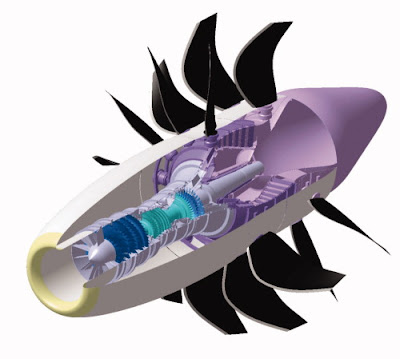

CFMI likes what open rotors, whether in pusher (right) or puller configurations, can do to lower fuel burn. But noise and installation issues will make them a challenge. Credit: CFM CONCEPTS

But another bit of feedback is a sign of the times. “Focus on CO2,” the LCCs advised. European political leaders have been the most pronounced adherents of the global warming message, which is to decrease levels of carbon dioxide from man-made sources. But the idea that increased regulation is necessary is gaining acceptance elsewhere.

“In the last six months, we have been impressed by how much the debate has picked up in the U.S.,” says CFMI President and CEO Eric Bachelet.

…..

We can thank Al Gore for this.

Since CO2 emissions are directly related to fuel burn, reducing specific fuel consumption (SFC) is the most effective way to address the issue. The LEAP initiative is based on dropping SFC 10-15%, maintenance costs by about 15% and noise by 10-15 dB. to meet requirements expected in the next round of noise regulations, Stage 4, says Planaud. Additionally, oxides of nitrogen (NOx) emissions will need to exceed by 60% the Committee of Aviation Environmental Protection (CAEP) 6 standards that come into effect next year.

Rig tests of the compressor, combustor and high- and low-pressure turbines in the initiative will begin this year at Snecma’s facilities in Villaroche, France, and GE’s at Peebles, Ohio. The tests are aimed at an engine launch in 2011, which is enough lead time for Airbus and Boeing to introduce a successor to their A320 and 737 programs, respectively, by mid-decade.

….

Started in 2005, LEAP56 includes composite fan case and fan blades, titanium aluminide 3D airfoils in the low-pressure turbine, ceramic matrix composite high-pressure turbine nozzles and a second-generation twin-annular pre-mixing swirler (TAPS) combustor. Clapper calls the combined technologies a “step change” for CFMI.

Composite fan blades are one of the most intense technology development efforts. GE introduced them on the GE90 and has extended the concept with composite fan cases for the GEnx. Those composites are laid in plies pre-impregnated with resin, a laborious process that GE tried without much success to automate. Besides saving weight and cutting SFC, composite blades are slashing maintenance costs. Only three blades have had to be replaced on GE90s since the engine entered service in 1995. Composite blades are so durable that GE is aiming for their certification on the GEnx with no service life limits (AW&ST Apr. 16, p. 60).

Using 18 wide-chord composite blades, rather than the customary 22 or more on older designs, combined with a composite fan case will save 400 lb. on LEAP engines, says Planaud.

However, the company anticipates LEAP56 production rates comparable to CFM56 engines, which have been as high as 2,000 a year, about five times higher than the GE90/GEnx series. As a result, the CFMI partners have been looking for composite manufacturing techniques that can be automated. Most promising is a process called Resin Transfer Molding (RTM) in which bands of dry preform are woven rather than laid on top of each other to create the composite structure.

The strength of small composite blades is an issue. The big GE90 wide-chord fan blades–as much as 115 in. long–have proven adept at dissipating the shock of bird and other foreign object strikes. But the smaller LEAP56 blades have less surface area to absorb such shocks. Tests on a CFM56-5C using 70-in. RTM blades will be done this year.

While noise, NOx, carbon particulate and carbon dioxide emissions are a growing political issue, the size of their fuel bill remains the biggest sore point for airlines.

All the world’s airlines combined spent $43 billion on fuel in 2001–13% of their direct operating costs (DOC)–when Jet A cost $0.66 per gallon. At current rates of $2.03 per gallon, the bill for all airlines combined will hit $117 billion this year, or 26% of DOC, says Clapper.

To tackle this problem, CFMI assigned a team to use a combination of computer studies and the company’s experience in maintenance to consider alternative engine designs. Most were rejected.

Among them were the geared turbofan (GTF) that Pratt & Whitney is developing. Its large-diameter, slower fan is expected to benefit fuel burn, but also will increase weight and drag, the CFMI team concluded. And the GTF was seen as driving up maintenance costs. Similarly, a two-stage turbine will be more efficient, but its higher operating temperatures are a worry sign for maintenance.

So the company ended up with a single-stage turbine, but with a higher pressure ratio for improved combustor efficiency than current models. “It’s a simple, rugged design with fewer parts and higher reliability,” says Clapper.

Looking beyond LEAP56, Snecma has been pursing an alternative strategy that holds some promise: a counterrotating fan to boost bypass.

More radically, CFMI has dusted off the unducted fan concept first proposed in the late 1980s as a weight-savings approach to lowering fuel costs in response to the industry’s first oil shock. That idea faded in the early 1990s when fuel prices receded. But with fuel high again, and likely to stay that way because worldwide energy demands have increased so much, CFMI is taking a second look at unducted fans, which it’s renamed “open rotors.”

Last October, Rolls-Royce noted that it is exploring unducted fans, too. Pratt says mounting and noise issues are too great a hurdle and is sticking with its geared turbofan (AW&ST May 28, p. 65).

Without the weight and drag of an engine nacelle, CFMI calculates that a counter-rotating open rotor will save 10% in SFC beyond the improvements it foresees from LEAP56. Fans in both tractor (puller) and pusher configurations are under study. Using twin rows of blades improves their efficiency and allows slower speeds to reduce noise, Klapproth says.

An ultra-high bypass ratio, on the order of 35:1, is possible–four times the 9:1 ratio expected from LEAP56 and seven times the current CFM56 ratio of 5:1. Pressure ratios would be about 15:1, similar to LEAP56, but well ahead of the CFM56’s 11:1.

But the open rotors are noisy, about 10% noisier than the LEAP engine, meaning cabins will need additional insulation. At its best, the engine is unlikely to meet the 20-dB. effective perceived noise reduction that the company foresees by 2020, Clapper acknowledges.

The largest CFM56 produced now, the -5C for the A340-300, has a 72-in. fan diameter. An equivalent-sized engine with an open rotor will require a 12-14-ft.-dia. rotor, posing significant challenges for mounting and certification.

Regardless of how well open rotor technology works, it’s unlikely to appear until late in the next decade “at the earliest,” says Clapper.

The noise issue alone could doom it. While engine makers are confident they can continue to lower fuel burn, which directly reduces CO2 emissions, and reduce NOx/carbon particulate pollution, they are increasingly worried about their ability to do so while simultaneously reducing noise because the technologies to do the former work against the latter.

Noise tends to be a local issue, emissions more national and international. So there’s the possibility of an interesting debate taking place. It may be decided pragmatically. The pain of higher fuel bills may be so great that it will drive compromises that will still benefit the environmental camp, but work against those fighting to reduce engine noise.

My guess is that this will be changed with new forms of zoning that get residences away from airports. In a battle between global warming, and local noise, the localities lose.

F/A-18E/F To Get New Air Combat Sensor

I think that this is a reaction to something that was perceived as lacking with current US fighter sensor suites.

F/A-18E/F To Get New Air Combat Sensor (Subscription Required)

Aviation Week & Space Technology
06/04/2007, page 30

Andy Nativi
St. Louis

Enhanced electronic warfare systems drive U.S. Navy to improve F/A-18E/F sensor suite

Printed headline: Bug Eyes

The U.S. Navy wants to upgrade its F/A-18E/Fs with an infrared search-and-track system out of concern that increasingly sophisticated electronic jamming systems could thwart the fighter’s radar system, leaving pilots “blinded” in air-to-air combat.

While the Russians have had these for decades, and they are part of the standard fit on both the Typhoon and Rafale, I believe that there have been only two combat aircraft so equipped in the US inventory, the F-106, and the F-14.

This is a recognition of the fact that our potential adversaries are aware of this.

Although the service has been upgrading the fighter’s radar, and the latest version (the APG-79 with active electronically scanned array) should have enhanced ability to nullify hostile jamming, Navy officials are worried about the proliferation of X-band electronic countermeasures systems, which could degrade radar performance. In particular, China’s expansive spending on electronic warfare equipment is being carefully monitored. The service fears this build-up could compromise their own freedom to operate in the Pacific.

Boeing would modify an external fuel tank to fit the F/A-18E/F with a centerline-mounted IRST. Lockheed Martin would provide the critical optics.Credit: BOEING CONCEPTS>

More than China, see below.

The addition of an infrared search-and-track system (IRST)–already standard on many Russian and western European fighters–would provide “spectral diversity” to the Navy. ……

As I’ve said, we are late to this game.


Boeing would modify an external fuel tank to fit the F/A-18E/F with a centerline-mounted IRST. Lockheed Martin would provide the critical optics.Credit: BOEING CONCEPTS

F/A-18 prime contractor Boeing has chosen Lockheed Martin to provide the sensor. A first prototype is set to be tested on a Super Hornet early next year through a company-funded risk reduction and capabilities demo effort. Enhanced versions of the AAS-42 electronics and optical units used on the F-14 (already available on South Korea’s F-15K) will be repackaged in a modified 480-gal. fuel tank. The equipment will also feature an off-the-shelf thermal control unit.

The fact that the South Koreans requested it for the F-15K implies that they are concerned about this very issue with North Korea.

My guess is that someone had done some analysis, and determined that if you put out a lot of power without a lot of sophistication, you can muddy the radar picture.

Boeing opted for a podded solution to save money. “Originally, we considered integrating the IRST into the aircraft fuselage, on the upper nose, or on the gunbay doors, but these solutions required significant structural, electrical and cooling system modifications and, in both cases, called for relocating existing antennas,” says Chris D. Wedewer, Boeing’s F/A-18E/F IRST program manager. “We also investigated the possibility of putting an IRST pod on the right fuselage station, opposite the fuselage-mounted Raytheon [Advanced Targeting Forward-Looking Infrared] targeting pod, but this option came with too many operational limitations in terms of field of view,” in particular when weapons are being carried, he adds.

Those limitations drove the decision to place the sensor on the centerline weapon station, traditionally the spot for the fuel tank. Since a fuel tank has already been cleared for that station, using such a device to house the IRST was seen as the next logical step. The IRST will also function as a fuel tank, with a part of a pod still able to accommodate 330 gal., Wedewer notes.

It is a fairly neat package for what I think is perceived as an immediate need.

….