Category: Defense Procurement

Navy Looking at C-2 Replacements…Not Gonna Happen

This report (paid subscription required) says that the Navy wants to start replacing the C-2 in 2017, with a complete replacement by 2026.

They are planning to let out the contract in 2011.

It’s not going to happen. Big defense cuts are on the way, and the 6 year time frame for designing what has to be a from scratch replacement (carrier landings, folding wings) given the ponderous nature of defense procurement.

Last Deliveries of Bell AH-1Z Use New Build Airframes

The US Marines have had two programs to upgrade their nearly Vietnam era helicopters.

The upgrades are known as the UH-1Y and the AH-1Z.

In addition to changes to avionics, these also involve upgrades to the engines and rotor systems.

It now appears tatt the the final 40 deliveries will be completely new airframes, as opposed to rebuilds.

From a FMS (foreign military sales) perspective, this means that Bell will be able to sell new build AH-1 helicopters with 4 bladed rotors, and modern T700 engines.

This is good news for Bell, which makes the AH-1 Cobra, and bad news for Boeing, which makes the AH-64 Apache, which is much larger and much more expensive to purchase and operate.

Much of the utility in an attack helo is in its sensors and fire control systems, and the AH-1Z will be very close to the AH-64 in those capabilities, as well as in weapons load, though it will not carry the hideously expensive Longbow radar system.

Coast Guard Stops Payments to Eagle Eye UAV Program

The US Coast Guard has shelved the Eagle Eye UAV Program.

It appears that Bell, the manufacturer of the aircraft, billed it as being nearly ready for production, and it clearly is not.

First flight, which is yet to occur, was supposed to be in 2006.

Yet another clusterf$%# associated with the Coast Guard’s Deepwater program, and another nail in the coffin for the Lead System Integrator (LSI) concept of government contracts.

It looks like the USCG will be going with an existing system.

US Air Force Intent on Committing Suicide

Gen. Bruce Carlson, chief of Air Force Materiel Command, told a group of reporters Wednesday that the Air Force will figure out a way to buy 380 F-22s, despite the fact that the Pentagon – through the Office of the Secretary of Defense (OSD) – has capped the number of Raptors to be procured at 183.

What is first obvious is that is engaging in insubordination by giving a press conference saying that he will find a way to subvert the decisions of a superior in his chain of command, and he should be fired immediately.

This is far more brassy, and far more public than anything MacArthur did to Truman.

That being said, if he gets his wish, he will destroy the USAF as a fighting unit.

Flight International’s Stephen Trimble does the numbers, and gets an additional 20 F-22s a year at $150 million an aircraft gets another $3 Billion a year over the next 10 years.

Based on my experience with military contracting, I’d double that number when operational expenses, the inevitable cost overruns, and gold plated block improvements are added.

To do this, I think that you need to slash personnel, and cancel pretty much every other program, the F-35, the KC-X, the next gen bomber, the next gen freighter, etc.

You will also have to reduce the existing inventory to cut costs and to reflect the fact that you don’t have enough people to keep the stuff running

Thais Sign With Swedes For Fighters, AEW&C

The Thai government has basically signed with the Swedes for the backbone of their air force moving forward.

They have purchased, “six JAS 39C/D gripen swing-role fighters, a Saab 340 Erieye airborne early warning & control (AEW&C) aircraft, a Saab 340 transport aircraft, and an air defense command & control system from Sweden.”

Sweden is actually doing a good job staking out the bottom of the current aerospace market, giving capabilities close to those of the big guys for less.

Iran launches project to build stealth aircraft

At least according to the Tehran Times.

In related news, I am now dating Janice Joplin.

This is obviously not true.

However, it is entirely possible that Iran might be working on some stealth projects.

The basic science for computing radar cross sections has been known for years, the math was published in a Soviet mathematics journal in the 1960s, and if a Linux cluster can do Shreck, it can certainly work on that.

To do an operationally meaningful low radar cross section manned aircraft is very expensive, and at this point, they are reverse-engineering their 1960s vintage F-5 aircraft.

However, if you wanted to create a drone, or a missile with a low RCS in the forward hemisphere, that would sound to me quite doable, with the caveat that I have never worked on issues of radar cross section.

F-136 Alternate JSF Engine Killed in Pentagon Budget

I fully expect it to come back. This happens every year. The Pentagon kills it, and Congress puts it back.

I support the F-136 for two reasons:

  1. I believe that having two ending suppliers for the JSF will make for better cheaper engines in the long run.
  2. There will be weight growth, and the F-135 appears to be marginal in that case for the STOVL version.

Of course, it’s not put back on the budget for those reasons. It’s put back because GE is big in a lot of Congressional Districts.

Delays in 30,000 lb Massive Ordinance Penetrator

It appears that there are significant delays with thebomb rack for the Massive Ordinance Penetrator (MOP).

Cost has increased 33%, and the delay is expected to be at least 10 months.

Considering the controversy over the weapon, Congress blocked funding to integrate it into the B-2, because of concerns that the Bush administration would use it on a surprise sneak attack against Iran, one wonders if the military might be dragging its heels until the crazies have left the White House.

Army and Navy Agree to Fight Sensible Procurement Policies

As I discussed last week, the military does not like the idea of competing prototypes for weapons systems (Paid subscription required), and they are opposing this on the Joint Air-Ground Munition (JAGM) Contract.

They are claiming that it will cost an additional $1.5 billion dollars, but what it really comes down to is that it removes the opportunity to gold plate the system, and hence gold plate their retirement gigs, through changes in requirements after a winner is selected.

Why India (and China) Won’t Catch Up With The West Soon

While this article on issues with India’s procurement of a military helicopter purchase, it acutally shows a deep problem throughout Indian society that can be extrapolated to most of the emerging Asian economies. (Paid subscription required)

The illegal use of middlemen, impending 2009 elections and regional geopolitical issues are all likely to slow India’s weapons acquisition process just as the world’s industry is gaining unprecedented access to what is expected to be a $40-billion market.

India’s army is the most recent casualty. The government halted the acquisition of 197 Eurocopter AS550 C3 Fennec helicopters as replacements for 1970s-vintage Chetak and Cheetahs when allegations surfaced that middlemen had been used to seal the deal. Indian law prohibits their involvement in military procurements.

As corrupt and self-serving as the Western and Russian defense industries are, you don’t find this as the rule. It’s the exception.

In the West, they shave the rules, in much of the developing world, the rules are observed, at best, in the breach.

I think that this will present a barrier to further development at some point.

Faster, Better, Cheaper, So It’s Opposed By the Military Industrial Complex

Noah Shachtman reports on a new concept in weapons systems procurement competition. and the pushback that it is getting from defense contractors and their pet politicians.

It’s about the Joint Air-to-Ground Missile (JAGM), a missile system, designed to replace the Hellfire and Maverick missiles. (It’s probably a family of missiles, as the 50 kg Hellfire has a 8-9 kg warhead, and the 200-300 kg Maverick has a 57-135 kg warhead).

They are going to select two different groups to compete the missile program, which is not surprising, but they will base the competition on actual physical prototypes, as opposed to paper proposals.

…. Last September, Young issued a policy that went beyond competitive bidding and resurrected an old idea: competitive proto-typing.

…….

But Young’s memo decried a pattern among “many troubled programs” that were pushed forward before they were ready, wasting time and billions of dollars. The problem, in part, was that defense officials often made decisions “based largely on paper proposals that provided inadequate knowledge of technical risk and a weak foundation for estimating develop- ment and procurement costs,” he wrote ….. hence, the decision to change the acquisition strategy for the JAGM program before it proceeded too far, too fast.

The defense contractors are apoplectic over this, which to my mind shows that it’s a good idea.

Earlier verification through prototype may add a few bucks, and a few months, early in the process, but it will likely result in better, and cheaper, products.

F-16IN to Get Supercruise

I have no clue as to the reliability of the source, but we have a report that Lockheed Martin will be offering the F-16 with a supercruise capability to India for it’s massive mid size fighter purchase.

I would assume that this would involve a growth version of either the F-100 or F-110 engines, probably the former, as it is lighter, and possibly some aerodynamic tweaks.

I also know that a clean F-15 exhibited low supercruise (below Mach 1.2) nearly a decade ago in a clean (no external stores) configuration.

I’m a little dubious of the report, there are a number of errors in the article, it states that the F-35 supercruises, and implies that the Typhoon does not.

Additionally, the F-16’s wing configuration tends to be draggy in the transonic and supersonic regime, and for meanigful supercruise, this ability would have to be exhibited while carrying at least 4 air-to-air missles, 2 on the wing tips, and two under the wings.

OK, It’s Official, I am a Purveyor of Weapons of Mass Destruction

Many years ago, around the turn of the millennium, I worked at Loral Vought Systems…..Lockheed Martin Vought Systems…..Lockheed Martin Missiles and Fire Control* in Grand Prairie, TX.

One of the items that I worked on was the Medium Extended Air Defense System, or MEADS.
I’ve also worked on the Armies ongoing but truly misbegotten Future Combat System (FCS), it’s largest procurement program.

So now, I’m beginning to see just how tied into the Military Industrial Complex I am.

Maybe I should ditch engineering and become a Klezmer.

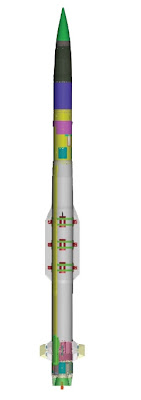
Yes, I worked on this, and that little flare behind the head is for additional volume for the motor to increase range. The original PAC-3 had straight sides.

It looks like they are still using ProEngineer as the CAD package. After a while, you can kind of get a sense of which cad packate it is from how it renders.

Yep, worked on this too, looking at a more flexible launch cannister than the PAC-3 launch cannister.

Worked on most of these too.

Worst place I ever worked. It was so bad that people who never worked at Stewart & Stevenson, Tactical Vehicle Systems would hang up when they heard Sealy, TX.

Made Dilbert and his workplace look like “Nerdvana”.

They ended up screwing up in reverse. Their final drawing package was bad enough that no one else wants to bid on FMTV contracts, because they can’t make heads or tails of the drawings.

*It was all the same place, it just went through one merger, and two name changes.
Note to self, need to finish article about FCS for my blog. It’s been sitting in my draft folder for months.
An itinerant Jewish musician, more specifically, one who plays music typical of Eastern European Jews.

Norway Requests Bid From Sweden for F-16 Replacement

Honestly, I think that this is a sham bid, and Norway intends to use this request to Sweden as leverage to get a better deal on the JSF.

That is what Eurofighter decided, when they withdrew from the competition.

Norway is arguably as hip deep in the JSF as any countries except for the UK, and (possibly) Italy.

Then again, if they are serious, Norway saves a lot of money, both on the initial purchase,the Gripen is the cheapest of the current generation, and over the life of the aircraft, since costs are roughly proportional to weight.

More on What the F-22 Can’t Do.

Well, last night I discussed how the USAF is screwing the proverbial pooch in its efforts to get more F-22s, and this weeks issue of Aviation Week confirms this assessment. (paid subscription required)

In this case, they are discussing the capabilities of the F-35 in what the US military likes to call “battle space”, and they reveal something about the F-22.

Specifically, the F-22 is the roach motel of data. Data checks in, but it doesn’t check out.

The F-35, for example, it, “Already offers some capabilities that are not available on the F-22,” which, “for example, has no other way, other than verbally, to send the detailed electronic surveillance data it collects to other types of aircraft or to ground-intelligence facilities.”

The F-22 is designed for the end of the world scenario, with the Soviets attacking through the Fulda Gap. It was designed to operate while the rest of the military infrastructure around it was destroyed, though why the Soviets would not go after the air fields is beyond me.

The Raptor is an expensive anachronism…Though the F-35 is not likely to be much cheaper to buy at the end of the day, it will be more flexible and cheaper to operate, though neither are required for the most likely scenarios.

Other Governments Turn to Commercial Systems, and Get More for Less

There are a couple of interesting articles (here and Portable Network Generates EW Attack Weapons in Aviation week(paid subscription required)about the increasing use of civilian tech in military electronic warfare equipment.

“The Chinese, like many countries without billions to spend on defense, are figuring out how to leverage all that commercial technology into their military capabilities,” says Rance Walleston, BAE Systems’ director of information operations initiative and information warfare. “We’ve spent a lot of time looking at Chinese technologies. They’re not building many unique devices. Their integrated air defense system [IADS] uses commercial standards,” such as GSM and voice over Internet protocols (VOIP).

The Syrian raid—which involved air-to-ground and network-to-network electronic invasion of a Russian-built IADS—is convincing some that custom-built, highly specialized and expensive air defenses with long development times are decreasing in deterrent value. In fact, they have become victims of their own uniqueness. Because they were hard to develop and field, they aren’t often modified. That gives electronic warriors the time to conduct analysis and build countermeasures.

We also discover that:

“The government historically procured single-use systems to go after signal X or Y,” Sinkiewicz says. “Now that’s unaffordable, and what they want is a multifunction capability with the same architecture and hardware that can go after many types of signals.”

I’m sure that some of the free market types would like to use this as an argument for the inherent superiority of the free market over government funded systems, but I would argue that the defense procurement infrastructure is among the most incompetent and corrupt segments of our governments, and that using this will not get good policy.

In fact, the Privatization of essential government services in the military (KBR/Halliburton, Blackwater, Triple Canopy, etc.) has proved to be an unmitigated disaster too.

The solution is to put adults in charge of the Military Industrial Complex, because we are currently reaping the consequences of not doing so for the past 60 years.

Once Again, USAF Shows That It Wants Toys More Than It Wants to Protect Nation

Deputy Defense Secretary Gordon England wants to use GWOT money to to keep the F-22 line open.

With no meaningful difference in stealth, and the F-35 being smaller, supposedly cheaper, more flexible (adapting it to electronic attack is easier) and capable of carrying a better bomb load, the only thing you get for the F-22 is that it flys higher and supercruises, neither of which have any meaning in the strategic context of any potential opponent we can see.

Read the article. It’s fairly clear that this is the result of mindless USAF lobbying over the past dozen years or so, and this is a case where the adults in the DoD, by which I mean the JCS and the civilian leadership, have been far too passive in reigning the flyboys in.