Category: Missile Defense

Russia to export Worlds Most Capable Surface to Air Missile

The S-400 is entering service with the Russian military, and they expect to begin exports in 2009.

It’s clear that they are looking at this to be a big seller. It should have some decent capabilities against stealthy aircraft, and it has good anti-cruise missile and anti-tactical ballistic missile capabilities.

Considering the range of the system (over 400km), it would be expected that it would be capable of engaging low radar cross section targets at a much shorter range.

Given that a conventional bomber would have a radar cross section in the 10m2 range, and detection range a function of 4th route of the RCS (i.e. a reduction of 32x in RCS will cut range by 1/2), you get potential detection ranges as follows, assuming 400km for the bomber.

Range
RCS
     Type
400 km
10m2
B-1, F-15
336 km
5m2
F-16
225 km
1m2
F-18E, Rafale
189 km
0.5 m2
Typhoon
48 km
0.00200m2
F-117 (WAG)
40 km
0.00100 m2
F-35
23 km
0.00010 m2
F-22, B2

So you are looking at something like a 15 mile detection range against the stealthiest targets.

Update: This range is for high frequency radars. The S-400 also has a VHF radar, which would diminish the effectiveness of stealth, to some (I don’t know what) degree.

Japan Starts Toward Abolishing Pacifism in its Constitution

Aviation Week has an article indicating that Japan’s interest in the F-22 is being driven by an turn toward a far more aggressive military policy.(subscription required)

If they just needed normal cruise missile defense, upgrading F-15 radars would do the job. The idea that that they want to acquire a large, long range, supercruising, and stealthy platform implies that they want to make preemptive strikes against cruise missile sites an integral part of this defense.

An air force must at least be able to attack the launch sites “to put an offensive ballistic missile capability at risk,” a senior U.S. Air Force official involved in the debate says. “You’ve got to get out in front of [cruise and ballistic] missile launches. Otherwise, some are going to get through.”

Of course, Scuds and their derivative (North Korea) are already mobile, and hence hard to strike and hard to hit, as evidenced by the problems in Desert Storm, when there was no threat to aircraft doing Scud hunting, and they could not reliably find the launchers.

But officials now say the fiscal 2008 budget may provide money for more upgrades. The reason is that the technology is a path to the world of network-centric warfare that has already been used by the U.S. Air Force. USAF first adopted the (v)1 radar but then upgraded it with a 21st century emitter and antenna—the 1,000-element, active electronically scanned array (AESA). That improvement, designated the APG-63(v)3, produces a radar with the ability to see small targets, such as cruise missiles, or to identify tactical ballistic missile launchers in their radar-generated ground maps. The radar also can transmit large files of imagery, electronically attack enemy sensors through jamming and insertion of false targets, and provide two-way digital connectivity to other aircraft and sensors in the battlespace.

“The Japanese could make that shift to (v)3 at any time,” the industry official says.

That shift would add another option to the decision about a new fighter for the Japanese air force. F-15s equipped with AESA would have a larger radar aperture than the F-22. As a result, in the defensive, anti-cruise missile role, the Eagle would have an advantage in detecting smaller objects at longer range because of its additional power and size. While attacking missile launch sites with the F-22 is a “strategically solid concept” for the long term, buying interim, AESA-equipped F-15Es or F/A-18E/Fs might be attractive to Japanese defense planners. So far, they have rejected the idea of a bridge aircraft.

This is the key phrase.

Aperture is the size of the antenna, and because the F-15 is non-stealthy, it has a larger antenna. The laws of physics dictate that the F-22 is inferior to the F-15 in this role.

When juxtaposed by the growing number militarist groups in Japan, and an increasing tendency toward those groups engaging in violence toward critics, this is a very troubling development.

Additionally, any problems in North Korea would handled by a the US Military, possibly with with F-22 sorties from either Korea or Japan, or F-35 sorties from a carrier.

This is intended to strike China.

Japan has never come to terms with the atrocities committed, including the only use of bio-warfare in modern military history, during its period of empire building, which is arguably the the worst of the 20th century.

Unlike Europe, where the militarism has largely been driven out of the public consciousness, in Japan it has been placed in a closet for later use.

Faith Based Missile Defense

You don’t have to be delusional to work for bush, but it helps….A LOT!!!!!

It appears the niminee for Chairman of the Joint Chiefs of Staff wants to deploy missile defense systems before they are tested.

This craziness starts at the top here, where Bush and his evil minions see missile defense as an unadulterated good, even if it is incapable of stopping a single missile.

The technology for creating penetration aids can be purchased at your average party supply store (mylar balloons with a shiny aluminum coating), it seems that testing should be done before deployment.

Faith Based Missile Defense

I’ve just finished reading an articleabout the Congressional Research Service (CRS) on the travails of the Airborne Laser (ABL).

In a word, it’s a mess.

We have, “The Missile Defense Agency (MDA) dropped the traditional requirements-setting process in favor of a “capabilities-based” approach, intended to more quickly field a system capable of responding to some, if not all, of the current ballistic missile threats, according to the report.”

So basically, they will field this against something like an Atlas Class liquid fueled rocket, which derives structural integrity from internal pressure and a very thin walled skin.

Problem is that only the Atlas ever used this. Liquid rockets with conventional structures, like the Titan and the Soviet systems are more robust, and can be hardened to become mroe robust. Solid fueled rockets are more robust still.

Moving to those does not require anything but a bit of time and money…After it’s not…OK, it is rocket science, but it’s not hard rocket science.

Additional problems:

  • “The total ABL program cost cannot be given or estimated because of the acquisition strategy adopted by MDA for missile defense”. This is almost certainly a deliberate attempt to shield a program over budget.
  • “Nor has the final system architecture been identified, meaning that the total number of ABL aircraft to be procured has not been determined.”
  • “ABL will be a highly visible asset. It is very large, and will be escorted by fighter aircraft. Its high altitude will also help to distinguish it from other wide-body aircraft.”
  • Long in-theater on-station time for the ABL is premised on forward basing. These forward bases would likely not have chemical replenishment capabilities, meaning return flights to the United States if the laser is used.

This is an ill conceived program that has continued through inertia, and the fact that the person who cancels this will likely have their career ended.


White Elephant

FAS A Good Insight Into the Current European ABM Kerfluffle

Along with good information on the Russian systems, and the US Posture in the Cold war, and this provides insight into why the Russians believe that this is targeted at them.

This US document might provide some insight:

Figure 1:
The US 1968 Nuclear ABM Strike Plan

“To ensure the penetration of the ICBM force, the Soviet ABM system would be attacked first. Minuteman E and F and Polaris missiles would first hit the Hen House early warning radars, and their Tallin system defenses [SA-5 SAM, ed.]. Then the Dog House radar and the Triad system around Moscow would be attacked. More than 100 Minuteman would be involved in the ABM suppression.”
Source: U.S. Strategic Air Command, History of U.S. Strategic Air Command January-June 1968, February 1969, p. 300. Excerpts (pp. 300-306) available here (pdf, 0.8 MB).

Here is his money quote:

All of this happened during the Cold War and many things have changed, but the basic motivation for targeting a limited missile defense system then was the same as today: The Soviet ABM system was entirely defensive and couldn’t threaten anyone (to paraphrase a characterization frequently use by U.S. and NATO officials to justify their missile defense plans today), but it could disturb the main ICBM attack on Moscow and military facilities downrange. That made it a top-priority target. And even though U.S. planners suspected that the system was not very efficient, they committed about 10 percent of the entire ICBM force to destroy it. To the extent the Russia ABM is operational, U.S. nuclear strike plans probably still target it today.

All in all, an excellent read, and it reinforces my believe that the US system IS to a large extent towards the Russians.

Congress Grows a Set of Balls (FINALLY!)

Not only is this of limited utility and provocative, it’s being pushed because it’s provocative.

Lynn Cheney was trying to start a war with China in the early 1990s, and Francis Fukuyama said that during the 90s, “There was actually a deliberate search for an enemy because they felt that the Republican Party didn’t do as well”.

This is a calculated attempt to put a new enemy in the pipe line for Republican partisan advantage.

Senate threatens Bush missile plan
Ewen MacAskill in Washington
Friday July 6, 2007

Guardian
President George Bush’s controversial plan to establish a missile defence system in eastern Europe could be scuppered next week if Congress votes to block funding.

The Senate appears ready to join the House in cutting from the defence budget the millions Mr Bush requested to fund US missile bases in Poland and the Czech Republic. The president would have to use his veto to go ahead but that would put the whole defence budget in peril.

The Senate move would add to the lengthy list of obstacles that have built up to Mr Bush’s plan. A consequence would be to end the stand-off with Moscow, which views the missile system as a threat. Speaking on Monday at the Bush family retreat in Kennebunkport, Maine, the Russian president, Vladimir Putin, reiterated his opposition to placing the missile system so close to Russia. There is also opposition within Poland and the Czech Republic.

….

Russia To Locate Missiles In Baltic Coast In Response to US Missile Defense Plans

Let’s see. We locate a “Missile Shield” against Iran somewhere that leaves much of NATO naked, but is along the Russian border, and we are surprised when they get huffy?

This is Condi Rice trying to recreate the “Evil Empire” because her profession has vanished with its fall.

Someone should tell her that Diplomat means more than, “An extremely unwise thing to call Guido “Knuckles” Lomat“.

FWIW, missiles fired from Kaliningrad could take a depressed trajectory, and strike NATO targets with little or no warning, and said “missile shield”, which is exclusively exo-atmospheric, won’t be able to touch it.

Russia threatens European rocket deployment
MOSCOW (AFP): Russia issued a veiled threat on Wednesday to deploy rockets in its Kaliningrad region bordering the European Union if the United States built a missile defence shield in central Europe.

Moscow and Washington are locked in a standoff over the US plans for a radar station in the Czech Republic and interceptor rockets in Poland.

Russia says the plans threaten its security.

The threat to put missiles in Kaliningrad was made by the influential First Deputy Prime Minister Sergei Ivanov only two days after President Vladimir Putin again raised the missile shield dispute with US President George W. Bush.

Putin has suggested to Bush that the United States use a Russian-controlled radar in ex-Soviet Azerbaijan, near the Iranian border, instead of having a shield in central Europe.

Putin has also offered the use of another radar under construction at Armavir in southern Russia.

“If our offers are accepted, Russia will not consider it necessary to deploy new rocket units in the European part of the country, including Kaliningrad, to counter the threat” from the United States, Ivanov was quoted as saying by Russian news agencies.

Ivanov, who was on a visit to Uzbekistan, said Russia had “found an asymmetrical and effective response” to the US project for a European shield.

“We know what we’re doing…. If our proposals are not accepted, we will take adequate measures,” Ivanov said.

Washington insists that its proposed missile shield is intended to guard against possible attack from “rogue states” such as Iran. Moscow believes the systems are directed against Russia.

They believe that it is targeted against Russia because it is targeted against Russia.

Pentagon’s raygun-packing 747 to visit DC

I’m dubious of the technology.

Pentagon’s raygun-packing 747 to visit DC
By Lewis Page
Published Wednesday 20th June 2007 13:14 GMT

The Airborne Laser, the US Missile Defence programme’s raygun-equipped jumbo jet, is to visit Washington tonight in an attempt to drum up support on Capitol Hill.

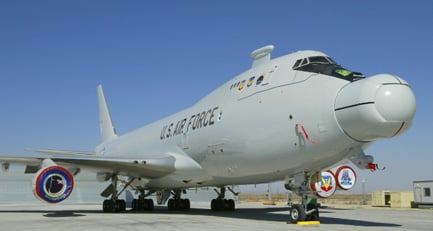
Airborne Laser aircraft

The Airborne Laser aircraft, intended to explode ICBMs shortly after liftoff.

The Missile Defence Agency says (pdf) the flying energy-weapon platform will fly into Andrews airforce base outside DC from its normal home at Edwards AFB in California. The 747 is expected to make a night landing, before being shown off to politicos, officials, and the media. It will return to the west coast on 21 June.

The Airborne Laser is a modified Boeing 747-400 freighter aircraft intended to use a Chemical Oxygen Iodine Laser (COIL) to destroy a hostile ballistic missile during the highly-vulnerable “boost phase” of its trajectory — the first few minutes after it is launched.

Missiles in boost are full of pressurized explosive fuel, so even a relatively feeble zapping could cause them to explode. Also, attacking a multiple-warhead ICBM at this point will take out all its re-entry vehicles in one shot.

Actually, the missiles are not full of “pressurized explosive fuel”. The last US missile to do this was the Atlas, retired in the 1960s, which used LOX.

Modern missiles use storable liquid propellants, and the most modern, solid fuel, which do not present the same structural vulnerablitiex.

Vladimir Putin Just Owned Bush and Rice

There is no mistake about this. Putin just convinced people that he is the adult in this situation, and that Bush and his TOADIE Secretary of State are loose cannons who can destabilize the region.

These folks screw up everything they touch.

Russian missile offer is ‘a major shift’ says Czech PM

LONDON (Thomson Financial) – Russia’s offer to set up a joint anti-missile base with the United States to end a stand-off between the two countries is a significant move, Czech Prime Minister Mirek Topolanek said.

‘I think that the Russian offer represents a major shift in (President Vladimir) Putin’s view of the problem,’ he told a joint news conference after a short meeting with his British counterpart Tony Blair in Downing Street.

The Czech Republic and neighbouring Poland have been at the centre of a row between the United States and Russia over the former’s proposed anti-missile defence shield in central and eastern Europe.

Washington, which says the shield is aimed at rogue states and not Russia, asked Prague earlier this year to host a radar tracking station and Warsaw to site 10 interceptor missiles to shoot hostile missiles from the sky.

Amid escalating Cold War-style language and threats, Putin sought to defuse the row at last week’s G8 summit by suggesting a joint Russian-US anti-missile base in Azerbaijan.

….

Bush Diplomacy Leaves Debris in Its Wake

The program is splitting Europe because it is poorly conceived and dishonestly presented.

Again, I refer you to my post on the patent system to provide some perspective on the level of performance of this administration

NATO Struggles With Missile Defense(Subscription Required)

Russian pressure heightens missile defense concerns within NATO

Printed headline: Out of Sync

NATO nations are growing increasingly divided over how to move forward plans to establish European missile defenses, with unease exacerbated by concern over Russia’s strategic objectives.

Officials at NATO Headquarters in Brussels say the U.S. plan to station a radar site and 10 interceptor missiles in the Czech Republic and Poland, using bilateral agreements, is throwing NATO’s own approach off balance. NATO worries are being aggravated by what one official describes as ‘well-orchestrated Russian pressure on all chess boards simultaneously, ranging from the CFE [Conventional Armed Forces in Europe] treaty to energy, Estonia, Kosovo, NATO expansion and missile defense.’ Moscow’s latest gambit is the offer of a joint missile defense system to be sited in Azerbaijan.

The crux of the problem is that the U.S. system is designed to provide protection for the continental U.S., and will only give some European coverage, through the proposed Polish and Czech sites. The NATO missile defense architecture would protect all of Europe. Command and control also remains an area of contention.

Let’s be clear. This is directed at Russia, Iran is just a pretext here.

That’s why Putin’s proposal of locating the radar in Azerbaijan made the Bushies look like fools.

It’s better to protect Europe, and does not threaten the Russians, which is the real objective of the US, Poland, and the Czech Republic.