Category: Recession

It’s Jobless Thursday!

And the number of initial claims hit an 19 month high, up 79K to 439K.

The consensus is that it was an artifact of the devastation of Frankenstorm Sandy.

In other, probably more significant news, the Euro Zone is back in recession, and ECB president  Mario Draghi is busy suggesting that it’s better to cut spending than it is to raise taxes, even though tax cuts have less stimulative effects than does government spending.

I swear, there is not a single economic “authority” in the entire Euro Zone who has any morals at all.

They have all somehow bought into the idea that creating pain for most of the members of a society is somehow an independent good.

It’s Jobless Thursday!!!

Initial jobless claims fell by 9K, and the 4-week moving average fell slightly too, though continuing claims and extended claims rose. (Half good, half “meh”)

Just be glad that we are not in the Euro zone, where the Euro zone unemployment rate hit a record high.

 In other news, consumer confidence hit a 5 year high, and the Institute for Supply Management’s manufacturing index rose to a 5 month high.

Of course, the big news will the the NFP numbers that drop at 8:30am EDT tomorrow.

Germans Give the Gift of Malaria

Because of austerity and EU mandated depression, malaria is making a comeback in Greece:

Global health bodies have issued warnings to travellers to the worst hit region in the south of the country, with fears that Athens could soon be affected.

Austerity budgets have resulted in drastic cutbacks in municipal spraying schemes to combat mosquito borne diseases.

In what is believed to be a first for Western Europe, Greece has experienced the first domestic cases of malaria since 1974.

Other mosquito-borne diseases that have slipped back into Greece include West Nile virus.

Statistics show that there were 70 instances of mosquito borne diseases in Greece in the first nine months of the year.

Seriously, Germany is not just going to kill the Euro, it’s going to kill the EU.

It’s Jobless Thursday

And initial jobless claims are worse than expected.

Additionally, it looks like China’s economy is approaching stall speed:

A key private sector indicator on Thursday, which showed Chinese factory activity slumped to a nine-month low in August against expectations of a modest pickup, throws up the question whether the worst is yet to come for the world’s second largest economy.

The second quarter, during which growth slowed to 7.6 percent, was regarded by many economists as the bottom for Chinese economic growth. However, experts say this view may have been overly optimistic.

It should be noted that while 7.6% seems to be a blisteringly hot growth rate, China has been running double digit numbers routinely for some time. (With the obvious caveat that Chinese numbers are crappy, but the delta probably remains significant.

Thanks Angie

The Euro Zone is back in recession:

The economy in the euro zone officially shifted to contraction from stagnation in the second quarter of 2012, data showed on Tuesday, portending a recession for the region later in the year that would put even more pressure on political leaders struggling to keep the common currency intact.

Gross domestic product from April through June fell 0.2 percent from the previous quarter for the 17 countries that use the euro, according to preliminary estimates by Eurostat, the European Union’s statistics agency. In the previous quarter, growth was zero.

Economists said the decline in output, caused partly by government budget cutting, meant the euro zone was likely to enter recession, broadly defined as two consecutive quarters of shrinking output. Even the German economy, which has helped compensate for weakness in Italy and Spain, seemed to be losing momentum.

“Growth of the German economy was no longer strong enough to keep the total euro zone economy above the zero line,” Christoph Weil, an economist at Commerzbank, wrote in a note to clients.

The newest data added to the challenges facing euro zone leaders as they return from vacation and again confront the debt crisis. Slower growth almost automatically translates into lower tax receipts, because people lose their jobs and companies earn less profit. That, in turn, puts even more stress on government budgets.

Madam Chancellor, this is an artifact your austerity fetish.

This Quarter’s GDP Numbers

Click for full size


H/t Paul Krugman for the Graph Pr0n

The GDP numbers for the 2nd quarter sucked:

The U.S. economy probably expanded in the second quarter at the slowest pace in a year as a softening labor market caused Americans to cut back on spending, economists said before a report today.

Gross domestic product, the value of all goods and services produced, rose at a 1.4 percent annual rate after a 1.9 percent gain in the prior quarter, according to the median forecast of 81 economists surveyed by Bloomberg News. Consumer purchases, which account for about 70 percent of the world’s largest economy, may have grown at the weakest pace in a year.

As the good Doctor notes, the real; problem is that the stimulus was too small in the first place, and too short as well, so we are effectively doing austerity in the worst recession in 80 years.

It’s Jobless Thursday

And yes, last weeks good numbers were an artifact of a flawed seasonal adjustment:

More Americans than forecast filed first-time claims for unemployment insurance payments last week as the volatility induced by the annual auto-plant retooling period wore off.

Applications for jobless benefits increased by 34,000 to 386,000 in the week ended July 14, Labor Department figures showed today. Economists forecast 365,000 claims, according to the median estimate in a Bloomberg News survey. The volatility in the numbers was due to a change in the timing of annual automobile plant layoffs, a Labor Department spokesman said as the data were released.

Determining whether the labor market is improving or deteriorating has been more difficult in recent weeks because a reduction in the number of auto-plant layoffs typical at this point of the year has thrown the Labor Department’s seasonal adjustment process out of line. It may take weeks to judge whether the labor market is making substantial progress.

Not good numbers this week.

More Bad Economic News

June retail sales fell:

U.S. retail sales fell in June for the third straight month, the longest run of consecutive drops since 2008 when the country was mired in recession.

Sales slipped 0.5 percent, with declines across a wide swath of industries from electronics and cars to building supplies, the Commerce Department said on Monday. Analysts had expected a small increase.

“Evidence is increasingly clear that the U.S. economy is slowing,” said Jim Baird, an investment strategist at Plante Moran Financial Advisors in Kalamazoo, Michigan.

The report adds to a spate of soft economic data that is raising pressure on President Barack Obama ahead of his November re-election bid. Republican challenger Mitt Romney is focusing his campaign on the weak economy, which has plagued Obama’s presidency.

Obama should have asked for about ½ trillion more for his stimulus.

Economy Suckage Continues

Click for full size


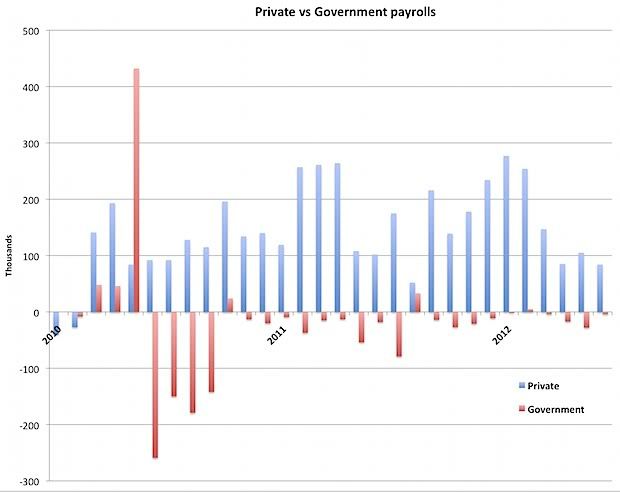
It’s the cuts in government employment, stupid!

Yes, yesterday initial claims improved a bit yesterday , but today’s monthly job figures are horrible, with unemployment (U-3) staying at 8.2%, and only 80K jobs, less than needed to match population growth.

As Felix Salmon notes, the real problem is that government payrolls have been slashed for the past year or so, as people make invocations to the austerity fairy.

BTW, while the U-3 unemployment rate was flat, but the less conservative, and to my mind more representative, U-6 unemployment rate rose to 14.9%.

Not good news.

It’s Jobless Thursday

And initial jobless claim have fallen for the first time in over a month, by 12K to a still crappy 377K, but the 4-week moving average rose, as did continuing claims, though extended claims fell.  (It should be noted that extended claims are being impacted by people running out their strings, so the drop is not necessarily good news).

I would note that we also have a slightly wonkish bit data point, where the yield curve has inverted, indicating that the markets think that the markets are expecting a deflationary environment:

One could argue that this is a positive development for the US consumer because it could mean price stability. However this move in TIPS certainly raises the risk of near-term deflation, driven by weak demand growth. And deflation is notoriously difficult to get under control. This feels (though only in the near term) a bit like Japan, a nation quite familiar with zero to negative inflation expectations.

Normally, the longer a bond, the higher the rate, because there is a cost to having your money locked up for long periods, but under certain conditions,  like investors desperate for a safe haven, the rates drop as the term lengthens (up to a point).

In a not entirely not unrelated note, the Chinese central bank has unexpectedly cut its benchmark rate in response to their economy slows.

Not a good economic news day.